
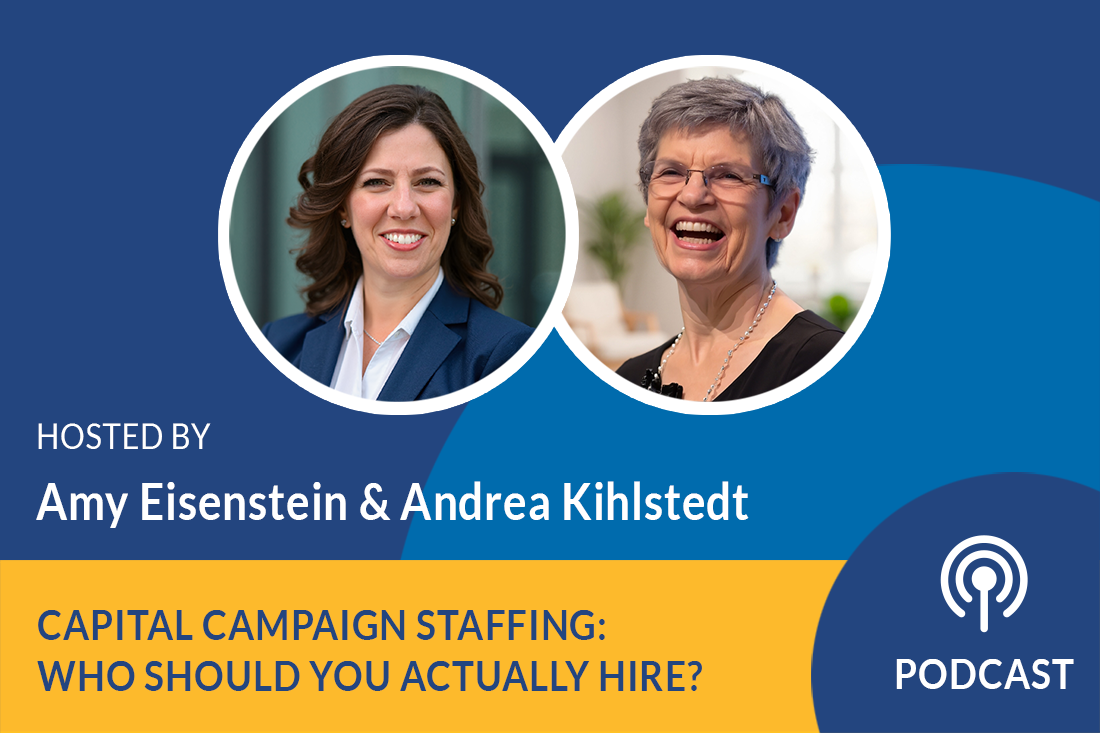
Podcast: Capital Campaign Staffing: Who Should You Actually Hire?
Season 6, Episode 7
Preparing to hire a high-level fundraiser or campaign manager for your capital campaign? The person you actually need may have a very different job description.
In this episode, Amy Eisenstein and Andrea Kihlstedt challenge a common assumption about capital campaign staffing and explain how nonprofits can expand their capacity without necessarily adding another senior development professional.
Listen to learn how to evaluate your existing team, identify the gaps that could interfere with campaign execution, and hire strategically so that your most experienced leaders can concentrate on the donor work that will determine whether your campaign succeeds.
Watch now:
Listen Now:
Andrea Kihlstedt:
Are you getting ready to staff up for your campaign? You might want to rethink that.
Amy Eisenstein:
Hi, I’m Amy Eisenstein. I’m here with my colleague and co-founder, Andrea Kihlstedt. And today we are going to talk about staffing for your campaign. And I think what we have to say may surprise you or delight you, one or the other, both maybe.
Capital Campaign Staffing: The Surprising Truth
Andrea, how did this topic come up for you and how do you want to get us started here?
Andrea Kihlstedt:
Amy, it came up in this way. Yesterday I recorded a terrific little podcast episode with Charity Roth from Jersey Community Hospital. Now, Charity is the head development person. She is the executive director of essentially the foundation that does the fundraising and runs the thrift store and is the auxiliary, the hospital auxiliary essentially. And she told me this story about her campaign, which has just now been brought to a very successful conclusion.
And one of the questions I asked her, because she’s a very small shop in a very small community. I mean, their whole community only has 25,000 residents in the entire community. So this is a small, small campaign, small community, small hospital. And Charity has been this solo person really to do all of the fundraising and support things aside from someone who helps with the resale shop. So I said:
“Well, Charity, how did you staff up for your campaign? Did you staff up?” Yes, she said all excited, “We did staff up.”
She said, “We hired a part-time person to help.” And she said, “It was fantastic.”
I thought, okay, Charity’s organization which had, I think at the top of their annual fundraising had raised maybe $200,000. They’ve just completed a five million plus campaign. I mean, more money than the hospital has ever raised ever.
Amy Eisenstein:
Yeah, when they came to us maybe four years ago, they were contemplating a $2 million campaign and they finished the campaign over $5 million with one additional part-time staff member as part of the point. And I don’t know that that’s the best story. We can tell others because I don’t want board members or executive directors to think you don’t need to hire. That’s not the takeaway, but you may not need to hire who you think.
Andrea Kihlstedt:
Yeah, many organizations, when they start thinking about a capital campaign, they, the board and the executive staff start saying:
“Well, we need to hire a campaign manager. We need to hire a major gifts person. We need to hire people at the top of our development staff.”
And in fact, what we see over and over again, and Charity’s is one sort of extreme example, but what we see over and over again is that people need to hire assistance — people to help get the grunt work done, people to help schedule calls.
Amy Eisenstein:
That’s not a good word. No “grunt work.”
Andrea Kihlstedt:
No, no grunt work.
Amy Eisenstein:
Just administrative work.
Andrea Kihlstedt:
I’m sorry, administrative work… that was a mistake. Yes, that was not good. But the stuff that doesn’t take great expertise, it doesn’t take great knowledge of major gifts fundraising.
Campaign Staff Require Diligence and Accuracy
Amy Eisenstein:
It takes diligence and —
Andrea Kihlstedt:
It takes accuracy. I mean, it’s actually not grunt work at all. I’m so not into having to be accurate that to me, people that do that, it’s amazing. So it takes people who are accurate, people who have a tolerance for that.
Amy Eisenstein:
Detail oriented.
Andrea Kihlstedt:
Yeah. Detail oriented people that you can pass stuff onto them.
You know it’s going to be done well and done right. You know your figures are going to be accurate. You can call on them to help with things that you, the executive director or the head development person don’t really have to do, scheduling, follow up, all of that detail work. If you have a really good person doing that, then you can turn your attention to the major gift donor work that needs to be done for a campaign. So that’s the point.
Amy Eisenstein:
Yeah. I think whenever I talk to potential clients or leaders at nonprofits that are thinking about campaigns or exploring the help they need, I think they’re always surprised when I say every organization needs two things:
- One is expertise — campaign specific expertise: strategy, plan, guidance, training, support. And that’s what a great consultant provides. That’s what we provide at Capital Campaign Pro, and they need execution on the ground. And the truth is that the executive director and the lead development person do the major gift work and the high-level fundraising of the campaign.
- And usually what they need to add is one administrative person to take a lot of the day-to-day tasks, like you said, the scheduling, the outreach, the data entry, the follow-up, the thank you notes, all sorts of important behind the scenes work.
And if other things need to be outsourced like some grant writing or event planning, you can do that too. But the lead development person that’s already there, that knows your community, that knows the donors and the executive director, they’re the ones that are going to be doing the highest level fundraising.
And I think sometimes people think you can just bring in a campaign manager or major gift officer to take that over. It’s just not how it works.
Capital Campaigns Require Help at the Support Level
Andrea Kihlstedt:
Yeah. Amy, let’s put some context into why that’s the case. Why in this particular kind of fundraising, the help you need is not help at the top, but help at support level. And every time you and I do a webinar, and we’ve done a fair amount of them over time over on capital campaigns, we always refer back to the gift trainings chart and we remind people that successful campaigns are made in their top 20 gifts, 20 gifts.
Now, campaigns generally take three years, sometimes four years, and the first two and a half years of that are spent soliciting those 20 gifts. I mean, they start out by developing a campaign plan and policies and that kind of stuff, but really the fundraising in that is identifying, cultivating, and soliciting the people from whom those top gifts are going to come.
This is not broad-based fundraising that requires a huge number of solicitations. It’s very targeted. Each one of those solicitations requires careful strategic thinking and execution. And for the most part, those things are best done by the founder, the executive director, the board chair, sometimes the head development person, the people at the top of the organization because they have the relationships.
Amy Eisenstein:
With coaching and consultation with your campaign consultant.
Andrea Kihlstedt:
That’s right. That’s right. But this is not the kind of fundraising where you’re having to do 200 or a thousand solicitations or letters. This is very, very narrow, focused, major gifts work. And for many organizations, it’s the first time they’ve done this kind of work at this high —
Amy Eisenstein:
Level. Yeah.
Andrea Kihlstedt:
So what they need is support so that they can be out doing the strategic work, the direct donor work, and not worry about whether all of the follow-up is done well, about whether all of the tracking is done well, about whether the reporting is done well. That has to be done well.
So that’s why, particularly in capital campaigns, which are top-heavy, all campaigns are top-heavy. They are made or broken in a few large gifts, and the bulk of your time and energy is spent soliciting those few large gifts. Then you get to the broad base of the campaign and then that’s a different story.
Amy Eisenstein:
Yeah.
What About Nonprofit Leadership Responsibilities?
Now listen, executive directors who are listening, development directors who are listening may be worried about their other responsibilities. What about the annual fund? What about program supervision and management? And that’s true.
What we see, well, what I would say is that we only work with small shops and everybody’s facing that. And during a campaign, there are opportunities to outsource, to delegate, to prioritize, to streamline, to use new technology and tools that help you become more effective and efficient, but the leaders at your organization are the ones doing these top solicitations. And if that sort of also freaks you out because you don’t have experience, you’re nervous, you don’t know if you have the donors, that also is what a good campaign consultant will help you with.
And what I would say is you’re not alone. Everybody’s doing this for the first time, or if it’s for the second time, it’s for more than they ever raised during the last time. But we full-time see organization after organization accomplish the most amazing things, and it is truly transformational. That’s the magic of capital campaigns. So if you didn’t yet listen to the podcast with Charity at Jersey Community Hospital, go back an episode or two and find it because she is totally remarkable and yet not unique. I mean, we see this kind of transformational story every day with the organizations that we work with.
Final Thoughts
So what else do you want to add?
Andrea Kihlstedt:
I think this actually is a really great topic, Amy, because it highlights what a campaign really is and the really narrow focused work of a campaign. And while it is narrow focused work, it requires a certain sophistication and knowledge to build the relationships with those top donors and to solicit them in a way that every solicitation is going to yield the best outcome, that that’s not child’s play. It’s not a lot of stuff. It’s not 500 gifts. It’s not a hundred gifts even, but each one of them is a little campaign in and of itself, and there is so much learning and so much magic in that process.
Amy Eisenstein:
So I just want to also just do a little shout-out. One of the things that I think is really special about what we offer our clients, when you hire this new person on your development team, they are given a login to an online portal that we have that invites them to weekly support calls and ongoing training and shares templates and samples that they can look at.
So they’re completely supported. We wrap our arms around your whole development team, new, experienced, and sort of meet them where they are. So you’ll have your one-on-one consultant working with you, coaching you, and also all of these amazing resources for anybody that you bring onto the team and existing members of the team.
So to me, that’s an amazing thing that we provide because everybody has members of the team that need more training, more resources, more support, more guidance.
Andrea Kihlstedt:
More experience. I’m aware, Amy, that when I or you or members of our advising team work with our clients, what we bring to the table is years of experience, the experience of multiple, often dozens of campaigns. And in doing that, you encounter all kinds of situations that you can draw from to apply to current clients. And we often are able to come up with ideas or solutions that we wouldn’t have been able to when we’ve started out in our work.
And now, because we had such a remarkable careers in this business, we generally can find ways forward that organizations that don’t have that experience may not be able to do. So when I talked to Charity, when I had the interview with Charity, she was saying how remarkable it was to have that kind of expertise and how incredibly helpful it was to move through the campaign that she didn’t know what she was doing in a campaign. And without us, without that campaign, it wouldn’t have worked.
Amy Eisenstein:
Yeah. Yeah. I love that.
Andrea Kihlstedt:
Yes.
Amy Eisenstein:
All right, great.
So listen, I think the moral of the story is:
Hire, but strategically and maybe not as expensive as you think.
Yes, you’re hiring more support, but it’s not the most expensive development person you can find. And you may be okay with one additional staff member. So it’s all relative. It depends where you’re at, what skills you have on the team, who’s already in place, where you can move people around, and I think being really strategic and thoughtful about how you fill the gaps and how you support the people that are there with new staff members.
All right. Well, thanks for listening. Great topic as always, Andrea.
Andrea Kihlstedt:
Always fun to do this with you, Amy.
Amy Eisenstein:
Thanks for listening. We’ll see you next time.


Leave a Comment