
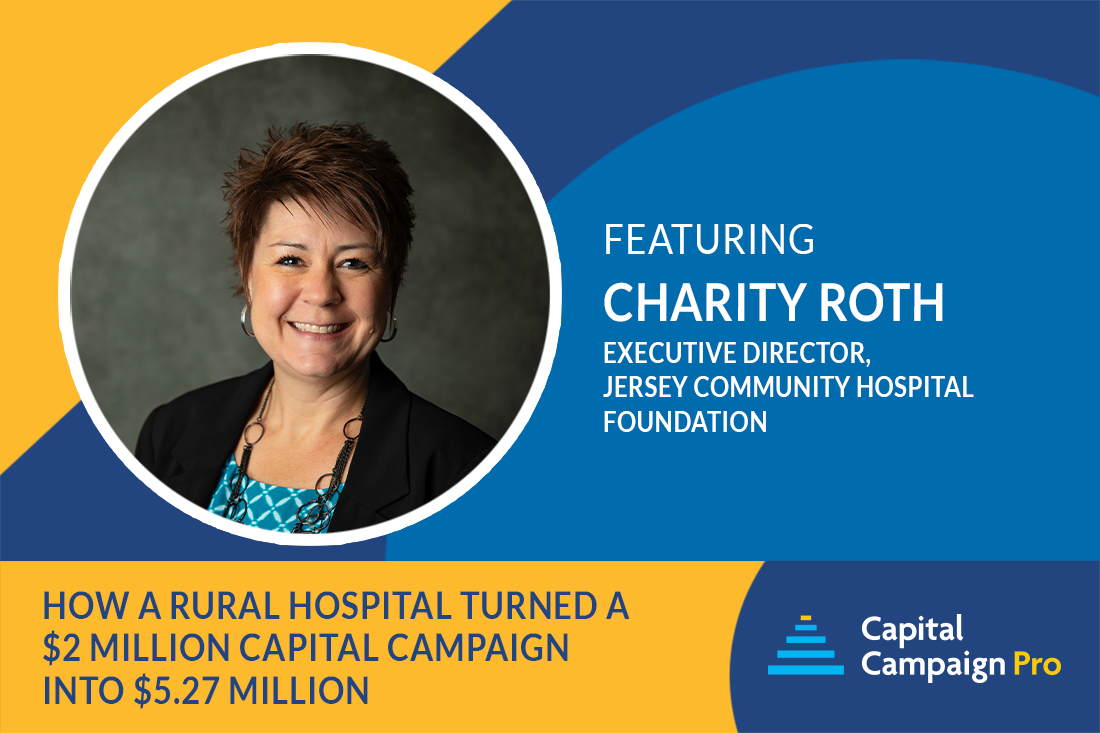
Podcast: How a Rural Hospital Turned a $2 Million Capital Campaign Into $5.27 Million
Season 6, Episode 5
What happens when a small rural hospital foundation that typically raises $200,000 to $300,000 per year is asked to launch a $2 million capital campaign and ultimately raises more than $5 million?
In this episode, Andrea Kihlstedt speaks with Charity Roth, Executive Director of the Jersey Community Hospital Foundation, about the remarkable campaign that transformed her organization’s fundraising capacity and brought an entire Illinois community together.
Watch Now:
Listen Now:
Andrea Kihlstedt:
Some campaigns seem quite miraculous, and today you’re going to hear about one.
I’m Andrea Kihlstedt. I am here today with Charity Roth, who is the executive director of the Jersey Community Hospital Foundation. Now, Jersey is not in New Jersey on the East Coast. Jersey is in Illinois. Welcome, Charity. Thank you so much for being with me today.
Charity Roth:
Thank you, Andrea, for having me. I’m thrilled to be here.
Andrea Kihlstedt:
Well, you’ve really got a remarkable story. Charity, when I first met you, the first conversation we ever had, I found out from you that you were the head of the hospital foundation. And then a bulk of your job was to run the resale shop. It was sort of your foundation was like a hospital auxiliary, right? And the resale shop made a chunk of money for the hospital. That was its primary role.
And I thought to myself, wow, that’s a big leap between running a resale shop and doing a capital campaign. And I sort of scratched my head and you seemed totally capable and willing, and on you came and I have watched your campaign and you flower during these years.
About the Jersey Community Hospital Foundation
Why don’t you tell us a little about the Jersey Hospital so people understand what kind of a community and what kind of a hospital it is?
Charity Roth:
So as you mentioned, we are in Illinois. We are actually what we consider St. Louis Metropolitan. So we are near St. Louis, but it is very much a rural community, a farming community. Our hospital itself serves about a three-county area, primarily Jersey County, which probably has about somewhere around 20,000 residents. So not a large community, but a wonderful place to live. Exceptionally generous community who they all support local, but the hospital is really important in our community. Though we are close to St. Louis, they really do rely on Jersey Community Hospital. And as the foundation director, I am able to continue to do things to support it, help the hospital be able to fund projects.
And as you mentioned, we do operate a resale shop. That was a very good portion of what we did, a lot of the funds, and we hosted events. I mean, that was how we supported the projects for the hospital outside of a few other projects here and there, but that was primary.
Andrea Kihlstedt:
So something happened then that somebody said, yeah, I think we should do a capital campaign. What brought that on?
The Need for a Growth-Focused Capital Campaign
Charity Roth:
So the need for the hospital to grow came about, and of course with growth also comes dollars and monies needed to be raised for that. And so our hospital governing board decided that they wanted to try to move forward with this project. And the foundation was actually kind of brought into the process of we need to be able to do this, we need to be able to fund it. We would really like to have community support. Not just for that, but it enabled them to do more, to be able to have donor support. So yeah, it was brought to me actually back I think around 2021. So it’s been a bit.
Andrea Kihlstedt:
And when they brought it to you, what they said was here we want to raise, what, $2 million and we want you to do it? Was that the gist of it?
The Initial Goal of $2 Million
Charity Roth:
Yeah, so we knew the project was going to cost around $20 million. And yes, we would like you to raise $2 million. At that point, someone picked me up off of the floor because prior to that, we were about 200 to $300,000 annually was what we were able to generate. So to go from that to two million, it was daunting. It really was. A lot of trepidation, I would say. Just a lot of… I’m always looking for a challenge, so I was eager for it, but I didn’t know that I wanted that big of a challenge at the time.
Andrea Kihlstedt:
Yeah. Was the hospital leadership itself willing to participate and to help?
Charity Roth:
Yes, they were. They were very good. So the hospital board, we have a hospital governing board and then the foundation itself has a board, and they were all very, very helpful with the process.
Andrea Kihlstedt:
Right. Okay. Now, I don’t want to keep people in suspense. So we’re going to jump to the end of the story and then we’re going to come back into the middle to figure out how you did it.
So you started, they came to you, they said, “Okay, we want you to raise $2 million to expand this hospital.” It is now 2026, and you are getting ready to celebrate the success of your campaign. So how much money have you raised?
Charity Roth:
We raised $5.27 million for this project.
$5.27 Million Raised!
Andrea Kihlstedt:
$5.27 million. I mean, that is utterly remarkable. Just to reiterate, your organization raised about, what? $250,000 a year at max before?
Charity Roth:
Yeah.
Andrea Kihlstedt:
And you actually were able to raise double what they set out to raise. Surprising even you, I suspect.
Charity Roth:
Pleasantly surprising me, yes.
Andrea Kihlstedt:
Pleasantly surprising you.
Learning Curve and Leadership Changes
Now, I know you had some leadership changes in the hospital during that period. Tell us a little about that.
Charity Roth:
We did. So our CEO of the hospital actually stepped down to pursue another career opportunity, and we went through the process of, at that point, not understanding… A little bit of concern with where we were going. Would a new CEO support the project?
We had an interim CEO for a portion of time who was actually part of the project, but the board brought in a new CEO, a brand new CEO. And surprisingly, he himself had not gone through a capital campaign either. So there was quite a big learning curve with even just trying to explain the concept and where we had been, where we were at, and where we needed to get to. So yeah, there was a big learning curve.
And as you know, because you know the end of the story all turned out very well, but it did pause our campaign for a little bit. I want to say it floated a little, maybe.
How a $2 Million Goal Became Over $5 Million Raised
Andrea Kihlstedt:
It floated. Yes, yes. So how did you get from a $2 million goal to a $5 million goal?
Charity Roth:
Well, that would be with the help of Capital Campaign Pro and our local feasibility study, the Guided Feasibility Study, which was just a great process. I learned so much through that and have recommended it to several people since then because it really does, it allowed us to connect with our community members and our donors in a way that we had never been able to do before. Really hear from them the reasons that they support the hospital, the reasons they continue to want it to be in the community. They don’t want to lose it. They don’t want to lose the services that we provide. And so it’s important to be able to connect with them and allow them the opportunity to support in whatever manner that they can.
Andrea Kihlstedt:
So when you did your feasibility study and you tested a $2 million goal, you heard that the community was willing to raise more than that and could raise more than that.
Charity Roth:
That is correct, yes.
Andrea Kihlstedt:
So you changed the goal right then. It didn’t change in the middle of the campaign because the needs changed or the costs changed. It changed because you saw the opportunity to raise more money. Is that right?
Charity Roth:
At that point, we changed it to a $5 million goal. And then as we neared toward the end of the campaign, we were getting ready to go public and we were almost there. And so we kind of were on the fence of do we go ahead and extend the goal a little bit and then try to stretch us or do we not do a public phase of the campaign? So we ultimately decided to do the public phase and then increase our goal to 5.2, which we then exceeded to 5.27.
Andrea Kihlstedt:
Right. Wonderful. Amazing. It is amazing. You must feel incredibly gratified, I guess might be the word. Or tell me how you feel. Let me not tell you how you feel. How do you feel about this?
Charity Roth:
Well, it was a very long process. It was definitely rewarding. And to be able to ultimately reach that goal was so thrilling. And again, couldn’t have done it on my own. I had some wonderful board members who were our co-chairs and they did such an amazing job, but they were ready to reach this goal.
Andrea Kihlstedt:
They were ready to be done.
Charity Roth:
They were ready to be done.
The Pattern of Giving Throughout the Campaign
Andrea Kihlstedt:
Was there one transformational gift or several large gifts? What did the pattern look like?
Charity Roth:
One transformational gift. It was actually from the family of one of our long-term, we call him just even a landmark doctor who had been just a landmark in the community. The family wanted to honor him and his wife, their parents. And so they really started the campaign off. They gave a large gift in the very beginning, a $1 million gift that was biggest we had ever… Obviously having not raised over to $300,000, a million dollar was a lot.
So that really did set us up. And then they had some just really… They wanted to be able to engage the community. They are not a, I’ll call it flashy. They didn’t want a lot of recognition. Obviously they wanted their parents’ names out there. But at the end of the campaign when we were getting near the end, they actually came in with one of the final gifts as well. And offered another matching challenge at that point.
Andrea Kihlstedt:
Right, right. That’s not uncommon actually. We see that a fair amount that someone comes in with a big gift at the beginning and then again, they will help wrap the campaign up. And it’s always so heartwarming to see people do that, to see the remarkable quality of that kind of generosity.
Charity Roth:
We’ll push the campaign over the edge, across the finish line. So it was wonderful.
Donor Recognition Done Right
Andrea Kihlstedt:
I think you also had an interesting donor recognition program.
Charity Roth:
So we do have an interesting donor recognition program on a general basis. I mean, we have a donor wall where they are able to do that, but we did come up with some naming opportunities and different naming levels for different spaces in the building that will be built. It’s not yet. But yeah, so just ways to honor folks.
But it’s pretty important. I know in some communities, naming isn’t necessarily… I don’t know what the word would be. Maybe trending in a different direction, not wanting a lot of recognition. But for our community, it’s about honoring families and honoring just the community and those who are in it. One of my favorite stories, and I tell this all the time, is as we were going through this process with the naming opportunities, we had one family who was not particularly an affluent family. They’re a farming community. They had 19 family members all came together to get a collective gift to be able to achieve a naming opportunity. So that one was really special. Yeah. So it’s a lot of fun.
Andrea Kihlstedt:
Yeah. Well, I know you told me when we were preparing for this, what a warm community, what a tight community this is. It’s very small, 25,000 people. It’s not a very big community. Everybody knows everybody. So actually seeing people’s names on the wall, seeing family’s names on a wall makes a bigger difference than it does in places where there’s not such a community bonding of –
Charity Roth:
Yeah. It’s not about the amount of the gift. It’s the fact that they wanted to be partnered with other folks and show that they were able to accomplish these things because of the collective, everyone coming together, doing their part.
Additional Staffing for the Campaign
Andrea Kihlstedt:
Right. So smart. And did you have help doing this campaign? Additional staff or what did you do for that?
Charity Roth:
When we started this campaign, though I had the support of the hospital, I was the only person in my department, so to speak. So I was an army of one, again, doing a lot of things. I did have a part-time person helping with the resale shop itself, but because of this campaign and knowing the undertaking that it would be, actually we were able to hire a part-time person for support, and that was tremendous. I’m not sure I would be here today if it wasn’t for that.
Yeah, so there was the two of us, but really relied heavily upon a committee or a couple of committees, I guess you could say. We had a core governance or core committee for the project, for the campaign, and it had two board members, one from each of our boards, and they were tremendous. As I mentioned before, they just did a fantastic job. Were really passionate about the project, passionate about making sure that we connected with different segments of the community and just that no stone was left unturned, so to speak, and that they just stuck with it. They were wonderful. Absolutely. In addition to some other business leaders and things that formed the different committees that they’ll be a part of a campaign.
Celebrating Capital Campaign Success
Andrea Kihlstedt:
And Charity, what are you doing to celebrate the conclusion of your campaign?
Charity Roth:
So next month we will have a gathering. We’ll have a —
Andrea Kihlstedt:
And next month, this is now August, so September of 2026.
Charity Roth:
September, yes. In September, later in September, we will have a celebration where we invite key donors, those who served on the committees for months on end and put all the work into it, and just have a time to celebrate. And I’m actually looking forward to an event that I can host that I’m not asking anybody for a penny, but giving back to them and being able to celebrate what they accomplished. So it’s going to be a lot of fun. There’s going to be a lot of recognition of just hard work and dedication and what the community was able to accomplish because it really is about this community.
Capital Campaign Lessons to Share
Andrea Kihlstedt:
It is really, it’s amazing what you’ve accomplished. If you were thinking about the people listening to this podcast who were just starting a campaign or just thinking about a campaign, are there some lessons that you would like them to learn?
Charity Roth:
Yeah, I would say learn to dream big despite your past reality. This may have been where we were, but who knows where we will get. Get the right support that you need and I, again, can’t say enough about Capital Campaign Pro. You guys were amazing.
And know your community, know your donors, but be willing to listen to expert advice as well. There were some times we got into some situations that didn’t quite feel, you’ve used the word feeling, didn’t feel normal to us, but they turned out to be very, very effective strategies. And not just a strategy, but just another way of thinking about helping people to partner with us. Just different ways of looking at it. Yeah, it’s about relationships.
If I could summarize the whole of the campaign itself, it was really about allowing us the opportunity to sit down with folks and hear what they’re passionate about, hear their why:
- Why would you want to support this?
- What does this hospital mean to you?
- And what does that look like for you?
And that was tremendous. That was, again, back to the whole guided feasibility study. I think the way that you guys developed it is so good because I get the information, I get that connection. And I feel like people are able to be honest with you too instead of someone else providing you the information. So it was very valuable.
Andrea Kihlstedt:
Right. Yeah. You really got to know your donors in a way that you hadn’t before.
Charity Roth:
Absolutely.
Andrea Kihlstedt:
Absolutely. When I was raising young children, now my children are all grown, but at one point our children made a sign that they hung up in our kitchen. My husband and I came down in the morning and the sign said, I’m going to get it just about right. The key to raising children is to find out what they want to do and then encourage them to do it. Which I though was a pretty good message from our young teenage children. And I think that same message also applies to fundraising. Find out what your donors want to do and then encourage them to do it.
Charity Roth:
Absolutely. Absolutely.
Andrea Kihlstedt:
When you do that, when you really take the time to find out what motivates them, how they feel about the hospital, why they want their hospital to grow and to serve the community better, where they come from in their relationship to the hospital, it motivates them to be generous. And then you can ask them from that place.
Charity Roth:
Right. And never assume they know what you know. That’s the other thing too, is you really do have to educate. You have to have the conversations, you have to have the opportunity to explain things and answer questions and connect.
Final Thoughts
Andrea Kihlstedt:
Well, Charity, I am so proud of you. Really from the time I first talked to you in 2021 until now, you have moved mountains. You have created this magical campaign, which I am sure is going to do wonders for the new and expanded hospital. I’m sure your celebration is going to be terrific. We look forward to hearing about it.
Charity Roth:
Thank you.
Andrea Kihlstedt:
There’s something about what we do, which is supporting people who are actually doing this work that is so gratifying when it works out as well as it has for you.
Charity Roth:
Well, I thank you so much for your partnership. This is the reason we are where we are today, so we thank you for that.
Andrea Kihlstedt:
Well, for those of you who are listening, if you want more information about Capital Campaign Pro, just go to capitalcampaignpro.com. Yes, capitalcampaignpro.com. I almost forgot. And there’s a button, I think it’s an orange button or a yellow button that says talk to us or something like that. And we’ll be happy to talk to you to see if what we provide is what is what you might need.
So Charity, I’m looking forward to seeing pictures of your celebration! Thank you so much.


Leave a Comment