
Ultimate Guide to Endowments and Capital Campaigns

Every capital campaign starts with a goal. What project or initiative at your nonprofit needs major funding? For many organizations, starting an endowment seems like a great answer on the surface. With a large pool of investment funds supplied through a capital campaign, your nonprofit could theoretically finance its operations for the foreseeable future.
However, while starting an endowment might seem exciting for your nonprofit, we’ve found that donors rarely share that sentiment. As a result, many nonprofits struggle to get their capital campaigns off the ground.
If your nonprofit is interested in pursuing an endowment-focused capital campaign, we’re here to provide practical advice for earning support. In this guide, we’ll cover:
- Capital Campaign Endowment FAQ
- The Challenge With Capital Campaign Endowments
- 3 Ways to Generate Support for Your Endowment During a Capital Campaign
First, we’ll start with basic questions nonprofits often have about endowments, so you can decide if a campaign to fund one is the right choice for your organization.

Capital Campaign Endowments FAQ
What is an endowment?
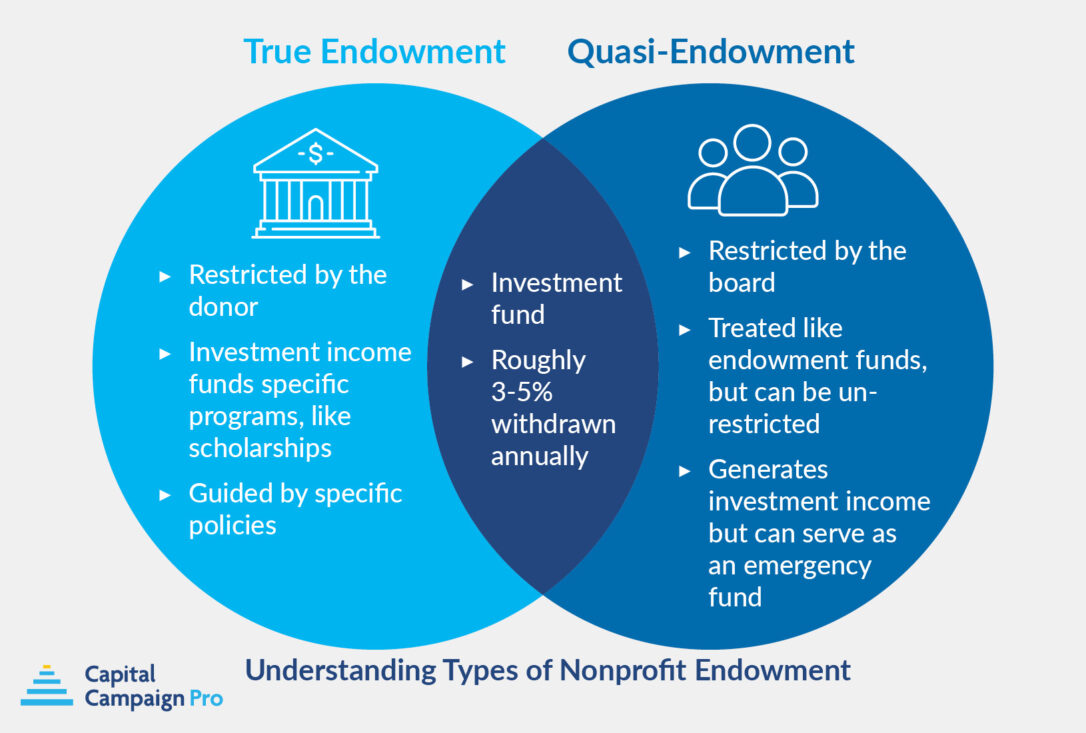
An endowment is essentially a pot of money that is invested over the long term. The principal can’t be spent, but the organization can draw down the investment earnings. There are several types of endowments with unique spending rules, but there are two main categories:
True Endowment
True endowment funds are restricted by the terms of a donor’s gift.
For example, scholarship funds are commonly true endowments. A donor gives with the stipulation that the principal must be invested and income from that investment is given to a scholarship. Colleges and universities usually have specific programs for such gifts with clear requirements about how much money someone needs to give to create a scholarship fund.
You might also see named faculty chairs or other specific items that are funded by donor-restricted endowment gifts. These restricted endowment funds are guided by specific policies that detail how they should be invested and spent.
Quasi-Endowment
Many organizations have a board-restricted or “quasi” endowment account. These funds are treated as though they are endowments, but they are restricted by the board rather than the donor.
That means that the board could unrestrict some or all those funds should the situation require it. In other words, a quasi-endowment could be seen as a rainy day or emergency fund, in addition to generating investment revenue.
How They are Similar
The two types of endowment are the same in that the money put in the funds is invested, and only a relatively small percentage (usually 3-5%) is drawn out annually to be spent on the organization’s mission. To put it simply, true endowments are restricted by donors, and quasi-endowments are restricted by the board.
Can we raise endowment money through our capital campaign?
Yes, but a straight endowment campaign seeking to raise cash gifts or pledges for your endowment is often a tough sell. In general, most donors would prefer to fund an immediate need rather than contribute to your bank account.
Rarely, you’ll find a donor who believes strongly enough in your organization and endowments that they’ll give to the endowment. During a capital campaign, it’s much more likely that people will consider a bequest with the intent of supporting an endowment in addition to their capital gift.
Should our building campaign include an endowment?
Even though most donors won’t make cash gifts to your endowment, you can still include an endowment as a component of your capital campaign.
Some donors will want to give as generously as they can, but they can’t make a big short-term gift. For them, the possibility of making a planned gift is a great idea. Of course, gifts that may not come in soon won’t help your building project. For that, you need cash or short-term pledges. However, your campaign can accept long-term gifts if your campaign goals include an endowment.
Some donors may wish to make combined gifts—one portion of the gift consists of short-term pledges and the other as a planned gift.
How do we set endowment goals in the context of our capital campaign?
Setting an endowment goal for your campaign can be challenging. If donors agree to a bequest, they may or may not identify the specific amount of money they plan to include for you in their wills. Even if they do, the donors’ estate may not have anything left to give away by the time they pass.
This means that attaching a specific dollar amount to a planned gift is challenging. You can estimate based on averages, but unless donors make current gifts to your endowment, you’ll be guessing.
Here are two ways to address this challenge:
- Frame your endowment goal around the number of bequest pledges you want to secure during your campaign. With this approach, you might have a capital campaign goal of $5,000,000 and an endowment goal of 30 new documented bequest intents. It’s simple, easy to count, and will encourage people to make a dual gift.
- Discount the stated gift intent according to the age of the donor. The older the donor, the smaller the discount. To determine the value of planned gifts, use resources like this one from the National Association of Charitable Gift Planners.
The Challenge With Capital Campaign Endowments
While we generally don’t recommend launching endowment-focused capital campaigns, some organizations have missions and donors that do lend themselves to raising endowment through cash gifts. If you have aging donors with a long-term commitment to your organization’s mission, then raising money for an endowment through short-term giving may not be far-fetched.
For example, an organization that provides long-term residential care may have family members of residents who would like to make endowed gifts to help ensure the care of their loved ones.
However, for most other nonprofits, earning endowment donations through a capital campaign is often a struggle. So what exactly is the problem?
Most endowment fundraising requests run into one or more of these issues:
- The impact is vague and hard to envision.
- The impact feels too small to be worth the size of the gift.
- The need doesn’t feel immediate.
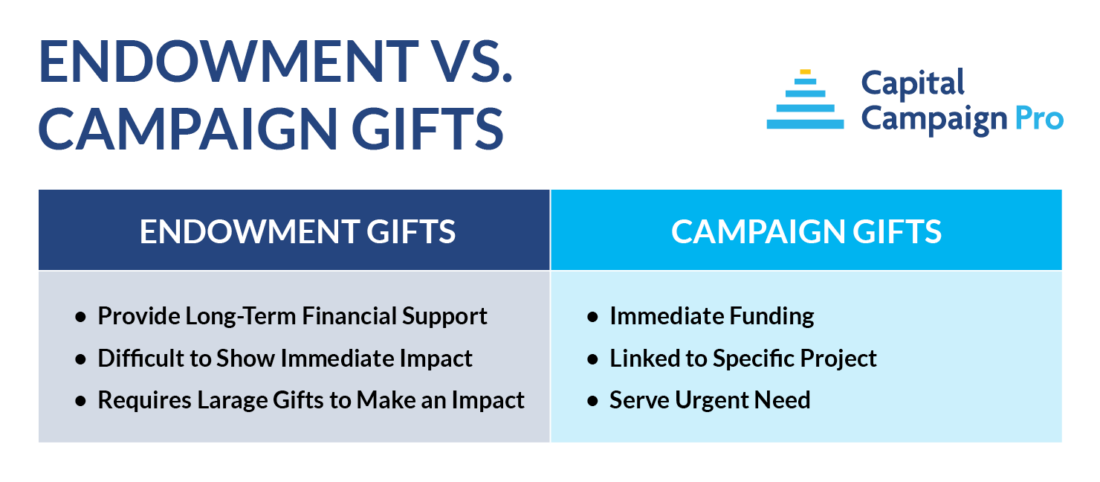
Capital campaigns ask for major gifts but make the case for support for specific, tangible outcomes that you can spotlight for donors. In contrast, an endowment asks for a major gift now to serve long-term needs, and it often takes years for the investment revenue to equal the size of the initial gift.
Keep in mind that, in round numbers, at 5% interest, a $100,000 gift adds $5,000 to your operating budget every year. This means that you must raise 20 times the amount you want to spend annually. Imagine saying this to your donor:
“I’d like to ask you for a gift of $100,000 for our endowment. Your gift would make it possible to add $5,000 every year to our bottom line.”
Giving $100,000 to your organization to generate a small amount for operating expenses is rarely an appealing proposition for donors. The impact just isn’t big enough.
However, if your nonprofit is still determined to fund your endowment through a capital campaign, we have a few tips we can share to help.

3 Ways to Generate Support for Your Endowment During a Capital Campaign
Include Planned Giving in Your Campaign
Before launching into a capital campaign to raise funds for an endowment, your organization should have a planned giving program. Bequests left in a donor’s will, trust, or estate plan comprise approximately 90% of planned gifts. They’re among the easiest planned gifts to set up, and they offer a high return on investment, with the average bequest being worth over $50,000.
An estate gift can be seen as a way of perpetuating a donor’s generosity. Imagine that Joanna Jones has been a loyal donor to your organization, giving to you annually for the last 20 years. Then one day, you get a letter from an attorney telling you that Joanna has passed away and that she has left your organization $25,000 from her estate. The gift has no restrictions.
When the money comes in, you have a choice:
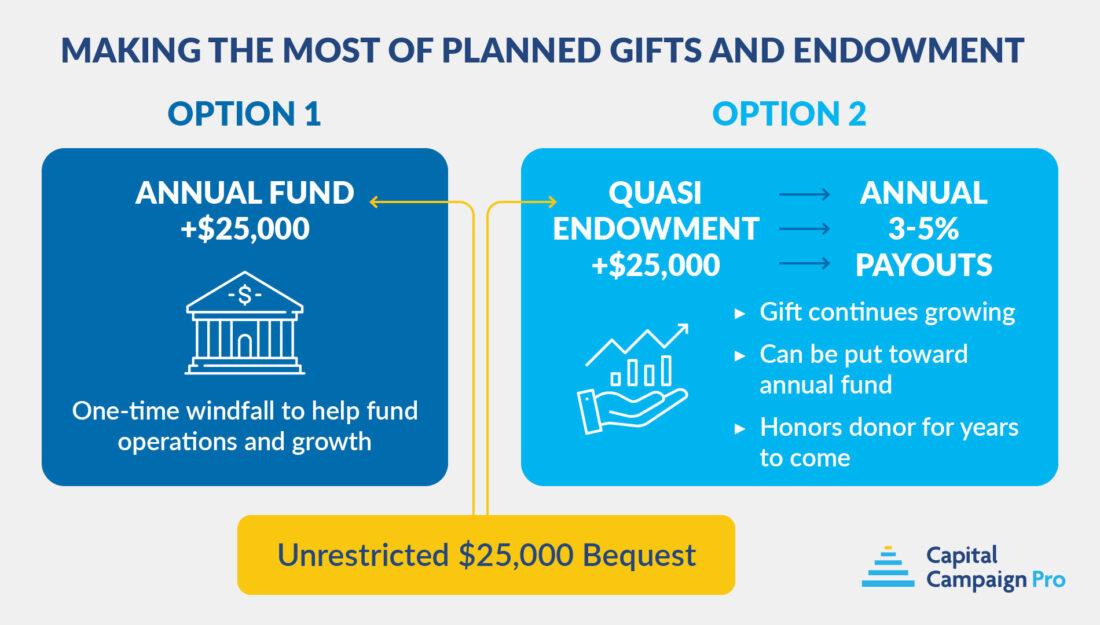
- You can use Joanna’s estate gift as a windfall for your annual fundraising.
- Or, you can put it into your quasi-endowment fund and invest it so that every year, you can use the return on that investment for your annual fund.
As you get ready for a capital campaign, you should make sure that you have the basics of a planned giving program in place. A few ways you can prepare include:
1. Make sure you use the correct bequest language and make information easily accessible.
Add details about planned giving and bequests on your website. Research other nonprofit websites to find standard language for discussing bequests. However, be sure to have your attorney review any language you plan to use about planned gifts before posting it on your site.
You can also offer your donors tools that will notify your nonprofit when new bequests are established. This is helpful because, in many cases, donors might not think to let you know that they’ve created, changed, or removed bequests in their wills.
2. Set up a stock acceptance process.
Invest in a donation management tool or work with your local financial institution to learn how to accept gifts of stock and sell them within 24 hours. You should have a policy to sell assets immediately. All you need to know is that donors should transfer appreciated stocks (those that have increased in value) directly to your organization.
Be aware that as stock gifts are processed through third-party brokers, they’re often reported to your nonprofit anonymously, making it difficult to attribute gifts and steward your donors. If you accept gifts of stock, have a plan in place for donors to notify you of their gifts in advance so you are ready to receive and liquidate them.
If donors have depreciated stocks (those that have decreased in value), they should sell them first and then send your organization a check. However, before making any gifts, they should always check with their financial planner or accountant first for the latest tax policies and benefits.
3. Prepare to accept other types of planned gifts.
While bequests are the most common type of planned gifts, there are many other options donors may want to explore. To maximize revenue, your nonprofit should be ready to accept these gifts.
For example, grants from donor-advised funds have grown significantly in recent years and continue to set both contribution and payout records. If you already have experience with DAF gifts, you might incorporate them into your campaign plan. If not, ask your major donors and prospects if they have DAFs and if they’d be willing to disperse funding to your nonprofit.
You do not need to be an expert in planned giving in order to accept planned gifts, especially if you focus primarily on bequests. Donors interested in more complex gifts should use their own advisors, including their own attorney, accountant, and financial planner, to make their gifts.
Make Your Endowment a Campaign Objective, not the Main Goal
It’s a bad idea to use a capital campaign primarily to raise money for your endowment. Capital campaigns are successful because they have well-defined short-term impacts, and as we’ve stressed, endowments do not.
However, you should consider including an endowment fund as one of the objectives of your capital campaign so you can use the campaign as an opportunity to encourage your donors to include your organization in their wills.
Rather than including a dollar goal for planned giving in your campaign, you might set a goal of earning a specific number of planned gifts during your campaign. For example, you might have a cash donation goal of $1,000,000 and a goal of 10 estate planning gifts.
Use Language that Motivates Donors
Consider moving away from the term “endowment.” Instead, use language that describes the purpose of the endowment funds. Donors are more likely to give to a “scholarship fund” than to an “endowment.”
You might consider, for example, inviting donors to contribute to:
- An emergency building maintenance fund
- A scholarship fund
- A future innovation fund
Defining your endowment around specific funds will keep people focused on the mission rather than the money, framing your donation requests around impact.
Consider an Opportunity Fund
If your organization is young or small and not ready for an endowment, but you know you will need sustainable financial resources as you grow, you might consider including an “Opportunity Fund” as a cash reserve. These funds are intended to be spent down over a specific period to support your organization’s early growth.
To encourage gifts, you might set a time frame for when and how those funds will be spent to help your nonprofit thrive.
Get Started Planning Your Capital Campaign
Capital campaigns are a key time for earning major revenue, but an endowment is often a difficult ask. Instead, your capital campaign should be an opportunity to speak with your donors about the possibility of making an estate gift. That will help grow your endowment, while also driving current donor commitments to the immediate aspects of your campaign.
Not sure how to begin laying out a fundraising strategy for your campaign? We can help. Capital Campaign Pro provides the resources, expertise, and coaching you need to develop a robust funding plan.





Leave a Comment