
How to Create a Capital Campaign Brochure: Our Top 4 Tips

Talk to most board members about a capital campaign, and they’ll probably start imagining the campaign brochure. Some may even suggest that, right off the bat, you hire a graphic designer to start working on it.
While your campaign will likely need a campaign brochure, there are four things you should know before you jump in:
- Tip #1: Don’t Create Your Capital Campaign Brochure Too Early
- Tip #2: Include All Necessary Capital Campaign Brochure Elements
- Tip #3: Seek Feedback About Your Brochure From Key Stakeholders
- Tip #4: Focus on the Benefits of Your Campaign in Your Brochure
Once you’ve digested these tips, you’ll be ready to create a capital campaign brochure that will have maximum results.g
Tip 1: Don’t Create Your Capital Campaign Brochure Too Early
When preparing for a capital campaign, many nonprofit board and staff members believe that one of the first steps is designing a beautiful campaign brochure.
It seems logical that you would create something impressive to show your largest and most influential donors. However, creating a brochure too early is one of the biggest mistakes an organization can make when getting ready for a capital campaign.
Why Should You Wait to Create Your Campaign Brochure?
Once you’ve created a fancy capital campaign brochure, you’re locked into whatever that brochure says. When first reaching out to major donors, the size and scope of your campaign is likely to shift between early quiet phase conversations and the kick-off of the public phase. During this early period, you will earn the all-important lead gifts, and they may be higher or lower than you anticipated.
Instead of having a goal physically printed in black-and-white, you should use a working goal during the early planning and quiet campaign phases. Based on these stakeholder conversations, you can review and finalize your campaign goals ahead of the public phase.
If you make the mistake of locking in your goal too early with a brochure, you’ll face issues like:
- Want to expand your program or project? It’s hard to do once it’s printed on glossy paper.
- Wish you could change your goal? Too late—it’s on the brochure.
- Need to expand or contract your building renovation? You’re going to need to throw out all those expensive brochures.
So, when someone says, “Let’s create a campaign brochure…” during the planning phase, it’s always, always, always too early.
So When Should You Create a Capital Campaign Brochure?
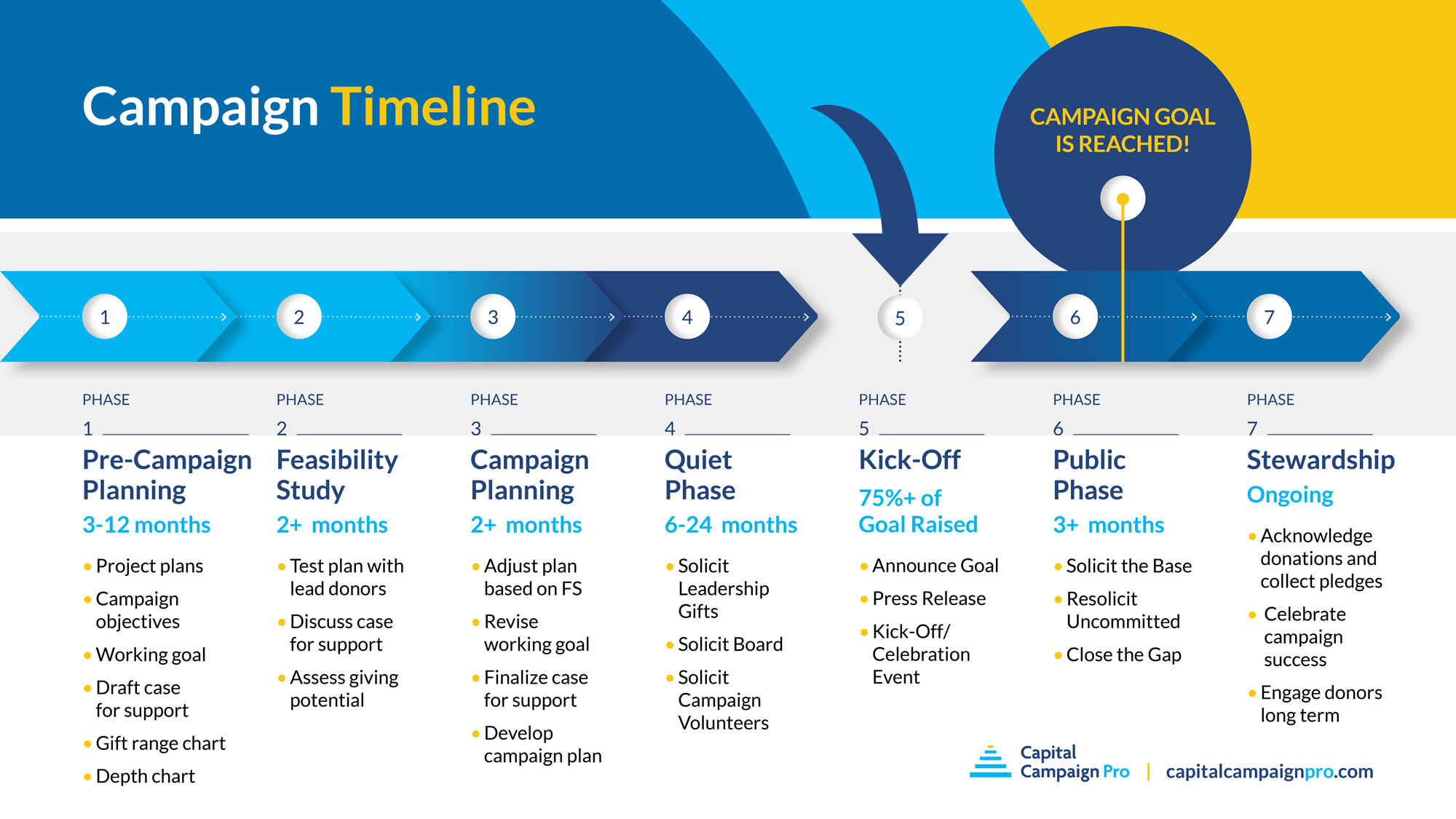
You should create your brochure in time for the kickoff and public phase of your campaign. Typically, the kick-off phase begins once you’ve raised 75% of your goal. This means that you should start creating your campaign brochure when this goal is in sight.
Our rule of thumb: Raise 65% or more of your campaign goal before creating a campaign brochure.
See the campaign timeline below for reference:
So if someone from your organization wants to create a brochure too soon, now you know exactly what to say (and why). Emphatically tell them:
“Not until we’ve raised 65% or more of the goal first!”
Once you’ve done that, then it’s time to create a beautiful capital campaign brochure.
Tip 2: Include All Necessary Capital Campaign Brochure Elements
Your campaign brochure should include three types of information:
1. Background information:
- A summary of our organization’s history, mission, programs, and goals
- Board of directors list
- Address, phone number, and contact information
- Name of the executive director
2. Information about the project:
- Key points from the case for support
- Drawings and plans
- Map showing project location
- Project budget and timetable
3. Information about the campaign:
- Campaign leadership
- Campaign steering committee
- Campaign goal(s)
- Table of gifts
- Donor recognition plan
- Ways a donor can make a gift to the campaign
- Name and contact information of campaign staff
While this may seem like a great deal of information, the clearer and more succinct you can make it, the better.
The best campaign brochures use headings and images to tell the story rather than long blocks of text. So keep that in mind as you’re developing your first draft.
Try experimenting with our template to get started:
Tip 3: Seek Feedback About Your Brochure from Key Stakeholders
Your donors can contribute a great deal to the campaign brochure.
During the early stages of your campaign, approach your largest potential donors and most influential community members to ask for their advice and feedback on the project. Doing so will show them how much you care about their input and increase their personal investment in your campaign.
Start with a Draft of Your Campaign Brochure
Instead of getting stuck with whatever campaign brochure you first envision, create a draft and share it with a few of your most thoughtful and influential donors. They will be thrilled that you’re asking their advice early in the process.
You might ask for their feedback individually or invite a few people to come together in person or in a video conference to discuss the draft.
Ask simple but specific questions like these:
- When you reviewed this document, what struck you as the most compelling and exciting part of this project?
- What are two or three questions that you think aren’t addressed?
- When you read over the draft, did you get a sense of why this project matters and why it matters now?
Don’t ask whether or not they like it. That won’t tell you much that’s useful. If you can, encourage them to stay away from wordsmithing and specific details. Instead, stick with bigger concepts and tell them that you and your team will do the rewriting.
Be sure to let each person know that you are asking several people for feedback, so you will have a range of suggestions. Creating a broader context will help you manage the feedback from any one individual.
Create an Updated Draft of Your Brochure Based on Feedback
Once you’ve collated the feedback and decided what advice to use, you can create an updated version and share that with everyone who provided feedback. Be sure to thank everyone for their help.
While you may not find all of the feedback useful, much of it will be, and the process of discussing it with donors will make for a much more effective campaign brochure.
Tip 4: Focus on the Benefits of Your Campaign in Your Brochure
Perhaps the most critical piece to developing a campaign brochure is to focus on the benefits of your campaign rather than the features and description of your project.
Consider this benefits-focused example:
If you are building a new cancer center, your campaign might focus on:
- The design of the new building
- The medical treatment rooms that will be available
- The waiting areas and operating rooms
While these details are important, the far more important information is the impact the new cancer center will have on the people who are treated there and their families. When you focus on the benefits of the new center to the people who will use it, your case will come alive.
Step into Your Target Audience’s Shoes
When you write your case for support, put yourself into the shoes of someone who is going to experience your project and think about what they really want from it.
Consider: How will your project benefit people and the community you serve?
Figure that out. Capture it in your campaign brochure. I promise you, people will want to contribute to your campaign!
Now, you’re well on your way to creating a great campaign brochure!
- You’ve waited until you are confident that your project and campaign goal are finalized
- You’ve included all of the content elements that should be in your brochure.
- You’re asked your key leaders and donors for their suggestions about a draft.
- And you’ve written the case so that it focuses on benefits and impact as opposed to features.
Great job! Your campaign brochure will most certainly pull its weight for you and your campaign.



Andrea,
Your timing is impeccable! SLO REP is working on a brochure. It is early, since we haven’t gotten 65% of the goal……or even know what the goal is! Hopefully, Kevin will have something by the end of the month.
One member of the committee recommended that we have separate sheets of paper that can be changed as needed, rather than a complete document. Currently working on something aimed at large donors.
Thanks again!
Cathy
We no longer do campaign brochures. We create campaign folders with pages representing each of the above elements: impact, building design, budget, board & committees, FAQ, etc. Those pages can be modified during the duration of the campaign and are very cost-effective.
Thanks Randa. I think that’s a great approach! Bravo.
This is a great idea! Thanks for sharing.
For our last campaign, we did a brochure – and regretted it. What worked were telling stories of the impact the new program and space was going to have. That, and a pdf that showed the rooms that were available to name. If I had to do it over, I’d do a one pager on the campaign and the project but be able to change it and print out the new version on our color copier!
Thanks for your great comment. You’ve described a great strategy for the major gift phases of your campaign. Way better than a brochure, I think. When some campaigns need brochures is if and when they recruit lots of volunteers to solicit lower end gifts. The primary purpose then is to reassure the volunteer solicitors.
Thanks Cathy. Glad it was helpful. See Randa’s comment below for another excellent alternative.
I wish I’d had this before my last capital campaign!
But now, you’re ready for the next campaign! 🙂
Thx for your comment, Michael.