
Podcast: Will Your Capital Campaign Cannibalize Your Annual Fund? What Really Happens
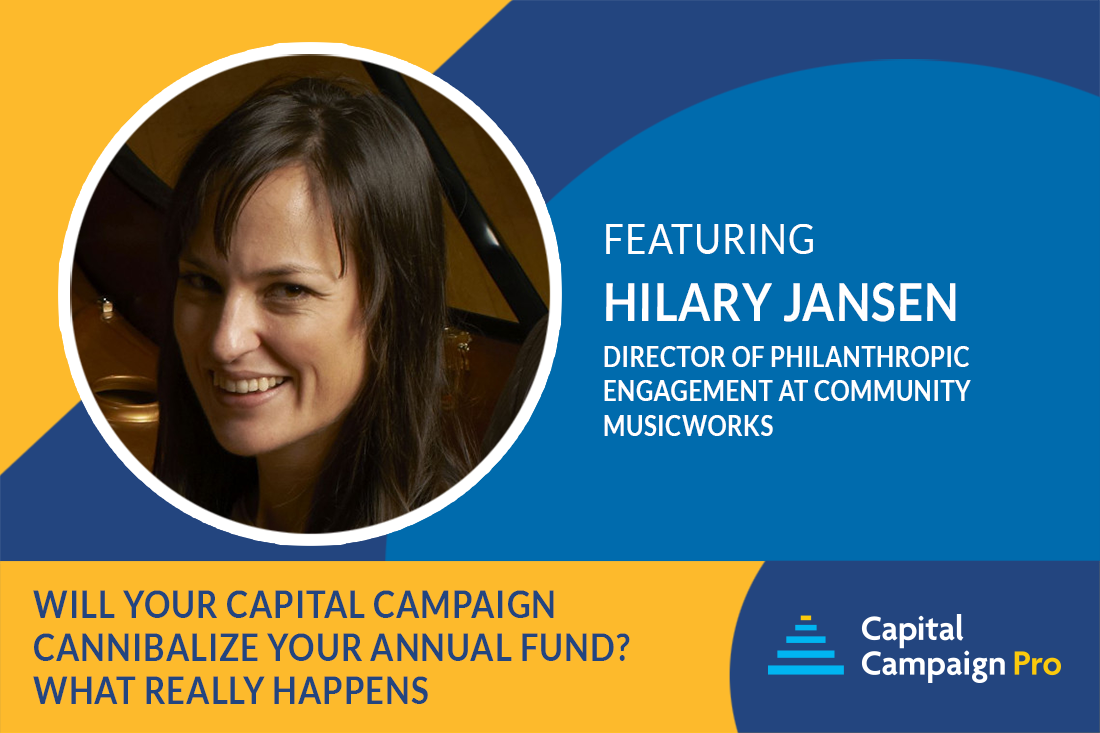
Season 5, Episode 30
Will a capital campaign drain your annual fund or strengthen it in ways you never expected?
In this episode, Andrea Kihlstedt talks with Hilary Jansen, Director of Philanthropic Engagement at Community MusicWorks in Providence, Rhode Island, about what actually happens to annual fundraising during and after a major capital campaign. Community MusicWorks recently completed a $15 million building campaign and has now lived through the results.
If you worry that campaign gifts will replace annual gifts, this conversation offers real-world clarity.
Listen Now:
Andrea Kihlstedt:
Cannibals, if there’s one question we get, is your capital campaign going to cannibalize your annual fund? And we have someone who has just lived through it to tell you what actually happens today.
I’m Andrea Kihlstedt, my friend and colleague, Amy Eisenstein is off today, and I am here with a very special guest, Hilary Jansen of Community MusicWorks. Welcome Hilary.
Hilary Jansen:
Thank you, Andrea. I’m so happy to be here.
Andrea Kihlstedt:
Well, I’m delighted to have you. Hilary, we at Capital Campaign Pro and I have worked with Hilary’s organization. She is the director of philanthropic engagement at Community MusicWorks in Providence, Rhode Island, and we have been thrilled to be able to work with them over a significant period of time into a campaign, through a campaign, and now post-campaign. So Hilary knows the answers to your questions about cannibalization (or lack thereof).
CWM’s Mission and Fundraising
Hilary, why don’t you give us a little background on CMW?
Hilary Jansen:
Sure. Yeah. CMW is a classical music performance education and social justice nonprofit organization located on the west side of Providence, Rhode Island. And our work at CMW is really anchored in the activities of our musicians and residents, the Music Works collective. That’s a group of about 14 give or take string musicians. And those musicians and the activities of those musicians sort of really ask the question of what does it mean to have this music in service to its community when that community is a city neighborhood?
You often hear of a string quartet in residence at a conservatory or a university. And here the idea is we have a group of musicians who are earning a full-time salary with health benefits and to have sort of a structured life in a city neighborhood. So that’s sort of at the foundational level, the basis of our work at CMW.
There’s sort of three legs that support a stool, if you will, three prongs and one is, like I just said, this professional performance ensemble that creates a new model for how musicians can really exist in their local communities. I say new, but this is CMW’s 29th year. So take that with a grain of salt. There is a music education component of course. We serve around 150 students with free after-school music program, learning stringed instruments. So those same professional musicians have a robust teaching element to their work in addition to their performance.
We present, I’m not looking at a calendar, but maybe 20 concerts over the course of the concert season and social justice. So being intentional about who we serve and thinking about how music is a means to understanding and conversation and thinking about that element of music making. So that’s just sort of a little snapshot.
Budgeting as a Small Development Shop
Andrea Kihlstedt:
Great. Let me ask just a couple of questions so people have a good picture. What’s the annual budget of CMW?
Hilary Jansen:
Yes. Our annual budget is $2.3 million. And I should note that before we moved into our building, the building being the result of our campaign, our budget was about $1.2 million. So it is a massive upward shift in budget since we’ve opened our building.
Andrea Kihlstedt:
Right. And you don’t get money from tuition?
Hilary Jansen:
We do not. All of our students do not pay tuition. They don’t pay instrument rentals. They come as a free service to the community.
Andrea Kihlstedt:
Which means that all of the money you bring in is raised, is philanthropic.
Hilary Jansen:
All of it is raised. Yeah. Right now we raise about 40-ish percent of our money through individual fundraising. So our annual fund accounts for about 40%. I should say that before this sort of big expansion in our budget, annual fundraising was closer to 60%. So that is something that we’re thinking about as an organization is how to bring that number back to 60%. So that’s a challenge. That’s something that we’re actively thinking about and planning for.
Fundraising Breakdown
But right now, individual fundraising is about 40%, foundations account for 25% or so earned income. And that is a number that comes through. We have a pay what you will ticket model for our concerts. We are starting this year… This is our second year in our building. We’re starting to a rental program for various spaces. So earned income is about 23%, government grants is 12-ish percent and we get very little through corporate giving. So that’s sort of a breakdown of where our money comes from.
Andrea Kihlstedt:
Right. And I should also say that yours is a very small development shop. There’s you and one other person plus the executive director. Or that’s not what he calls himself, but whatever.
Hilary Jansen:
Founder and artistic director.
Andrea Kihlstedt:
Founder and artistic director who was involved in fundraising.
Hilary Jansen:
Who was a key fundraiser for sure.
Andrea Kihlstedt:
Right. So that’s a picture of Community MusicWorks. We have worked with Community MusicWorks planning a campaign and through a campaign they raised about $15 million when all was said and done in their campaign, built a fantastic building which has now been open for a year or more.
Hilary Jansen:
This is a year and a half. We opened year and a half, September of ’24.
Fears of an Annual Fund Shortfall
Andrea Kihlstedt:
And of course there were all those worries about, well, what’s going to happen to our annual fund? And here’s an organization that relies extensively on their annual fund. So the idea of losing that because they were asking for big campaign gifts was horrifying to them. Now let’s fast-forward to today. Right? Looking back. So what did happen to the annual fund during your campaign?
Hilary Jansen:
Yeah. Like you said, and the way you started, this fear of cannibalization is a big one. And I will say that Andrea, as our advisor reassured us many times, let’s see, the campaign really fuels the annual fund. It really doesn’t take away from it. But it was a huge anxiety and it turns out is almost always the case, always probably Andrea was correct and the campaign was really a catalyst for our… Has proven to be a catalyst for our annual fund.
We increased our annual fund goal quite a bit in that first year, last year having opened the building and we’ve increased it again since and last year we exceeded our annual fundraising goal by quite a bit. And this year we’re on track to do really well and it’s been a wonderful success story. And another thing that Andrea told us might happen has really proven to be true. And I know our campaign, which we’re building and campaigns are for various things, but in our case, the building, the object of our campaign, has been such an extraordinary fundraising tool really. And I think its existence has allowed us to really increase our annual fund goal to come back to donors.
And there’s this physical marker of asks that in the past might’ve been more, obtuse isn’t the right word, but you’re fundraising for programs, but here’s a home for those programs. And you can see how those programs exist in the day and you can drive by in the street and see someone playing violin up here and people coming in for a concert over here. And there’s this physical reminder of abstract programs, of things that can be abstract in a conversation. There’s this wonderful, physical reminder of what we’re actually doing and it’s been really an extraordinary tool.
Andrea Kihlstedt:
Yeah. So it still feels counterintuitive, let me say, that while you’re raising this $15 million over and above your annual fund, this was not a comprehensive campaign that you did. It was over and above your annual fund from the very same people for the most part that your annual fund was coming from.
And I understand people’s anxiety because it still feels counterintuitive that while you are asking people for gifts that are far in excess of what they have given before, you’re still asking them for annual fund gifts. In some cases even increased annual fund gifts. And they say yes. Now, how do you explain that?
Actually Increasing the Annual Fund During the Campaign
Hilary Jansen:
I think there’s several different ways in which that happens. One is for some of our largest campaign asks, the people that we’re asking are really seasoned philanthropists. They have been doing this for a long time and they understand how this works. If you have philanthropists who are making a million dollar gift, this is something that they do and a system they understand and they understand that these two things exist separately and both are vitally important to the organization. So there’s that sort of element. But I think at CMW, I’ve been here for three, four years.
Okay. Four years at CMW and I stepped into an organization where there has been years and years and years of extraordinary stewardship of a very dedicated donor base. And so CMW has a donor base who believes so deeply in the mission of the organization, and there’s been such a sense of trust built up over many years that if my predecessor or Sebastian, our founder, or I coming in and having a conversation and we are expressing a need, they understand that need to be genuine because there’s years of trust and there’s a long relationship and a belief in the work of the organization.
And that doesn’t go away. It’s not like, oh, what? You’re asking me for two things, I’m out. The ask doesn’t come out of the blue. None of this comes out of the blue. It’s people who have walked alongside the organization and see what this growth could mean and step up because they trust and admire the work over many years.
Andrea Kihlstedt:
Yeah. Did you have any or very many people say, enough already?
Hilary Jansen:
No.
Andrea Kihlstedt:
I gave you $100,000 last year and now you’re coming back and asking me for more money this year?
Hilary Jansen:
No. I mean, sure, one or two. Not to say that it didn’t happen at all, but when it did happen, it wasn’t in a I’m so offended way. It’s like, no, we’ve reached the cap of what we can do. I think this is something that you worked alongside us with.
When the campaign started, it was a $10 million campaign and over the years, increased probably three or four different times to finally reach 15 million. And so there was some question of how many times can we raise the campaign goal? So that was something that we really grappled with you and talked through a lot and thought through a lot. And even when we thought, okay, well we could actually use more than $15 million, there was a point at which we weren’t going to raise that goal anymore.
But when it came to individuals thinking about their gift giving and their philanthropy, no, we didn’t face a lot of sort of, “How could you. Oh, enough is enough.”
Andrea Kihlstedt:
I think that’s what people are worried about. I think they worry that they’re going to come to you and you’re going to say, what? Again?
Hilary Jansen:
No, that really didn’t happen for us. Yeah.
What Happened to Giving After the Capital Campaign
Andrea Kihlstedt:
Yeah. Let’s talk about what’s happened after the campaign. You said that your budget has increased significantly post campaign because now you have a building to run, you have additional expenses, your programs are growing. You haven’t raised that goal just because. You’ve raised it because the building brings with it additional requirements.
Hilary Jansen:
Yep.
Andrea Kihlstedt:
And once again, you too were anxious about whether your fundraising could keep up with the increased… Particularly on the heels of this incredibly successful campaign. I mean by anybody’s standards, this was a successful campaign.
And then it’s like, all right, you’re going back to people who have given $10,000 year after year and you’re saying, yes, this is fantastic. You gave to the campaign and now we’d like you to consider $15,000 this year. And that was anxiety. Now what actually has happened? You’ve been through a year of annual fundraising post-campaign. What happened?
Hilary Jansen:
A few things. So when we opened this building, our former space is a block and a half down the street, and it was a space where parents would buzz the buzzer and our musicians would come down, bring them up. There wasn’t enough room for sort of community in the space itself. Our concerts were in various places around Providence, which frankly is an important part of the model being in different spaces in the wider community, but there wasn’t as much of a sense of a home base for our students.
Now we have a 24,000 square foot building moving really from more of a peripatetic music and performance and after-school program to being a real community center. So that’s just context because beyond we have a performance hall where the public comes in. Teaching spaces, practice rooms. We have what will soon be a cafe open to the public. And so you have just immediately a lot more ways to interface with the wider community and with your own students and families who are in the program.
And so for instance, in our concert hall now we have an audience who is coming into our space. When they come into our space, they see evidence of our programs. And so that’s a whole potential donor base that we have the opportunity to connect with. So you come in for a concert, but you say, oh, what happens here? And we’ve had people wander in to find out what we’re all about. That never would’ve happened in any other context. A lot of our donors are also our concert goers. And so again, they’re having that same experience. And so when they come in, they are in this beautiful concert hall, they sort of see our concerts and programs in a different light. And that ask makes sense.
If you’re not ever going into those rooms where the lessons are happening, the bigger ask doesn’t always make sense. And I think the building gives it context and it does allow us… It sort of is an architecture. Just the architecture alone is a new thing. It’s a new type of building for Providence. It draws people in a different way. There’s just different ways to engage with our community. Our parents used to have to drop their kids off, come back and you’re parking and we’re in the middle of the city. It’s not a place to hang out.
But now there’s just 50 people hanging out at cafe tables and playing board games and having Zoom meetings and doing whatever while their kids are bopping from place to place. And so there’s just all these… The word community in Community MusicWorks is manifest, right? You see it happening in front of your eyes and the students have really taken ownership of the building. It was clearly their space, which was our every hope and desire going into this. You build a fancy, beautiful building that’s like, well, we ultimately want it to be for the kids who are here, and it has proven to be. And so having this home, this sort of visual manifestation of what community is at CMW, what is the community of Community MusicWorks? You can see it. And so I think that has been just the most extraordinary thing for our fundraising.
Andrea Kihlstedt:
Yeah. I mean it’s so wonderful to hear you talking about that. Early on in the planning process for this building, I was a real proponent of how important the community space would be. And that comes out of my own experience in a music institution with my daughter when she was young. And I had had such an experience then when my daughter was young and I knew that it was going to be important here. And I think I was sort of a lone voice at the time, and it’s so interesting to hear you talk about it now. It makes me very —
Hilary Jansen:
Yeah. It was a smart voice because it really is a heartbeat. And we don’t even have the cafe yet where you can go buy a coffee and get a snack. It’s really just the space now and tables and the feeling of a community gathering space. But I can just imagine what it will be when that cafe goes into action.
Key Lessons Learned
Andrea Kihlstedt:
Yeah. So pause and reflect for a moment. While you haven’t been there through this entire campaign, you’ve been there through a large chunk of it and we’ve been running the fundraising program and the post-campaign part. You came to this business really without a huge amount of experience and major fundraising.
You were kind of a newbie in this, so you were thrown into the deep end of the pool now in a very high functioning organization, I will say. But still, it must’ve been a little daunting. And I’m wondering, just sort of in closing, do you think, what are some of the key lessons that you’ve learned through this process?
Hilary Jansen:
I will say two things, I think. One is I absolutely came into this not having worked in development. I came to sort of helm this department not having worked in development, but the reason I was hired, I think we can go, is because before working at CMW, I worked for many years in artist relations. So I worked with pianists in particular, but with musicians in sort of partnering with them in their artistic goals. And it was a job that was about understanding that individual artist. A roster, a very diverse artist, understanding what their goals were, what their musical goals were, what their career goals were. Then helping them to achieve that. It was truly all relationship building.
And coming into development work, it is truly all relationship building. I think coming into development work without having context, I probably thought, well, you’re pushing your organization, but that’s not what you’re doing.
You are building relationships with people who are connected to the work you do. And so that is something that I always center. That’s just so important to center.
And frankly, that has yielded extraordinary things for CMW. I mean, the reason we could have this sort of outsized campaign for the size of our organization in the city that we live in is because of years and years and years of relationships that were built up over time. That is ultimately what led to the success of this campaign, is just connecting with the people who believe in what you do. That is the base of it all. And there’s that element.
And the other thing I would say about what I learned about capital campaigns and whatever the thing is this:
[T]his outsized thing is that you’re raising money for — it’s not the thing you’re raising money for. It’s what that thing does for your mission. At least that’s how I felt coming out of this.
Yes, it is an amazing building. It is a beautiful building, it is an architecturally like extraordinary building. But what it is it’s a home for our programs and mission. And so going back to your question about annual fund cannibalization and it is like it doesn’t happen because this is a place for all those things to grow. And people see that. Like I said, one of our biggest hopes was that this would be a place that was owned by our students. And it is. It is a home for our mission, and that’s the sort of anchor of it all. Yeah.
Final Thoughts
Andrea Kihlstedt:
Hilary, hearing you talk sort of reinforces for me something that I have known for years and even I tend to forget, which is that fundraising is not an add-on to an organization. It is an integral part of an organization, right? That they are wound together and you can’t just think about fundraising. You have to think about it in the context of an organization that centers and prioritizes the community and the mission and the donors. And that when an organization does these things in a seamless way, instead of having fundraising over here and the organization over here, then you get this magic, which certainly CMW has had in its fundraising (and continues to have).
Hilary, what a pleasure. I have been in this fundraising business a very long time and working with CMW and seeing the lessons of your campaign has been one of the privileges of my professional life. So really, I thank you so much for sharing your wisdom. Anyone who’s listening, if you ever are driving through Providence, take a look for Community MusicWorks. Drive by, stop in, walk through the building, experience their community. Look up Hilary. Do you mind if I say that? Hilary,
Hilary Jansen:
Please do. It would be a pleasure to welcome anyone.
Andrea Kihlstedt:
It is an organization worth stopping in to see and sort of just enjoying what it is to have an organization that really understands how these things happen organically. So thank you. I so appreciate your being here with us today.


Leave a Comment