
Podcast: What to Do When a Donor Gives Before You Ask
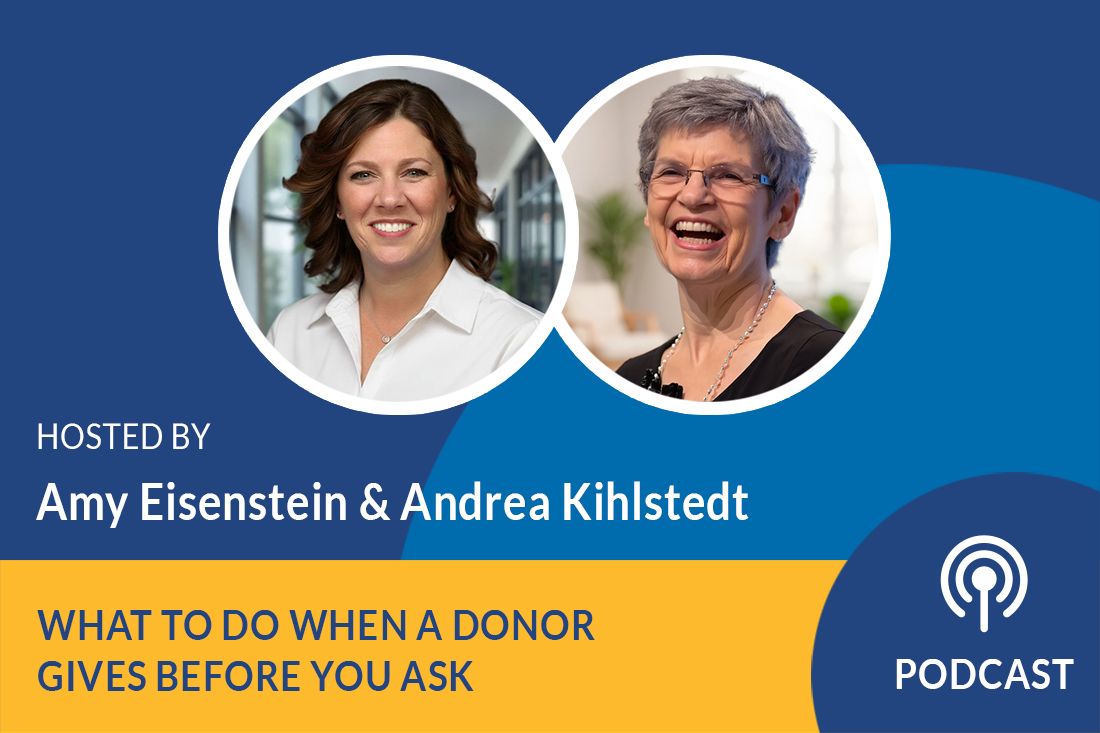
Season 5, Episode 35
What do you do when a donor gives before you even ask?
In this episode, Amy Eisenstein and Andrea Kihlstedt explore one of the most overlooked —and potentially costly — moments in capital campaign fundraising: the preemptive gift.
This conversation is especially valuable for executive directors, development leaders, and campaign volunteers who want to avoid common pitfalls and build stronger donor relationships.
Listen Now:
Amy Eisenstein:
What would you do if somebody handed you a check before you asked for the gift? Hi, I’m Amy Eisenstein. I’m here with my colleague and co-founder, Andrea Kihlstedt. And today we are talking about preemptive gifts.
Andrea, you have a terrific story about preemptive gifts, so let’s hear it.
Andrea Kihlstedt:
Sure. Thanks, Amy. These preemptive gifts are things that happen enough so that we really are excited to be talking about them. They don’t happen all the time, but donors do give before they’re asked. And often they give before they’re asked because they know they’re going to be asked for a big gift and they want to give a smaller gift. So it’s common that the preemptive gift is smaller than you were hoping for. And here’s my story.
Where’s the Harm in a Preemptive Gift?
When I was young in this business and I was working with a wonderful mentor by the name of John Sinardinas, he was fantastic. And he was a Cracker Jack fundraiser. He was just terrific. And John would generally make friends with, become very, very connected to the people who were his largest donors. And one of the donors, he was a development person at a college. And one of his key donors was a very low-key guy who had a ton of money and he didn’t like doing anything fancy.
So he, Paul, the donor and John used to meet quite regularly at a local diner. You can imagine the diner, red padded booths worn Formica tabletop, a waitress who knows you because you’ve come in again and again. That’s the kind of diner it was. And they met regularly.
Amy Eisenstein:
Love it.
Andrea Kihlstedt:
They knew one another well. And John’s college was in the middle of a campaign and he had decided that it was time to ask Paul for his campaign gift. And he had let Paul know. He said, “Paul, let’s meet at the diner because I want to talk to you about the campaign we’re doing at the college.”
So they arrive at the diner, they sit down, the waitress brings the coffee that she knew they wanted. And Paul says to John, “John, I always enjoy meeting with you, but you really don’t have to be asking me for a gift today because I’ve already made up my mind.” And he hands John an envelope across the table.
Amy Eisenstein:
Yep. Now, what do you do? What did John do?
Andrea Kihlstedt:
What did John do? What did John do? So here’s what John did. John took the envelope. He put it down on the table and he slid it towards himself. He slid it over, right? Slowly. He picked it up. He opened the envelope. He looked at it. He left the envelope in the envelope.
Amy Eisenstein:
The check in the envelope.
Andrea Kihlstedt:
The check in the envelope. He reclosed the envelope, put it back on the table and slid it back to Paul. Slowly. And John said:
“You know, Paul, I so appreciate your early gift, your gift to this. But I really don’t want to accept this gift until I’ve had a chance to really talk to you at length about this campaign. There’s so many things about this campaign that are right in your wheelhouse and you haven’t even had a chance to… I haven’t had a chance to tell you about them. You haven’t had a chance to learn about them. So can we literally table this gift and then we can decide about it later on. So while I totally appreciate it, let’s just put it aside.”
And he slides the check over to the side.
And then he proceeds to have a conversation with Paul about the [capital] campaign, not just about the campaign, but about why the campaign fits into Paul’s priorities. John was an excellent development person. He knew a ton about what Paul wanted to do in life, what he wanted to do with his money. He knew about Paul’s values.
So he wasn’t just telling him, “Well, here’s what the college is doing.” He’s saying, “Well, here is this special project that I think really fits these things that you do.” And they had a great conversation. At the end of the conversation, Paul said, “You know, John, you’re probably right. It really was a preemptive gift.” They knew it was a game. “And you know what? Let’s put it off so I have a chance to think about it.” And John said, “I want to introduce you to professor who can tell you more about this project and why. Maybe we can meet with the president of the college and we just need to help you understand better and see if it’s something you would really like to do at a higher level.”
And everybody was happy and that eventually is what happened. Took quite a while, but I think this guy ended up giving one of the bigger gifts to the campaign. And his little check that he had preemptively given to John was a thing of the past.
A Good Rule of Thumb: Continue Engaging
So Amy, what do you think about that? What do you think about what John did? Would you do that?
Amy Eisenstein:
You know what? I don’t know. And I think it’s really important that we’re having this conversation because every fundraiser should be prepared for a preemptive gift and not be reactive in the moment, but really think about, and it’s probably happened to all of us. What would you do? What will you do when that happens?
And of course, I think there’s so many it depends. How well do you know the donor? How confident of a fundraiser are you? At what point in the campaign conversation? So there’s a lot of scenarios and what ifs. I think what I really value about the story is that he actually looked at the check in the moment. And I don’t think a lot of fundraisers would have the nerve to do that. I would’ve probably asked, “Would it be okay if I look at the check?” Because that will shape how I react.
What if it is what I was going to ask for close or more? I mean, you don’t know until you look at the check. So I think I would probably say, “Is it okay with you if I look in this envelope right now so we can continue this conversation?” Then assuming that it is a disappointing check or significantly less than you were hoping to ask for, then you figure out a way forward.
Now, I’m not sure that I would… I think John was one of the best of the best, right? And he had the confidence and the wherewithal to be able to turn the check back over. I’m curious what you think and what you’ve done after hearing that story. But to me, I would say:
“Listen, I would like to teach you more about the campaign. I’d like to continue discussing and have you learn more about what we’re doing and why it might be more exciting than this check reflects. And would it be okay if we took this check and put a pin in it as potentially a first installment or an early gift?”
I don’t think I would give back the check in too many scenarios just in case something does go awry. But I would make it really clear that I want to continue engaging, that we’re looking for more, that we hope they’ll be even more excited and want to make a bigger difference. So what would you do?
Another Early Campaign Gift Scenario
Andrea Kihlstedt:
Well, here’s another scenario. So let’s assume, Amy, that you are my donor and you’ve given me a check.
Amy Eisenstein:
Yep.
Andrea Kihlstedt:
And I think I have to look at the check.
I cannot look at the check. Right?
Amy Eisenstein:
I agree. I agree.
Andrea Kihlstedt:
If I don’t look at the check, then it’s sitting there. And I mean, there’s this awkwardness. So I can either ask you, as you suggested, “Is it okay if I look at the check now?” Or I can just look at the check and respond to it. I don’t know that I need permission. You’ve given me the check. I can just look at the check.
Being Forthright With Your Donor
If I know you pretty well, I can say, “Amy, this is what we call in the business a preemptive gift. I actually had in mind to ask you for something significantly bigger than this,” right? And, “Did you have a sense of that? And are you trying to fend me off?”
So then I turn it back over to you and I hear from you how you’re feeling. I want to turn it back to you as quickly as I can so that you say, “Yeah, I knew you were going to ask me for something bigger than I could do, so I feared I would take charge of it early so it wouldn’t be awkward between us,” or whatever you’re going to say. So I want to both keep the communication open for the possibility of another or a bigger gift, but I also want to find out why you made this gift now and why it was a preemptive offering and if you had been anxious about what I was going to ask you and if you’d like to know what I was going to ask you for.
Amy Eisenstein:
Yeah, that’s great. I love that. So you might say:
“Tell me about this. How did you decide on this amount? This is an extremely generous gift and we are going to need a small handful of donors to give significantly more if this campaign is going to be successful. And I’m wondering if we could explore that?
Frequently, donors are pledging over three or five years, whatever your pledge payment is, and can we continue this conversation?”
But tell me more about what —
Andrea Kihlstedt:
Tell me more.
Amy Eisenstein:
… how you decided to give this amount.
Andrea Kihlstedt:
I think that’s the way I would go.
Amy Eisenstein:
Yeah.
An Ideal Response
Andrea Kihlstedt:
I would say:
“Thank you so much for this gift. Tell me more about how you decided it, why you made the gift today. Do you think about this as a first gift? Is there a chance that we might come back to you later in the campaign?”
I want to get you talking for me to know how to function. Now, I think what was happening with my friend John is that John had a pretty deep relationship with this guy and they were playing games. They were playing games with each other. Paul knew John wanted a lead gift from him. This was a major donor, right? He knew it. He was just playing games with John and John was playing games with Paul. And in some circumstances, that’s a perfect role.
Amy Eisenstein:
I don’t know if you just saw my face, but I took a breath. I don’t want this to be a game. That makes me deeply uncomfortable. And I think that for most people, and I’m going to say for most women, that’s not the right strategy.
Andrea Kihlstedt:
Yes, I think that’s exactly right. I think John and Paul had this thing going.
Amy Eisenstein:
If they could have a pissing contest —
Andrea Kihlstedt:
It’s very male, right?
Amy Eisenstein:
Yes.
Andrea Kihlstedt:
Very male. It was a pissing contest. That’s exactly right.
Amy Eisenstein:
It’s not the right strategy.
Andrea Kihlstedt:
It’s not the right strategy. Although the piece of it that definitely is the right strategy is that John looked at the check.
Amy Eisenstein:
A hundred percent. And that he said, “I think let’s get you excited about potentially doing more.”
Listen, there were a lot of things that John did right and we can learn from the story. To me, the only thing that I don’t feel good about is him giving the check back. I just don’t. I think that that is a risky game that I don’t want to play with my organization, my donors, my charity. So I’m not going to give the check back, but I am going to say:
“Listen, tell me more about what motivated this gift, what your thinking was around.”
And be clear that if this campaign is going to be successful, we’re going to be looking for donors to give significantly more. And are they open to continue to learning more, to continuing the conversation and the idea that this is potentially a first installment?
Andrea Kihlstedt:
Right. That’s right.
Amy Eisenstein:
So that’s… Okay.
Andrea Kihlstedt:
I think that’s good. Right?
Final Thoughts
Amy Eisenstein:
Great. Listen, so this fun conversation, an important topic, and it does happen all the time, is what we talk with our clients about. So if you’re thinking about a campaign, if you’re getting ready for a campaign, I hope you’ll visit the Capital Campaign Pro website. It’s CapitalCampaignPro.com and sign up to talk to us. Just no obligation, just a strategy session to talk about how we might support your campaign. We want to learn what’s going on, what kind of support or help you might need.
And this is just a teeny, tiny example of the kind of strategy that we work with our clients on on a regular basis. So one more question for you, Andrea. What happens if somebody mails you a preemptive check or sends it direct deposit or whatever? It shows up in the account, right?
Andrea Kihlstedt:
It shows up in the account.
Amy Eisenstein:
And you haven’t even met with the person.
Andrea Kihlstedt:
Yeah. Well, and I think the strategy is just about the same, right? You contact the person, you thank them for their gift and you say:
“I so appreciate this early gift to the campaign. And I’d really love to schedule time to get together with you so I can tell you more about the campaign. You made this gift without really knowing very much. It’s just terrific, but can we get together so I can learn more about what your interests are and I can tell you more about what we’re really doing here.”
Amy Eisenstein:
Excellent.
Andrea Kihlstedt:
So I mean, I would do the same thing just in a little slightly different way.
Amy Eisenstein:
Right. Okay. So here’s the deal. Everybody on your team needs to be prepared for preemptive gifts. So send this episode to your executive director, your board chair, your fundraising committee chair. Forward this episode so that everybody on your team hears it. You all talk about it in advance, decide what the strategy is. It may vary from donor to donor and circumstance to circumstance, but you’ll have some tools.
This was, I think, concrete and tactical. You know I love concrete, specific, tactical. I absolutely love this episode, Andrea. And whether you’re a first-time listener or a longtime listener, if you could like the episode, give us four stars, five stars. I don’t know how many stars. Give us some stars, as many stars as you can and follow so that you get all future episodes.
We really appreciate you listening and thanks for joining us today. Thanks for that great story, Andrea.
Andrea Kihlstedt:
Oh, makes me think about my old mentor, John, without whom I would not have become a fundraiser. So nice to think about him.


Leave a Comment