
Podcast: Transcend or Transmit: How Nonprofit Leaders Can Break the Burnout Cycle
Season 5, Episode 34
You got into nonprofit work to make a difference. So why does it feel like you’re running on empty?
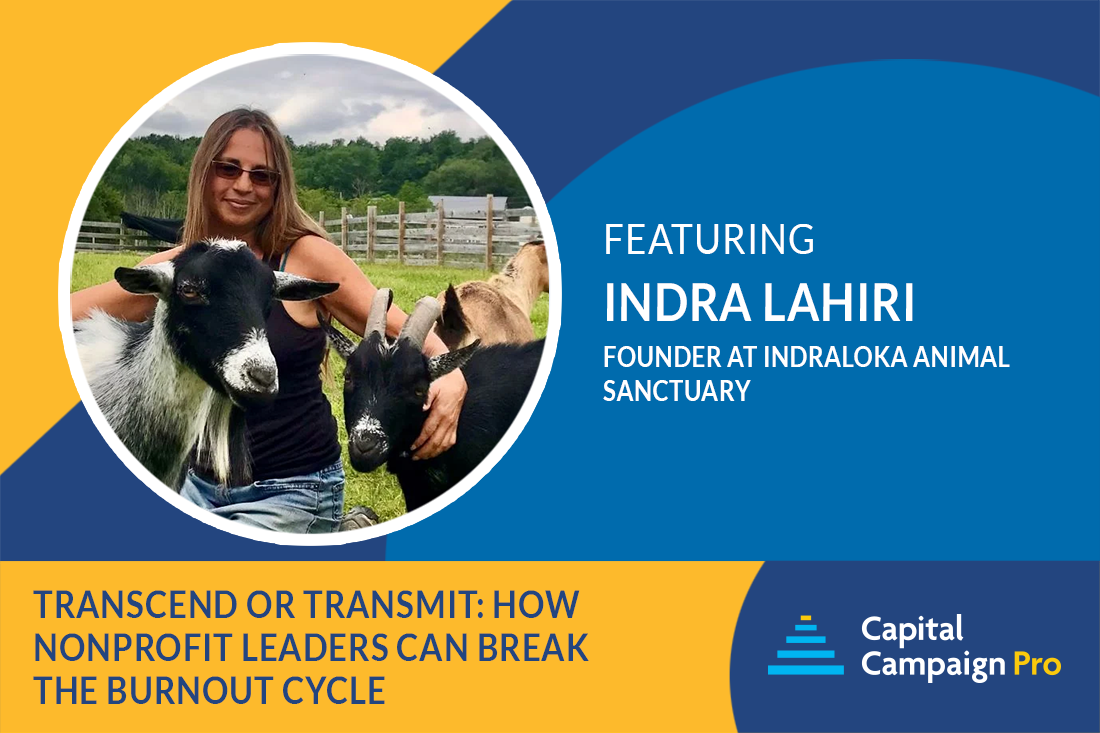
In this episode, Amy Eisenstein sat down with Indra Lahiri—an organizational psychologist, traumatic stress specialist, and founder of Indraloka Animal Sanctuary — to discuss what burnout really looks like and what you can do about it.
You cannot pour from an empty cup, and you cannot lead a capital campaign from a place of depletion. Taking care of yourself is not a luxury. It is the foundation that makes everything else possible.
Listen Now:
Amy Eisenstein:
Nonprofit leaders are facing stress and burnout at unprecedented rates. Hi, I’m Amy Eisenstein and Andrea’s taking a break today, but we have a very special guest. We’re going to be talking about stress and burnout because I think that is such a prevalent issue among nonprofit leaders today and you may be feeling that way too.
So today we’re going to be talking to Indra Lahiri, who is an organizational psychologist certified in traumatic stress studies and is the founder of Indraloca Animal Sanctuary. Indra has decades of experience working with Fortune 50 organizations, and helping professionals. Her work focuses on burnout, secondary traumatic stress, resilience, and post-traumatic growth. She draws from both Western and Eastern psychology and spiritual traditions, and Indra helps individuals and organizations reconnect with meaning, compassion, and sustainable wellbeing. She is the author of Journey to Wholeness: Transcending Trauma.
Indra, I’m so happy to have you here.
Indra Lahiri:
I’m so happy to be here. Thank you.
Amy Eisenstein:
Well, I just want to share that we met years ago now when we helped you with the little mini campaign for your animal sanctuary.
Indra Lahiri:
You sure did, and that was such a great class in such a tough time during the lockdown, where we were doing a capital campaign right during the lockdown. So I was so grateful for you and Andrea guiding us through that.
Amy Eisenstein:
And all the animals are moved now, you’re in your new home?
Indra Lahiri:
Oh, yeah. Everybody’s moved into their new place and we use those lessons that you and Andrea taught us all the time. So thank you for that.
Amy Eisenstein:
Amazing. I’m so happy to have you here and I’m so excited to hear about your success.
Breaking the Burnout and Stress Cycle
Today we’re going to talk about burnout and stress. So they really are prevalent in the nonprofit sector right now. So I’m curious from your perspective, what are leaders missing when they think about or try to fix burnout? And if you want to define burnout, maybe we should start there. Maybe we should back up even. What is burnout and why are we experiencing it? Why are we worried about it? Why are we talking about it?
Defining “Burnout” in the Nonprofit Sector
Indra Lahiri:
Yeah, it’s an important question. Burnout is when we start to become tired or cynical about our work. Often it’s due to hard times. In the nonprofit world, it can be hard times financially. It can be hard times because we’re seeing so many clients suffering, lots of reasons. So burnout is when we start to really get tired and it starts to impact our energy levels and our ability to do the work. Some people don’t always feel it as tired. Sometimes they start acting controlling.
So if you have a strong tendency when you’re under stress to go into one direction and it’s not a good direction, you’ll probably go there when you’re burning out.
Amy Eisenstein:
Oh, okay. Thank you for defining that for us.
Defining Traumatic Stress
Indra Lahiri:
Secondary traumatic stress is different from burnout because what happens with secondary traumatic stress is when we take on the trauma of the people that we are trying to help, and when that happens, it can actually impact our brain and the way that our brain functions just the same as if we experience trauma ourselves, and so that puts us into a situation where we are experiencing post-traumatic stress while we are trying to help the very clients whose traumas have caused us the PTSD, and so it’s a real challenge, but I think what’s important for us to remember, Amy, is that it’s not a question of if any of us will burn out or start having secondary traumatic stress.
The fact is when you are in a helping profession, you will experience these things. It’s not a shortcoming. It means that you’re human and you care. So what matters more when we are faced with trauma is what do we do about it? We’ve got two choices. We can either transcend it or we transmit it, and that’s when our organizations start to fall apart.
Amy Eisenstein:
Right. Okay, so I’m guessing we want to transcend it.
Indra Lahiri:
Yes.
Amy Eisenstein:
So how do we transcend it? Is fix the right word?
Indra Lahiri:
How about heal? Yeah.
How to Heal from Traumatic Stress
Amy Eisenstein:
Heal. Okay, how do we heal? How do we transcend?
Indra Lahiri:
We need to take time and we need to learn about our nervous system and our brain and what’s happening to us so that we can recognize that when it’s occurring, and then there are specific tools and techniques that you can use to help rewire your brain and regulate your nervous system so that your executive function, which is the part of the brain that gets hijacked when we experience trauma. It’s also the part of the brain that we need to do our work.
So by doing that rewiring of our brain, we heal and our executive function can take back over again, and then we can learn techniques to prevent it earlier on when we see it coming.
Amy Eisenstein:
Okay. So most of our listeners who are feeling trauma, stress, and burnout, can’t go learn about how the brain functions. So let’s talk about some simple techniques or steps that listeners can take right now without them doing a whole bunch of research or going off in search of other help. What are some simple things that busy, stressed out, overworked nonprofit leaders can employ to try and heal, as you said?
Indra Lahiri:
Two things:
- One is you need to give yourself some time to heal, and I mean time to heal. I mean taking time away from taking care of other people, whether it be an hour or a day, or whatever you can spare, you need to take some time and give yourself the space to heal.
- The other thing that is tremendously helpful is to learn some simple nervous system regulation tools, and those will vary from person to person for what feels good for them in the moment.
One thing that I love is deep breathing. So pranayama, yoga breathing, right? It can be very helpful. This has been used for thousands of years to help human beings regulate their nervous systems, and it’s a wonderful technique. Meditation can be very helpful as well. There are a lot of these tools. Exercise is helpful for some people. Dance can be great. Turn on some ridiculous music and just jump around your living room. I do it with my dogs every day. We have a ball.
Amy Eisenstein:
I love that. So first of all, I want to thank you for acknowledging that sometimes it’s just an hour, right?
Indra Lahiri:
Sometimes that’s all you’ve got.
Amy Eisenstein:
I didn’t know if you were going to say take a sabbatical. Most people do not have the luxury of taking a sabbatical, but an hour, a day and a week, and schedule those.
Indra Lahiri:
Absolutely, and if you are experiencing PTSD from secondary trauma, then an hour a day of meditating or dancing with your dogs is not going to, it’s not going to solve it. It’s a bigger problem that needs professional help, but if we are burning out, then those techniques can certainly help us, and those things help us to prevent burnout and secondary traumatic stress moving forward.
So one of the tools that is super helpful is to create a self-care itinerary where you think about all the different kind of energy levels that you might need. So you need to feel peaceful sometimes. You need to feel energized sometimes. You need to feel soothed sometimes. So we pull out all of those things and then we say what are the activities that make us feel this way? Because for everybody, that’s different, right?
So then we take those activities and we say now I’m going to create an itinerary so that every day I’m doing three of these things. In the morning, I’m doing something for myself. In the middle of the day, I’m doing something for myself, and in the evening I’m doing something for myself. You just give yourself an itinerary like you would for any other work project, right? Here are the things I’m going to do at this time on this day, and you do it.
And there may be a day where you were going to take a hike up a mountain and you decide instead you need to lay on the sofa and read a book, and that’s okay. Don’t lay on the sofa and read a book every day, right? So too much of any one thing is going to be bad for us, but if we mix it up and make sure we spend the time to take care of ourselves a little bit every day, that can do a lot to prevent these things from happening to us going forward.
Amy Eisenstein:
That’s great. I love the preventative nature of this, right? Before it’s too late.
An Important Mindset Shift: What You Can and Can’t Control
Indra Lahiri:
There’s one other thing that I’d like to point out, and it’s a little bit different than the kinds of activities that I was talking about, and it’s kind of a mind shift situation, and this is around our tendency to be attached to the outcome of our work.
So for example, I am a psychologist, right? So when I work with individuals or organizations, my goal is to lead them through a process that is healing and that in the end they’re feeling healthy, they’re feeling joyful, they’re feeling strong, but when I attach to that, I’m attaching to something that I can’t control. What I can control is how good a job I do in teaching them, in supporting them, in caring about them, in doing all of the things that I can do to make optimal circumstances for them to have that joy and that health that I want them to have.
So we need to be really careful not to attach ourself to outcomes that we can’t control because that is the primary thing that causes burnout.
Amy Eisenstein:
Yes. So interesting. I think we can dig into that. I’m going to segue a little bit and maybe we’ll circle back to that, but for nonprofit leaders who are listening who feel exhausted, but responsible for everyone else, what is one mindset shift or practice? And I mean I think we were starting to go there that can begin restoring resilience right now.
Indra Lahiri:
Have you ever invited someone over to your house and offered them a glass of water?
Amy Eisenstein:
Yeah.
Indra Lahiri:
Can you imagine doing that and then not having any water to give them? So we got to fill our cups, right? We got nothing to give if we don’t fill our cups, and I get it. I do the same thing. My tendency is I love my people and I protect my people and I want to make sure they’re okay.
Taking a Step Back
So I want to take on all the extra stuff and never take any time for myself so that we can meet the needs of our clients and the animals in our care, and the humans on the team and everybody else, and if I keep doing that, I have done that before. In the beginning when I started the sanctuary, that was exactly what I did, and what I ended up doing was getting so burned out on top of having secondary stress from some of the animal rescues that we went out and did, that were just absolutely horrifying things to see.
Those things ended up triggering my childhood trauma and I ended up being a terrible person to work for, quite honestly, just terrible. I was mean and I was not patient, and I was way too controlling because those are the areas that I go to when I’m stressed out. So I realized that I needed to take a step back and heal, and the way that I learned to do that was by watching the animals that come from these horrifying, unspeakable situations and yet still find a way to find joy again.
Amy Eisenstein:
I love that, and I think so many listeners are really going to see themselves or maybe a boss, probably a boss, but see this in themselves and really step back and say, wow, we did get into this sector to help people, to heal people, to do good in the world, and yet we’re so stressed and angry and controlling.
I think this is really going to resonate and it’s heartbreaking, but the reality, and so just by bringing these issues to the surface and calling them out, I think people can have that mindset shift like, “What do I need to do to lead my team and to even interact and engage with donors so that I’m coming from a happier, healthier, more loving place?”
Indra Lahiri:
That’s right.
The Choice of Transmit or Transcend
Amy Eisenstein:
So okay, let’s go back to this idea of having choices, right? We encounter trauma or stress. We have two choices. We can transmit it or transcend it.
Indra Lahiri:
Yeah.
Amy Eisenstein:
So say a little bit more about what that might look like in practice for leaders and organizations.
Indra Lahiri:
So when we experience a trauma or even have the secondary experience of a trauma, it impacts our brains. What happens is that it tells the ancient part of our brain, the amygdala, right, that we are in danger, and so it starts to react to that. The problem is that when we experience it in a serious way, like some of those things just hit you harder than others, right?
So when we experience it in a serious way, that amygdala doesn’t turn back off. So it is stuck in fight or flight mode, and it can’t turn off, and it’s taking over all the function from this part of our brain, the prefrontal cortex, which is where we do all our good thinking and talking and asking donors for money and explaining the project that we’re working on, and coordinating with the teams and the partners and all of that, right?
So we can’t do it in other words. We think we can because we’re in a state that is unhealthy, so we can’t see ourselves in those moments, but those are the things that are happening to us. So would you remind me the detail of the question?
Amy Eisenstein:
Yes.
Indra Lahiri:
I remember the first part.
Amy Eisenstein:
That’s okay. We were talking about two choices, right? We’re transcending it or transmitting it, which we don’t want to do. So let’s keep going with transcending it. Yes.
Choice #1: Transmit
Indra Lahiri:
Well yeah, so when the amygdala is hijacked like that, we are transmitting it. So we are acting out of fear or anger or other emotions that are the ones that we have when we think we’re in danger, right? So we want to transcend it instead. So in order to do that, we have to calm that amygdala down, and it’s not that easy to do. When you’ve experienced a serious trauma, it’s not that easy to do. That’s why I was saying before, the self-care.
So by having regular self-care, your nervous system gets used to a calmer state. So it’s easier to get back to something that you’re used to it, just like any other exercise that you do. If you pick up a barbell and you never picked one up before, it’s going to be really heavy, but if you do it every day, it’s going to get lighter and lighter, right? Our brains are the same way.
Choice #2: Transcend
So we want to not transmit and instead transcend, and in order to transcend, the first thing we have to do is calm our nervous system down so that we can take control of our minds back. Once we can take control of our minds back, we can start processing all of the things that we have experienced. So for example, we had a situation a couple of years ago with a cow that had been shot in the face and the farmer did not bring her to a veterinarian and the wound just kept getting worse and worse. By the time we were called in, it was really bad and she was in terrible pain and she was also terrified. So we had to go back there eight times to try to rescue her and all of that time she was suffering.
And none of us could sleep at night thinking about this cow with just half of her head was just infected and it was rotting. It was rotting while she was still alive. It was terrible. So we needed to calm ourselves down from that and then we needed to process it. So once we got ourselves calm and, okay, we’re feeling safe again, we needed to talk with each other and we needed to talk with people outside the team too about what we experienced, what happened, how it felt, what we went through.
That connection to other humans and that willingness to be vulnerable and talk about it is a huge part of how human beings heal because the brain gets calmer through connection. We are social beings as humans, and I say this as a deep introvert, but nonetheless, we are social beings and our minds and nervous systems need the connection. So that’s another important piece of it is the ability to talk through.
Give Yourself Time to Heal
The other thing that’s going to be so important is to give your body the time to heal. So we calm our nervous system down, but all of that panic is still living in our body and it’s going to come up. Do you ever get through a moment in life when you’re super stressed out and somebody comes in behind you and you jump?
Amy Eisenstein:
Yes, for sure, right?
Indra Lahiri:
So that’s letting you know your body is still living in a state that is a little panicky and time is going to be the answer to that and physical movement too, and that’s where I’m really very lucky because I have access to all these rescued farm animals and they are wonderful for helping us to really recover from that kind of thing because they’re very calm and their breathing’s very regulated. They’re also very attuned to our emotions because they’re prey animals, so they’re attuned to predators and we’re predators.
What that means is they can help us to recognize when something’s not right with us because they see it before we do. They can smell the pheromones that come up as we have different emotions. They can hear our heartbeat and the blood moving through our veins and how fast or slow those are going. So they’re really great to help us learn about ourselves and start to heal.
Amy Eisenstein:
Yeah, what came to mind for me is I think we all need therapy pets in our offices. No matter what kind of nonprofit you’re running right now, how can you bring animals that will calm you and soothe you into the workspace?
Indra Lahiri:
Usually people think about dogs and cats for that, and that is absolutely true that dogs and cats can be very helpful in that way, but because they’re predators and they’re not prey animals, they’re not quite as good at it as farm animals, and the reason for that, again, is that we are predators too, right?
And so those of us who are predators, dogs, cats, humans, others, we are not as sensitive. We’re not designed to be constantly looking for danger the way that they are. So that’s why they can hear so well and they can smell so well and they can sense things in us that other predators can’t.
Amy Eisenstein:
Interesting. Indra, so how can people determine whether they are sort of normal stressed, for lack of a better word, and when it’s time to seek professional help? Because we don’t want to be giving advice to people who need mental health professionals to step in, right?
Different Techniques for Different Times
So these are preventative measures for common stress and to prevent burnout, but I just want to differentiate and acknowledge that there is a time and place where deep breathing and petting, soothing animals, and dancing in your living room, which I am a big supporter of all of those things and exercise and walking around the block and all the things, and I think we do need real reminders to do that and make that a regular part of our day, but then there’s a point where it’s beyond that.
Indra Lahiri:
Yes, absolutely and you ask a really important question because when we’re in that state, it’s hard for us to see it. So if we’re starting to get feedback from people, if we’re finding we’re fighting with a lot of people. So-and-so, my colleague just did this and that, and that donor’s really irritating and this one canceled a meeting and you start to feel that way, that’s a little clue for you, or if you get up in the morning and you’re just tired, you don’t want to get to work. That’s a problem, right? Because those of us who are in this work, we didn’t go in it for the money, right?
So you went in it because you wanted to make a difference, and if you stop feeling that excitement about making the difference, it’s letting you know that something’s wrong, but the best and clearest way to do this, if you think that any of these things are happening and they might be issues for you, you can go online and find a professional quality of life test that you can take yourself. It’s a self-test, essentially.
We use a professional version of it, but there are self-tests freely available online, and that will tell you exactly what your level of burnout is, what your level of secondary trauma is, and what your level of compassion satisfaction is, and it shows you even the norms. So it’s been used just around the world. I mean with lots and lots, I mean hundreds of thousands of people. So they have norms that they can share with you and you can be:
“Oh, look, I’m right at the bottom of the norm for burnout, but I’m all the way above the top on secondary traumatic stress or whatever.”
So that’s going to tell you, if you see that you are in the middle range to beyond the range for secondary traumatic stress, I’m going to tell you, “Go get help right now.”
Amy Eisenstein:
Okay, so just to clarify, this is not asking ChatGPT or Claude.
Indra Lahiri:
No.
Amy Eisenstein:
No. So what’s an example or what’s it called again so that people know.
Indra Lahiri:
The Professional Quality of Life Survey. The ProQOL is the short name for it.
Amy Eisenstein:
Perfect.
Indra Lahiri:
Professional Quality of Life Survey and it is available freely online. It’s a wonderful scientifically validated tool that can help us understand what’s happening with ourselves or with our team members.
Amy Eisenstein:
I love that.
Final Thoughts
Indra, where can people find you and how can they visit your magical farm? Animal sanctuary I should say.
Indra Lahiri:
Thank you so much for asking. People can find us at our website and on social media. It’s Indraloka, I-N-D-R-A-L-O-K-A.org, and also we have lots of wonderful opportunities for healing if people are interested. We have something called the Resilient Professionals Mastery Series that is retreats and coaching combined to help people heal and recover and also learn the tools that they need to prevent burnout and trauma in the future, and that has been so successful. We’ve actually reduced burnout by 50% in our last cohort and secondary traumatic stress by more than 30%, which is almost unheard of.
So I would love for people to come and visit us and if they want to join, they absolutely can. It’s a wonderful opportunity to spend time with the animals and other professionals and really learn more good tools about how you can be the most effective version of yourself by taking care of yourself.
Amy Eisenstein:
What a wonderful way to close. Thank you so much for joining us, Indra. Really, this is such an important topic, especially in this moment in time that we’re living through. I think it’s more applicable than ever. So thank you for sharing your tools and your wisdom, and I can’t wait to visit the Animal Sanctuary.
Indra Lahiri:
Can’t wait for you to visit either. Thank you so much for having me on the podcast.
Amy Eisenstein:
Thank you so much, Indra.




Leave a Comment