
Podcast: The Natural Ebbs and Flows of a Capital Campaign (And How to Use Them to Your Advantage)

Season 5, Episode 44
What if the “slow” periods in your capital campaign are actually some of the most productive opportunities for building donor relationships and campaign success?
In this episode, Amy Eisenstein and Andrea Kihlstedt explore the natural ebbs and flows that every capital campaign experiences — and why nonprofit leaders should stop viewing slower periods as setbacks.
Whether you’re in the quiet phase of a campaign, preparing for a major fundraising push, or wondering how seasonal changes affect donor engagement, this conversation offers practical insights that can help you manage campaign momentum more effectively.
Listen Now:
Andrea Kihlstedt:
Ebbs and flows. Every capital campaign has ebbs and flows. Do you know which you’re in? Well, listen here and you might find out.
Amy Eisenstein:
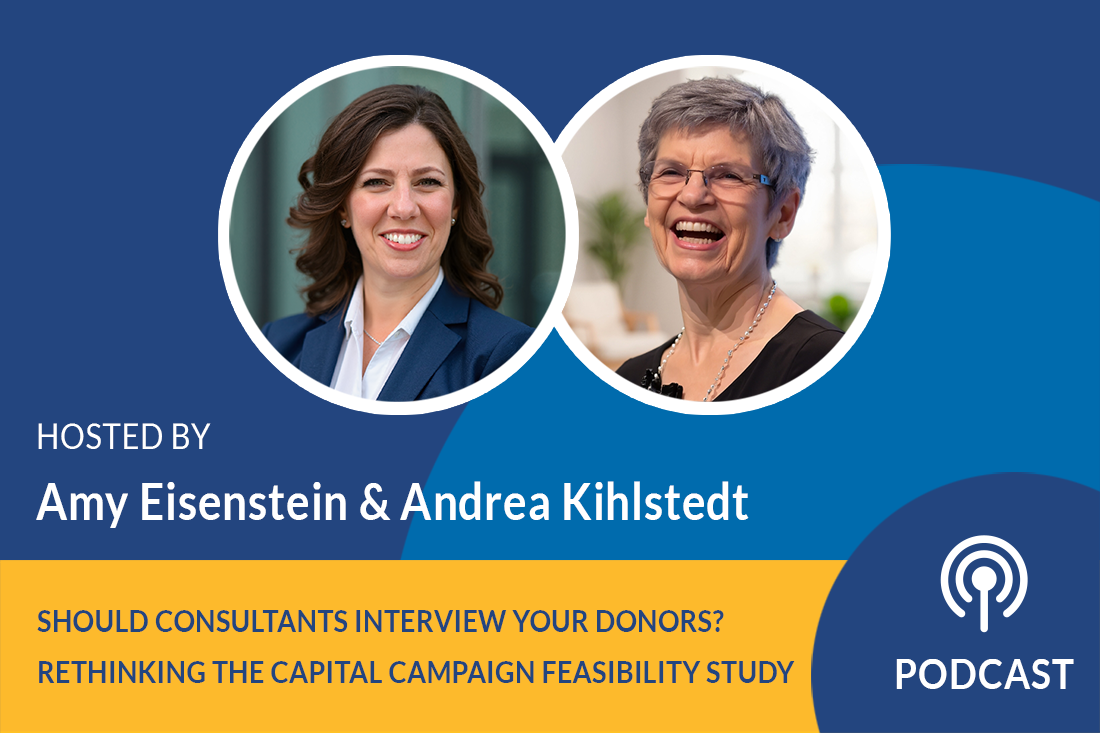
Hi, I’m Amy Eisenstein. I’m here with my colleague and co-founder, Andrea Kihlstedt. And today we’re going to talk about the ebbs and flows of your campaign.
The Ebbs and Flows of a Capital Campaign
Every campaign goes through periods of lots of activity and slower periods. And You know, it sometimes catches nonprofit leaders off guard. I think especially the slow periods. And, you know, we’re going to talk about how to make the most of them and why they happen and why it’s not a problem. It’s just part of the natural cycle of campaigns.
Campaigns are long. And so having high levels of intensity for long durations is Doesn’t necessarily work. Okay, I’m rambling. Andrea.
Andrea Kihlstedt:
Yes. So, Amy, you know, there are many ways to think about this. There are seasonal ebbs and flows, right? Summer, winter, fall, spring. And every organization has a natural pattern, a natural rhythm, right? Depending on when you do your annual appeal, depending on when you do your gala appeal. depending on where you are in your campaign, whether you’re in the beginning or in this quiet phase of the campaign.
So there’s sort of a natural rhythm from your organization, from your development program. There’s also a natural seasonal rhythm, and it varies, but, you know, We happen to be recording this at the very Memorial Day is about to happen. And Amy and I were thinking about, well, what happens in the summer?
Is the summer a productive time for your campaign?
Amy Eisenstein:
Or is it not?
Andrea Kihlstedt:
Or a slow time. And is a slow time a good time for your campaign?
So it’s an interesting topic because you tend to think about a campaign as being go, go, go, go, go. The reality is that a campaign is you really push hard for certain periods of time, aiming for deadlines. But then in a natural campaign cycle, there are long periods. This quiet phase tends to be a long kind of plodding period where your work is largely with individuals. And you can coordinate that around the seasonal flow as it relates to your organization and to where you are in the country, for example.
Coordinating Around a Seasonal Campaign Flow Makes Sense
Amy Eisenstein:
Yeah, let me pick up on that. You know, we started, you’re right, with this idea that summer feels slow or your staff or your donors might be away, out of town, on vacation. But we then, as we were talking to prepare for this episode, really thought about how powerful a time the summer might be. And of course, it also depends on your organization. If you are in a location where donors flock to during the summer, there’s a great opportunity there if you are in a location where maybe donors fly away from you know, that’s something else to consider.
Or if you are a summer camp raising money, everything’s happening. So, you know, a lot depends on your organization, but also seasonality.
But I think we started with the idea, don’t make the assumption, we sort of started with the idea that summer might be slow. It may not. And that can be a good or, you know, a productive time or a less productive time, and both are okay, as long as you’re thinking about it strategically.
Andrea Kihlstedt:
You know, Amy, for many, many years, come September, I always have this hankering to go to an office supply place to buy notebooks and pencils or whatever, right?
Amy Eisenstein:
Schools starting, schools in session. Right, schools starting, right.
Andrea Kihlstedt:
I think for many people, whether you’re actually in school or not in school, whether you have children or don’t have children, there is something about fall coming that is woven into you that makes you want to get organized, that makes you want to get going, that makes you, right? And the time before that, July and August, when many people are on vacation, is this time when people feel more relaxed.
And when because they feel more relaxed, it may be the perfect opportunity for you to be scheduling individual meetings with people. Maybe to ask them for money, maybe just to get better acquainted with them, maybe just to cultivate and deepen the relationship. So maybe you’re inviting them to something. It may be that your organization has something special during the summer.
Maybe you run a little concert series or a festival of some sort. And you can use that not necessarily as a chance where you’re going to have a big event, but where every week you try to get together with one or two of the people involved. who are going to be significant donors to your campaign. And you can do it in a way that is in keeping with the more relaxed summer season. Right.
Amy Eisenstein:
Because while you or your staff may be away for two or three or four weeks over the summer, you’re there for many weeks over the summer as well. And probably as this the same for your donors is that their work is a little more relaxed. People are out of the office. You know, they’ve got some things going on for some parts of the summer, but they may have some slower weeks, days, weeks, months as well. You know, and your example of this summer series reminded me, Andrea, you know, we worked with a small performing arts center recently.
And, you know, they sort of were worried that summer was a real downtime and all their donors were away.
But they had this… Friday nights, you know, come to the performance kind of thing. And one of their big potential donors RSVP’d. They were sort of surprised to see it. And they used it as an opportunity to say, let’s get together the following week and discuss what’s going on. And it was sort of a surprise aha moment for them, but a real good example of these things that happen all the time. All right.
Wisdom from Jerry Panas: The Power of Tomorrow
You also have a wonderful story that you tell. I think you learned something from Jerry Panas years and years ago about scheduling with people. Regale us with your wisdom.
Andrea Kihlstedt:
Yes. Yes. So, you know, every once in a while you go to a seminar or some kind of event. the learning opportunity, and something sticks in your brain from it, right? Many times we go to these things and three years later, you have no idea what you learned, right? You’re just gone.
Amy Eisenstein:
Or the next week, you have no idea what you learned. Or the next week, you don’t remember, right?
Andrea Kihlstedt:
But this is one thing that I went to something that Jerry Panis did, and he said something that after many years stuck in my, still sticks in my brain, and it’s this.
There are two great times to schedule meetings with donors or with anyone, actually. One is tomorrow. And the other is six or eight weeks from now. Now, why is that? That’s really funny, right? So why tomorrow? Because everybody knows what their calendar is tomorrow. Right? Do you know what you’re doing tomorrow?
Amy Eisenstein:
Absolutely. Yes.
Andrea Kihlstedt:
Do you have a two-hour window over lunch? If somebody invited you for lunch tomorrow and you weren’t busy, you could say yes. Yes. Because you know. If you asked in two weeks, it’s going to be, I don’t really know what I’m doing and maybe other things are settling or not settling. If you ask in six or eight weeks, chances are your calendar’s pretty free.
- So if you ask tomorrow, they may say, no, I can’t do it tomorrow. That’s OK. Right. Then you’re on the scheduling mode anyway.
- And if you ask in eight weeks, they say, well, let me get out my calendar. And then you’re first on the calendar for the Tuesday eight weeks hence.
I thought, what a smart idea. And it was one I had never thought of before. But as you think about getting in touch with your donors now, particularly in the more relaxed times of year, the holiday times, the summer times, when people are sort of in more flow mode, right? You should use the, let me invite people tomorrow to have a cup of coffee.
Amy Eisenstein:
Yeah, what is the chance that you have time tomorrow, right? And then… You know, I bet a lot of times people say, you know what? In fact, something just canceled. Something got moved. I do have time tomorrow. But if you ask me for next week or the week after, I’m going to say, oh, the calendar looks really full. I don’t know. And, you know, that’s funny, Andrea, because I often say to people, don’t schedule with me for the next two weeks. Schedule with me for a month from now.
Right. And, you know, it’s I hadn’t really thought about it that way before. Right. But I often tell people, please don’t schedule anything for the next two weeks. After two weeks, I’ll be better. Of course, then the calendar fills up. But at least it’s then it’s on the calendar.
Andrea Kihlstedt:
Right, right. But if I say to you, hey, Amy, how about tomorrow? Let’s see if we can have lunch tomorrow. Then if something’s opened up, you’re going to say, oh, yeah, let’s do that. Right.
Amy Eisenstein:
Or anytime tomorrow, right? I mean, you know, coffee. Do you have 30 minutes tomorrow? I’d love to, you know, then whenever it is tomorrow, it works.
Andrea Kihlstedt:
You know, the other thing I love about that is that it has a nice informality to it.
It has an ease to it, right? It has a friendly nature, which scheduling something in a more formal way in eight weeks doesn’t.
So that’s not to say that every time you try to schedule tomorrow, you’re going to be successful, but you should never hesitate to try. And if you can’t do that, then you can do it later.
Amy Eisenstein:
If they say no. And then you can say, you know what? I was thinking about you and I’ve been meaning to get you on the calendar. Is there any chance you’ve got time tomorrow? I somehow have all afternoon free, right? And then if that doesn’t work, okay, let’s see if we can get something on the calendar. You know, does next month work for you? You know, what days of the week, what times of the day is better for you? Because I’m wide open.
How Capital Campaign Ebbs and Flows Have a Natural Cycle
Andrea Kihlstedt:
Let me switch back to the bigger topic, which is one of kind of ebbing and flowing.
Amy Eisenstein:
Yeah.
Andrea Kihlstedt:
Because I think it’s important for people who are in campaigns to realize that naturally – campaigns have ebb and flow periods. The campaigns have a lot of stress, right? A lot of stress. The risks are high. The numbers are high. The stakes are high. A lot of things are going on. The planning of the project, you’re talking to your largest donors. No one can manage that level of stress consistently for the three or four years it takes to do a campaign. So it’s wise to let yourself have some periods where you’re not going to be so driven, where you’re going to be a little easier.
And you should look at what the calendar is for your organization and say, okay, when are we going to ease up a little?
When are we going to have a little more fun? When are we going to to be a little less pressured in our campaign, understanding that in a month or two, it’s going to be September or January or whatever it is that you know you’re going to be getting going again. And just because you know you have to raise all this money doesn’t mean that you need to be driving the whole time. It will burn you out.
Amy Eisenstein:
Right. So if you’re… going to say, OK, in August, we’re not going to have a campaign committee meeting where, you know, maybe do some behind the scenes thing, but we’re not going to schedule meetings. And then in or July and then in August, we’re going to try and schedule for meetings. We’re going to take the approach of, you know, are you available tomorrow or is September better? Right.
Yeah. I love that.
Andrea Kihlstedt:
I love that. I just want people to breathe a little, to take that moment to breathe. Breathing is healthy.
Amy Eisenstein:
Right. And, you know, then you can do some thinking. It’s always important to have thinking time. And, you know, I think it’s good that you also said something about the holiday season because people feel like there’s nothing happens during the holiday season. It’s the summer, you know, people are, okay, we don’t want people taking the whole summer off or not doing anything in November or December.
So the question is what could be meaningful and productive and trying to schedule some of these impromptu meetings and just having a relaxed conversation is a lovely way to spend some of that downtime. Maybe December is not downtime. It’s end of year fundraising.
But, you know, a little bit more relaxed about the campaign and, you know, trying to figure out who are the three people that we might meet with and might work out for their schedules. You never know.
Andrea Kihlstedt:
Yeah. You know, it’s funny. You and I, Amy, are both driven, right? I mean, you really are a driver now. I’m at a stage in my life when I am less driven, but I have gone, you know, in my prime, I was driven. I was driven to make things happen.
So it’s interesting for us to have a conversation encouraging people to relax even when they’re in a campaign and to appreciate the natural ebbs and flows of their organization, of the seasons, and of their campaign.
Amy Eisenstein:
Now, it doesn’t mean taking three months off and ignoring the campaign. That’s not what we’re suggesting. No, Amy, I don’t think anybody thought we were suggesting that. See, it makes you anxious even to think about that. It does. It makes me anxious. I do. I do think that people can fall out of the habit of campaigning into the stress of everyday nonprofit life. And so I think there’s an important distinction to make.
Andrea Kihlstedt:
You know, Amy, that’s one of the great reasons that people should work with us. Because then they have an advisor, right, who not only encourages them during the kind of more gentle periods of a campaign, but then makes sure that they’re on track when they need to be on track, right? That it’s not all on them, that they have someone to work with who can help manage these ebbs and flows, who know, they know when it’s important to be gearing up. And they know when it’s important to be taking a little breathing time.
So when you have someone on the outside who really understands capital campaigning, like our advisors do, they give you the confidence and the ease that you’re not going to fall off a cliff if you take a moment to breathe.
Amy Eisenstein:
Great. I love that. Thank you. I did. Did you see my anxiety rising? I did. It made me laugh.
Final Thoughts
Excellent. All right. Well… This was great. I think that, you know, people really need to hear, you know, what happens in the summer. I love your story of can we get together tomorrow.
And if you’re taking two or three weeks vacation, that is fine, too. We encourage it. Don’t worry about it. Don’t make assumptions that your donors aren’t available during busy or sort of traditionally off times. I think that those, to me, are my two takeaways. Right. That’s great.
Andrea Kihlstedt:
Amy? You and I are heading into Memorial Day, the Memorial Day weekend, and we are going to have a little retreat, the two of us.
Amy Eisenstein:
Yes.
Andrea Kihlstedt:
We’re going to Maine to have a business retreat.
Amy Eisenstein:
We always use the summer for some good thinking and planning time, so I hope you do too. All right. Thanks so much for listening to us.


Leave a Comment