
Podcast: How a Capital Campaign can Turbo-Charge a Modest Fundraising Operation
Season 5, Episode 43
What does it actually take to launch a $40 million campaign when your organization has almost no fundraising history?
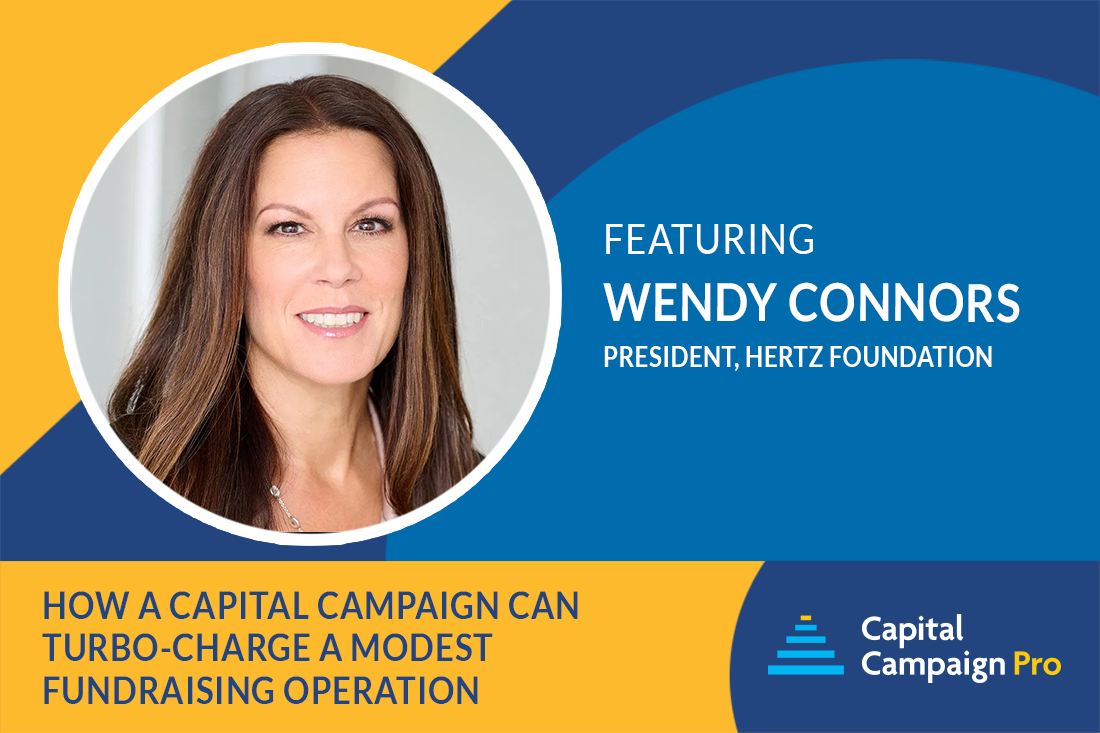
In this episode, Andrea Kihlstedt sits down with Wendy Connors, President of the Hertz Foundation, for a candid, behind-the-scenes look at one of the most remarkable campaign transformations in recent memory. The Hertz Foundation supports science and engineering PhD students — but for most of its history, it barely fundraised at all. When Wendy joined to lead development, the board didn’t even know the difference between an annual gift and a campaign gift.
This is a must-listen for any nonprofit leader who wonders whether their organization has what it takes — and wants to hear from someone who found out firsthand.
Listen Now:
Andrea Kihlstedt:
You want to hear about a successful campaign? Well, you’ve come to the right place.
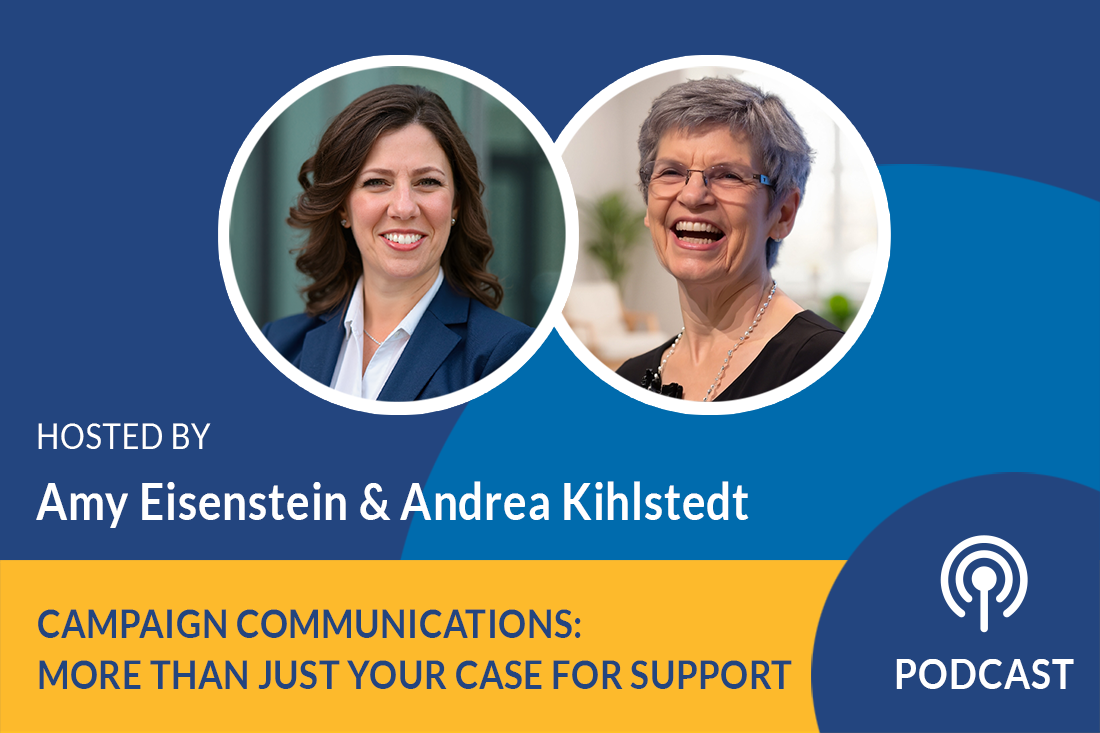
I’m Andrea Kihlstedt. I’m the co-founder of Capital Campaign Pro, and I am here today with the wonderful Wendy Connors, who is now the CEO of the Hertz Foundation, based in Boston. You’re in Boston, Wendy. I am in Boston. Yes, well, welcome, Wendy.
Wendy Connors:
Thank you so much for being with us today. It’s a delight. Thank you for having me.
The Hertz Foundation’s Capital Campaign Challenge
Andrea Kihlstedt:
So, Wendy, you’re with the Hertz Foundation. Foundations are not our normal sort of, you know, bread and butter. Why don’t you tell us a little about the Hertz Foundation?
Wendy Connors:
Sure thing. I would be happy to. So the Hertz Foundation is a public charity, and we became a public charity in 2010. And so we have been… We’ve been fundraising only for 16 years. And so we actually had never had a campaign before, but we launched our first campaign a few years ago, which I’ll get into, of course. But we exist to support science and engineer PhDs and support them throughout their career. And our founder, John and Fannie Hertz, they saw a need in the United States to develop scientific talent and were very concerned about competition internationally, particularly with Russia in the late 1950s, and wanted to see our engineer and physics enterprise get stronger, specifically by investing in young, promising scientists.
Andrea Kihlstedt:
So Wendy, so what happens? So scientists who are still in school or just getting out of school will apply to be one of your fellows? Is that the way it works?
Wendy Connors:
That’s correct. If they are looking for, they want to participate in a PhD program, they apply to us and then we fund them for all five years of their PhD fully. And then we also support them throughout their career through mentorship and career development opportunities and a fantastic community that we’ve developed over time. Wow.
Andrea Kihlstedt:
Do you fund their scientific projects as well?
Wendy Connors:
We don’t. We actually give them the freedom to use that support as they see fit so they can follow their research questions wherever that might take them.
Andrea Kihlstedt:
Great. And how many, are they fellows? Is that what you call them? Yes. Once a fellow, always a fellow.
Wendy Connors:
Once a fellow. How many fellows do you have? We have 1,300 fully funded, and we have just over 80 that are currently being funded and in PhD programs. Right. So I have to ask you this.
Andrea Kihlstedt:
So a fellow has an implication that they’re all men. They used to have that implication. I assume that’s not true now. That is not true.
Wendy Connors:
In fact, I believe that our first female fellow was funded in the mid-60s. So I think we’re ahead of the curve in a way of being more equitable and more diverse. And so, yes, we have many amazing women leading organizations in national security, climate science, in biosecurity. We fund all of the promising scientists regardless.
And actually, that was a very important part of our funder’s mandate was that we would, regardless of gender, of religion, funding was for the most exceptional scientists. Right. That’s fantastic. And tell me what inspired a campaign?
So… That’s a great question. In fact, it’s why I was brought on board was to really assess whether we needed what we could possibly expect from this community in terms of a fundraising drive.
And I think that because we hadn’t developed much of a development or operation before really 2015, 2016, there was a recognition that we needed to build out our support for in terms of endowment support, in terms of fundraising for fellowships and community, rather than sort of more hand-to-mouth, which it had been prior to the launch of the campaign.
The Lack of a Fundraising Program
Andrea Kihlstedt:
The foundation was not particularly active in fundraising because it had these generous donors that set it up. Is that right?
Wendy Connors:
That’s right. We did have the family money that was bequeathed to us. And we also only started to really ask for money starting in 2010. And even still, we hadn’t really invested in the kind of fundraising that nonprofit organizations benefit from, in great part because we had that endowed support, but we also hadn’t We just hadn’t asked the community to do that before. So as you well know, Andrea, that that takes time to build that culture of philanthropy. And it really didn’t exist in a meaningful way.
We had a few very generous donors that were fellows early on. But besides that, we didn’t have a broader base of support, which was entirely necessary.
Andrea Kihlstedt:
Right. So you were brought in to figure out, well, can we really do a significant campaign?
Wendy Connors:
That’s right.
The Need for Systematized Development
Andrea Kihlstedt:
And what was that like? How did you go about that?
Wendy Connors:
It was a wonderful introduction to this community because with the support of Capital Campaign Pro, I was able to develop this campaign study and being new to the organization, I was able to invite conversation around what’s meaningful to individuals who’ve been supportive or could be supportive in the future. And so I learned so much about our capacity as an organization was quite significant.
The commitment of our fellows was evident right from the start. And the stories of impact were remarkable and such an easy story to tell. And so we had all of the pieces that make for a successful campaign. We just didn’t have, we hadn’t really launched an effort to ask in a meaningful and concerted way.
In that campaign, I learned that a $40 million campaign would be a stretch for the community. But nonetheless, this is not a group of people that hide from challenges. And the board ultimately agreed that that was an ambitious but appropriate goal. And part of what led the board to agree to that, because I think there was real concern at first whether we could achieve that, and they certainly didn’t want to put a number out there and not achieve it, was the campaign study that was so well supported by your organization.
And I think that we were able to These are scientists that we’re working with. We were able to demonstrate a truly data-centered analysis on where the philanthropy could come from. As you know, it never comes out exactly how you think it does, but certainly the capacity was there and the effort and the desire was what we had in spades.
So we just needed to systematize our development efforts.
Andrea Kihlstedt:
A $40 million campaign is no small thing. task for an organization that had not spent decades actually raising $2 million, $3 million a year. This was a big shift. It’s a big campaign, right? And you didn’t have a ton of donors who were used to giving you large gifts, right? So not only were you undertaking a big campaign, but you were doing it in the middle of having to shift the culture of an organization.
Wendy Connors:
I think that’s maybe my favorite part of capital campaigns. It’s the culture. It’s generating that philanthropic culture that lasts and sustains an organization well beyond the timeframe of a fundraising effort. And that certainly happened for us.
We developed a strong message. We’re able to identify what’s distinctive about us as an organization, what’s valuable to our fellows and beyond our fellows. Also, we needed to generate support from partners and friends as well. And, you know, we were building on a strategic plan that we launched. So we had some ideas and some four pillars of clear parameters and interests and guideposts of where we wanted to go as an organization.
So being able to translate that strategic plan into action and into fundraisable goals was, you know, it was a classic mechanism, but nonetheless, very successful.
A Major Role Shift During the Capital Campaign
Andrea Kihlstedt:
Yeah. So it’s somewhere in the middle of this campaign. I don’t know. We’ve been working with you for six years, maybe five, six years. Four years, but yes. Right. A while. And when we started with you, you were chief advancement officer and had been brought in to do that work. And now you’re the CEO, right? Chief executive officer. So that’s a jump. It wasn’t, for me, an unexpected hop. How exciting was that? And how did that happen? And what changed?
Wendy Connors:
So my predecessor, Robbie Baker-Kosak, she started to think about retiring. And she and I worked very closely with one another. And I also worked closely with the board. And I think that there was a sense on the board that this is a this is an opportunity for us to have continuity where we were really in it.
We have been in a period of momentum and growth and we didn’t, I think that the board probably didn’t want to risk losing that, that, that continued growth. We had a, we have such a strong team in place and I was able, I was, I was proven and tested in the way that I was able to, help shape our fundraising operation into being a successful and sustainable revenue generating mechanism.
So the board approached me and we had lots of conversations about what that could look like. And I was honored and privileged to take it on and delighted to continue to work with a great team that Robbie had built and also bring a few other people on to follow up through on our priorities.
Andrea Kihlstedt:
So when you made that shift, did that radically change your role in the campaign? Did you bring someone else in to be the chief advancement officer? How did that, what was that like for the campaign?
Wendy Connors:
Yeah, so I think that, as you know, the head of the organization continues to fundraise, but having someone with the expertise to be able to lead the development team is really important. I was fortunate to have hired a giving officer mid-term. transition without actually knowing that I was going to become the president. And so she was sort of Katie Meyer. She was terrific as a team member, but I also had a sense that she would be a fantastic leader of the development team. And so we were able to make another seamless transition and bring her on board. So all of the stars aligned, Andrea.
Transforming a Nonprofit Board to be Campaign-Focused
Andrea Kihlstedt:
It was great. Yeah, it’s fantastic. Right. You know, we often hear stories about stars that don’t align. So it’s not so uncommon that, you know, that an executive director will depart for one reason or another and that it’ll be a fairly bumpy transition. So it’s wonderful to hear when, you know, things just move forward and move up and it’s a tribute to you and your predecessor in this role that the organization was put together so well and that you could manage this big transition together. Well and effectively.
Good for you. I believe that through this campaign, your board has really begun to think of themselves differently with regard to giving and fundraising. How did you do that? That’s no small trick.
Wendy Connors:
You know, I have been so… struck by our volunteer engagement, our leadership volunteer engagement. We had two co-chairs of the development committee who have continued to be instrumental throughout, and they brought expertise and knowledge, but they needed more tentacles to be able to reach the community. And so at pivotal moments, they made investments in the campaign, but also made very articulate, cogent remarks to the board and helped me recruit new board members as well as new volunteers to the fold. And so one of the things that Katie Myers then did was bring about a campaign advisory group.
So we extended our development committee even further by having having non-board members engage in the campaign, particularly in the public phase. And so in essence, we’ve tripled our volunteer force in development alone. I’m not kidding when I tell you that this is completely motivated by the volunteers themselves. We’ve provided the opportunity. They have stepped in. People who said, I don’t want to fundraise are now asking for money. And so what is that secret sauce? I honestly think it’s really believing in a mission and truly caring about it taking precedent in people’s philanthropic priorities.
Andrea Kihlstedt:
You know, I’ve often sort of wondered, wondered in the sense of wonder, right? Not question, but actually I have been amazed by what it looks like at the end of a campaign when you match up or you compare the gift range chart with the donors, right? With how many people have given and how many of those people I mean, not the donors, but the volunteers, right? How many of the people who actually give were volunteered in some way? And it’s always high. The proportion is always very high.
People who volunteer also give. right? And many people who give decide that they’re going to help in some way or other. And it’s almost like magic. You know, you talk about, one talks about volunteers in a campaign almost as an aside, but the reality is that it’s a part of the secret sauce of successful campaigns. It is.
Wendy Connors:
And this is no different. I’ve had a lot of experience with campaigns. I would say this one was the most pronounced in terms of a philanthropic shift among volunteers. This was not an organization or community that talked about money. In fact, one of my first board meetings, there was real questions about what an annual gift was versus a campaign gift. Like, can’t I just give my annual one gift like I normally do? And why would I need to do a special gift? And seeing those donors go from annual support to major gifts, multi-year gift support is remarkable.
But you’re right. It’s because they’re also investing their time and their great thinking on how to make this successful.
Andrea Kihlstedt:
You’re nearing the end of your campaign. I don’t think you’ve quite gotten there yet. Is that true? You’re not.
Wendy Connors:
That is right. We are in that phase. where you can see that we’re gonna get there, but we still need everyone’s support. And it’s a really wonderful time to be there and keep the community motivated, engaged, and challenged. And we have learned that this company, this organization really loves challenges.
So our recent participatory drives, we had a giving week last month that was resoundingly successful. Our Giving Tuesday effort in the fall, which we’ve never done. done either, just yielded really promising results in terms of participation for the future, but also for the campaign.
So I expect that we will close by the end of this calendar year, as we’ve hoped, and we will hit our targets. But more importantly, I really feel like we’ve built something sustainable that will take us beyond the campaign.
Stand-Out Moments from the Capital Campaign
Andrea Kihlstedt:
Yeah. As you look back over these last few years of the campaign, are there a couple of stories that stand out to you, a couple of really key moments?
Wendy Connors:
There are moments in every campaign, as you well know, that you start to feel like, oh, gosh, did we overestimate what we can do here? Yeah. And I felt that way about over a year ago. And our two development co-chairs, right before our board meeting, we were making the decision whether to go public or not. And our two development co-chairs made major gifts in a way that took us over what the board had agreed would be the mark of, if we hit this mark, we will go public.
And going public meant that we were going to be able to announce it to our community, but at our major signature annual event in the summer. If we had missed that, I think we would have missed an opportunity, a really important opportunity to engage our bigger community.
I think that, and our development co-chairs knew that, and they expressed confidence. It was really important. They were expressing confidence in the team. They were expressing confidence in me as a new leader of the organization. And it was an important moment. confidence builder for the whole board. Now we’re going to do this. We’re actually going to go public. It was really one of those moments where I just mentioned it to them a few weeks ago. That may have been one of the most pivotal moments.
Do I think we still would have gotten there? I do. We have the pipeline. But sometimes psychology is so critical in getting to the goal.
Andrea Kihlstedt:
Yeah. I’m interested in knowing how that happened. Did they talk to one another about beforehand? Was it a plan that they made to do that? Did they talk to you individually? Did they wait and announce what they were going to do at a board meeting? What was the process by which this came about?
Wendy Connors:
I think they both themselves individually recognized that they wanted to do something. And they also recognized the moment. They shared it with Katie Meyers and myself beforehand, but they announced it. There was a sort of a drum roll moment. And we were able to say, hey, we’re here. We’ve reached the mark to go forward publicly. And it’s just a wonderful way to leverage your leadership, you know, and also motivate others. It was very inspiring. Yeah, it actually gives me the chills. It was a moment. It was definitely a moment.
Andrea Kihlstedt:
It was a chill-inducing moment where everybody, you know, and it’s very hard for people then to sit back on their hands when they have people who are part of their group stepping forward, right? I’ve been thinking a lot, partly because of our political situation, but about this phrase, courage is contagious. Yes, yes.
Wendy Connors:
It’s true.
Andrea Kihlstedt:
It certainly is the case in fundraising that when people start, stand up and step forward and do something extraordinary other people follow. It’s amazing, really.
Wendy Connors:
Well, you had mentioned the gift table, and that’s part of that, right, is you’re setting sights. And at first, when you first show that gift table, people are like, we’re never going to be able to get that Bob gift. And then you do, and you’re like, okay, well, maybe we can do this. If I have time for one other just quick story, this is not a community that was accustomed to pledging. And they also like to be anonymous. And so those two things are challenges for a campaign.
As we know, you know, good pledges are very important in helping people see a path to getting to a major gift. And anonymity doesn’t unlock the, you know, the kind of, oh, wait, she did that. I can do that. So in order to kind of break through that, We just focused on the mission, honestly. We really needed to tell a story succinctly.
We had a fantastic partner in helping us develop the campaign messages and our video and our photography. And we also did a brand launch last year at the same time, which made all of that really possible. But it unlocked other support partners. that we can champion and highlight. And even the people who don’t pledge as much, I saw them just grow their annual support considerably as a result of the whole campaign operation. So I think that there are other ways to get you know, to get to that goal.
And you have to just be a little nimble in the moment and say, okay, you know, how do I work with my community? My community is different. Everyone feels that way. That was, those were two challenges that we overcame in different ways.
Andrea Kihlstedt:
Yeah. I mean, the anonymity challenge is really significant, right? It just, because it doesn’t give you the chance of saying so-and-so is, you know, here now, you know, with an abhorrent Obviously, your key donors are not anonymous, the key people. But beyond that, they don’t want to stand up. So it’s interesting. There are a fair number of academic community, academic-related organizations where donors want to hide, have experienced that before. I worked in one community where the joke was that the wealthier the person, the older the Volvo was.
Wendy Connors:
Right. It’s true. In Boston, that is a well-known fact.
Andrea Kihlstedt:
People don’t get fancy in some communities. In some communities, they do. That’s a cultural thing as well.
Engaging the Scientific Community Throughout the Campaign
One of the interesting things you’ve done, I think, in your process is to engage the scientific community in your campaign. And they probably aren’t used to giving or thinking that way either. How have you gone about doing that?
Wendy Connors:
I’ve actually been thinking about that a little bit lately. You know, I think that never let a challenge go to waste. You know, the stability in the science funding ecosystem really underscored how important it is to have stable, consistent support. And so, especially starting last year when we saw reductions at NIH and NSF, the Hertz Foundation is privately funded. We are not necessarily dependent on those organizations, but we are part of a scientific ecosystem. And so there was a lot of… collaborating and idea sharing that went on, but also there was just this undercurrent of outside support saying, you guys have been doing this a long time.
You seem to know what you’re doing. We want to engage with you, whether it’s philanthropically or through partnerships. And so you know, the board along with Robbie Kosak, my predecessor, engaged in the strategic plan. One of the pillars was to develop partnerships. And so simultaneously, you know, so we were building that arm of our partnerships and getting new organizations like Breakthrough Energy and ADI building on our partnership with the Gates Foundation that had preceded our more concerted effort. And all of these things collided in a place of helping us engage the scientific conversation more deliberately and gain partners.
Right. Which, of course, supported the campaign also. Which is support. Exactly. I think that’s fantastic. It’s a nice story.
Andrea Kihlstedt:
Yeah, it’s a great story.
Wendy Connors:
It is an under-discussed thing about the scientific community engaging in philanthropy. When I was at MIT, helping to translate people’s passions for an organization into their philanthropic commitments was just an upward battle a little bit. You have to find out what people care about and then translate that.
Andrea Kihlstedt:
Well, I’m so excited by what you’ve been able to do. I really am. You know, you’ve done a remarkable job. You’ve done a remarkable job moving up into being the leader of this organization, into building a big group of volunteers to support the campaign, in changing the culture of your board. One of the reasons I know you’ve done that, by the way, is that at Capital Campaign Pro, we have a regular… process of checking in with clients, right, of checking in and seeing how people are feeling, right, to make sure everybody’s happy.
And our Chief Happiness Officer, Sarah, talked to somebody on your team not so long ago, and he was just glowing in terms of seeing the transition, how you’ve been able to transition your organization from being a relatively lackluster fundraising. I don’t know that he would say it that way, but you know, not a very assertive fundraising program to really being very effective. He was just singing your praises about that. So it’s always fun to hear things like that.
Wendy Connors:
As you know, it takes time. It takes time and focus and that sometimes you have other things that you need to do.
Andrea Kihlstedt:
Yeah, I mean, it takes time and focus sometimes. It’s not easy to keep focusing on that because culture changes, doesn’t change overnight, right? You have to keep gradually working on it. And it’s not that all of a sudden everybody wakes up excited about fundraising. It’s a slow shift. And then you realize people are really thinking about how they deal with this organization from a philanthropic point of view. So it takes real careful thinking. steady attention. It’s like planned giving.
Wendy Connors:
It just takes steady, careful, careful attention.
Wendy’s Tips for Your Capital Campaign
Andrea Kihlstedt:
Wendy, if you were to think about the people who are listening to this call and from what you’ve learned over these past few years over this campaign and your other campaign experience, are there a couple of things you would say, be sure to do this or be sure to do that?
Wendy Connors:
Every campaign needs objectivity. So having… having outside support through an organization like yours was critical. And in fact, I didn’t know your organization existed. And what I didn’t want, since I was new to Fundraise, I was new to Hertz Foundation, I didn’t want to hire someone who would do all of the interviewing for the campaign study for me. I wanted to develop those relationships, because I didn’t have them yet. And so I was like, gosh, I want outside counsel and guidance, but I don’t want someone to do the campaign study for me.
I started doing research. I found you. And it really has been a successful partnership. I do think there are lots of good reasons to have the chief development officer or the president of an organization conduct those interviews.
It’s a relationship-building exercise. And so no campaign is successful without relationships. And asking advice rather than asking for money is such a wonderful precursor to developing that relationship. Everyone knows that. So I’ve been really grateful for that. I think also is to not underestimate the power of the campaign study as a tool that even if you don’t, perfectly match up in the end with your gift chart. Your gift table is flatter or it’s sharper. I think that you have to learn as you’re going what’s resonating with the group and where support is falling and then dial into that.
So for us, we did end up getting that top gift, which I wasn’t sure about. But to get there, we actually had to build it. And so, you know, by focusing in the middle of the pyramid, we were able to get to the top.
Andrea Kihlstedt:
Yeah. You know, that I suspect is a consequence of the fact that the Hertz Foundation had not done decades of fundraising, of major gift fundraising, right? You hadn’t built that yet. So you build it through your campaign.
Wendy Connors:
Yeah. Right.
Andrea Kihlstedt:
And that’s, I mean, it’s amazing that you did it and that you could do it. It’s wonderful. So that sets you up well for the future.
Wendy Connors:
It does. But then I have to mention the third one, which is so critical, and being able to communicate your impact and your distinction. If you can’t do that cogently and coherently, across your volunteer base, your team, you as an individual, and then your ambassadors, like that next rung of people who are talking about it. If you can’t communicate a really solid message of impact, you’re going to have a hard time being successful. So investing there is really important too.
Andrea Kihlstedt:
Yeah, and you’ve really woven that through our conversation. We haven’t picked it up in a very big way, but it’s woven through our conversation that you had pillars. You had four pillars from your strategic planning process, that you hired a firm that was great in telling your story and visually and verbally, that that made a big difference, and that that’s how people have really been inspired and have lit up through this campaign. Well, your story is inspiring, Wendy. Thank you so much for sharing it with us today.
It’s just a treat to see. I look forward to watching the celebration of your campaign conclusion before the end of the year. Thanks so much.
I really enjoyed the conversation.
Wendy Connors:
I so enjoyed working with your team.

Leave a Comment