
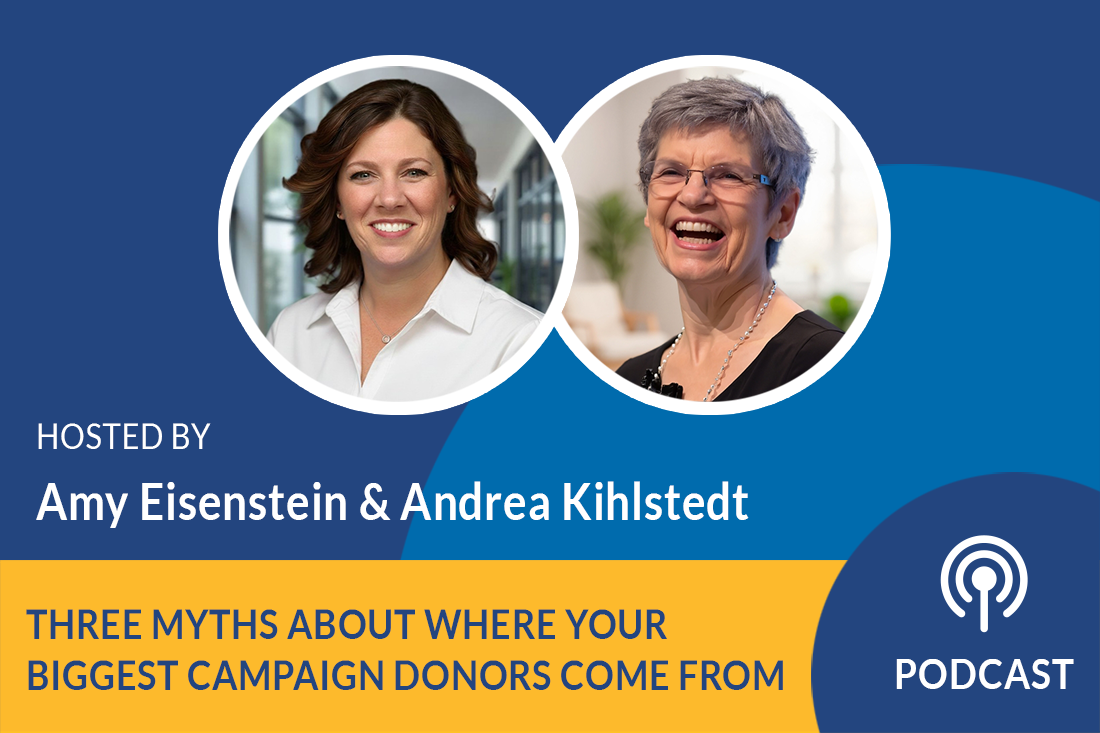
Podcast: Three Myths About Where Your Biggest Campaign Donors Come From
Season 5, Episode 42
Where are your biggest campaign donors going to come from? If you’re like most nonprofit leaders, the answer feels like “somewhere out there” — a major philanthropist who just needs to hear your story.
In this episode, Amy Eisenstein and Andrea Kihlstedt are here to challenge that assumption — and bust the three most common donor myths that derail capital campaigns before they even get started.
This is a must-share episode for board members, executive directors, and leadership teams who are still waiting for a magical major donor to show up.
Listen Now:
Amy Eisenstein:
Misconceptions about where the biggest donors come from. If you don’t know where the biggest donors for your campaign are going to come from, you are not alone. Stick around.
Hi, I’m Amy Eisenstein. I’m here with my colleague and co-founder Andrea Kihlstedt, and today we are going to bust some myths and misconceptions about where to find the biggest donors for your campaign.
Where Do Your Biggest Campaign Donors Come From?
Andrea, as always, get us started. Why is this an important topic? And we’ll get started on misconception number one, however you want to get started.
Myth #1: Donors Who Haven’t Ever Given You Big Gifts Lack the Capacity
Andrea Kihlstedt:
Misconception number one is that because no one has ever given you a big gift, that no one in your community of donors has the money to give you a big gift. No one can give you a big gift. That’s a big misconception, and it’s a very common one. The biggest gift anyone’s ever given us is $1,000. How can we imagine that somebody would give us $500,000?
Amy Eisenstein:
Yeah. I think the theme of today, all the misconceptions tie back to this idea of that the big donors for your campaign are out there somewhere. You don’t know them. They’re not on your list.
Okay. So, number one: if you don’t have any current big donors, you can’t possibly have any big donors. Is that sort of the idea?
Andrea Kihlstedt:
Right. Yeah. And that’s a slightly different idea from the fact that the big donors are out there, not in here. They’re related, but it’s slightly different. Let’s say, let’s take a good look at the people who are your donors, the people who feel strongly enough about your organization to give annually. Even if they’re just giving $50 or $100 a year, doesn’t mean that some of them don’t have the capacity to give you really big gifts.
So the first place to begin always when looking at, okay, who are those top 20 donors, is right under your nose, right among the people who already give to you, who are already committed to you. And some of them may have resources you had no idea about. Some of them may have family resources that you had no idea. Not everyone who has significant amounts of money likes to flaunt that. Not everyone likes people to know that they have money. There are a fair number of people who have money who are just as happy if you don’t know.
So get rid of this idea that just because people don’t give you big gifts, it means that they don’t have the money to give you big gifts. That’s just simply likely to be wrong.
Amy Eisenstein:
Right. So that they can’t or that they won’t.
We hear this all the time as campaign consultants. We don’t have any donors over $1,000 or over $5,000, so how could we possibly have any half million dollar donors, or even $100,000 donors? It is hard to imagine someone who’s been giving you $1,000 or $5,000 giving you $100,000.
But the reality is that mostly we do find those big donors among your donor base, and they haven’t given more…
- One, because you’ve never had a big enough idea or a big exciting project before.
- And two, of course, you haven’t asked them for that. You haven’t cultivated those levels of gifts.
And the reality is that for most big campaigns of any size, you need to find 20 to 30 donors that are going to give transformational gifts. You’re not looking for hundreds or thousands of donors at that level. You’re looking for a handful of really important donors.
So myth number one is that you don’t have any donors on your list that can give big transformational gifts. 99% of the time it simply isn’t true.
Myth #2: Super-Wealthy Donors Are Out There Waiting to Give to Your Cause
Andrea Kihlstedt:
Yes. Now, let’s look at the other side that you brought up a little bit ago, Amy, which is that there are donors out there who don’t know anything about you who are likely to give those big gifts. That’s the other side of that issue. That somehow there are very rich people who are interested in your topic and interested in you. They just haven’t found you yet, or you haven’t found them yet. So you need to be looking around for people who are really rich.
Amy Eisenstein:
Yeah. I mean, either in your community or people like Mackenzie Scott or Bill Gates are going to swoop in and save your campaign. I mean, there’s all sorts of myths going around that the big donors are somehow out there. If only Oprah knew about you, it would save your campaign, and it just is unlikely. Mackenzie Scott is not likely to swoop in and save your campaign.
So there’s this notion among your board members, among your leadership team, that these big donors are out there somewhere, and you just need to find them and connect with them. It’s very hard to do.
Now, of course, going through a campaign process, you will identify and recruit and cultivate some new donors, but that’s not the first part of the process, and it’s not likely to happen quickly or fast, and it’s not going to be the majority of your big donors. So while you may, going through a campaign process may identify, attract, recruit, cultivate some new donors likely in your community who are already connected to your board members and your major donors. It’s not the place to start. And I think that’s a big misconception and mistake that lots of nonprofit leaders make.
Andrea Kihlstedt:
For a long time, I thought that in every campaign there was sort of a surprise gift, a surprise, a magical gift. And in many campaigns, there is a gift like that, maybe two gifts like that, but it’s not the bulk of what happens. And whether you actually identify some people who were these surprising major donors or not, has everything to do with how well you are communicating with the people who already know and love you, because those are the people who are likely to lead you to anybody else who’s going to give you a big gift. So you have to focus well on the people who are right in your radar.
Amy Eisenstein:
Because what do we say? Hope is not a strategy or a plan. That’s just sort of wild speculation and hoping that somebody is going to come along, and you need 20 of those somebodies. So maybe you’ll get two or three of those sort of outlier gifts, but the bulk of them will be from people you know and people who are already involved and connected. I can’t say that enough. And people don’t believe us because they don’t have current large donors or a robust major gift program. But okay, let’s move on.
Andrea Kihlstedt:
Yes.
Myth #3: A Campaign Consultant Will Bring You Large Donors
Amy Eisenstein:
Myth number three is that a consultant is going to bring you large donors. I often hear requests, “Is that what you do as a consultant? Will you help connect us? Will you introduce us to other donors?” And the answer is a very hard no, resounding no. So what do you think of that concept Andrea?
Andrea Kihlstedt:
Well, I like to sort of laugh about it a little. So here’s why I laugh about it.
Let’s imagine, Amy, that you’re a consultant in a local community, and you’ve been active in your community, and you know a lot of people, some of whom have a lot of wealth. And the very idea, as a campaign consultant, you work for three or four or five organizations in your community, and you’re bringing those wealthy people with you in your little shopping bag to those organizations so that they can give to the organizations that you work for as opposed to the organizations that they are interested in is absurd.
Amy Eisenstein:
And after I do that two or three times, do you think they’re going to answer my calls anymore anyway? I mean, it’s just crazy. Yes.
Andrea Kihlstedt:
So, I mean, the relationship is not between the consultant and the donor. The relationship is between the organization and the donor.
While there are local consultants who know the community and know the community well, and sometimes there’s a benefit in that, there is a much bigger benefit in working with a consultant who really understands capital campaign fundraising, and then working with them to understand how to mine your community for people who have the potential of loving your mission. That’s what you’re really looking for. You’re not looking for people who have a relationship with the consultant. That’s ridiculous.
Amy Eisenstein:
Right. Good consultants will help you figure out who on your board are connected to philanthropists in the community. Where are the existing relationships? Who might have a connection, and how to research what people, what potential donors love and are interested in, both those that already give to you and that are sort of one step removed?
Andrea Kihlstedt:
I mean, the thing that drives me nuts about that is that sometimes … we hear this a lot actually … is that organizations often hire consultants because of that, because of the relationships that they have in the community. And the consultants that they end up hiring may have been involved in one or two campaigns, but they certainly aren’t campaign experts. It makes me so sad because there’s a ton to know about capital campaigns, and the only way to know it is to work on multiple campaigns is to have a ton of experience in this field.
So when you have an opportunity to hire a consultant who has deep experience on one side, and a consultant with limited experience who knows your community, there’s no question in my mind that the deep experience is what you need. You have access to your community.
Make Sure Your Local Campaign Consultant Has Actual Campaign Experience
Amy Eisenstein:
It’s a pet peeve of ours. I mean, we hear from time to time that somebody’s hired some local consultant in their community who really has almost no campaign experience. It’s totally shocking. Well, they’ve been in the community a long time. They worked at two nonprofits. And it just sort of blows our minds that that’s who they picked.
Andrea Kihlstedt:
Or they worked for the hospital foundation while the hospital was doing a big multimillion-dollar campaign. Well, that doesn’t qualify someone to be a campaign consultant. It really doesn’t.
Real-World Story to Help You Find Your Biggest Donors
Amy Eisenstein:
All right, let’s tell a quick story. There are countless stories that I can think of of how this idea of finding donors within your donor base work.
Andrea Kihlstedt:
Yeah, here’s a good story. Some time ago, we worked for an organization that, by the end of their campaign, was incredibly successful in raising some real significant gifts. And among those significant gifts came a major gift from a family in the community who was never known for having money. These were people who were artists, actually. Of all the people in the community, you wouldn’t think of them as having money. But it turned out, after the fact, that their extended family had owned a business, and the family had sold the business, and all the family members had come into a windfall just about the time this campaign was going on.
And the way that came about, the way the gift came about was because in their preparation and cultivation, they invited people to come together several times to learn about the campaign and about the plans for the new building. And this couple came to one of those events. I mean, they had been a low-level donor to this organization for a long time, and they came to one of these events. And after the event they called the executive director, said:
“You know, we want to give a special anonymous onetime gift because we have this windfall.”
It ended up being one of the largest gifts to the campaign. And the reason they found out about it is because they did a really good job of using the process of planning the new building to engage the people who had been longtime donors, even low-level donors to their organization. And they never would’ve known about this. It was nothing that presented itself. These people hadn’t changed. I mean, when people come into money, they don’t change the way they live for the most part. They don’t buy a fancy car. They don’t start buying mink coats or whatever; diamond rings. They live exactly the way they lived. Only they have a bunch of money that they didn’t have before.
So what you need to focus on as you plan a campaign to move really, to transform your organization, you need to use those plans to transform the organization, to let people know what you’re doing and get them excited. And some of those people will step forward. You don’t have to go hunting for them. They will step forward if you’re doing a good job of communicating and using the planning process to engage people.
Final Thoughts
Amy Eisenstein:
Excellent. All right, three myths. One, that people in your database, your current donors don’t have the capacity and/or won’t give to your organization, but mostly it’s, don’t have the capacity. So that’s simply not true. Number two is that the big donors are just going to be out there somewhere, they’re related, they’re connected, those ideas.
Andrea Kihlstedt:
Well, and those big donors who are out there are looking for you, want to give to you. That’s the misconception.
Amy Eisenstein:
Well, yeah.
Andrea Kihlstedt:
It’s the other —
Amy Eisenstein:
Well, but they’re out there somewhere.
Andrea Kihlstedt:
They’re out there somewhere, and if you could just get to them, they’d want to give to you.
Amy Eisenstein:
Right, right. Okay.
Andrea Kihlstedt:
That’s a misconception.
Amy Eisenstein:
I guess the other one related, if we’re going to add an extra one, is that there’s some wealthy donor that’s going to swoop in and save your campaign. I mean, it’s sort of a connected idea.
And then the next one, the last one is that a consultant is going to magically bring you donors, connect you with wealthy people. I mean, it just simply doesn’t happen. So be wary of any consultant that’s promising you big donors. I can’t tell you how many times I’ve also heard of organizations that said:
“Well, we picked this consultant because they were going to help us find donors, and they didn’t.”
Now, whether that was a miscommunication.
What we say is we help you learn how to leverage your donors, how to leverage your connections, how to engage your board members to figure out who they know, how to get them to develop their current existing relationships.
But we don’t just bring new donors to the table. We don’t magically have donors show up, but we help you figure out who your donors are and how to engage them in meaningful ways that get them to consider significantly larger gifts than they’ve ever considered before. That’s what a magical campaign consultant does.
Andrea Kihlstedt:
Right. Well, and that really brings back the parable of the teaching people to fish. Do you give them fish, or do you teach them to fish? And it’s always much more powerful to teach people how to do something so that they can continue to do it in the future. These are skills that provide an organization with amazing opportunities going forward to build relationships with major donors and that transforms an organization.
Amy Eisenstein:
All right, everybody, thanks for listening. Hopefully, this sparked something. You can share it with your board members, share it with your leadership team, anybody who’s having magical, mythical ideation about where your big donors are going to come from.
Hopefully, this gets the conversation going. So feel free to share and we’ll see you next time. Thanks for listening.


Leave a Comment