
Podcast: Why $2 Trillion in Charitable Funds Isn’t Reaching Nonprofits
Season 6, Episode 8
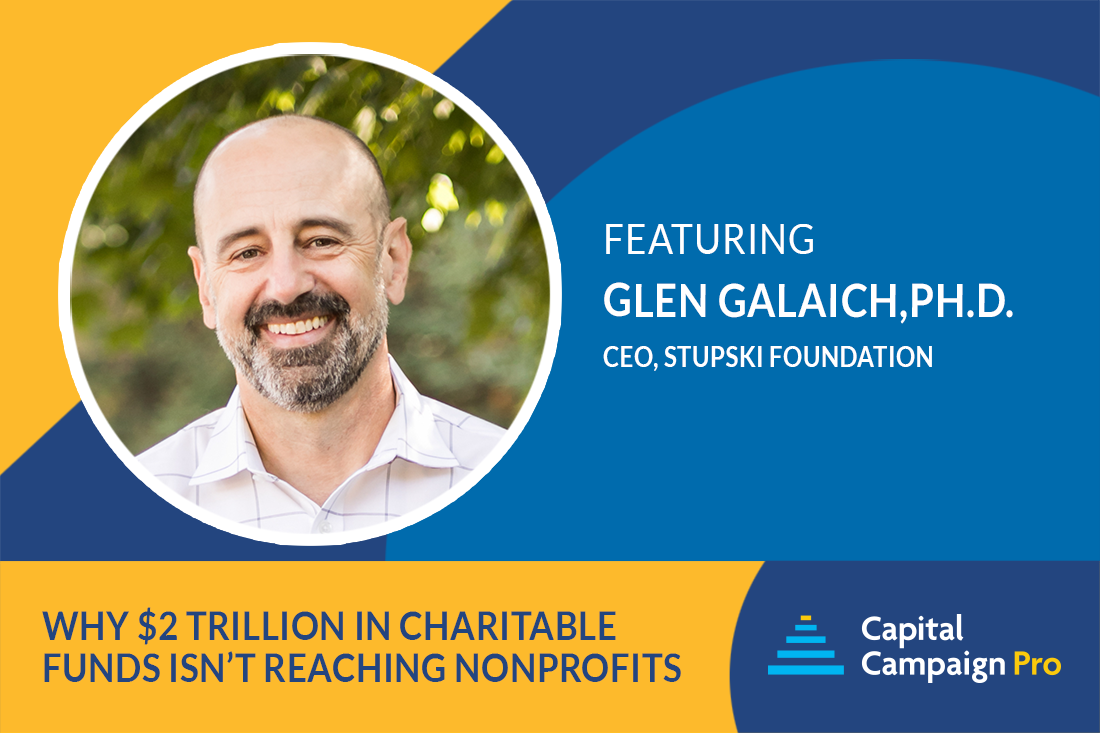
More than $2 trillion designated for charitable purposes is sitting in foundations and donor-advised funds. Why isn’t more of it reaching the communities that need it now?
In this episode, Amy Eisenstein speaks with Glen Galaich, CEO of the Stupski Foundation and author of Control: Why Big Giving Falls Short.
This episode offers nonprofit executives, development professionals, board members, major donors, and foundation leaders a candid look at who controls charitable money, whose expertise shapes funding decisions, and what could happen if philanthropy placed greater trust in the people closest to the challenges.
Watch now:
Listen Now:
Amy Eisenstein:
If you’ve ever been puzzled or frustrated by foundations and the grant making process or even mega donors and why they maybe would or wouldn’t give to your organization, today’s guest is for you.
Hi, I’m Amy Eisenstein. Andrea’s taking a little break today, but I have a very special guest with me. We’ve got Glen Galaich here, and he is the author of a new book called Control: Why Big Giving Falls Short. And I’ve been reading through it. It’s excellent. I highly recommend it. We’ll put a link in the show notes to it. Glen is the CEO of the Stupski Foundation, and he has a very, very interesting take on giving and philanthropy. So Glen, welcome to the show.
Glen Galaich:
Thank you so much. It’s really, really an honor to be with you today. Thanks for making the time.
Glen’s Experience Over Two Decades of Philanthropy
Amy Eisenstein:
Absolutely. So let’s get started. You’ve worked in philanthropy for over two decades. Why don’t you talk a little bit about how you’ve spent your time and currently running a $500 million spend down foundation, and really how has your thinking changed over the last two decades?
Glen Galaich:
So for the most part… What I want to say upfront is that we use the word philanthropy very loosely. And what I’m really focused on in Control is the foundation sector, the donor advised fund world, and really the individual donors that are giving at a million dollars or more a year. It’s a big giving book. And of that, of all the philanthropy we have in the United States, that’s really just a minority really of how much goes into nonprofits annually.
So we’re at about 600 billion annually, a little over that. Of that, about 200 billion I think you can account for as individual big giving. The rest, about 400 billion is everyday people. And so philanthropy, no matter what happens with the foundation sector, is still going to be vibrant in America. But foundations are big money and big organizations and small organizations want to get that money.
So you’re right. In the book, I’ve really tried to, through my own experience and through my own thinking, tried to think about ways that we can make this money flow. Because right now these charitable accounts that have been created, foundations and donor advised funds are over $2 trillion housing money that’s not actually going out.
Amy Eisenstein:
All right. I love that. Let me back you up. I did jump in because I was just reading your book, so I feel like I know you and your story, but for our listeners, tell us how you got into this work, how you got started. Let’s back up a little bit and we will circle back to the question that you’re trying to answer in the book. But I think a little level setting probably is a good idea. And that was my fault. I should have started there. But tell us how you got into this work and a little bit about what you do, and then we’ll dive into the book.
Glen Galaich:
Sure. So I got into the work, I think a lot of people say the same thing, I don’t know how I got there, but I ended up there. I was looking for work in San Francisco. I had been an academic in Colorado in political science. I was finishing off my PhD and my wife was an immigration attorney and she wanted to do work in San Francisco. So we moved and I was looking for a job and ended up with the World Affairs Council. And the World Affairs Council in Northern California is one of the bigger branches of that entity. And they were starting up something called the Global Philanthropy Forum. And I was asked to be on that team to get it going. And that’s how I got into it.
I accepted the job. I remember Jane Wales who was running the organization at the time said, “I don’t want to hire you as a program director here, but I have this project called the Global Philanthropy Forum if you’d be interested.” And I was like, “Sure.” I had no idea what philanthropy was. I probably couldn’t have even spelled the word at the time, but I was immediately fascinated by it. I think a lot of people who get into it and kind of geek out on philanthropy like I have, you’re just drawn to the idea that there’s so much potential for action, so much possibility for social change and using resources for really good things.
And at the time, I don’t know how long your listeners have been in the sector, there were some really big exciting things going on on the West Coast. You had one of the first dot-com booms had already blown open and there was a new one starting, and this new one was really exciting. There were these little companies called Google and Yahoo and Facebook that were all starting to grow quickly and they were fun environments and everyone thought, “Hey, the philanthropy is going to be really fun that comes out of those entities.” 25 years later, they’re not looked upon the same way, nor is there philanthropy. So a lot changed there.
The other couple big things I’ll say really quickly, strategic philanthropy was a really big deal at the time. Hewlett Foundation and Paul Brest were really driving this idea that we could be much more strategic in how we move money. I got completely into that and wanted to do that work. And that’s what drove me for about 15 to 18 years. I ran an organization for a while called The Philanthropy Workshop where we trained individual donors on how to give strategically.
So I’ve worked with literally thousands of individual donors. And then eventually in 2015, Joyce Stupski hired me to run her foundation, which had been around for 18 years at that point. And due to the passing of her husband, who was the mind and machine behind making Charles Schwab into an international company, when he passed, she wanted to do a spend out, grant making. And so she brought me in to do that.
On Giving Strategically
Amy Eisenstein:
All right, you used the phrase “give strategically.” You were teaching donors or philanthropists to give strategically. So talk through what that looked like at the time, and then maybe we’ll get into how perhaps your thinking has changed.
Glen Galaich:
So the operating system for philanthropy, it’s been written about in many books, comes from Carnegie, goes all the way back to the 19th century. And the belief is that if someone has done very well in the economic system, they’re special and they can solve problems in ways that the rest of us are unable.
And so they are obligated to help those who are unable to succeed in this system. And therefore, I guess you’d call it sort of the no bless oblige of a society that doesn’t want to say we have classes, but we do. And so that is the driving operating system.
So when you get to the 2000s, there’s all this money being created, new money, new exciting entrepreneurial structures in place, venture capital, tech boom, all this stuff. And there was a belief that we can channel the brilliance of the business sector and the people who have succeeded in it into philanthropy. We would challenge these people to identify problems they want to solve and bring their minds to the table to solve them.
And so I very much bought into that narrative and built an organization for people that had already established private foundations or had donor-advised funds at local community foundations or maybe at Vanguard or wherever they had it, and really get them to lean into themselves. You’re the center of this, so what interests you? What values do you have? What drives you? Sharing all the different ways, tactics, and strategies that philanthropy operates from large foundations to small, which one are you going to use to affect the world the way you want to affect it?
So in Control, I rename it donor-centered strategic philanthropy, even though we didn’t refer to it that way in the past, probably some still don’t, but it is just one version of strategic philanthropy. This one is donor-centered.
Amy Eisenstein:
That’s interesting. In fundraising, my fellow fundraisers, we are very familiar with the idea of donor-centered fundraising.
Glen Galaich:
Sure, sure.
Amy Eisenstein:
So I’m sure it’s all rooted in the same ideas and place. Okay, so in your new book, Control, your thinking has changed. So walk us through that process and what you believe now.
Glen Galaich:
I think if any of us went through 2017 through, let’s say 2022, that was a period of great, in my opinion, great disruption in how we think about philanthropy. And I think we’re still going through it. I hope we are. Otherwise, my book is going to die. But really, I hope we are going through a period of really thinking about this.
But I would say that the shift started when DEI in particular became very prominent in foundation circles. Almost every conference you went to, there was an emphasis on what we were calling DEI. I think it’s morphed more into racial justice and equity now. So that was one of the first things I think that really shook the ground of foundation life. Then out came Anand Giridharadas’s book, Winners Take All, followed by Decolonizing Wealth from Edgar Villanueva. And that group of things going on really shook the sector. And that was just as I was coming in as the CEO with the mandate to build a strategy based on what Joyce Stupski wanted.
So I was caught in my own personal and mental conflict as we were starting to build out really dynamic hypothesis driven strategy and putting all of our grantees and all of our staff through that. I started to read all these materials. I started going to the conferences more. I had really not been to many foundation conferences, since I had worked with individuals, I really didn’t know the sector all that well.
And I was really starting to hear from activists, from racial justice leaders and others that foundation sector, especially the stuff that was built on donor-centered strategy, was just completely missing them. And that concerned me.
And I just started really thinking, when you look at where change has happened and how our country is built around locality and community, why should we expect that change is going to happen just because someone created an online auction system where I can sell my Star Wars figures, why should we expect that they’re going to be able to save democracy? Why not look at the communities that actually have all kinds of ideas for changing and fixing and solving their own problems? Why aren’t we listening more to them and giving in ways that really answers their needs? And that’s where my own and our foundations conversion started.
$2 Trillion in Bottlenecked Funds
Amy Eisenstein:
Okay, that’s helpful. All right, so I think this leads into this, but I may need to back up and get more explanation. But one of the things that you talk about is this $2 trillion that’s bottlenecked in foundations, donor-advised funds, instead of reaching communities. So I think you’re sort of getting there, we may need to circle back to some concepts, but why don’t you tell us about that? How did you come to see this idea that all of these funds are bottlenecked and then help us get it to the communities that need them?
Glen Galaich:
I think for people that have made a lot of wealth, the most comfortable place for them to operate is in the portfolio. It’s in the money that’s in the foundation. I think if you watch the dynamics of boards of foundations, this certainly was the case with Stupski, and I think I validated this across hundreds of other foundations, it’s very rare that a board blocks a grant request from a program staffer.
So they don’t have a lot of knowledge of or experience with the day-to-day dynamics of social change, but what they do feel comfortable with are hedge funds, private equity, mutual funds, working with investment professionals, working with estate planners, accountants. And so there’s an orientation toward protecting, keeping, growing the portfolio. And it’s all built into this idea of control, and it’s all based on the idea that we need to make money to give money.
And so I think it’s obviously true that someone can’t give money until they’ve made it, of course. But once it’s in a charitable setting, which I think… Most people lose sight of the fact that when a person makes a donation to a private foundation, it’s only a private foundation because it only has one or two donors. It’s not private in the sense that the money is somehow secured in a private place. It’s actually because of the volume of tax subsidy that goes into it’s actually public money more than it is private money. And on top of it, they’ve given it to an organization that is not them.
So when you think about a foundation, it is this public entity that should be, in my opinion, governed by people who have answered an obligation that the American people have said, which is:
“We are happy to give you a major tax benefit. We are happy for you to put it into this entity that you’re probably going to name after yourself, and we’re even comfortable with you putting your family on the board of this thing, but you have to act like public stewards. You have to give in a way that benefits the public, not you.”
And that’s where things fall apart. So the investments, the grant making, it’s all about what’s comfortable for the board. It’s all about what’s comfortable for the family and their legacy and being unified and doing great things together.
The last thing it seems is that the public is of interest. So that’s why the money doesn’t move because one thing that has become almost like a law of foundations, even though it really is just a fake rule, is that they need to live in perpetuity. So to live in perpetuity, that requires that you give as little as you are required to give and make as much as you can possibly make so that you can live forever, giving very little for the rest of the foundation’s existence versus using the money as it was intended today.
Amy Eisenstein:
Right. So that’s a total mindset shift and perhaps a policy shift that needs to happen many layers of society, from government to local, to all the way through probably. So say more. I’m not even sure what to ask. Let’s keep unpacking it.
Glen Galaich:
Sure. We’ll sweeten the can.
Communicating with Those Who Are Controlling the Funds
Amy Eisenstein:
Yeah. I mean, I think that we’re with you in theory, and I mean, certainly from the donor perspective and… I’m sorry, not the donor perspective. I’m on sort of the nonprofit side, from the perspective of the fundraiser and the executive director running these, of course, that makes total sense. But when we’re dealing with foundations, family foundations, donors with donor advised funds, how do we communicate this or how do we get them to think differently about releasing more funds, letting go of some of the control or even… Yeah, let me stop there. How should we communicate with people who are controlling the funds?
Glen Galaich:
Well, first of all, I think I’ll make a pitch for the book again. I mean, I wrote this book for people who are in a power dynamic. It’s hard to say to someone. I have examples in the book where I very carefully negotiated conversations with Joyce where because she was already a bit of a maverick by being in a spend out position, I just leaned in on that. And I know that’s an advantage I had to be able to say:
“Hey, you did all these things already. Can we keep going? Can we release more and more control?”
And she was very open to that at times. That’s not easy for a lot of other people. So in conversations I’ve had over the years, people have asked me:
“Can you just write an email I can forward or something I can send to my dad so that he can hear that he’s a little controlling?”
And that was what led me to write the book. Here’s a book you can hand to someone. And the way I’ve written it, I’ve tried to write it in a way that it’s not necessarily saying to the reader, you are controlling. It’s asking you to look at the stories of others and even my own story and take note of where control really shows up and where people have converted away from it and reflect upon ways that you could do the same.
So I know a lot of fundraisers, having been a fundraiser myself at times, I mean, I know that relationships are critical and you can get to a place with donors. I’m sure many of your listeners are in very, very close contact, very deep relationships with donors where maybe they could share the book with them and even ask them to give the book to other members of their family who may be more controlling. That’s the only way it’s going to move. There’s no way in the world a donor is going to walk into Barnes & Noble and sa:
“Hey, there’s a book about controlling donors. I want to read that.”
That’s not going to happen.
Amy Eisenstein:
No, probably not.
Glen Galaich:
So that is a task. The other thing I’ll say, which is really challenging for a fundraiser, so I appreciate this, we have to get to a place where we are asking for what we really need from a foundation as opposed to what we think they will give us. What we think they will give us reinforces the little that they’re going to give away. I think more foundations need to face the fact that they have a lot of assets that they could be using, and instead it’s invested in hedge funds and private equity and a lot of other investments that are actually working against their mission.
So they need to hear from the world that we are in dire need. I recognize this is a high bar. This has been an extraordinary year. We watched at the start of 2025 as so much social finance was pulled out of the system by the White House. Foundations, instead of giving more, decided to protect their assets more than they’ve ever done that I’ve seen, and I’ve been behind the scenes to watch how it all happens.
So you would expect now a year later when we can see the burnout, when we can see the struggle, when we can see services that are being shut down, people who are being laid off, you would expect foundations to respond. And to make matters even crazier. Last year was an extraordinary year for investment. Unlike prior crises we faced, whether it was COVID or recessions, this was a year of massive growth for just about every foundation portfolio saw massive growth and they’ve locked down and some are actually celebrating giving 1% more. I think really foundations need to take a good hard look in the mirror and say:
“Is it more important for us to be holding onto this money than the organizations on the front lines?”
And that question I don’t think really comes up in the boardrooms of foundations. So I’m hoping that if we are all asking for what we truly need and are putting more pressure on the decision makers from the trustees to the CEOs to the program directors, that over time we’re going to see much more pressure to give these funds rather than hoard them.
It Will Take a Mindset and Culture Shift
Amy Eisenstein:
Yeah. I mean, unfortunately, it sounds so obvious, that’s not the unfortunate part, the unfortunate part is I’m not sure that it’s going to work unless it comes from the other direction. I think you’re putting too much stock in the nonprofits being able to move the needle by asking for more. So I —
Glen Galaich:
I’m going to be fair to myself on that, I’m saying that’s a role we can play as nonprofits. Look, I think if anyone out there has followed my work before you, I think you know I’m a very strong critic of the foundation sector and that’s where I put most of my emphasis. Where I do struggle is how we would design policy change, and that’s why this book is really about mindset and culture shift because that can be done immediately in any place. But the policy part, as much as I think it’s going to come, is very challenging work.
Amy Eisenstein:
Yeah. All right, so let me shift a little bit and move us to the idea that you have come to believe that when communities lead the way in philanthropy, outcomes improve. And I think that actually that argument might move the needle more with foundations, right? So tell us about seeing that happen.
Glen Galaich:
Well, I think first of all, it’s always hard to make a counterfactual case when you don’t necessarily have data to show. Again, I’m going off of how our country is designed, we’ve got districts and counties and community level work. We fundamentally believe in both how we operate and the norms that we have in our country that local is a good thing, that communities are able to best address what they need.
So I believe that anyone sitting on a public foundation board, sitting on any foundation board should be really tapped into the community. That’s the number one thing, and those that are least tapped into it should probably step away. So if you have a concern with a community of people that have been marginalized historically or recently marginalized as a result of changes in trade policy or whatever it might be, if you are a family that has ultimately participated in the marginalization, are you best positioned to really respond or to provide solutions?
So ultimately, that’s the argument I’m making, that your job as a donor is to take a look at where your mindset rests on a spectrum from excessive donor control on the one hand to community engagement on the other and reflect, am I really engaging the community in the solutions we are funding? Am I getting true input from community leaders as to what they need to solve their issues? The first question I would ask is, have you asked a community leader if they’d prefer five cents every year on the dollar or whether they prefer the whole dollar?
I’m guessing that you would hear most of the time we’d prefer the dollar. I think every fundraiser would prefer to get a dollar rather than five cents. So if you start there, you’re already going to find, if you’re not responding to that very basic concept, you are probably a controlling donor and it’s time for you to think about, in my opinion, steps you can take to really fund the community needs and community solutions, starting with asking, how much do you really need?
Amy Eisenstein:
Yeah. One of the best analogies for something like that that I’ve heard is something about your house is on fire and the firehouse wants to conserve water, so they dole out 5%. It doesn’t actually put your house fire out, your house burns to the ground, but they’re going to save that water for future needs.
Glen Galaich:
Right, yes.
Amy Eisenstein:
You’ve heard this one.
Glen Galaich:
Yeah, they’re going to be able to provide 5% water to all the houses in the neighborhood as they burn down.
Amy Eisenstein:
Right.
Glen Galaich:
It’s a perfect example. Yes, a very nice metaphor.
A Spend Down of $500 Million
Amy Eisenstein:
Yeah. Okay. One or two more questions, I think. So at Stupski, you’re in the process of a spend down of 500 million. Is that true? Do I have that number correct?
Glen Galaich:
So by the time we spend down, we will have moved roughly $650 million over 10 years.
Amy Eisenstein:
So talk about the decision and the thought process, because as you’ve pointed out, most family foundations want to exist far into the future in perpetuity. So how did your team make that decision and what results have you seen so far?
Glen Galaich:
So here’s the place where I also have benefited. Joyce made the decision before any of us arrived. She decided she wanted to get as much impact as she could, and she equated that impact with money out the door.
Amy Eisenstein:
Amazing.
Glen Galaich:
Lots of foundations might tell you:
“Well, we have this incredibly gifted team. We offer a ton to the grantees we work with, so it’s far more than money. It’s really who we are.”
I don’t want to question my peers too hard, but I don’t think that’s what most people come to foundations for. I don’t think they come to have a great conversation with a program director about how they can fix their operations. I know people tell stories like that all the time, and I’m sure they’re extremely talented. I have great program staff members here, but I think even my program staff would tell you that one of the main reasons they are here is to move money, if not the only thing they’re here to do.
So that decision was made for us before we arrived. How we did it, how quickly we did it, all of that was left on the table by Joyce for us to figure out. We’ve gone through periods of speeding up. Last year, we moved 70% of our available grant making assets, which as a result has made it so we don’t have all that much now and we certainly won’t have anything much next year, and that’s why we’re probably going to close down for the most part at the end of 2027. Our intention was to go to 2029, but it looks like we’re going to wrap up our grant making operations in 2027 because we’re simply trying to respond to need.
We didn’t put out a big campaign, set it at 70% last year. Other foundations had set it at six, but we felt somewhere between 6% and 70% is probably what a lot of foundations should be doing right now. I’ve really tried to differentiate between spending down and spending out. Spending out sounds really scary to people who want something to live forever. And so there is a softer place to land, which would be so helpful to fundraisers and nonprofits, which is spending down a bit.
And I point to the Marguerite Casey Foundation as an example of this. They made a decision last year, and they haven’t said it this way, but I’m pretty sure from conversations I’ve had with the staff there that this is their intention. They are basically spending down to the original grant that Jim Casey made to the Marguerite Casey Foundation. So they were up around a billion dollars and they’ve decided to spend down over the next 10 to his original $400 million gift. So that means they’re going to move 500 million more dollars than they had intended over the next 10 years.
What a great example. It’s not spending out. They’re going to plateau there at 400 million and sustain. If every foundation over the next 10 years took that same approach, I just can’t even imagine the volume of impact we would see in the world. I would even say you could probably take a big step in protecting and ensuring we have democracy for much longer if that happened. But again, there are other needs families have. They don’t feel the urgency in these families like we feel. They have their own concerns, like I said, about legacy and teaching future generations how to be philanthropic. And all of this has become more of a priority than actually addressing social change.
Amy Eisenstein:
Yeah. All right. Well, I think everybody in my audience is going to be cheering you on, hoping that you can spread this message far and wide and maybe they will… I would encourage listeners to send this episode on to some of your funders if you’re brave enough, if you dare. And I guess that’s part of the issue is that probably some people would not feel comfortable sending this to their funders because they’re worried that the funders won’t be happy with this message, so better for you and me to be spreading it.
But I do hope that some listeners will feel like they’re in partnership enough with some of their funders that they would be happy to share or certainly running out and getting a copy of your book Control and then having a discussion about it maybe in their boardroom, because I’m guessing that some board members at nonprofits also sit on foundation boards. And so it would be a great book club book for your nonprofit board at your local community foundation. So let’s help you, Glen, spread the word.
Final Thoughts
So one final piece of advice or words of wisdom that you want to share with those listeners?
Glen Galaich:
Well, first of all, thank you very much for having me on, and that was a great call to action. And that is the point. As I said earlier in the book, hand the book out to people. We give them away here at the foundation. We’re not in the moneymaking business. We’re just trying to help push the conversation. I believe there are more donors out there with thicker skin than we give them credit for. I think they are capable of reflecting. I think they’re capable of feedback and critical review. I’ve done it. Lots of my friends have done it. Don’t be afraid. You’ll live.
Amy Eisenstein:
Excellent. I love that. You’ll live. They’ll live too.
All right, Glen, thanks so much for joining me. Good luck. Keep spreading the word and I look forward to hearing more on how it goes. Thanks for joining us.


Leave a Comment