
Podcast: Stuck Campaigns, Quick Wins: The Four R’s to Restart Capital Campaign Momentum
Season 5, Episode 5
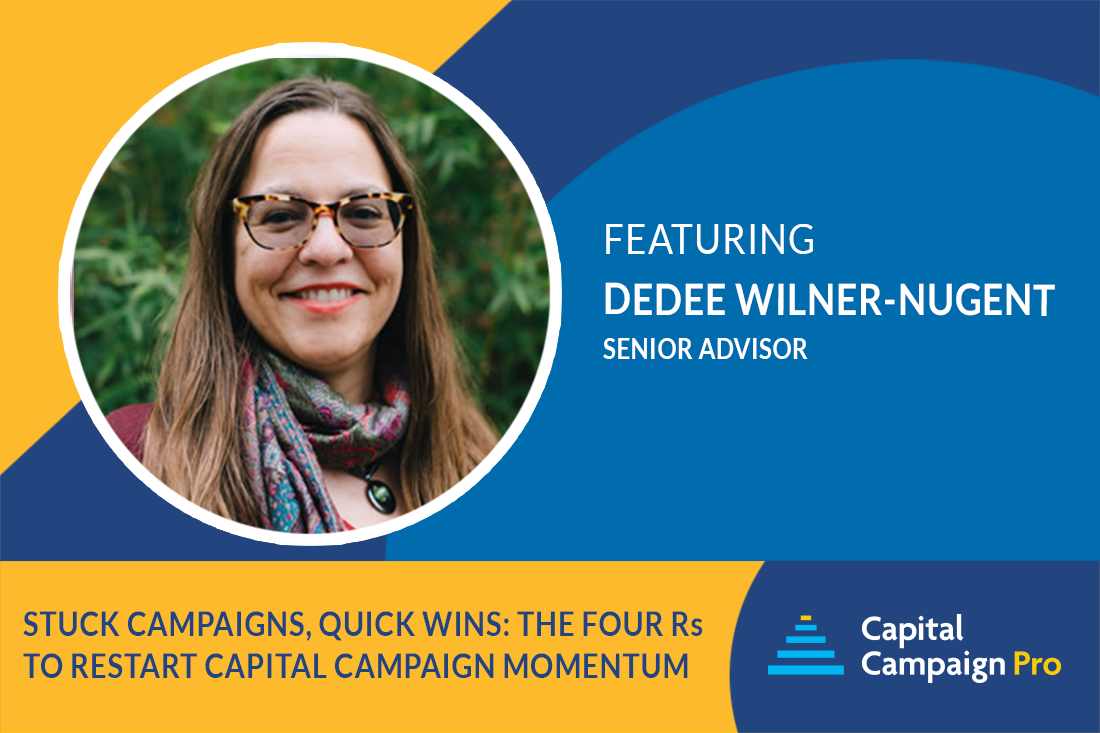
In this episode, Andrea Kihlstedt talks with Capital Campaign Pro senior advisor Dedee Wilner-Nugent about what to do when a capital campaign feels stalled. Dedee shares a practical framework she uses with clients across the country: the Four R’s. These simple moves help leadership teams steady nerves, reengage volunteers, and rebuild momentum during the quiet phase and beyond.
Whether you are a CEO, development director, or campaign chair, this episode gives you a clear playbook to steady the team and move forward with confidence when progress feels slow.
Listen Now:
Andrea Kihlstedt:
Is your capital campaign in an ebb or a flow? I promise you if you’re doing a capital campaign, you will encounter both of those. But we are here to talk to you today about the ebbing portion of a campaign when it feels stuck.
I’m Andrea Kihlstedt, co-founder of Capital Campaign Pro, and I’m super excited to be here today with my special guest, Dedee Wilner-Nugent, the senior advisor in Capital Campaign Pro, who is in Portland, Oregon, and has worked with some of our most challenging — she’s done magic with some of our, in my opinion, most challenging situations. She is just like a magician in helping people figure out how to get what feels like a stuck campaign back on the road.
DeDee, welcome, I’m so glad you’re here with me today.
Dedee Wilner-Nugent:
Thank you, Andrea. It’s a pleasure.
Regain Capital Campaign Momentum with the Four R’s
Andrea Kihlstedt:
Now, as Dedee and I were preparing for this little podcast, I asked her to write up something saying, well, how do you deal with campaigns that feel stalled? And she came up with something that I love, I’ll call it the four R’s. Right? Don’t you love four of anything? Four R’s, four A’s, four B’s, four C’s… We have, for this particular session, we have four R’s. And I’m going to feed her one at a time, and she’s going to tell you about them, and how she uses them. And it’s going to be your job, listener, to see if you can remember these four R’s by the time we get to the end, that’s your little test at the end.
So, okay, Dedee, the first one, first R is reframing. What do you mean by that and how does it work?
1. Reframing Your Campaign
Dedee Wilner-Nugent:
For many people, this campaign that they’re in the middle of is the first campaign they’ve ever done, it’s hard to understand what’s normal, what’s not. So, when I say reframe, what that means is really normalizing the fact that campaigns don’t operate at a steady cadence at all times. As you say, there are ebbs and flows, and they’re predictable.
So, we know that most campaigns start slow, they’ll speed up, and then as they wind down they’ll slow down again, that is a typical pacing, and then within that there can be other sub-shifts in momentum as well. And so, just normalizing the fact that campaigns don’t operate at a steady shamble, they speed up and slow down is the first piece.
And just to remind people not to panic, and to be prepared, and to build in expectations and resilience on the front end so that as these shifts occur, we can be prepared to pivot thoughtfully.
Andrea Kihlstedt:
One of the challenges I think that staff members have when a campaign feels stalled is that their board members get nervous, or their committee members get nervous, their campaign committee members get nervous. Everybody is sitting and waiting for the next piece of good news, or the next… And they wonder if they’ve signed on to something that’s going to be a dismal flop.
So, you are telling them, or someone’s telling them, that this is just a part of campaigns can be hugely helpful. Do you see that as your role as an advisor?
Dedee Wilner-Nugent:
I think that it’s the role of the leadership team to set expectations at every stage of the campaign, I think as an advisor, my job is to make sure that the leadership team is doing that work of expectation management, and is setting the right expectations. So, I bring the experience of many campaigns to that conversation, but ultimately I think when an organization embraces that culture of expectation management internally, it’s going to serve the campaign better than if it’s just the advisor championing that.
Andrea Kihlstedt:
Right, right. Sometimes I think also in the reframing process, it’s helpful when committee members and staff members understand and look at the entire length of the campaign, at the calendar for the campaign.
Dedee Wilner-Nugent:
Exactly.
Andrea Kihlstedt:
And say, well, this is a three-year campaign, and here’s where we are, and here’s how long we have, which really often in the quiet phase, that’s a generous amount of time, so it can accommodate some quiet times and people forget that.
Dedee Wilner-Nugent:
Yeah, I’m glad you brought up the campaign phases because I think that that’s an important tool that, when we are introducing a campaign to a leadership team, or a community of helpers who are going to help us fulfill our goal, having a tool that helps people understand where are we in that process, and then keeping that document updated as we’re moving through the process so that people have a sense of how long will we be in this phase, and what is my role in this phase?
Because often when things are slow, it can be misinterpreted as permission to coast, or just a lack of clarity, things can feel vague, if we don’t understand, if I’m not doing something right now, then somebody else is. And my job is just to stay current with what they’re doing, and then I understand when my role kicks in and when I need to be activated.
Andrea Kihlstedt:
Right. Yeah. Going back to this word reframe, the first of these R’s, it strikes me that you’re really reframing something from disaster to normal process.
Dedee Wilner-Nugent:
Exactly, exactly. So, we start by framing at the beginning, you can prevent the need to reframe at the outset, so that when you get to a slowing, you just are reminding people, oh, we talked about this before, and here we are. So, previously on capital campaign, the adventure, we said this was going to happen, and here it’s happening now. That’s one way to reframe as we’re going through the process.
2. Recommit to Purpose
Andrea Kihlstedt:
Let’s move on to the second R, now your second R is to recommit to purpose.
Dedee Wilner-Nugent:
Exactly. And that’s really reminding us to center the vision at every step of the way. Often capital Campaigns can feel like we’re way down in the weeds, so far away from what inspired us to do them in the first place. People can begin to drag their feet because they don’t feel emotionally connected to the why of the campaign any longer, because they’ve been staring at their same assignment sheet week after week for a few months, and we just don’t make time to have these conversations about why we’re doing this work in the first place.
And so, bringing a mission moment, a campaign vision moment into every meeting is another way to ensure we’re reconnecting to purpose and to people. The other side of that is really recognizing both the purpose of the campaign and the people who make the purpose possible, which is their campaign leaders.
So, activating a campaign champion who can speak on behalf of the mission and kind of act as a cheerleader for the campaign leadership team can be a useful tool in how to help people reconnect with purpose.
Andrea Kihlstedt:
Yeah, that’s interesting. I could imagine, and I’ve seen this happen, that in a lull time of a campaign, that someone who’s given a really large gift, a large early gift, step up and talk about why they gave that gift, why it was important. I worked for a theater company some time ago, and a generous family gave a million dollars to kick this campaign off, and periodically they would stand up and say, here’s why we did this, and here’s why we feel so strongly about this campaign, and we know it ebbs and flows, but we are totally committed. Does that perk people up?
Dedee Wilner-Nugent:
I love that example, it reminds me of another campaign that I’ve been working on, that’s past this point now, but they were at a time where the institution’s president had been doing the bulk of the heavy lifting to bring in some early lead gifts, and the board hadn’t really been engaged very deeply yet. And it was time to then activate the board, and we were able to identify a donor who had made one of those early lead gifts, who was also on the board, to then rally everybody else to join the team at that point.
So, I agree that, when we are… sometimes we’re focused on one population and it’s time to shift to another population, and new leaders need to step up to help carry water at that point, and that’s when this can be a really useful strategy.
4. Refocus on Small Wins
Andrea Kihlstedt:
Great. So, we have reframe, we have recommit to purpose, now we have one that I particularly like, which is to refocus on small wins. Every campaign has small wins, talk to me about that.
Dedee Wilner-Nugent:
Sure. So, when we first think about, if at the highest level when we think about capital campaigns, we think we’re working toward a goal, but often that goal is two, three years into the future, often it’s after a lot of pre-campaign work that will then lead us to beginning to solicit things that will… Early lead gifts, there’s so many phases. And it can feel discouraging if you’re looking at the whole thing and trying to take it in one bite.
And so, breaking a campaign down into phases, and then within those phases, breaking down progress into benchmarks where there can be accountability for them, and there can be a sense of momentum as we’re knocking down those benchmarks can help the team avoid feeling overwhelmed and allow people to focus.
Andrea Kihlstedt:
Yeah, I think it’s so interesting, one of the complicating factors of any capital campaign is that you have many people working on different aspects of the campaign. You have board members working on soliciting the board, for example, you have people working with the architects on the building plans, if it’s a building campaign, you have someone working on putting together on the feasibility study, if you’re doing a feasibility study, you have people working on prospect research, you have people working on putting together a lead gift committee, you have people working on solidifying the leadership of the campaign, who’s going to chair the campaign… Right?
Many things are going on in these early phases of the campaign, and it’s very easy for one piece, people working on one piece, not to know that people are working on other pieces. It’s like all this stuff is going on, the development director or the campaign director has their arms wrapped around all of that, but it may not be obvious that somebody needs to be telling everybody about the totality of these little powerful things that are happening.
Dedee Wilner-Nugent:
I love that point, Andrea, because the other half of this piece of setting short-term goals is then declaring victory when you achieve them. And then, to do that, again, being able to share that news with people across the campaign, and generate buzz and motivate action. So, I think a clear internal communications plan is really beneficial to helping address that feeling of doldrums or disconnect from the campaign, at least a monthly update to every campaign stakeholder would be really helpful, just celebrating not only outcome successes, but process wins as well.
So, maybe there were 50 meetings scheduled, and out of those we had five gift conversations, and we closed two gifts. So, you’re not just celebrating the two gifts or the dollars involved, but you’re celebrating all the work that went into that, which encompasses some of those other roles you talked about, where they may not be donor-facing roles, but they’re still essential to the momentum of the campaign. And if we can all celebrate each other’s work, then we’ll all feel lifted and carried along by the journey.
Andrea Kihlstedt:
I once worked on a campaign where the development director or the campaign director, I don’t remember anymore, but was someone whose kids were involved in sports, very actively involved in sports, and she was very much about teams, and about rewards, and about putting together structures so that when things happened, everybody felt like they were part of that process. She would have little gatherings where she would give awards for the team that accomplished the most, or… to me, personally, I wasn’t involved with my kids in sports, it’s not a culture I know or understand well, and I was kind of put off by it until I saw how well it worked, that people were really delighted to be part of that, they were delighted to be part of a winning team. They were made to feel part of a winning team by not necessarily seeing yet that the dollars were so high, but by seeing how much was going on, and that filled this void of the fact that it takes time for these dollars to come in.
Dedee Wilner-Nugent:
Absolutely. And what I love about what you’re saying is, the idea of joyfulness as food for campaign momentum. And so, if we can center joyfulness in every campaign conversation and notice our successes, together as a community along the way, we’re going to have more fun, and if we’re having fun, we’re going to be more motivated to do the work.
Andrea Kihlstedt:
Yeah. We haven’t talked, something about a big concept here, which is that the way capital campaigns work is that through the whole first maybe year and a half, sometimes two years, most organizations are soliciting maybe 20 or 30 gifts, in hopes of bringing in 15 or 20 gifts, but big gifts. Now, collectively, those gifts may make up 70, 80% of the campaign goal, so the dollar goal is big. But the number of gifts that come in during that part of the campaign is relatively small, which actually accounts for this sense of ebb and flow. When you hear that a big gift has come in, everybody’s excited, and then you go for three months and nothing comes in, or four months, or five months, because these big gifts all take time.
And that’s the ebbing part, that’s why all campaigns go through this sense of, well, nothing’s happening, nothing’s happening, no money’s coming in, do we have a problem? It’s the structure of a campaign that sets it up that way, and what we’re talking about here, what Dedee has outlined for us or are ways to mitigate that very natural sort of vacuum between these big gifts, really. I sort of hadn’t thought about it that way before, but I think that’s often what happens.
Dedee Wilner-Nugent:
I think that’s absolutely right. I often think of a campaign momentum in terms of a sine wave, if you’re a visual thinker, kind of that big upside down rainbow, kind of, with flat sides. And the idea is that the quiet phase, that early insider lead gift phase, is the slowest part of the campaign. Absolutely. And then, it speeds up as we move into mid-level gifts, and then as we’re wrapping the campaign, and we’re looking for the last few gifts, it can slow down again. So, absolutely.
But if we think about the campaign not merely as a project of gift collection, but we think of it as a project of relationship development, then there’s a lot more there there during the quiet phase. And that’s something that I often talk to my organizations that I’m working on campaigns with about, is having our methodology really be rigorous about the steps, the relational steps of moving a donor toward a gift conversation, so that we’re counting all of those steps as well as the gift in our celebrations.
So, for example, have we talked to every one of our top prospects recently? Not about the campaign, but just to reaffirm the relationship with their primary contact, that bilateral relationship. And then have we engaged that donor in a multilateral context, where we’re introducing them to other members of our leadership team and being current in those relationships? And then, have we introduced the campaign concept to that donor, and their reaction been, and have we had a chance to consider that reaction and plan a strategy?
And then, finally, are we ready to make it ask for a gift, and how did that go? So, there’s a lot of steps that we can focus on and achieve victory before that gift, during those long months, rather than just thinking somebody’s doing something, and it’s taking a long time.
Andrea Kihlstedt:
Right. Or maybe nobody’s doing anything and nothing’s happening.
That’s the biggest worried. Right?
4. Reassess Your Campaign
Dedee Wilner-Nugent:
It goes into my fourth recommendation.
Andrea Kihlstedt:
Yes, fourth R.
Dedee Wilner-Nugent:
Yeah, exactly, which is reassess.
Andrea Kihlstedt:
Yes. And what is that, and when does that happen?
Dedee Wilner-Nugent:
So, if you’re doing these other things and the campaign still feels like it’s not progressing, relationships with donors are not moving intentionally and predictably toward a place where a solicitation is possible, or a solicitation has been made and it’s sort of gone nowhere, and you’re not able to connect with a donor to complete that conversation.
If things like that are happening, or there’s tensions within the team, or possibly a shortage of capacity on either the volunteer or the staff side to do the work, then that’s time for a reassessment. Reviewing the prospect list and refreshing it, if some donors are just not moving, maybe they aren’t going to give us the gift that we’re trying to secure from them, or maybe it’s going to take longer than we thought.
And we have the bandwidth to then pivot some of our energy while that’s on the back burner, cooking slowly, to move some other donors on our depth chart up to the top of the priority list, and get some short-term wins with lower level gifts while we’re waiting for that other gift to come to fruition. Or if we’re having staff capacity issues or volunteer capacity issues, we can reevaluate that, maybe do some restructuring, and then go back out and try again with some new systems in place.
Andrea Kihlstedt:
Dedee, these are wonderful strategies, and I know you, a magician with your advising clients, how do you think about using them? Do you go through one at a time with them? How do you use these strategies with your clients?
Dedee Wilner-Nugent:
It’s not a one-size-fits-all situation, I think that in general, introducing these concepts at the very beginning of a working relationship can be really helpful. So, if you’re a campaign leader and you’re orienting your volunteers, or your board, or your staff team to a campaign, introducing the concept of campaign momentum as a thing at the very beginning of your work, setting those expectations, that’s number one on our list of things.
I think that’s just, it’s always good to start with number one, frame and then reframe as we go along. Connect the dots between what we said six months ago and where we’re at today, all the way along the process.
I think number four is also important, and can happen at the beginning and then throughout the campaign, which is that making sure we have the right capacity and systems for managing people in place, and that our donor list is the right list, and that we have them prioritized in the right order, those things, I think do it at the beginning and throughout the campaign, on a regular cadence. The second and third priorities, engaging emotionally with the campaign vision and having a cheerleader or setting short-term achievable goals, those I think are things that are done constantly, and so they happen throughout the process. One in four are done episodically, as needed, and two and three are done basically all the time, every time you have a meeting, you should be thinking about two and three.
Andrea Kihlstedt:
Right. It’s so helpful to think these things through, let me pause just for a minute and talk to our listeners. If thinking about these things, these constructive ways to keep your campaign going and feeling fresh seems really appealing to you, you might want to think about working with a campaign advisor. And if you go to capitalcampaignpro.com, you can actually sign up on the homepage for a strategy session to find out what that would look like, and how we might work with you. Or while you’re there, you can look under the resources tab, we have a host of free resources, campaign plans, the Ultimate Guide to Capital Campaigns and other material.
So, by all means, go to our website, take a look, click the button to sign up for a strategy session, or just take a look at some of the free material, and maybe it will help you as you plan for your campaign.
Recapping the Four R’s and Final Thoughts
Now, Dedee, let’s finish up with this little quiz. I promised or quiz, right?
Dedee Wilner-Nugent:
Okay. You did.
Andrea Kihlstedt:
To are listeners. Do you think they remember what these four R’s are? Shall we refresh their memories?
Dedee Wilner-Nugent:
Well, let’s do it.
Andrea Kihlstedt:
Okay. What’s the first one?
Dedee Wilner-Nugent:
The first is reframe, and that is to normalize the experience of the fact that campaigns have a momentum that is not consistent throughout, it ebbs and flows.
Andrea Kihlstedt:
Great. I love it. And the second one?
Dedee Wilner-Nugent:
Is to reconnect with purpose and people. So, reminding ourselves about why we’re doing this, the campaign vision, what is the point of all of this, and why do we care? And then embodying that in the form of a champion and empowering that person to help us, but remind everybody of what’s important.
Andrea Kihlstedt:
The third one?
Dedee Wilner-Nugent:
Is to refocus on short-term achievable goals for the week or the month, and to celebrate progress as we go.
Andrea Kihlstedt:
And finally, the fourth one?
Dedee Wilner-Nugent:
To reassess when other strategies aren’t working, revisit the prospect list, reprioritize leads, and identify who needs a new approach.
Andrea Kihlstedt:
Four approaches that you can use if and when, and I promise you it will happen, your campaign feels stalled.
Dedee Wilner-Nugent:
That’s right.
Andrea Kihlstedt:
Thank you so much, Dedee, that was so helpful. So helpful for me actually, to get some clarity about the subject. And it comes up again and again, so I think it will be helpful to our listeners.
Dedee Wilner-Nugent:
Hooray. I hope so.
Andrea Kihlstedt:
I so appreciate your being with me today.


Leave a Comment