
• About
  • Login
  • Skip to primary navigation
  • Skip to main content
  • Skip to footer
Capital Campaign Pro Logo

Capital Campaign Pro

Everything You Need for a Successful Campaign

  • Services
    • Campaign Consulting
    • Feasibility Studies
    • Campaign Readiness
  • Pricing
  • Results
  • Resources
    • Free Resources
    • Campaign Pro Blog
    • Weekly Podcast
    • Free Webinars
    • Live Q&A Sessions
    • Research
  • Let’s Talk

Podcast: When Your Campaign Goes Over Goal: What to Do Next
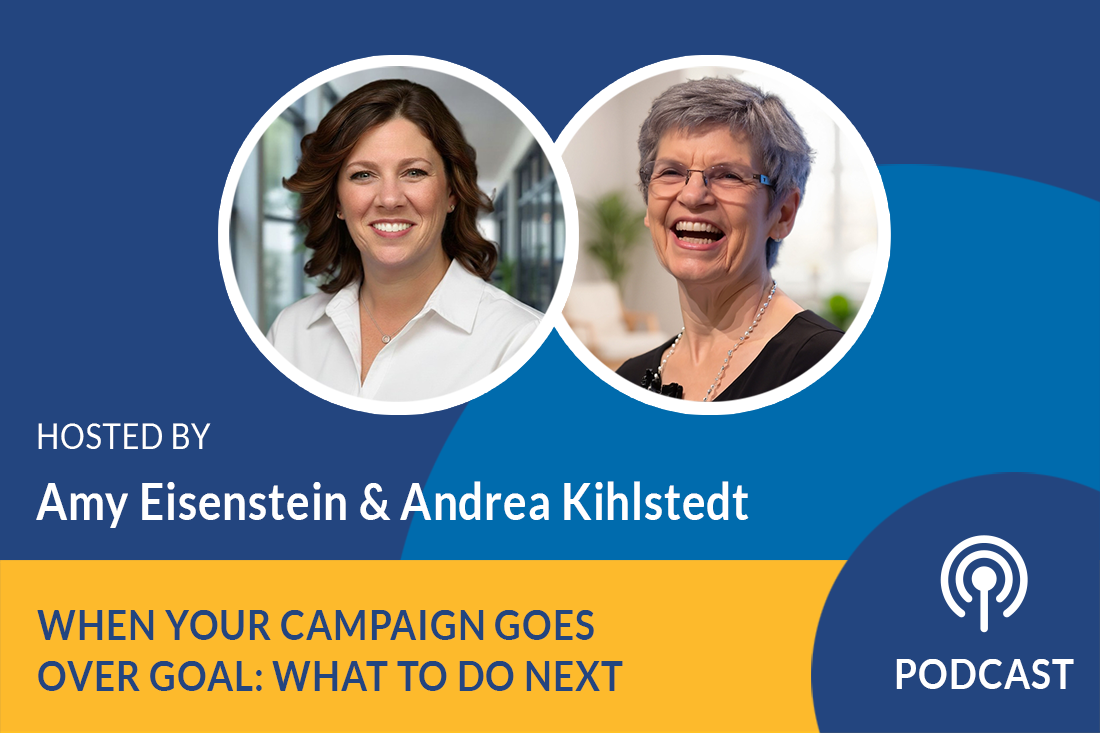
By Amy Eisenstein and Andrea Kihlstedt

Season 5, Episode 41

Three clients. One week. All of them over goal. And then the question no one fully prepares for: what do you do the day after?

In this episode, Amy Eisenstein and Andrea Kihlstedt celebrate a remarkable milestone — three Capital Campaign Pro clients crossed their campaign finish lines in the same week — and walk through exactly what nonprofits should do in the hours, days, and weeks that follow.

Whether you’re wrapping up a campaign right now or are still years away from your finish line, this episode will help you plan for the moment that makes all the hard work worth it.
Listen Now:


Andrea Kihlstedt:
Success is like magic.

Amy Eisenstein:
Hi, I’m Amy Eisenstein. I’m here with my partner and co-founder, Andrea Kihlstedt, and today we are talking about successful campaigns, which is so exciting. I love this topic.

Successful Capital Campaigns: What to Do When You Surpass Your Goal

Andrea, why are we talking about successful campaigns right now?

Andrea Kihlstedt:
Well, we had this amazing month. We happened to be doing this on the 1st of May, but during April, within the last week actually, we had not one, not two, but three clients finish their campaigns, go over their goals. And it really happens from one day to the next.

All of a sudden something they’ve been working on for years, all of them have been working on these campaigns for years, and all of a sudden they wake up and they check their numbers, and lo and behold, if it was a $5 million campaign, they raised 5,122,042 cents and they went over their goal.

Amy Eisenstein:
Hopefully not too many cents in there. But yeah, let’s just talk about it and give them a shout-out. We’re not going to name names, but we’ve got a hospital foundation, we’ve got an environmental group, and we’ve got a social service agency that went over their goal this week actually.

So it’s just such an amazing, amazing feeling for everybody involved. For our team, for their team. So today we’re going to talk about what do you do, the day, the week, the month that you go over goal. I mean, I think most people think about the big ribbon cutting or the big event, but that’s not what we’re talking about here, so let’s get a little more granular.

Campaign Success Hinges on a Small Group of People

Andrea Kihlstedt:
Yeah. So let’s think about what’s happened during these years of a campaign. When you begin a campaign, you pull together often a small group, a small committee. In our model you involve people throughout the life of your campaign, you involve both staff and volunteers in the campaign itself. At the same time, there are people who are working hard on developing the plans if it’s a building project, for example.

So you have people who are involved in the actual project planning point of view. And really over the course of three years or four years, however long it’s taken you to do, you probably have 40, 50, 60, 100 people who have been involved in making this happen, in one way or another. Some of them have been involved for the whole kit and caboodle, from the very first day when you started thinking about the project, and in doing the strategic planning that led to it, up through the campaign itself, and have had numerous conversations with executive directors, development directors, donors, I mean, for years, to make this happen.

Amy Eisenstein:
Right. And we can put a name to some of these people. So sometimes we think of, it may have started in the executive committee of your board, but the executive committee of your board three or four or five years ago may be different than today’s executive committee. But there’s often we talk about a campaign core committee who’s the kitchen cabinet or the core members of your campaign committee. Who was on that original board? Who’s on your board today?

So different ways to think about how to identify some of the… I mean, many of these people, it’s very obvious, but you may want to think back over time and think about who has made this happen from the beginning.

Be Sure to Thank Your Top People

Andrea Kihlstedt:
Well, and chances are there are some board members who were very active in the beginning and who cycled off during the campaign period. And you may have seen then some new board members. So when we stop thinking about throwing a big party and we start thinking about first of all, letting key people know, letting them be the first to know, you really will start by making a list. Just sit down and make a list of all the people you can think of who in some way or other had a role in this campaign. And then —

Amy Eisenstein:
Maybe the top 20 donors, right?

Andrea Kihlstedt:
That’s right. I mean, and maybe there is one donor who really kicked off the campaign’s success with a big gift. I know one of the organizations I worked with, there was a family foundation that set the tone with an initial contribution that set the whole campaign going. Now they don’t see these people every day, but really if you look back on the history of the campaign, it was those people who really set it up.

So you have to start by thinking back and really start making some notes, and say, okay, last night we went over our goal. Who do I want to tell today on day one of success? Who do I want to be the first to know or among the first to know? And how would I inform them? And maybe, I mean talking about this family foundation that set this campaign on the way, they called them up that day, saying:

“I thought you should be the first to know that your gift which you made three years ago, set us on the path to success, and last night we went over our goal.”

Amy Eisenstein:
How great would it be to get that phone call?

Andrea Kihlstedt:
Can you imagine, right?

So the idea is not to sit down and make a huge big list of people and then write one email that you send to everybody. The idea is to make a list and prioritize it, and pick the top 20 or 30 people, whether they’re volunteers or donors or board members or staff members who have really played a critical role of making this happen, and then either call them or write each of them a text or an email that is very particular to their work on the campaign, that lets them know that what they did through this long, complicated process, really made a difference. And you want them to be among the first to know, that —

Amy Eisenstein:
And if you can swap out any other donor’s name for their name, then it’s not personal enough. So say something about what they specifically did, or what you learned from them, or what you appreciate about them. If you can substitute anybody else’s name for the message you leave or the email you write or the conversation you have, keep thinking, because these are your insiders, your real gratitude opportunities. Right?

How to Thank Your Campaign’s Top People

And maybe the executive director takes 10 people and maybe the development director takes 10 people and maybe the board chair takes 10 people, but really what can you do to make sure that whoever’s being contacted on this day feels really special about it?

Andrea Kihlstedt:
Yeah, and you can tell them:

“Listen, we’re going to have a party. A little down the road. We’re going to have a party to celebrate, but I want you to be really among the first few people to know, because you’ve been so pivotal in making this happen.”

And I mean, that makes such a difference to have people actually be thinking about you, and it doesn’t need to be a big or complicated message. It just needs to be a message letting them know that you’ve thought about them and that something momentous happened and you want them to know and to know how important they’ve been to making this happen. You can accomplish so much with that.

Amy Eisenstein:
Yeah, so let’s take a few of those key people. So let’s say your board chair needs to be thanked and your executive director and development director also need to be thanked and acknowledged. So what role can everybody take in… You know? If you’re an executive director listening. The day you go over goal, you should do something really special for your development director. If you’re a board chair listening, you should do something really special for the executive director and maybe the development director too.

Thanking Your Staff

So this isn’t just about donors or board members or volunteers, but what can you do for the staff who have slogged through this campaign? I mean, say:

“Next week, let’s go out to dinner, let’s go out to lunch, let me treat the executive team for lunch.”

Or whatever it is. I think it goes both ways. And as board chair, you’re really wanting… You know? Andrea, you know, Sarah and I, we’re about to publish our new latest book called A Board Member’s Guide to Capital Campaign Fundraising.

So I’m always thinking these days about what can board members do to support the staff? What is their role? And I think the week the campaign goes over goal is a great opportunity for maybe the board chair writes an email to the rest of the board, acknowledging all the staff’s hard work and what they’ve done, and it’s a great opportunity to make the staff feel really special too.

Andrea Kihlstedt:
You know, the staff is particularly important, because of course what’s going to happen to the staff is that they have a brief moment where they can say, “Isn’t it great that we went over goal?” And then there is a huge amount of work to do on stewardship and following up and wrapping up loose ends.

There’s months of work to do to actually wrap up the campaign from a staff point of view. But taking the moment that it goes over goal and really celebrating that, letting everyone breathe for a minute before they go into this long, what really is not quite so exciting anymore. Right? It’s like wrapping up the loose ends —

Amy Eisenstein:
Pledge collection. Pledge collection, yeah.

Andrea Kihlstedt:
Pledge collection, not quite so exciting. Right?

Amy Eisenstein:
Yeah.

Andrea Kihlstedt:
So it’s important that you really do celebrate and recognize the staff in whatever way is right for your organization, but that you do it in a way that really is heartfelt and acknowledges and recognizes the hard work that’s gone into it.

One of the ways that I like to think about this is to think about it rather like an onion. You think about the people who are closest to the campaign, closest to the project, closest to the organization, and then gradually you fill in other rings of people who may not have been as close but who played a role. And you think, okay, at each one of these layers of the onion, how am I going to communicate with people? Right? What’s the best way to do that?

And gradually you build out. The longer you can stay personal, the better, as you build out your communication strategy. But at some point you’re not going to be able to do that anymore. That doesn’t mean that you shouldn’t take this going over goal moment seriously for everybody. We shouldn’t be very long before you send an email out to everybody saying, “Woo-hoo, we did it.”

Amy Eisenstein:
Right. “And you helped us do it.”

Andrea Kihlstedt:
Yes, exactly.

Amy Eisenstein:
“We couldn’t have done it without you.”

Andrea Kihlstedt:
Exactly.

Amy Eisenstein:
Which is true. So I’m glad you brought us around to this communication strategy, Andrea. Of course all of our clients have access to our Online Toolkit, and there, there is a communications plan, grid, and strategy, and it really focuses on who and how and when. And I think that’s sort of the crux of some of this, is what is the message, who are we messaging to, and how are we messaging to them?

Thank Key People Before You Announce Your Success

So eventually of course you’re going to announce your campaign is a success, in lots of vehicles, email, on social media, probably a press release. But what comes before that, and as you say, how personal can it be? And the closer they are to the center of the onion, the more personal the communication method and strategy is.

And it does take some thinking about, because you don’t want your biggest donors to find out with a press release or on social media.

Andrea Kihlstedt:
Right. That’s right.

Amy Eisenstein:
You don’t want your board members to find out when you post to the public. So there is an important nature of thinking about the rollout and the strategy. And for those organizations that are passing their campaign goal this very month, it’s not too late to roll it out well, but if you’re not quite there yet, you can start thinking about it.

Andrea Kihlstedt:
Yeah. The other thing to consider is that when people have been part of a success, it makes them feel happy to continue on with the organization. It feels great to be part of something that’s successful. You feel like you kind of have a little ownership of it, or it makes your heart glow.

So handling this moment in a campaign well and making maximum use of it, has really long-term consequences. If it’s a building, once the building is open and the ribbon is cut, and the people you called when you went over goal, will come to that ribbon opening, will feel like they are part of it. Sometimes we spend so much time thinking about the big formal ways to do things, but by far and away the most effective communications and ways to deal with people are the personal ones where we say, “So-and-so, when you made that gift back in such and such, it really set us on our way.” And without —

Amy Eisenstein:
If you’ve had significant people who did challenge matches, you might want to include them in this core list. Because they leveraged their gift, they lifted people up, they moved the needle. So —

Andrea Kihlstedt:
Speaking of challenge gifts — so one of our clients that just finished their campaign, finished it with a challenge gift, that in the email that they sent, it says:

“We’re within spitting distance of our goal, and someone has given a challenge gift. And for every 10 gifts that come in between now and midnight, we will put in an additional $10,000.”

Amy Eisenstein:
Nice.

Andrea Kihlstedt:
So it was a very targeted, specific thing that actually finished the campaign for them. And of course once it went over the goal, I imagine one of the first calls that they’ll make is to the person who put the challenge out there.

Final Thoughts

Amy Eisenstein:
Yeah. Great. I love that. All right, so if you’re thinking about a campaign, getting ready for a campaign, this may seem very far away, but this is what you’re planning for. This moment of going over goal. This is the payoff of years and years of hard work.

And so you may be two, three, four, five years away from this milestone, but it is exciting to think about, and what we’re all aiming for when we plan a campaign. So if that’s you, I’d love for you to visit the Capital Campaign Pro website at capitalcampaignpro.com, and sign up to talk to us, because we work with clients every day who are getting ready to go over their goal and planning to go over goal, and we’d love to talk to you about how we might help you in that process.

So Andrea, thanks again for a great topic and for bringing this to our listeners.

Andrea Kihlstedt:
It’s a fun topic to bring, right? We often use this time to wrangle with problems.

Amy Eisenstein:
Yes, yeah.

Andrea Kihlstedt:
It’s fun to use it to wrangle with success.

Amy Eisenstein:
Yeah, I love it. All right, great.

So call your donors and plan for success, plan for that day when you go over goal. It may be sooner than you think. All right, thanks for listening. We’ll see you next time.

Filed Under: All About Capital Campaigns Podcast

You Might Also Like...

Podcast: How a Capital Campaign can Turbo-Charge a Modest Fundraising Operation

By Amy Eisenstein and Andrea Kihlstedt

Podcast: Three Myths About Where Your Biggest Campaign Donors Come From

By Amy Eisenstein and Andrea Kihlstedt

Reader Interactions

Leave a Comment Cancel reply

Your email address will not be published. Required fields are marked *

Footer

Everything You Need for a Successful Campaign

Talk to Us

Get to Know Us

  • Free Strategy Session
  • Campaign Consulting
  • Feasibility Studies
  • Campaign Readiness
  • Meet the Team
  • Partners
  • Contact Us

Resources

  • Campaign Resources
  • Campaigns: Ultimate Guide
  • Campaign Pro Blog
  • Weekly Podcast
  • Free Webinars
  • Live Q&A Sessions
  • Research

PO Box 686  |  Westfield, NJ 07090  |  Ph: 201.970.9766 © 2026 Capital Campaign Pro, LLC  |  Privacy  |  AI Policy  |  Terms  |  Refer & Earn

Get More Capital Campaign Advice

Our weekly newsletter is full of practical tips to make your campaign more successful. Subscribe today: