
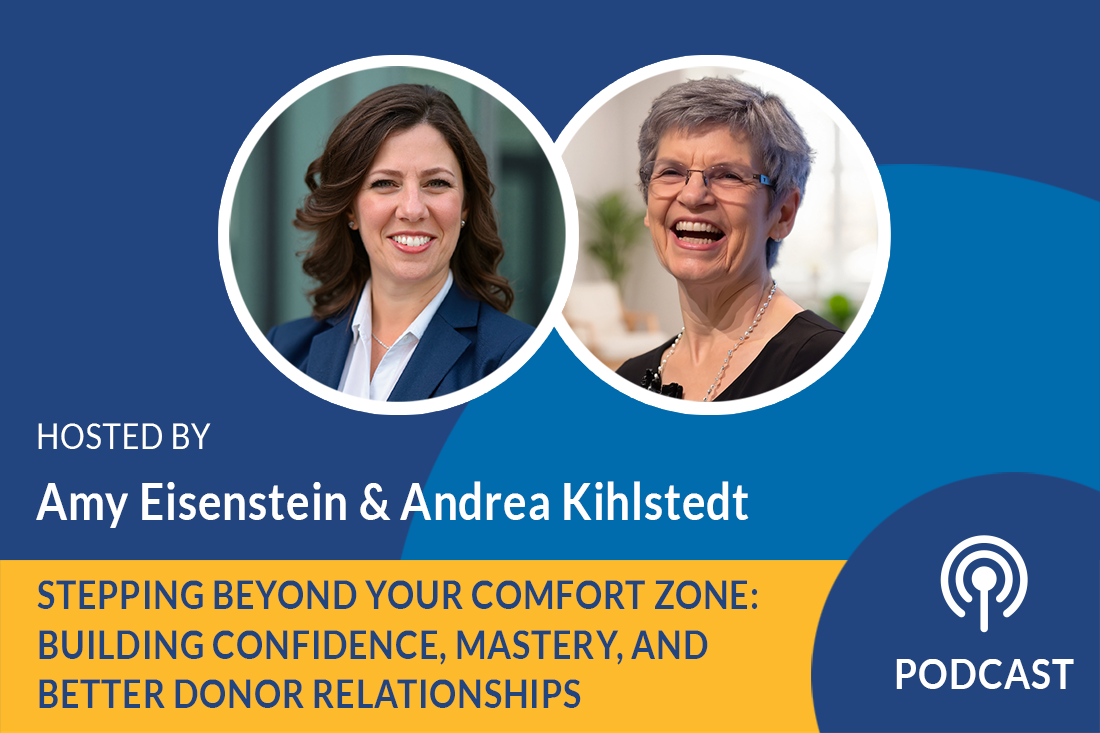
Podcast: Stepping Beyond Your Comfort Zone: Building Confidence, Mastery, and Better Donor Relationships
Season 5, Episode 14
In this episode, Amy Eisenstein takes the guest seat as Andrea Kihlstedt interviews her about stepping outside her comfort zone — preparing for and delivering a 35-minute keynote speech without notes in front of hundreds of peers. Amy shares how she built confidence through practice, coaching, and mastery — and how those same principles apply to fundraisers leading capital campaigns.
This conversation will inspire nonprofit professionals to stretch beyond their comfort zones, refine their skills, and embrace the mindset that confidence is built, not born. Whether you’re preparing for your next major gift conversation or simply trying to deepen your donor relationships, Amy and Andrea’s insights will help you approach your work with mastery and ease.
Listen Now:
Andrea Kihlstedt:
Does your capital campaign have you stepping outside of your comfort zone? If so, today’s topic is for you.
Amy Eisenstein:
Hi, I’m Amy Eisenstein. Of course, as always, I’m here with my colleague and co-founder and partner, Andrea Kihlstedt. And today we’re going to turn the tables a little bit because often I’m more in the interview position and you’re answering questions and today we’re going to flip the script a little, aren’t we?
Andrea Kihlstedt:
We are. We are. Today, I am going to interview Amy about how she handled it when she was outside of her comfort zone and what she did about it and what happened.
Stepping Beyond the Comfort Zone: Amy’s Personal Story
So here’s the quick story. Amy has been doing presentations and trainings for quite some time, but she recently was invited to give a big keynote speech by the Case Conference, actually the Community College Conference of Case where there were going to be about 500 people in the room. It was one of these lunchtime keynotes where you really have to be on your game. And they asked her to do this keynote and she took a deep breath and she said “yes.”
And as with many times, when you agree to do something that’s going to push you up, push you beyond something you’ve done before, you say yes, and then you say to yourself, Oh my goodness, what have I done?
Amy Eisenstein:
I don’t know if I said that, but I said, “What do I need to do to prepare?”
Andrea Kihlstedt:
Right. Well, I would’ve said, “What have I done?” And then I would’ve said —
Amy Eisenstein:
No, no. I was excited. I’m excited.
Andrea Kihlstedt:
You were just plain old excited. So okay, Amy, you had this talk you were going to give like 25 minutes over at lunch hour in front of a big group of people who were professionals in our field and you knew you had to do something to prepare. How did you think about it? What did you do to get going?
Amy Eisenstein:
Well, as you know, as you mentioned, I’ve been speaking at conferences for 15 years. So I’m not new to giving talks, to training, to speaking at conferences, to doing workshops. But this particular keynote was of a different level and I’m excited. I’m ready to go there. And so I actually signed up months ago for this very intensive six-month training on upping your speaking game.
And so I have been working hard for months now with a coach, with a trainer through a program on writing better speeches, on delivering better speeches in terms of delivery, content, all of the things that go into speech writing. So it was an amazing opportunity, but it got me out of my comfort zone. I gained new skills, new confidence. I worked hard.
Like Doing a Capital Campaign for the First Time
And I think the reason we’re talking about this, telling this story is both because when development directors and executive directors do a campaign for the first time or even for the second time, they are. They’re getting out of their comfort zone. They’re leveling up their skills. They’re gaining skills and confidence and it’s the same idea. And we do that around here too so I think that’s in part why we wanted to share this story.
Andrea Kihlstedt:
So I’m going to jump to the end of the story because I want people to imagine, and this really is what happened. I want them to imagine you walking with great confidence onto the stage of this big room with so many people without a note, without slides, just ready to take over and give your speech for about what, 25 minutes? Is that what it was?
Amy Eisenstein:
35 minutes.
Andrea Kihlstedt:
So it was a long speech. And you held the crowd for that whole time and you did it because you had prepared and thought about it and had coaching and worked on it in ways that you had never done before. Now, how did you actually do that? What was your relationship with your coach like? Was it similar to the way someone might work with a coach on Capital Campaign Pro? I don’t know.
Amy Eisenstein:
Well, it’s so interesting. When I first learned about this program, I was startled, surprised, and delighted to learn that their model was so similar to our coaching, advising, consulting model that we do here with our clients at Capital Campaign Pro. And the idea that I had access to online tools, resources, videos on how to start thinking about the ideas, the stories, the construct of a good speech and how to develop it, practice it, rehearse it, and then meeting with my coach about every other week or so to implement it was really similar to how we work with our clients and amazing how much it moved the needle in terms of my skillset and confidence.
And I think the one thing that was a total aha about four weeks before the speech, I’m reading it to my coach, I’m practicing it, and he says, “Put your notes away. Just get rid of them.” And I thought, “Well, I can’t do it. I don’t know it. I can’t do it that way.” And that one sentence was worth the whole month or six months of payments that I paid him because that over the next week changed the way I practiced, rehearsed, thought about it and just getting rid of my notes was so transformative. And I think that to me is the magic of working with a coach. One little idea that was a throwaway comment on his part. It was the first time I figured out … Well, it took a few days, but oh, I can do this without any notes at all.
Andrea Kihlstedt:
Right. You know, Amy, what that reminds me of, I think it’s so important and such an important point. What it makes me think of is that when you could do that speech for 35 minutes with no notes, you fully own the material.
So you could be right in the room, you could be with the people in the room, not trying to click or to get new slides, not trying to look at your notes, not trying to … Where am I? Not trying to read. But you could drop all of that and then you could really be responsive to what was going on in the room. Now, what does that remind me of? It reminds me of the solicitation process.
Amy Eisenstein:
Of course.
Andrea Kihlstedt:
Of what it’s like to actually solicit a gift from someone. And people get so concerned when they think about soliciting a gift. What material do I need? Do I need a script? What are the questions I should ask? When you get really good at soliciting a gift, you don’t need anything. You can put your notes away and just like you were in the room, Amy, with your group, when you really become an experienced and good solicitor, you know the material so well that you can just be there with the donor having a real conversation right in the moment.
It’s Not About Winging It; It’s About Being Prepared
Amy Eisenstein:
I think that that’s so important. A few things that you said. One is I didn’t wing it. So you’re not suggesting winging it or making it up as you go into a donor meeting. It is about knowing your material and your questions and the arc of the conversation that you’re going to have so well that you can be flexible in the moment, but it’s not that you’re not practiced and rehearsed. You’re so practiced that it sounds natural.
That was the goal is that it sounds natural, but in fact, I’d put hours and hours and hours into preparation, practice and rehearsal into it. And I think that that is what makes a good solicitor good, that you can change in the moment. When there was some audience interaction and donor interaction, you need to be able to respond in real time, but you also need to really have a mastery of the material and what you’re going to say and how the conversation could and might go.
Andrea Kihlstedt:
Yeah. I love that word mastery. You really worked so hard that you mastered the material just like you will do when you talk to donors, right? You master the material, you know what the mission is, you know what the case is so clear and so well that you can really focus on who the donor is and what the energy in the room is.
Building Confidence and Mastery with Your Material
Now, let’s talk for a minute, Amy, about the content of your speech. So far, we’ve really talked about what it is you did to get yourself to be a really good speaker. And it was very successful, by the way. She really pulled it off. But what was your speech about?
Amy Eisenstein:
Well, the speech was about helping fundraisers be happier at work and develop good habits so that they raise more money. And the key habit that I focused on in this particular speech was truly engaging with or speaking with one donor from a select list of 50 prospects every day.
So you have your top 50 prospects as we often do in campaigns. That’s who we’re thinking about as we head into a feasibility study and in the quiet phase. Who are those 50 lead prospective donors who could make a real difference at this campaign and selecting one from the list of 50 to speak with and engage in a real and meaningful way every single day.
I think the challenge is that most development directors and executive directors are wearing so many hats, doing multiple things responsible for everything from grant writing to event planning to direct mail, that somehow talking to donors takes a backseat and most development directors aren’t in the habit of really engaging with donors in meaningful ways. They give up too soon, they get discouraged, they get distracted or have other things going on. But that was the point of the speech is that good habits, speaking with donors every day will make you happier and more successful.
Andrea Kihlstedt:
Yeah. It’s so interesting to think about why so many people hesitate to be in touch with their donors and they’re not in touch with a donor every day. That’s rare in our business where we talk to somebody and we talk to lots of people in lots of organizations and we rarely talk to somebody who says:
“I have a practice of being in touch with my major donors, a major donor every day.”
Nobody says that to us. And they shouldn’t be saying that to us. They should be doing that. Now, why aren’t they? What gets in the way? I think this ties actually back into the beginning of our conversation, and it’s because they don’t feel this sense of mastery. They’re nervous about what they should be saying and how they should be saying it.
And what happens if a donor says no, or what happens if a donor asks a question that they don’t know the answer to? Or what happens if the conversation doesn’t go well? There are so many things that hold them back.
Amy Eisenstein:
Well, that brings up the issue or … I told you that I messed up in the middle of the speech and how I recovered. So I want to tell that story in just a minute because it happens, right? I did freeze and fortunately I survived to tell the tale. And I’m going to share that in just a minute.
Talking to Donors Naturally
But first I want to go back to what we were talking about in terms of the importance of talking to donors. One of the stories in the speech I told was of a client that we worked with over the last few years who did a Guided Feasibility Study. It’s a community college and the director of the foundation of the community college went and included one of her key prospects, lead potential donors to the campaign in the guided feasibility study with us. And she talked to him and he basically said, “Unfortunately, your campaign is not one of my priorities and I’m not going to support the campaign.”
Now, she could have at that point said, “Thank you very much,” and never talked to him again. But something in her … She had this sense that he could and might and should be the lead donor for her campaign, but even after he told her no, she kept in touch regularly, reaching out quarterly to consult with him, to give him updates, to ask for his advice and feedback, and even ask him about other donors and how she might approach them in the community.
And you know the end of the story. After two years, he came through with the lead gift of $2 million for that campaign. And if she had not been the one to interview him initially in the feasibility study, she would never have kept in touch with him. And even after he said no, she kept in touch. And that’s what we’re talking about in terms of really making donors partners in your process and not just surface conversation. She really consulted in him, confided in him, valued his feedback about others in the community and looked to him as a partner, even when he wasn’t or might not have been a donor.
Andrea Kihlstedt:
Amy, I think another side piece of that particular story is that the more she met with him, the more she got to know him, the more those meetings felt perfectly natural, the more she didn’t need notes, the more she didn’t need collateral, the more they were just conversation. It was a mastery. She had a mastery about her conversation with that person.
Amy Eisenstein:
Yes. And then he trusted her.
Andrea Kihlstedt:
Right. That’s right.
Amy Eisenstein:
And then they had a real relationship. And it wasn’t just about money because he had told her no. And so then she could talk about other things and get his advice and feedback and then the gift happened because they had a relationship and he trusted her and he knew she was doing a great job with the campaign. Totally an amazing, amazing story.
Andrea Kihlstedt:
Interesting to me how all of these themes come together, right? The theme about practicing and about trying out things that feel daunting and getting help and expertise in helping you do that and actually facing your own fears and moving ahead and working on things until you own it well enough so that you are perfectly comfortable. And then you can sail just like you did in your story. But you have to tell your story about what happened before our time runs out. Now you teased that.
Recovering from a Freeze – Don’t Panic
Amy Eisenstein:
All right. So I was doing great. I was probably 20 minutes into this 35 minute talk and I was telling stories and I was making my points and the audience was with me and I just froze. I had no idea what came next. I didn’t know what I was supposed to say or where I was going. I couldn’t remember where I was and I paused and I said to the audience, “You know what? I’m having a senior moment.” And they were with me. And I said:
“I don’t know what I was talking about or what I was going to say.”
And I was buying myself time and I took a deep breath and I said, “You know what else?” I said, “I turned 50 this year.” And they cheered. Everybody cheered. And I said, “Listen, I have totally forgotten.” And then of course it came back.
Maybe it was 30 seconds. It might’ve been a minute. It felt like an eternity. But of course I said, “What were we talking about?” They didn’t have to answer. I figured it out myself. I got back on track. The rest of it was fine. But I think too many fundraisers are afraid of those moments and we’re all human.
If you can say to somebody, listen, I’ve never asked anybody for this much money before, and I am a nervous wreck, but the mission is too important for us not to have this conversation. I think you can be genuine, authentic. I just said, “You know what? I totally don’t know what I’m talking about.” I froze. The audience was totally there to pick me up and support me and your donors will be too. Just be authentic, be yourself, be vulnerable. And somebody, when I was finished and I was cleaning up and somebody came up and she said:
“Oh, what a Brené Brown moment we just had. You were so vulnerable. It made us love you even more.”
I wasn’t perfect and that’s okay. I let the audience in on that and it endeared them toward me, I hope. And it’s okay. I survived. I messed up and nothing bad happened.
Andrea Kihlstedt:
Right. In fact, good things came out of that.
Amy Eisenstein:
Good things came —
Andrea Kihlstedt:
You were able to be vulnerable.
Amy Eisenstein:
Right.
Final Thoughts
Andrea Kihlstedt:
So Amy, let’s wrap up. It’s been such fun trying to pull all these many threads. This has been a complicated recording, I think, a complicated discussion. Because on one hand, we’re talking about stepping up your game and getting the help and advice and consulting you need in order to do that.
We’re talking about how much time and energy it takes to practice, to develop real mastery of whatever it is you’re doing, whether it’s capital campaigns or soliciting gifts or giving a big speech, how much effort that takes until you own it enough to settle into it. And finally, we’re talking about the actual content of your speech, which is to develop great habits, including talking to a donor every day.
Amy Eisenstein:
Yes. Well, I’m excited to say that I’m towards the middle or end of my six-month speech writing intensive and not just writing, performing, all of it. And so I just want to say that I’m available to give keynotes. So anybody listening, planning a conference, I’m ready. I’m ready.
And this spring and next summer, I’m going to have two really well-developed polished keynote topics. So I can’t wait to share them with the fundraising community, the nonprofit world. I’m super excited about it. So thank you for giving me the opportunity, Andrea, to share this journey I’ve been on with our listeners.
Andrea Kihlstedt:
Oh, I’m so proud of you. You and I worked together for, I don’t know, eight or nine years now, and I’m just always bowled over by the intention and attention you put into making yourself better, into learning new things and carrying them out and doing them well. It’s impressive. We can all learn from your model, Amy. Thank you. Thank you for that.
Amy Eisenstein:
Well, thanks, Andrea. All right. Well, thank you listeners for joining us and we hope you’ve been inspired and motivated to learn new skills and get a coach and level up your game and your confidence and we’ll see you next time.


Leave a Comment