
Podcast: Should Consultants Interview Your Donors? Rethinking the Capital Campaign Feasibility Study
Season 6, Episode 9
What if the most valuable part of a feasibility study is the donor conversation your consultant never has?
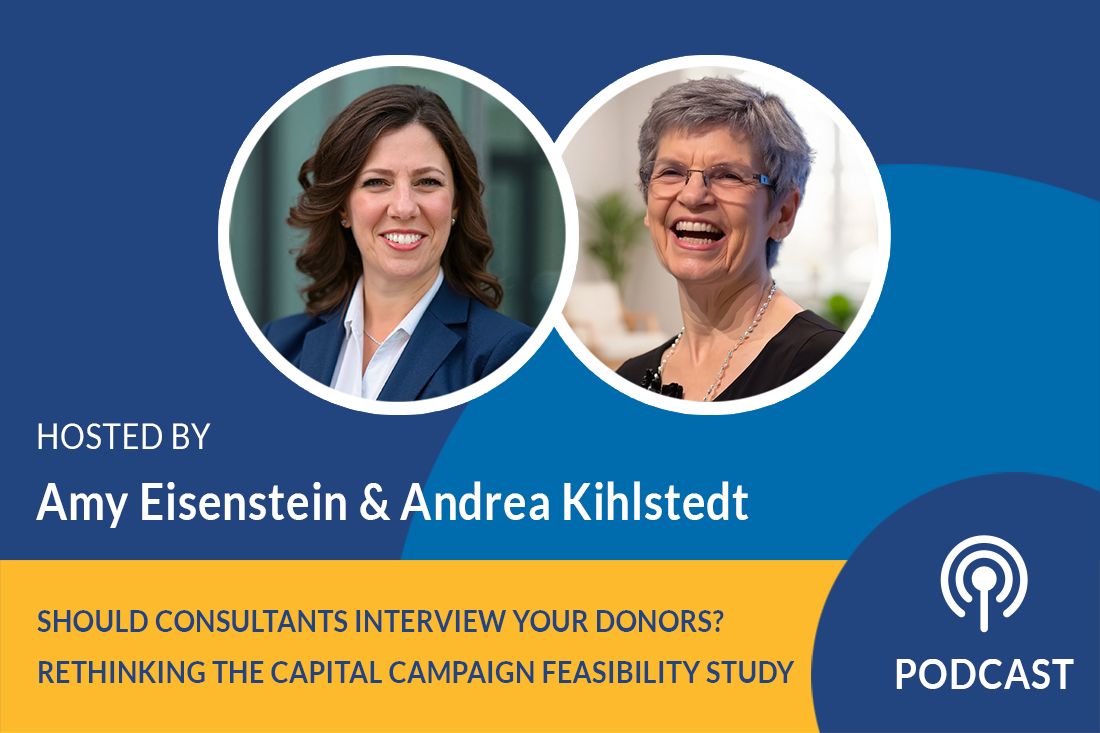
In this episode, Capital Campaign Pro co-founders Amy Eisenstein and Andrea Kihlstedt challenge a longstanding assumption about capital campaign feasibility studies: that an outside consultant should conduct confidential interviews with your largest donors.
If your organization is considering a capital campaign, choosing a feasibility study model, or wondering how to engage major donors before making an ask, this conversation will help you think through who should be in the room and what your team could learn by being there.
Watch now:
Listen Now:
Amy Eisenstein:
Does your organization do things same old, same old, because they’ve always done them that way? Or do you try new things that are better? That’s the topic of our podcast.
Hi, I’m Amy Eisenstein. I’m here with my colleague and co-founder, Andrea Kihlstedt. And today we are talking about fundraising feasibility studies. And we’re talking about them because they’re often the way that campaigns get started and there’s a better way to do them than we’ve done them in the past.
Andrea, let’s talk about them.
Pioneering a New Model for the Capital Campaign Feasibility Study
Andrea Kihlstedt:
Yes, Amy. For years and years and years, the way fundraising feasibility studies were done was that you hired a consultant and the consultant went and did confidential interviews of your top donors. And then they put together the results without sharing them with you because they were confidential and they came back and told you how much they thought you could raise in your campaign. That’s standardly the way they were done.
About 10 years ago, we decided that it was high time that the model was changed. I had been in the consulting business a long time and there was things about that model that constantly bothered me. And I thought, well, why don’t we see if we can experiment? And what was the change that we wanted to instigate? We thought that feasibility studies should, rather than having a consultant having us go and talk to your major donors, that we should train you to go and talk to your major donors. I mean, after all, that’s where the relationship really should be.
So wouldn’t it be possible, couldn’t it be possible to work with leaders of the organization so that they could go and talk to their largest donors in feasibility study conversations, and then we could help them make sense of those conversations and come up with a perfectly reasonable and effective campaign goal and report where everybody then knew what went on in those.
So we changed it from having the consultants do the interview to having the leaders do the interview. Now that was about 10 years ago we started down this path. Since then, we have done well over a hundred.
Amy Eisenstein:
Yeah. Well, hold on. So when we first did them, we didn’t know if it would actually work because we were so entrenched in the standard best practice at the time, and we sort of subscribed to and bought into this idea that donors would reveal things in a confidential setting, in a confidential conversation, and that really it was considered best practice for a consultant to do these interviews confidentially with the biggest donors. So when we tried them, the first two or three, we weren’t sure if donors would open up to nonprofit leaders.
Luckily, we had two or three organizations that were willing and happy to be guinea pigs with us, and we really weren’t sure it worked. But now a decade later, over a hundred organizations have done this. We have learned that, of course, this model has turned out to be so much better than we even imagined it could be. And I think one of the reasons that we’re talking about this today is because we recently saw a blog post by a colleague, a consultant that we both know and we’ve worked with over the years, we’ve respected, we’re friendly with them, and yet they are still strongly advocating for this old model. And so we had to talk about it, Andrea, right? We had to.
Andrea Kihlstedt:
That’s right. That’s right.
3 Myths About Feasibility Studies Holding Campaigns Back
Amy Eisenstein:
So let’s start with three reasons that nonprofit leaders, board members, and honestly consultants believe still 10 years later that the consultant should do the interviews. People are afraid to change.
Myth #1: Donors will be More Honest with an Independent Campaign Consultant
So what’s one reason that people say, and then we’re going to refute it, of course, that the consultant should do the interviews?
Andrea Kihlstedt:
The belief, Amy, is that if a donor talks to an independent consultant as opposed to the executive director, the board chair of the organization, that they will be more open, that the donor will be more willing to say things, negative things perhaps that they feel about the organization than they would be if they were talking to the executive director or the leaders of the organization, so that it’s easier to unearth bad stuff. I mean, really that’s terrible. What a terrible reason to set up a process. You’re setting up a process with the assumption that people have bad stuff to say or that you’re wanting to unearth bad stuff.
Amy Eisenstein:
And the model has no recourse. So let’s say that a donor does say something bad, then what happens is the consultant gives the nonprofit a report that says somebody among this group of 30 donors said something bad, but I’m not telling you who it is and you can’t get back to them and there’s nothing you can do about it. I mean, the whole thing is so crazy.
Andrea Kihlstedt:
I know. It’s so amazing to me that this went on for so long and that nobody asked these fundamental questions. These supposed feasibility study interviews that consultants do are supposedly confidential, that the consultants will not share with the organization what the donor has said in the interviews. And that the presumption is that there is bad stuff to share. When I was doing interviews like that and feasibility studies like that, I always wondered, frankly, why executive directors weren’t more worried about hiring consultants to go out and talk to their largest donors. I mean, it’s like really? While you can understand that the worry that a lead donor, a major donor wouldn’t want to say bad things about an organization to the executive director, you don’t want to presume that bad things are going to be the headline of these conversations.
Amy Eisenstein:
That’s a funny take. The other thing is that, well, now that we’ve been doing this for 10 years, we can say with all authority, full authority that first of all, donors don’t hesitate actually to say bad things. If they have something to say, they are happy to share it. I mean, it’s almost a joke here now, right? Nonprofit leaders are, “Oh, donors complain to us whenever they feel like it. They tell us all the bad things.” Great. That’s part of having an open, honest, real relationship is being able to talk about the challenges and the things that aren’t going well. And that’s a good relationship building tool, among many other reasons.
Andrea Kihlstedt:
We often talk about treating our donors, having organizations treat their donors as partners. Their largest donors really are partners. My friend Gail Perry used to say, “They’re partners, not pockets.” And I always thought that was a wise saying. And talking to your largest donors as getting ready for a capital campaign in these interview conversations are a wonderful way to really play out that partnership agreement, to say to your donors:
“Here’s what we’re planning. We want to know what you think of it. What questions might you have about it? Here are things we are wrestling with. We want your input to help us as we develop this plan.”
What a wonderful constructive conversation you can have with your major donors that way.
Amy Eisenstein:
Yeah. Okay. There’s so much more I want to say on the topic. There’s too many things whirling around in my head. Let’s go on to a next reason and maybe we’ll circle back to some things.
Myth #2: Campaign Consultants Won’t be Biased Compared to Nonprofit Staff
So another reason that people argue that consultants should do the interviews is that there is a concern that the consultant won’t be biased in what they’re hearing. They’ll be able to filter the information from donors more, I don’t know, with less bias than a staff member would because the staff member has more invested in the project happening. So what do you say to that?
Andrea Kihlstedt:
Well, first of all, everyone has some bias or other, that’s always. And what we’ve found is that we don’t just send people out to talk to their donors. We actually train them quite carefully so that they can go and have conversations with donors that are not selling the organization, but that are really inviting commentary and feedback and discussion. And people can learn that. We find that people are able to carry on these conversations without saying:
“Isn’t our organization great, and this is what we want to do, and don’t you agree with us?”
That’s a matter of being trained so that you really can do these conversations effectively without bringing bias to the process.
Amy Eisenstein:
But I think you’re right. Consultants bring their own bias. And the good news is that after a hundred of these, we’ve found that it works, that nonprofit leaders are able to parse through what they’ve heard in a reasonable way. And when people have concerns, it’s good for them to hear that because if one donor has the concern, other people have the concern, and they need to know that early on before heading into a campaign. Pretending it’s not there is not good for them. And that’s pretending the leaders aren’t smart enough to figure that out, and they absolutely are.
Myth #3: Nonprofit Leaders Don’t Have Time to do the Interviews
Another thing that we hear or another reason that we hear that consultants should do the interviews is because nonprofit leaders don’t have enough time. Now, this sort of begs the question, is it really about time or is it because they’re nervous to go out? Are they not making the time? But to me, what we talk about here at Capital Campaign Pro is what could be a bigger priority for a nonprofit leader heading into a campaign than meeting with their top 30 donors? And of course they don’t have time.
Nobody has time for anything. The question is, what are you going to prioritize? And part of our job as consultants is to help prioritize, delegate, find the time, offload. You can give a consultant other things like grant writing or event planning or writing your annual newsletter or your monthly newsletter, whatever it is. You can hire help, administrative help. There’s lots of things to help with the time issue. If you don’t make time to talk with your biggest potential donors, are you going to make time to ask them for gifts?
Andrea Kihlstedt:
It’s a good question. Right. It’s a good question. Right. What’s more important? I mean, that’s really what I’ve often said that to organizations when they say:
“I don’t have time. I’m so busy, I don’t have time.”
I say:
“Well, what is more important than talking to your largest donors?”
And they kind of go… Right?
Amy Eisenstein:
Yes. All right, so let’s talk about some more reasons. I mean, we sort of started to talk about these three reasons people think consultants maybe should do the interviews, which hopefully we’ve refuted a little bit, but let’s talk about the real benefits of this new model. We keep calling it a new model. Is it new if it’s 10 years old now? And something we talked about before we hit the record button but I want to sort of bring back is that we’ve been talking about this model now for almost a decade and it’s actually catching on.
Other consultants are starting to do it. Nonprofits that we’re talking to are talking to multiple consultants that do this model where the consultant trains the nonprofit leaders to have these conversations. And yet there’s still enough resistance that people are just dragging their feet coming along to this better model.
4 Reasons Why Nonprofit Leaders Should Conduct Feasibility Study Interviews
So let’s talk about some reasons that hands down, no contest, it is better to have nonprofit leaders in the rooms with their donors than consultants. They’re irrefutable.
Reason #1: Donors Prefer to Speak to Nonprofit Leaders, Not Consultants
Andrea Kihlstedt:
Amy, I’ll give you the best one on my list.
Amy Eisenstein:
The top one. What’s the top one?
Andrea Kihlstedt:
Top one on my list. Because donors like it better. Donors like to talk to the leaders of the organizations. In fact, as we were thinking about shifting models, one of the reasons we did is because we had some people we knew who were philanthropists who got in touch with us and say:
“We get tired of having these young consultants who are not so young consultants come to our house to interview us on behalf of one organization after another. We would much rather talk to the leaders of the organization. Can’t you figure out a new model?”
We literally had donors calling us up to say you guys —
Amy Eisenstein:
I think the words of one of them were, “They beat a path to my door.”
Andrea Kihlstedt:
“I’m tired of it.”
Amy Eisenstein:
“I don’t want to talk to another consultant. I don’t need a middle person.” That’s what it is. It’s a middle person who doesn’t actually know that much about the organization or the campaign. Okay, so the number one reason is the donors would prefer to talk to leaders of your organizations. Do we need any other reasons?
Andrea Kihlstedt:
Well, let me tell you that we now have some pudding and the proof is in it. So what is the pudding? Well, we have a lot of donors who have had conversations with a lot of organizational leaders over many years, and no donor has said, “Gee, I’d rather talk to a consultant.” We have not heard that once, though in the beginning we were timid, so we would make that a possibility. If you would rather talk to a consultant, we can make that happen. Have people done that? No. That’s proof and pudding.
Amy Eisenstein:
Proof and pudding. Yeah. So I just love, we recently did a feasibility study with one of our clients this way, and honestly, almost every executive director is nervous at the beginning of this process. So are the development directors, right? If you don’t have lots of experience talking with big potential donors, it is nerve-wracking, which is why we prepare you so carefully. We role play, we practice, we practice some more, we debrief with you. But this executive director just really touched me when they came back and said:
“This process was so powerful because for the first time ever after being an executive director at this organization for 15 years, I’ve had these real strategic, authentic, open conversations with my donors. And I heard some things that if a consultant had told me that the donors said that about my organization, I wouldn’t have believed it, but I heard it right from the donors.”
And I just think, oh my God, that’s incredible. That’s why we do this this way. Okay. But there’s so many other reasons other than the donors actually wanting to talk to your leaders.
Reason #2: You Get Full Transparency when You Conduct the Interviews
Number two potentially on the list is that there’s full transparency. In the old model, the consultants are going in under the auspices of confidentiality. That’s in theory how you get donors to open up to you and say whatever they have to say about the organization, but that’s not good. In this model where your leaders are sitting across from your donors, you know exactly what everybody said, you’re able to make sense of the goal that you and your consultant work out as you analyze the data, and everybody feels comfortable and happy and excited about the goal because you know why the goal is the goal, because of the data you collected in these interviews.
And when the interviews are confidential in this old model and the consultant hands you a report that says, “Here’s the analysis and here’s what we think,” everybody’s left scratching their heads wondering, “How did they get to this number? How did they come to these conclusions?” But there’s no more of that. You’re in the room. There’s complete transparency.
Andrea Kihlstedt:
Well, and to follow up with that, Amy, I mean, that also means that when the campaign gets underway, you can go back to donors knowing what the prior conversation was. So you can go back to them and ask them for a gift informed by the prior conversation. You’re not pretending you don’t know or you know that they had a conversation but you don’t know what they said.
So it makes it very awkward when a consultant has had that conversation and you don’t know what was in that conversation. In this case, you can go back to people and say:
“We’re now ready for a campaign. We talked several months ago, and now I’d love to have a conversation with you about your gift to this campaign.”
It is a smooth, easy, comfortable road on both parts, both your part as the leader of the organization and the donor’s part because they know what they said too, and they know that you know what they said. Right?
Reason #3: It Paves the Way for a More Successful Solicitation
Amy Eisenstein:
Maybe that’s the number one reason. You’re better prepared for the solicitation. That’s the number one reason to do this model. There’s so many number one reasons. They’re all number one reasons. But the idea that you are better prepared for the solicitation because you’ve had this pre-ask meeting in this strategic conversation, you’re literally preparing the donor for the ask in whether it’s the next conversation or two conversations down the road, but this is the ultimate cultivation. I don’t know why you would want to outsource that to a consultant. It makes no sense. It makes the whole process choppy and you have to start over.
Andrea Kihlstedt:
It’s funny, Amy, that’s how change happens, that you do something in a certain way for a long time and you become familiar with that way and you are convinced of it because that’s just always the way it’s happened. And then when you start looking at it differently and you start turning it over and seeing it differently, all of a sudden it breaks apart and you start seeing things you never allowed yourself to see before. And I feel like that’s what’s happened with this feasibility study model.
Now that we fully understand how this new model works, we can’t imagine doing it the other way. It’s like, how did people… I mean, I did it the other way for a lot of years. How did I let myself do that without asking these questions? And it is the way change happens. You hold on to what you know until all of a sudden you realize that it’s broken and then you develop something new.
Amy Eisenstein:
So listen, if you’re listening and you’re having an aha moment, a light bulb moment, I want you to forward this episode to your leadership team, your board members, your staff members, key staff members. If you’re having a conversation about how should we do a feasibility study or how should we get started with our campaign or you’re just thinking about a campaign, this might be the episode that makes everybody sit up and go:
“Aha, I understand now. Light bulb.”
Reason #4: You Gain Tremendous Confidence in Your Fundraising Capabilities
Okay, so one more benefit is everybody on your team, the senior leaders at your nonprofit are going to have significantly new and better fundraising skills, major gift skills that they’re able to use throughout the campaign and beyond because you’re going to finally have gained confidence, cracked the anxiety of speaking to major donors, understand what it’s like to sit across from a major donor because there’s so much intensive training that we provide.
The truth is after the third conversation, everything gets better. The first three are filled with anxiety. But the good news is that when you go back to ask for a gift, even though there’s some anxiety, you’ve already cracked that nervous energy, you have more confidence, you’ve had this earlier conversation. But honestly, these skills will last you the rest of your career. Whether you stay at this organization or go to another nonprofit, you are going to be a better major gift fundraiser than you were before this experience. So that to me is transformative and magical.
Fianl Thoughts
Andrea Kihlstedt:
We could go on about this for a much longer time, but I think we’ve talked enough for today, Amy, right? We like to keep these short.
Amy Eisenstein:
All right. Listen, if you’re listening and you’re curious, visit the Capital Campaign Pro website. I’d love to talk to your leaders, your leadership team. If you’re thinking about a campaign, go visit capitalcampaignpro.com and sign up to talk to us and we’ll have a chat with your leadership team. And if you want to do our model, of course, we’d love to talk to you too.
So thanks for listening as always, and we’ll see you next time.


Leave a Comment