Podcast: How a Small Development Team Raised $10 Million for a Youth Shelter Campaign
Season 5, Episode 45
What happens when a nonprofit thinks it’s ready for a capital campaign—but discovers it still has critical groundwork to complete before moving forward?
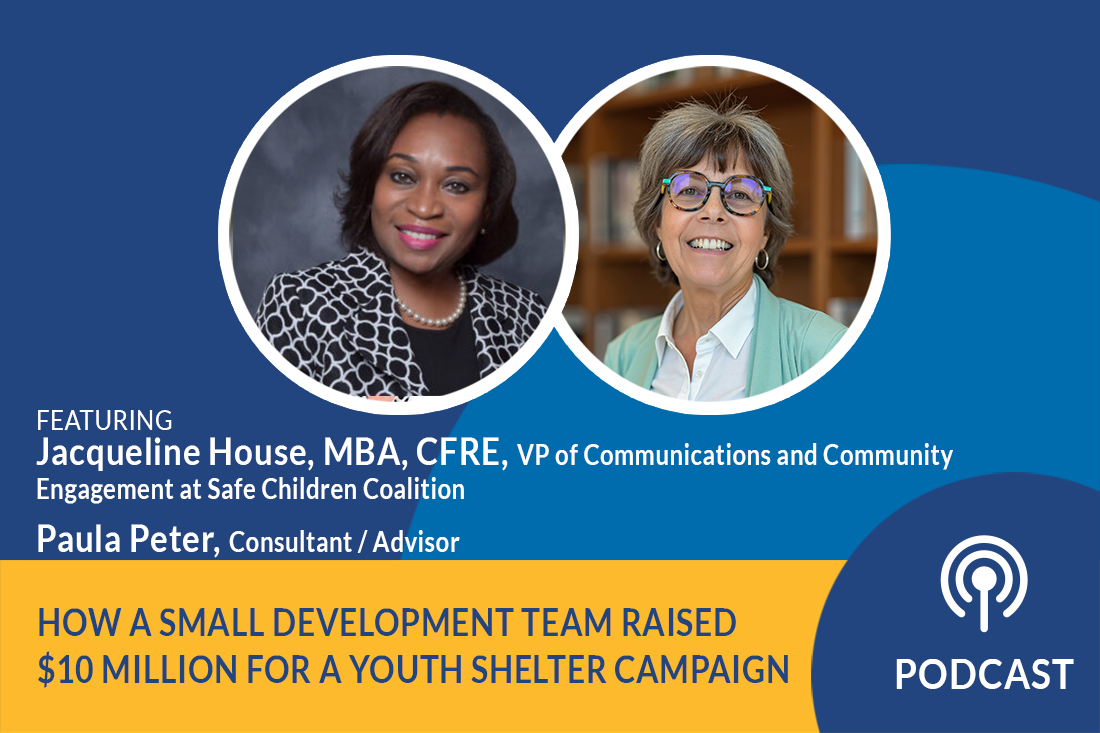
In this episode, Amy Eisenstein sits down with Jacqueline House, Vice President for Communications and Community Engagement at Safe Children Coalition, and Paula Peter, Capital Campaign Pro Campaign Advisor, to explore the remarkable story behind a campaign that grew from an initial $3 million goal to nearly $10 million raised for a new youth shelter serving vulnerable children across Florida’s Suncoast region.
If you’re preparing for a capital campaign or looking to improve your campaign strategy, this conversation offers valuable guidance from leaders who successfully navigated the challenges and opportunities of a transformational fundraising effort.
Listen Now:
Amy Eisenstein:
You’re in for a treat today because we have two very special guests to talk about an incredibly successful campaign with a small development shop. So stick around.
Hi, I’m Amy Eisenstein. Andrea’s taking a break today, but I have two very special guests with us today. We have Paula Peter, one of our campaign consultant advisor extraordinaires here at Capital Campaign Pro, and we have Jacqueline House, who is the Vice President for Communications and Community Engagement at the Safe Children Coalition. So welcome to the two of you. Thank you so much for being here.
A Capital Campaign for Safe Children Foundation
All right, so we’re going to start with you, Jacqueline. I want you to tell listeners about Safe Children Coalition and why you wanted to do a campaign. Give us a little background.
Jacqueline House:
Safe Children Coalition is the community-based child welfare agency on the sun coast of Florida, serving three counties in Circuit 12, Sarasota, Manatee, and DeSoto Counties. We serve over 10,000 children a year with foster care adoption and prevention and diversion programs. And we wanted to do a campaign because we needed a new youth shelter building, replacing a building that was built in 1959 that wasn’t providing the space needed for the children that we needed to serve. And so for a building built in 1959, we had used it as much as it could be used and we needed a new space.
Amy Eisenstein:
Yes, I can imagine. And tell us a little bit about how the campaign went and I’m giving a teaser and your first original working goal and then where it went and where you are now.
Jacqueline House:
Well, the campaign was a challenge because the board and senior staff thought we were in a campaign and we really weren’t in a campaign. The original goal for the shelter was around $3 million, then it was raised to 5 million, then it was raised to 7.5, then it was raised to 9.5 and we ended up raising almost $10 million.
Amy Eisenstein:
Oh my gosh. Okay. Can you imagine listeners, 3 million, to 5 million, to 7 million, now over $10 million? So first of all, congratulations. What an amazing accomplishment. So you, your team, everybody should be so proud.
And so of course here at Capital Campaign Pro, we are so honored to have played a small role in your success and Paula has been your advisors for several years now, three, four years, something like that. So Paula, why don’t you just say a little bit about the beginnings of your working with Jacqueline and sort of how far she’s come
Paula Peter:
Meeting Jacqueline in the very beginning was a instant delight for me. She’s focused. She was crystal clear about what advantages she had and what disadvantages she was working with in her organization. She had a wonderfully committed board that had virtually no idea about fundraising and how it happened and were supportive of it but not really able to engage.
So that was the first reality check for Jacqueline. It didn’t phase her. She had a CEO who was very new to the position and also a wonderful human being and a wonderful leader, came from program, not from administration. So Jacqueline was sort of herding everyone along and letting them know what she was going to do, but she was very clear-eyed about the fact that it was all on her shoulders and she had to figure out how to make it not be on all her shoulders. So I didn’t have to tell her that.
I just showed up and listened to her and said, “Okay, let’s see what is at your disposal here.” And she just worked it brilliantly. So it has been a delight and a learning. And Jacqueline ended up using structures that I’d not used in other campaigns in order to serve her, working with all of the community foundations, of which there are many in her multi-county area and did that brilliantly and they became her ambassadors.
So it was a brilliant campaign on all levels because it was all out of her instinct and experience that really drove it.
Amy Eisenstein:
Well, I know we’re having you two on the podcast because you have mutual admiration society for one another and your partnership I think was so effective for a variety of reasons, some of which we’re going to tap into today. So, Jacqueline, you’ve been a client of course of Capital Campaign Pro; that’s no secret.
Why Capital Campaign Pro Was the Right Choice
So let’s talk a little bit about why you chose Capital Campaign Pro and specifically for our feasibility study model. So just for listeners that don’t know, I mean, we do talk about it all the time on the podcast, but the model of feasibility study that we use or the approach that we take is that we guide the process and you, the leaders at your organization conduct the interviews with your donors. We help with all other parts of the process with coaching, with guidance, with support, with training. So why did you choose the model and how did you feel this gave you an advantage?
Jacqueline House:
We chose the model initially because there was a low barrier to entry. And as we were getting ready to go into this campaign, we had not yet had any seed donations or any funds that were available that we could see paying a large upfront fee for a consultant to help us through this campaign. So initially that’s why we were drawn, that’s why I was drawn to Capital Campaign Pro.
As I continued to work with Capital Campaign Pro, and the admiration is mutual for Paula, it was meeting us where we were at every single step of the campaign. So if we weren’t prepared to move forward, we could stay in that phase of the campaign and do more work until we were ready to move forward. And that low barrier of entry really helped us to stay where we needed to be in those phases before we moved forward.
The Guided Feasibility Study was something also that really worked well for us because we didn’t have relationships with major donors in the space where my organization was where program had existed for a long time, but essentially this was a brand new 501(c)(3) because of circumstances that had happened before I arrived. So we needed to develop relationships and the Guided Feasibility Study helped us to do that.
We did not have to guess about who said what. We were in the room, donors spoke directly to us and the myth that donors won’t tell you what they think, that’s not true. They will tell you the good, the bad, the ugly, what you do very well, what they have questions about, what they’re not sure about. And we learned that directly from our donors. And I think that was a huge advantage to being able to get those initial gifts because we had had a conversation, we had a foundation upon which to build and donors understood where we were going and what we needed.
The Guided Feasibility Study Process
Amy Eisenstein:
Great. I’m so glad. Thank you for saying that. So just so listeners understand, Paula helped prepare you for those conversations, right? Can you say a little bit about how that process worked?
Jacqueline House:
I think first of all, the reassurance that we could do this was valuable. And having Paula specifically focused on Safe Children Coalition and the donors that I was going to be speaking with and preparing those questions specifically for those donors, walking me through the different scenarios that could happen, what could be potential answers, what could be my potential response to those answers was valuable.
And in my case, we clearly weren’t ready for a campaign. We clearly were not. But being able to work with Paula and understand what we needed to do to get ready, to pause, get ready and then come back and work with Capital Campaign Pro to move us through those phases was invaluable. I think if we had put out a large consultant fee upfront, we would have felt pressured to continue even though we didn’t have those important building blocks in place.
Amy Eisenstein:
I think everybody at organizations are often, maybe not everybody, but many times people freak out about a pause. How long was your pause and did it impact your progress significantly?
Jacqueline House:
Our pause, as I remember, it was about six months. I think it was a necessary pause to push us forward to ending the campaign. So I think it wasn’t time wasted. It was time well spent making sure that we were ready to talk to donors and that we had answers ready for what it was that we wanted to do.
Amy Eisenstein:
Paula —
Jacqueline House:
I don’t know what Paula thinks about that, but I think it was time well spent.
On Taking a Pause During the Campaign
Amy Eisenstein:
Yeah. So Paula, I’d love your perspective on their pause and what you’ve seen with other organizations and with Jacqueline’s organization taking the pause. And then I also want you to comment, Jacqueline specifically mentioned the idea that lots of consultants say that they have to talk to your donors during a feasibility study because donors won’t be open and honest. And you did that model for decades before you switched over to the Guided Feasibility Study model. So I don’t know where you want to start. Which one of those two you want to start with?
Paula Peter:
Well, let’s close out on the pause a little bit because in my mind, most organizations have to pause at some moment in the structure, whether it’s before they go out for feasibility or whether it’s to really take in and understand the implications of the results of feasibility. And in Jacqueline’s case, they’ve never really done this before. The donor prospect pool and the interview pool were all pretty new. Some of them had given to the organization before, but there wasn’t really a relationship.
So for Jacqueline with a new CEO whose credibility was as yet untested, really getting the ducks in a row was critical. There was no time spent wasted in her shop. That’s just because of who she is mostly, but there was no wasted time. It was critical because when she went out to interview, she was on her game. I mean, it was clear from the responses she was getting. So I am actually pretty supportive of pauses for the right reasons at different times in the campaign. So I would just say that. Jacqueline, anything you want to say about that before I move on?
Jacqueline House:
I think also in the pause, the supportiveness of having Paula and Capital Campaign Pro say, “This is necessary.” Even though I have a board that doesn’t understand fundraising at that point, did not understand why we needed to take the pause, it was comforting for my CEO and board to know that, listen, this is a professional, this is a professional organization who has done many campaigns and they too agree that we need to take a pause.
Paula Peter:
Yeah. And it’s a learning. It’s a part of the educational process for your CEO and the board and it worked.
What Made this Pause So Effective
Amy Eisenstein:
Okay. So you know what? Before we get to the Guided Feasibility Study interviews, what did you do during the pause? What made the pause effective? Because you weren’t just sitting back and then go do your regular annual fund stuff. You were actually working to get ready for the campaign. So what are one or two things that that involved?
Jacqueline House:
We were in the pre-campaign planning phase and for us, that included really getting clear about:
- What is this youth shelter
- Why do we need it?
- Where is it going to be located?
- Do we actually have a site?
- Doing all the work to get a site and being able to work with programs to talk about what did this building look like?
- What’s going to be in it?
- Why is that going to be in it?
- Why is it going to be seven and a half million dollars at that point? What makes that up?
And for my organization who is 99% contract-driven, county government, state government funded, why do you even need a capital campaign? How are we going to answer that question? Why is someone else not doing this? Why do we need donors to do it?
And then it was also an opportunity for me to look at my shop and figure out what tools do I need? What additional consultants do I need? What additional staff positions might I need in order to actually be successful in this campaign? So it definitely wasn’t a sitting and just not thinking about the campaign. It was quite busy and getting ready to move the campaign forward.
Paula Peter:
And my recollection is, Jacqueline correct me if I’m wrong, but in addition to running the campaign and everything else in development, you played a key role in the project management of this building, correct? There was a lot on your shoulders.
Jacqueline House:
Yes. I think it needed somebody to drive it forward. And so if it was going to be driven forward on all fronts, I couldn’t fundraise without those elements, so I needed to get them in place.
Why the Guided Feasibility Study Model Worked So Well
Amy Eisenstein:
All right, Paula. So let’s circle back to this idea that you spent most of your career doing what we now talk about as the old model of feasibility study where you, the consultant interviewed donors on behalf of organizations and you probably believed as most consultants do or did, that it was important for consultants to interview donors for confidentiality, and honesty, and openness reasons. And now we’ve switched the model. So how do you think about that and how did it work for Jacqueline?
Paula Peter:
Well, I did this work, feasibility work starting in 1990. And I would say for the first 18, maybe even 20 years of doing this work, I was a diehard about believing it needed to be confidential interviews. I was very good at it and I got unbelievable feedback and data and what a client needed to be really, really helpful in crafting campaign plans for them and for clients. And I would say that I came kicking and screaming to this new model. Andrea had piloted this and decided it was the direction she and Amy were going to go and she was my friend and she’d had a lot of great ideas. Some of them had not panned out and some of them had, but I loved her energy and I said, “I don’t know. I’ll test it with you, but I’m not convinced.” I did the first one and I was convinced.
Now some of that was timing. I think in the first 20 years of my career, at least the first 10, 15 years of my career, I don’t know if it would’ve worked because not every donor had had 16 other feasibility interviews when I started working. So it was still a bit of a novelty for donors and they weren’t so candid and open with the recipients of their gifts and everybody’s ego was kind of fragile. It was tough. So it worked really well as a model. But by the end of that timeframe, I had interviewed the same folks in any given community for as many as 10 times —
Amy Eisenstein:
Wow.
Paula Peter:
For various clients.
And they knew the drill and I came in and they told me exactly what I needed to know, but it was a stale model. And when I started hearing from them, the donors that I typically interviewed, “Paula, we don’t really need to meet. Here’s what I’ll tell you so that we can just both have an hour back.” And then it became less productive. Right. It was much more perfunctory. And by then I think people were over it. “I don’t need to talk to a consultant. Why are they paying you? Why can’t somebody just come talk to us? We’ll tell them.”
So it was time. It was time to shift just because the whole world philanthropically was shifting and there was so much more fundraising going on than had been going on at 1990. So I think that it was both time and it was the model. And then what I learned from the new model and the first time I did it, it was just so apparent Andrea’s brilliance about this.
I had clients come back to me so energized, so ready, so primed to go out and solicit, even if they didn’t have a lot of solicitation experience, so confident both in their case and in their ability to present it, that that was more powerful than the data even that they were getting. That is the brilliance of this new model and I can’t stress it enough.
So I’ve done, I don’t know how many now for Capital Campaign Pro and that was one of the earlier ones for me.
Amy Eisenstein:
You’ve probably done more than a dozen, right?
Paula Peter:
Yeah. No, I don’t think two, but probably more than —
Amy Eisenstein:
A dozen. Yeah.
Paula Peter:
And every one of them has been the same. Now they haven’t all gone smoothly in terms of the process getting ready for them. I just did one with a client that they took them a year to get ready to do it. Even though they thought they were ready to go on day one and we had to pause to do a strategic plan. So, okay. That happens. But hey, what happened in that, like with Jacqueline’s, what happened during that pause to get that strategic plan, help a new CEO get oriented, and grounded, and committed, and they just made their fifth lead gift solicitation in —
Increasing Confidence and Competence
Amy Eisenstein:
All right. Wow. Wow.
Jacqueline, do you feel that this process increased your confidence and your competence as a solicitor?
Jacqueline House:
It did 100%. I think that the fact that I needed to, in this new community, in this new role with this new organization, I needed to build relationships and it gave me an opportunity to ask for feedback and just to get to know donors before I needed to ask them for anything. And so, that age-old wisdom ask for advice is true and that’s what the Guided Feasibility model follows. We’re asking for advice.
And I think that the Guided Feasibility model, just building on something that Paula says, when it’s you, when it’s the client conducting the interviews, it makes it unique to that organization. It’s not the same person that’s interviewed them for other campaigns. This is brand new. This is brand new for me. This is brand new for you. It’s an opportunity to explore what a partnership might look like.
Paula Peter:
Well said.
Anxiety About Interviewing Donors
Amy Eisenstein:
All right, great. All right, so we’ve talked about some early challenges that you encountered planning for the campaign and some training, but were there any specific anxieties or concerns that you had that you are willing to share?
Jacqueline House:
I think that Paula was really good in assessing my readiness. And I don’t want to say emotional, but what I mean is pulling out any anxieties that I may have been feeling about moving forward with the campaign. And as we were preparing the Guided Feasibility questions and Paula was in her brilliance and training me about what could happen and what questions would be good questions for specific donors, she asked me if I was feeling any anxiety around interviewing donors.
And part of the anxiety that I was feeling as a Black woman in a community that does not mostly look like me, working with donors who do not look like me was being the only person who looked like me in the room and being the person that was coming to ask for major gifts. So that was one of the biggest anxieties that I had around working with donors who did not look like me.
Amy Eisenstein:
Yeah. Well, thank you for sharing that. I appreciate that. So Paula, you’re a white woman. Jacqueline’s a Black woman. How was that experience or coaching Jacqueline to be the only non-white person in a room with her board members, with donors? Frequently, she was the only Black woman in the room. How was that like for you or what was that like for you, I should say?
Paula Peter:
I remember the day very well, that we had that first conversation and I was so grateful that Jacqueline felt safe enough to share that anxiety. And while I can never know what that is for her, it’s my job to meet her exactly where she is and to find a way to support her. So I encouraged her to talk about that and I encouraged her to think about specific scenarios and how she might navigate anything that might come up.
And we talked through a lot of that in the training, but mostly I wanted to just be able to give her the confidence that she knew her stuff and that she could go in proud and she could go in with confidence and she could go in with the conviction that she has for this organization and to really live that case, to really be able to talk about that case from the heart and that everything else would fall into place.
But should she have anything that is uncomfortable or that she didn’t really know how to handle, or even just to report back, that we had a back-and-forth arrangement to just debrief and strategize. So it was a great opportunity for me actually as a white woman to hear that very directly from Jacqueline. That is her experience, it is real and I believed it. I validated that and I wanted to be sure I could do whatever I could to support her.
Amy Eisenstein:
Jacqueline, do you remember anything specifically about those conversations and what was the impact on you as a fundraiser?
Jacqueline House:
I do remember the impact on me even having that anxiety without having the experience in this specific setting yet, because as a Black woman, of course, I’ve had this experience in different settings, which is what gave me the foresight to say, “Hey, I’m having anxiety about this specific area,” was just Paula’s ability to validate that this is a real concern, that this is a real experience, this is not something that you’re making up in your head, this is something that is real.
So that was the first impact and that made me feel that I had the support. And indeed, some of those circumstances did come up where it was my perspective and my gut that said:
“You might be being dismissed because of who you are and who you’ve showed up in the room to be.”
And then being able to come back and talk through those specific instances and strategize around, we still have a goal here to reach.
So now what are some strategies? What are some questions? What are some conversations to have with this specific person? What is it about them that will help us to move past what is happening here to focus back on the project and the goal was very helpful. And I think that even if you’re not a Black woman, we’re all diverse in different ways, that just having that support through a campaign, because this is a social science, we’re working with people, that’s the social part. The technical part is the science. Just having that support of a Capital Campaign Pro advisor, and I actually call my Capital Campaign Pro advisor a coach because she coached me through those specific instances.
Amy Eisenstein:
I love that. Thank you for sharing that. I’m sure there’s some fundraiser listening that that is really resonating with, so I appreciate that. Earlier in the conversation you said we meet you where you are and I really feel that way about all of our clients. It’s not about shame, or blame, or wherever we’re starting, we’re going to meet you there and whatever kind of support you need to get you to your goal, we’re going to do our best to provide it.
Final Thoughts
So I’m wondering if you have any advice, Jacqueline, first for you and then Paula, I’m going to come to you. So Jacqueline, specifically I think for Black fundraisers or other diverse fundraisers, what’s one key takeaway that you might share with listeners?
Jacqueline House:
There are many key takeaways. We don’t have time for all of them, but one key takeaway that rises to the top for any fundraiser is to use the voice of an outside expert to move your project along. To add to that, get the support that you need as a fundraiser and as a human being to be able to move your project along as well.
I think I continue to work with Capital Campaign Pro because just as we’re developing personal relationships with donors, I’ve developed a personal relationship with Capital Campaign Pro. In addition to all of the tools, the online toolkit, the Wednesday peer-to-peer calls where you’re meeting people from all over the country who are in a situation just like you, that peer support.
In addition to all of that, the relational part is important. And I think hiring a consultant, that should be at the top of your list. How are you going to work well with the person, or the people, or the consultant that you’ve hired to help you move along the campaign?
Amy Eisenstein:
Thank you. Paula, what advice or key takeaways would you give to listeners?
Paula Peter:
I’m looking at Jacqueline’s face and I’m reflecting on her campaign and her journey from start to finish and it makes me want to tell everyone listening, believe in yourself. You are better than you know. And to Jacqueline’s point, if you have a good partner, you’ll know it.
Amy Eisenstein:
I love that. Well, thank you all, both of you for joining us. I mean, it’s so amazing after three, four, I guess four years or more of hard work to go from a goal of 3 million, to 5 million, to 7 million and now over $10 million raised Jacqueline, it’s just a testament to your courage, your confidence, your stick-to-itiveness, your grace, your elegance under pressure. And there was pressure and I’m sure there were frustrating times where it seemed like something was going to fall apart and you persevered. So congratulations and thanks for sharing your story. It means a lot to us.
Jacqueline House:
Thank you. Couldn’t have done it without you. Thank you.
Amy Eisenstein:
All right. Thanks, Paula.
You too for being an amazing partner and coach to Jacqueline. So we appreciate you both. And listeners, we’ll see you next time. Thanks for being here.


Leave a Comment