
Podcast: Not Every Capital Campaign Builds a Building — This One Changed 800 Lives
Season 5, Episode 39
When most nonprofit leaders hear “capital campaign,” they picture a new building. A groundbreaking ceremony. Architectural renderings. But what if the most transformative investment your organization could make isn’t a building at all — it’s the people who do the work?
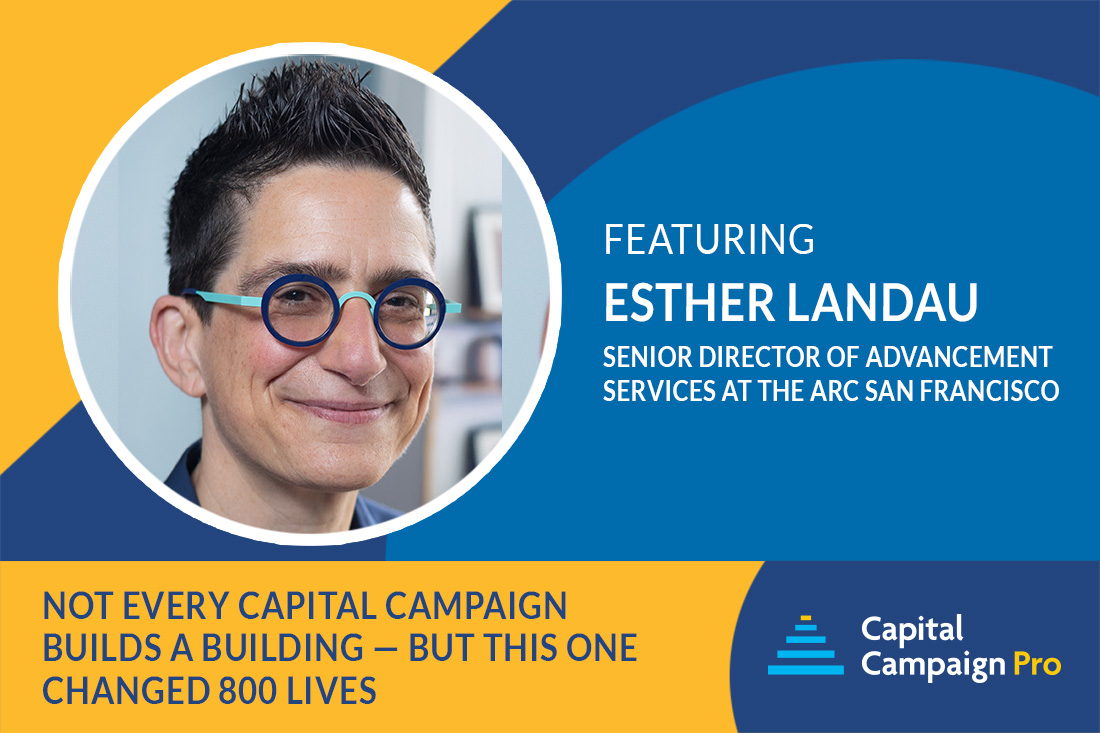
In this episode, Andrea Kihlstedt spoke with Esther Landau, Senior Director of Advancement Services at the Arc San Francisco, about a $3.3 million capital campaign that had nothing to do with bricks and mortar. Instead, the campaign funded staff pay increases to reduce crippling turnover and shrank a waitlist that was keeping adults with developmental disabilities from accessing services they needed.
Listen Now:
Andrea Kihlstedt:
Don’t you love to hear about campaign successes? Well, I’ve got one for you today.
I’m Andrea Kihlstedt, co-founder of Capital Campaign Pro. My partner, Amy, is not with me today, but I have a wonderful friend and colleague with me who’s going to tell you all about her campaign. So welcome to Esther Landau, who is the senior director of advancement of The Arc San Francisco. Welcome, Esther.
Esther Landau:
Thank you so much, Andrea. It’s a pleasure to be here.
The Arc San Francisco’s Capital Campaign
Andrea Kihlstedt:
So Esther, let’s start out with a little background. Why don’t you tell people about The Arc San Francisco and how you ended up in a capital campaign?
Esther Landau:
Sure. The Arc San Francisco is celebrating its 75th anniversary this year as an organization that serves adults with developmental disabilities in San Francisco, Marin, and San Mateo counties. So it’s a very local organization. And we serve about 800 adults. And about four years ago, we launched a strategic planning process to really look at how we knew we needed to grow.
We didn’t know what it would take to get there, but some of the key things that floated to the surface were the fact that our staff pay was not at all sustainable. It was not a living wage. And the outcome of that, that really impacts our participants is that our wait list is really long. And we’re always going to have a wait list because there’s new people coming out of the high school programs and so on, but the amount of time people were waiting was just really frankly unjust.
And we found in the beginning of this process to do this campaign, as we were building the conversation points in our donor discussion guide, that it was helpful to look at really the core piece of our strategic plan. The why of our capital campaign really had to be that people with developmental disabilities experience barriers to inclusion nearly everywhere they go. And that The Arc exists to work with them to remove those barriers. So we couldn’t be a barrier to their success. We had to do something to bring more people in off the wait list. And so we launched a $3.3 million campaign to essentially shrink our wait list and grow our programs. And that’s what we did.
Andrea Kihlstedt:
Right. And you started this campaign about three years ago?
Esther Landau:
Yes, that’s right. About three years ago, and we have one month to go.
Not All Capital Campaigns Build a Building
Andrea Kihlstedt:
Just at the very end. As you know, Esther, many capital campaigns are for buildings. And what you’ve described here is not a building campaign. It is a capacity building campaign. It is a building campaign, but just of a different nature. So of your $3.3 million that you’ve been working to raise, is some of that sort of a quasi-endowment fund or where is that money going to go?
Esther Landau:
Well, it’s actually, it’s already going. That’s the beauty of it. The money is going… 2.5 million was dedicated to increasing our staff pay, so we would have greater ability to hire and retain staff, and therefore bring more and more people off the wait list. And then about 800,000 would be for the growth of our programs.
So things like creating a new internship program that would help people build towards career skills with the San Francisco Rec and Park Department. That happened during this time. And also increasing the footprint of our health advocacy program into all three counties because the need is so great, but we haven’t been able to hire enough staff, enough funding to hire enough staff to provide those services.
Nearing the Capital Campaign’s End — $150K To Go
Andrea Kihlstedt:
Right. Great. So let’s not hold people in suspense. You have a month to go on your $3.3 million campaign. Where are you in that campaign right now? And do you expect to get to your goal within a month?
Esther Landau:
Yes. I’m manifesting that, but I’m also holding in my mind something that you once said, which was that the success of any campaign is that you got every dollar that was out there to get. And sometimes you can set a goal and you’re just doing your best to set that goal and the money might not be there or more money might be out there. So I think that’s helping me for sure. But yes, I’m manifesting. We have $150,000 left to raise.
Andrea Kihlstedt:
Ah, yes. You really are just about at the squeaky end.
Esther Landau:
We are. We are.
Andrea Kihlstedt:
Esther, I’m so glad you brought up that definition of campaign success. I actually think it’s really important that people understand that, that when we start campaigns and we set these preliminary goals, these draft goals, no matter how careful we are, no matter whether we’ve done feasibility studies or other work, you’re never sure really what’s going to happen. And many campaigns have many surprises, both on the upside and the downside.
We’ve had campaigns that started out with an $8 million goal that ended up raising $15 million. And we’ve had campaigns that started with a $10 million goal and stretched like mad to raise eight million, and they were both successful.
Right now, what made them successful, they raised every last dollar they could raise for that plan at that time. And I think that’s such a great definition of success. If you were to have a campaign and you would set a campaign goal of $2 million, and you had raised $2 million, but you knew you had left a million dollars on the table that you hadn’t even asked for that would not count as a success in that definition.
Esther Landau:
Correct. Yep, exactly.
Surprises During the Campaign Along the Way
Andrea Kihlstedt:
So okay, three years ago, here you are often cooking, often heading to this campaign. You want to start out by telling us what surprised you most? What has surprised you in these three years?
Esther Landau:
Yeah, a few things. The main thing is just how generous people are, how much people want to help to their capacity. And then also, there were also people who gave more than we asked them for. That’s always a surprise. The person who I sat down with and I took my deep breath and I asked her if she would consider a gift of 7,500 to the campaign because that’s what I had sort of penciled out for her. And she said:
“Oh, no, I know what I’m going to give you. I’m giving you 25,000.”
It will spell out my chair. It was so funny. How amazing that people know when you’re reaching out to them what this is about, if you’re transparent and they think about it and it’s just people are amazing. And then even something I learned that was very surprising to me too, is that our participants, our clients wanted to donate to the campaign.
And so that opened up this whole new question for me of how do you ethically fundraise with people who have developmental disability or may have some kind of cognitive challenge in understanding what… You need to be absolutely sure this person understands what they’re doing, but then why should you deny someone the joy of making a donation? I mean, that’s huge. It’s a beautiful thing. So that really surprised me too.
Andrea Kihlstedt:
That reminds me of a story from my fundraising past, which I’ll tell really quickly.
The Joy of Making a Donation
Years ago, I worked on a library campaign and the library had had someone with developmental disabilities who did their custodial work for years. This man lived with his parents. He had gotten a job at the library when he was a teenager and had worked for maybe 30, 40 years. I mean, a long, long, long time he had worked at this library.
And when they did this campaign, no one had thought about him as a donor. And one day he walked into the executive director, the head of the library’s office, and he said, Mary, he said:
“I want to give a gift to the campaign. I’ve decided I want to give $1,000. But the stipulation, the condition – I want to be able to present it to the board myself.”
So he said, “Of course.” He went to the board and he told the board that the library had become his home and saved his life and had become his home. That gift became the story of the whole campaign and just inspired everybody, I think, to give more.
I mean, it still makes me cry to think about that. And that’s what you’re dealing with, right? Stories like that, people where The Arc has made a huge difference in their lives and they want to help. And sometimes I think we make financial assumptions about people that aren’t accurate also.
Esther Landau:
Exactly. Even with one of these participants who wanted to give, and he knew what he was able to give. And I was suggesting that he could maybe make a monthly… Break it up into monthly living and stuff. And he was like:
“Oh, no, I want to do it all right now. I’m so excited.”
And he had the funds, so I didn’t need to baby him at all. He’s perfectly capable of making that decision.
Andrea Kihlstedt:
Yeah, what fun to deal with things like that. But there are times in campaigns that aren’t so fun.
Esther Landau:
Correct. I will admit that there were parts of, at times in the campaign where it felt to me like I was dragging a bag of rocks behind me. I was moving, but it was like, ugh, everything just takes so long. And I am a patient person, but the timeline is amazing.
And also, people who specifically ignore the emails that are about sitting down to talk with them about a gift, they answer all your other emails. They’re not ghosting you. They know what it’s about, but I would say that’s probably was the biggest frustration in the campaign was the radio silence around from some people who normally would be communicative.
So I had to learn to just sit with that and not take it personally.
Andrea Kihlstedt:
Yeah. Did you find ways to deal with that, creative ways to…?
Esther Landau:
Yeah, deal with the frustration or deal with the trying to get a sit down?
Andrea Kihlstedt:
Both.
Esther Landau:
Right, yeah. Dealing with frustration was just basically about just little pep talks, internal pep talks on it’s not about you, it’s not about you, it’s not about you, that kind of thing. But then as far as, I would say my one hot tip that I have that didn’t always work, but it often worked was when I was trying to get a meeting with someone, I would look up on Yelp, a cafe that was either near their office or near their home, and I would put the name of the cafe in the subject line and say, “Can we grab a cappuccino at She Memo or whatever?”
So they would at least open the email because it would be different from the other emails they were getting. That did work a number of times where I had a real sticky, sticky challenge. Yeah.
Overcoming the Delays of Lead Gifts
Andrea Kihlstedt:
Yeah. For the most part, did you find that when people did that sort of delay, it was because they didn’t want to make a gift or they just didn’t want to decide about it?
Esther Landau:
I think the latter. That’s my guess anyway. I mean, we had one… Well, one of our lead gifts came after nine months of patient outreach, outreach, cheerful, persistence, as they say. “Hello, I’m still here.” And we sat down with him and he was another one who ended up giving more than we asked and has been an advocate for the campaign since then. And he spoke at our public phase launch event. So yeah, I don’t know what to say about the folks who still have never responded. I don’t know. I don’t know because they haven’t told us. Right.
Andrea Kihlstedt:
At some point as you get towards the very end of the campaign where you are now, your task becomes closing up loose ends, tying up loose ends. So the people that haven’t gotten back to you after months and months of trying, you can then change the communications and say:
“The campaign is coming to an end. I hope you will make your gift by such and such a time.”
And if not, am I to understand that you’ve decided not to give to the campaign, right? You turn it so that you bring it to a close.
Esther Landau:
Exactly. And you release, bless and release.
Andrea Kihlstedt:
You bless and release them. Exactly. Exactly.
Esther Landau:
And for whatever reason, and they shouldn’t feel sheepish or guilty about it because I mean, what I really want to communicate to people too is that no is a complete sentence.
Andrea Kihlstedt:
Fine, right? Yes, I love it.
Esther Landau:
It’s really like I’m an adult. I can handle your no, and it’s absolutely legitimate answer to this question.
Staffing Up for a Successful Capital Campaign
Andrea Kihlstedt:
Yes, yes. Esther, I want to step back. I suspect that some of the people who are listening are curious to know what kind of a support staff you had for this campaign. Is it just you or did you have other people helping you?
Esther Landau:
In the beginning, it was just me. I have a director of communications who supported around the collateral and my executive director, Kristen was my trusty sidekick too. We had a volunteer committee that came with its challenges too, like every volunteer committee, and they definitely put in a good amount of work. But no, we didn’t hire a person to keep the trains running, and that was a challenge.
I wish that we had been able to because I felt very split multiple times over the course of the campaign because so many, you have multiple annual fund seasons and multiple annual fundraising events and on top of keeping this beast moving down the road. Yeah. Anyone who can manage to get some support, I would recommend it.
What it’s Like Working with Capital Campaign Pro
Andrea Kihlstedt:
I know as far as a campaign consultant, you worked with Capital Campaign Pro.
Esther Landau:
Yes.
Andrea Kihlstedt:
And you were assigned an advisor, Xan Blake.
Esther Landau:
Yes.
Andrea Kihlstedt:
What was that process like for you?
Esther Landau:
It was so phenomenal to have Xan as a coach, mentor, consultant. I learned a huge amount from her, and I really appreciated her high level perspective and her knowledge about how different campaigns have worked, her support and advocacy with our board of directors, letting them know that Kristen and I would be very involved in this project, that we might not be as available to them, and that they would be expected to step up. It was really helpful to have her voice in the room around that and her training on our little feasibility study team.
We did a Guided Feasibility Study with her, which I was like, “That was worth its weight in gold.” I was still relatively new to The Arc, so I get to meet all these donors. How do you send out some stranger to go meet your donors? I don’t understand why people do that.
It was phenomenal. And just the regular cadence of meetings and keeping us focused on track to the things that really mattered. Yeah, it was invaluable. I owe a huge debt of gratitude to Xan.
Andrea Kihlstedt:
Yeah, that’s fantastic. It’s always wonderful to hear that. Xan is a terrifically talented woman and you learned a lot from Xan. One of the things that we do at Capital Campaign Pro, which is just so, so valuable, even to me, every week we have a drop-in call for our advisors that they can come to or not as they wish.
There are, I think, 12 advisors and people come when they have campaigns that they’re advising to and have questions that have come up and they want some other advice from other experts. And we have these amazing conversations among experienced campaign people about how to deal with this or how to deal with that.
And then that, in some cases, that’s really helpful for them as they go back and work with their clients. But I thought I would’ve given anything as a young consultant to have that kind of a resource, to be able to have a group of really experienced consultants to call on weekly for things.
I’m so happy that it’s part of Capital Campaign Pro. It just makes my heart warm that that’s the way it works.
Esther Landau:
Yeah. And I love to… Occasionally Xan would say, “I’m going to go back to the group and see what they have to say.” And she’d come back to —
Andrea Kihlstedt:
And it’s just so fun to hear about these campaigns and what’s going on in the campaigns makes us all smarter and wiser and better.
Esther Landau:
Yeah, exactly. Exactly.
Engaging Donors Throughout a Capital Campaign
Andrea Kihlstedt:
So Xan has told me that you are wonderfully resourceful and good at engaging donors, at communicating with them and engaging them, at engaging them at events, for example. She said that you really have done a remarkable job of that in all sorts of ways. Are there particular things you found to be useful?
Esther Landau:
Sure. I mean, the ongoing friendly cultivation of donors is just a part of how I think about doing the work and staying connected with them as people. But as far as the sort of teaching the lessons of the campaign and bringing people in more deeply to the problem we’re trying to solve, we did our public phase launch event where we invited donors who had already given to the campaign and people who we hoped would give to the campaign.
We hoped that the donors who already gave would make a second gift and so on. And as part of the program, we had an immersive experience on the ground floor of our building. There’s a central area and we set up four different stations that represented barriers basically to access to services. And when you arrived at the event, you were given a profile of a person who was trying to secure services for themselves.
And some people came in with advantages and some people came in with a lot of disadvantages and everybody had one wildcard that they could play if they needed to. And they would go to each of these four stations if they even made it past the bureaucratic barriers station or transportation. And at each station, they would roll the dice to find out if they were going to have a good outcome or not at that place.
So it was really random, which is unfortunately the state of affairs. People who are lucky enough to have parents who can drive them to a workplace can get a job because they don’t need to arrange for transportation and wait for a year to get on a paratransit list. So I think it was a really great exercise for us, and I think we could see how much it impacted the people who went through the experience because some people didn’t make it. They were just going to have to wait longer.
Andrea Kihlstedt:
Right. And then did you send them home or could they come into the party?
Esther Landau:
We let them come into the party, but we asked during our program, so how many of you got frustrated and didn’t get through? That’s the reality. Yeah.
Andrea Kihlstedt:
Yeah, that’s amazing. I mean, what a great experience. I bet you got fantastic feedback from people about that.
Esther Landau:
We did. We did.
Andrea Kihlstedt:
Yeah. What a great thing to do. And how long did the experience make them take before you-
Esther Landau:
Oh, only like 10 minutes. We didn’t want to bum them out for the night. So you do get to go upstairs and have wine.
Andrea Kihlstedt:
Right, right. Yeah. No, I think that’s a wonderful idea. And it’s an idea that many organizations could adapt. They could use it for their gala, for their campaign kickoff.
Esther Landau:
Exactly.
Andrea Kihlstedt:
Here are the things you’re trying to solve. You have to go through these hurdles and these barriers before you can come into the party. What a great idea.
Esther Landau:
Exactly. Exactly.
Don’t Underestimate Personal Videos for Donor Engagement
Andrea Kihlstedt:
Yeah. You also have a reputation for being particularly good at using videos, personal videos, their communications. How did you do that?
Esther Landau:
Yeah. Well, you can just record a video and a text message to someone. They will watch it. And so if you have been emailing them and not getting through to them or even texting them and it just lands and you never hear back, I recommend making a cheerful, friendly video to… So it’s like you just popped into their office to say hello. They will watch it. They will respond in some way.
Andrea Kihlstedt:
Yeah. That’s fantastic. Yeah, this technology is so easy now and we don’t often think to use it in that way.
Esther Landau:
Yeah. The less polished, the better.
Andrea Kihlstedt:
Right. Yeah, that’s right. Yes. The less polished, the less formal… I mean, that’s true with almost all kinds of communications. Exactly. Exactly. And the funny thing is that people, as people are dealing with donors of higher and higher wealth, they want everything to be more and more polished.
Esther Landau:
Exactly.
Andrea Kihlstedt:
Which is just the backwards place that they should be. The less polished, the more questions, the more openings, the more personal with people who really have the capacity to make large gifts, the better.
Esther Landau:
Exactly. Because if you go the route of… I mean, I don’t want to disparage any of these video storytelling tools and things like that, but if you go the route of using those and you send it out to some of your donors, they know you didn’t make it really just for them, just for them.
You went through this process. And so I feel like that’s part of my… I’m jumping on board with AI and those kinds of communication and efficiency tools, but I think people feel it when you have made the personal effort to do something just for them.
Polished is Not Always Better – Consider Authenticity
Andrea Kihlstedt:
Yes, yes. And AI does have the negative consequence of having everything feel polished. Everything feels polished, and it is a downside of it, of using it. Writing is better, the layout is better. Everything starts to look smooth. And for really good fundraising, smooth is not what we’re about.
Esther Landau:
Exactly. Exactly. Exactly.
Andrea Kihlstedt:
It’s a paradoxical lesson, I think.
Esther’s Personal Capital Campaign Tip
And so in closing up, if you were to advise people just going into a campaign with a couple of tips, what would you advise them?
Esther Landau:
Two, one is recognize early that this campaign will move at the speed of your donors, not at the speed you’ve selected. So if your board is pushing you to predict when you’re going to get the… I mean, you could put some things down, but you have no control over it. They do. And then the other thing is I would say, I’ve had to keep saying this over and over to myself, if you haven’t gotten a no, the answer isn’t yet no. So don’t just assume, because you didn’t hear from someone back from someone for six months that they’re telling you no. You have to actually get it to know that it’s a no.
Andrea Kihlstedt:
I think you come out you, anyone doing a campaign, anyone who’s in the role of making a campaign happen, comes out with great strength, great strength of character. You learn persistence. You learn not to be slapped down by things, right? It’s a part —
Esther Landau:
Exactly.
Andrea Kihlstedt:
…job experience.
Esther Landau:
Exactly. Exactly. Maybe it was like my history as a musician and getting some of the harshest feedback and you learn that it’s not about you and you just have to stay steady because if the cause matters, then you can’t stop.
Andrea Kihlstedt:
Yes. I think that’s a great line to end on actually. If the cause matters, you can’t stop. Esther, it’s always a pleasure to talk to you. It’s so much fun and I wish you well on this last month of your campaign. I look forward to raising a glass of champagne here for you when we hear that your campaign is officially over.
Esther Landau:
Thank you so much, Andrea.
Andrea Kihlstedt:
Really, it’s been a pleasure to work with you all this time on the Wednesday calls and really what a wonderful spirit you are.
Esther Landau:
Yeah. Well, CCPro is such an incredible resource and the community is as well. I really, really appreciate it.




Leave a Comment