
Capital Campaign Consultant Costs: An Essential Guide
If you’re considering launching a capital campaign, you’re probably already thinking about how a campaign consultant might fit into your plans. You might be anxious about consulting costs and how you’ll pay for them. You may also wonder what type of consultant you need and how to find the right partner. All of these considerations can feel a little overwhelming.
That’s why we’ve compiled this guide to capital campaign consultant costs. We’ll cover the different consulting models, how they charge for those services, and what you can expect in terms of broad price ranges. Click to jump to any section:
- Should I Hire a Capital Campaign Consultant?
- How Much Does a Capital Campaign Consultant Cost?
- What are The Different Capital Campaign Consulting Models?
- Campaign Consultant Payment and Billing Structures
- The Right Model at the Right Time
- Contracting for Success
Get your questions about capital campaign consulting costs answered, so you can start budgeting for your campaign.

Should I Hire a Capital Campaign Consultant?
If you’re planning to launch a capital campaign, you should likely hire a campaign consultant at some point during the process. However, keep in mind that there are multiple types of capital campaign consultants. Some organizations will need full-service consulting, while others benefit more from advisory support that builds internal capacity.
The trickier questions, such as “what type of consultant do I need?” and “how do I find the right partner?” will need more nuance. As a starting point, think about what you want from your campaign (outside of reaching your financial goal). For example, success for one nonprofit might include high levels of board engagement, whereas another aims to improve long-term fundraising capacity.
Consider your needs by taking a look at:
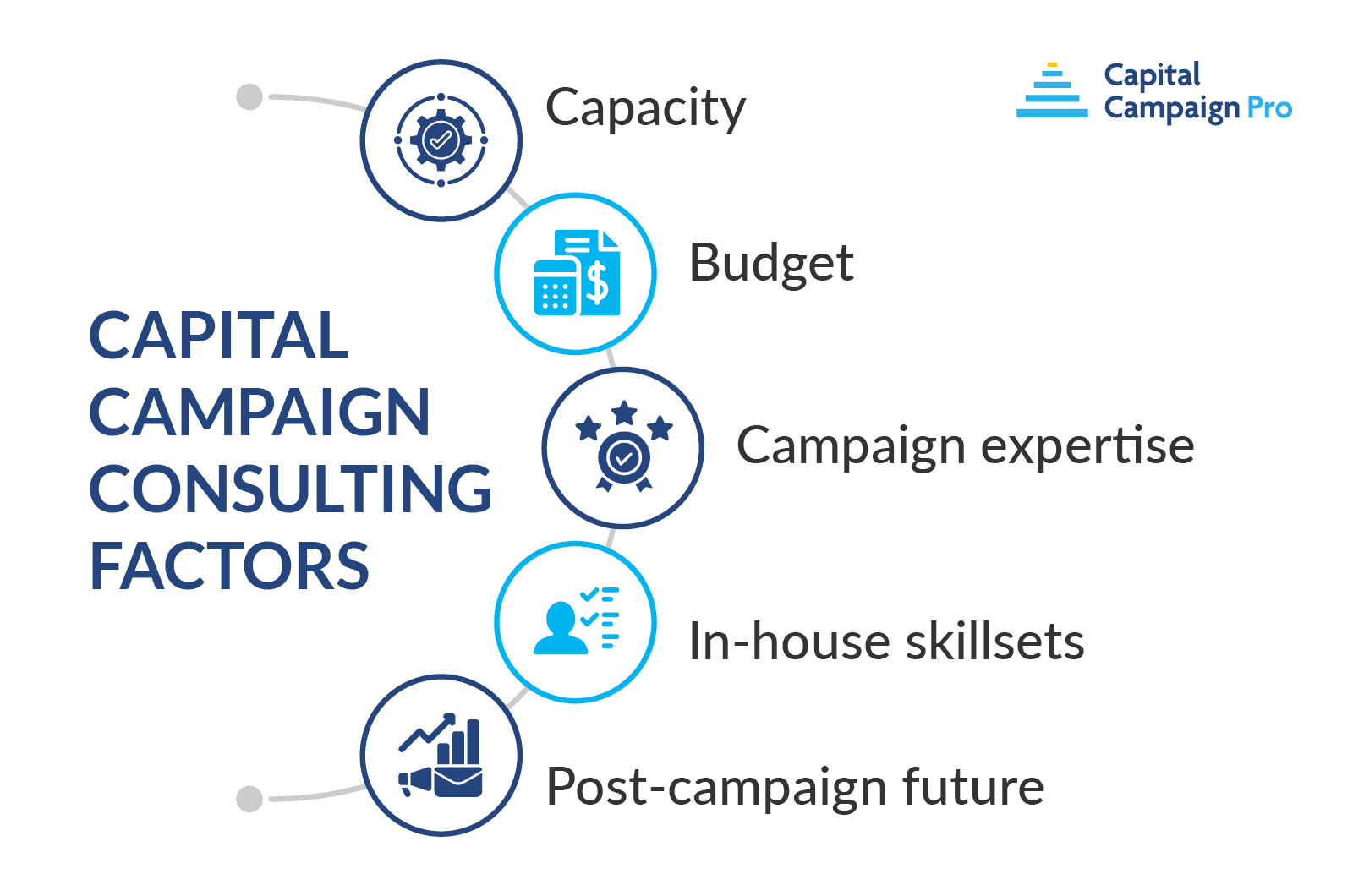
- Capacity: Do you have the help you need to meet annual goals, or is more support essential regardless of a campaign?
- Budget: What portion of your campaign goal can you invest in the fundraising process?
- Campaign expertise: Do you have staff members with capital campaign experience?
- In-house skillsets: What are your team’s strengths and gaps?
- Post-campaign future: What’s your vision for your fundraising team after your campaign wraps up?
When assessing consultants, their costs will depend on your campaign size, the scope of services, the consultant’s level of involvement, and the duration of the campaign.
Understanding your priorities and needs now (and revisiting them when things change) will help you determine what type of consultant is right for your organization at each step of your campaign.

How Much Does a Capital Campaign Consultant Cost?
To understand how much capital campaign consultants usually charge for their services, you’ll need to take a look at industry benchmarks. As a nonprofit industry benchmark, campaign-related expenditures are expected to total around 5-10% of the campaign’s goal.
This 5-10% includes more than just hiring outside help. In addition to hiring a consultant, you should account for the cost of events, marketing materials, additional staff, and internal resources (like software or prospect research data).
For example, if your capital campaign goal is $10 million, you can realistically expect to spend as much as $1 million on campaign-related expenses. Some organizations will roll that up into the campaign goal, resulting in an $11 million campaign goal. Fortunately, most donors understand the need to spend money to raise money.
While investing $1 million in running a $10 million campaign might feel like a lot, it’s actually an impressive ROI. The bottom line is that every campaign needs a budget, and your campaign costs—including consulting support—should come out of that budget.
Of course, capital campaigns last multiple years, and that should be taken into account when setting a budget. For instance, if your total budget is $1 million, and your campaign lasts four years, you have $250,000 to spend per year. The cost of a consultant as a percentage of your goal will certainly only be in the single digits, but it may still be a significant expense. For some nonprofits, capital campaign consultant costs alone might be more than you spend in off-campaign years.
However, alternative consulting models may have lower costs. For example, in comparison to a traditional consulting model, an advisory approach is less expensive, while still providing strategic guidance and support for internal capacity building.

What are the Different Capital Campaign Consulting Models?
As you contemplate your organization’s needs, bear in mind that every campaign needs two distinct things:
- Guidance from someone with deep campaign experience.
- Boots on the ground to get the work done.
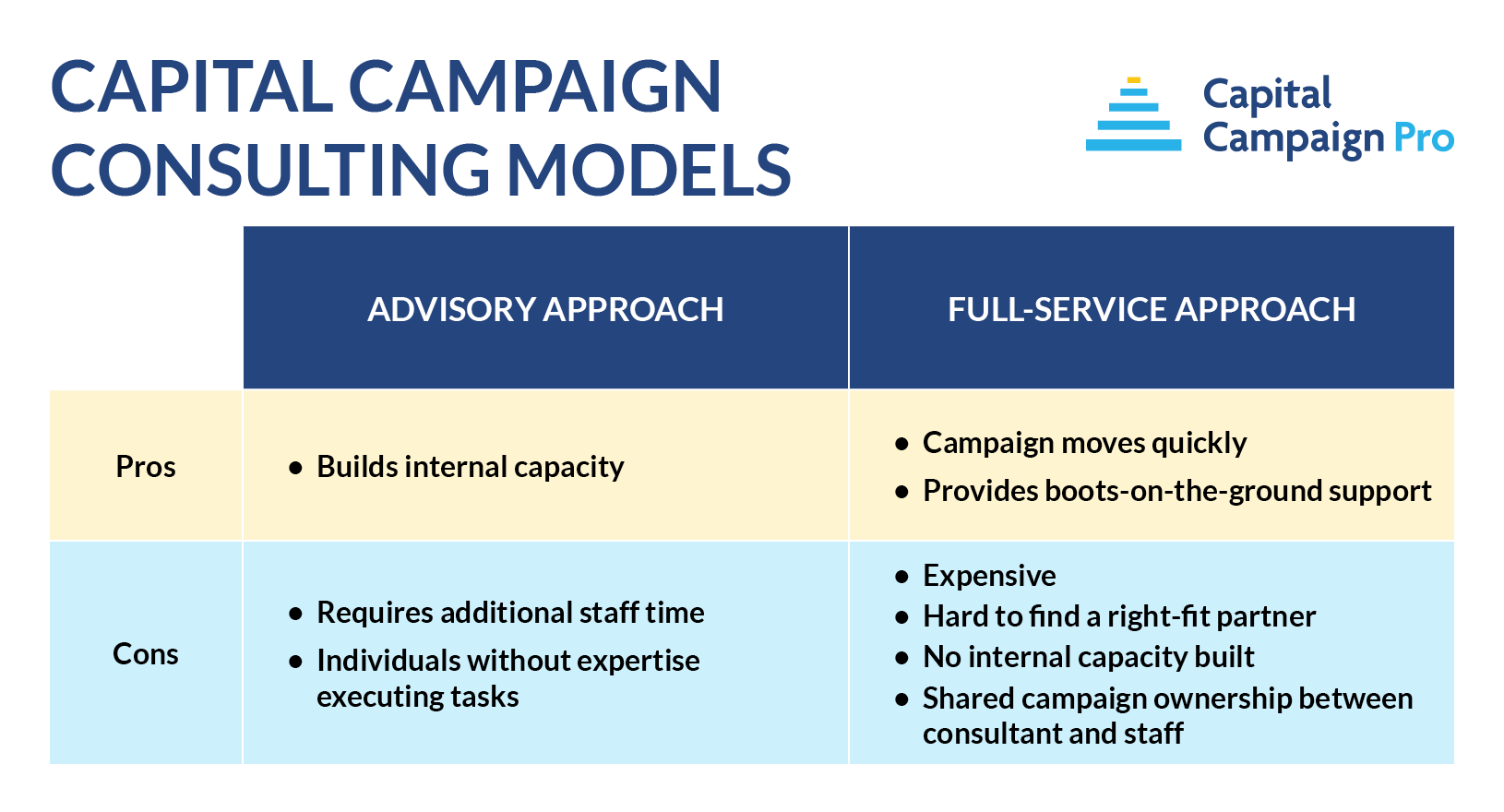
Some consultants provide high-level advice and guidance, while others offer a full-service approach, providing both advice and hands-on work, from leading committee meetings to writing proposals and sending thank-you letters during the public phase. Here’s a quick breakdown of the differences:
The Advisory Approach to Campaign Consulting
In the advisory campaign consulting model, the consultant provides guidance, and the organization implements their recommendations. Your staff leads the project with experts by their side, building confidence in the process.
When an organization takes this route, the campaign will still need additional boots on the ground to get the actual campaign work done. To meet that need, many nonprofits choose to invest in their own team by hiring additional staff for the campaign. Both new hiring expenses and consultant fees would be factored into the campaign budget.
Many nonprofits will want to keep their new staff after the campaign ends. To ease this transition, they’ll use the runway of the campaign budget to work these additional staff positions into their organization’s long-term operating budget.
Pros
- Your team builds internal capacity from the ground up and often lives on in the organization well past the campaign’s conclusion
Cons
- Additional staff time might be required to handle the workload
- Oftentimes, the person implementing the campaign work is not the person with the deep campaign expertise; the person with the deep expertise only comes in for big meetings
The Full-Service Approach to Campaign Consulting
On the other side of the spectrum is a full-service approach. In this model, the consultant or firm not only brings expertise but also does work for your campaign themselves.
A member of the consulting team may join your office either in a full or part-time capacity and carry out tasks that advance your feasibility study or campaign, like scheduling meetings, conducting interviews, managing prospect lists, writing materials, training volunteers, producing reports, and more.
Pros
- Can push the campaign forward at a rapid pace
- Checks the boxes of expertise and boots on the ground in one solution
Cons
- Expensive
- Hard to find a right-fit partner where both needs (deep expertise and strong implementation) are well met
- No internal capacity built over the long term (i.e., the consultant leaves after the campaign’s conclusion)
- The consultant potentially owns the campaign more than the staff does

Campaign Consultant Payment and Billing Structures
When hiring a capital campaign consultant, you can usually expect one of the following billing models:
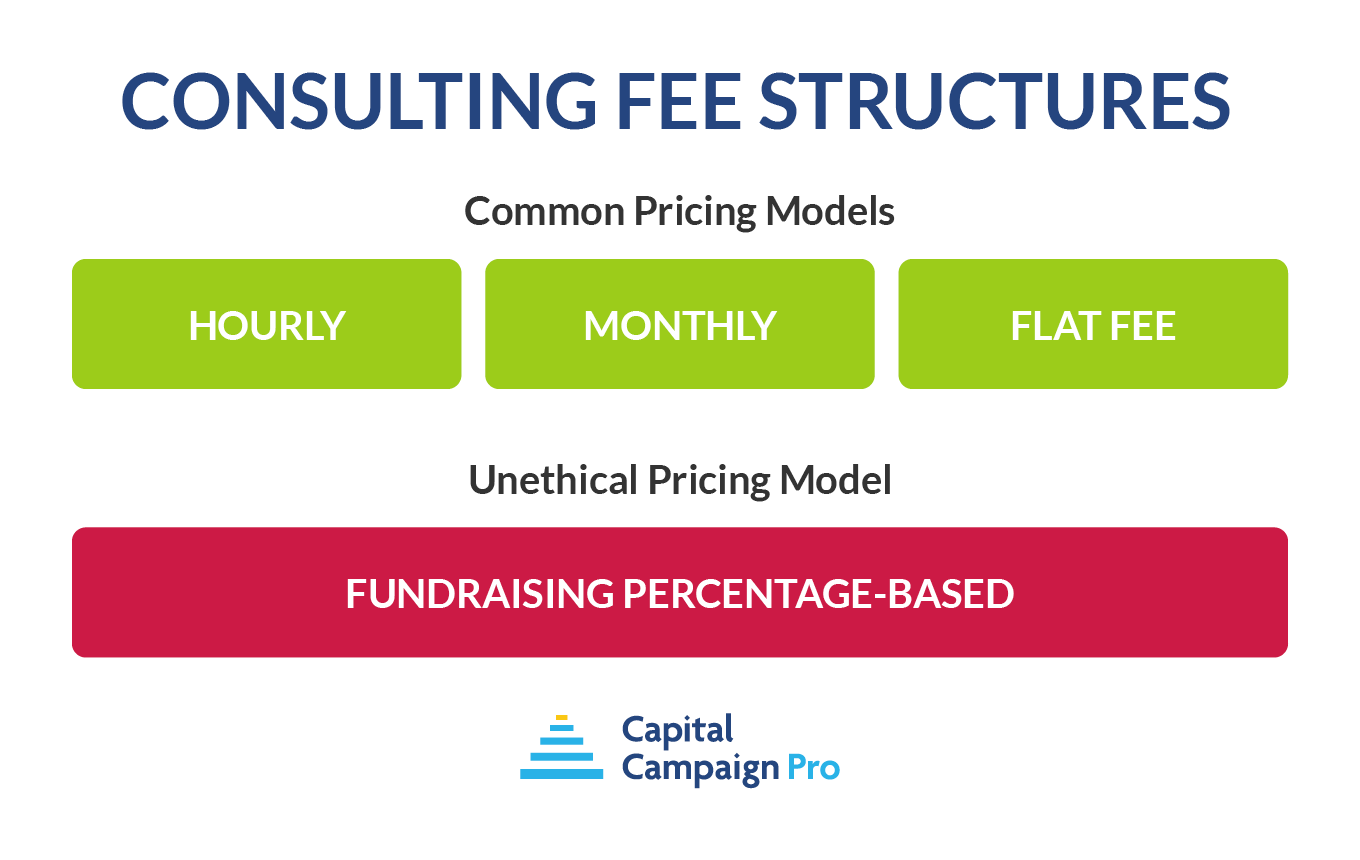
- Hourly: Some consultants charge an hourly rate, which can range from $150 to $500+ per hour, depending on their experience and the complexity of the work.
- Monthly: Monthly retainer fees typically range from $2,500 to $30,000+ per month, depending on the consultant’s level of involvement, the size of the campaign, and the services provided.
- Flat Fee: For specific deliverables (e.g., conducting a feasibility study, creating a case for support, or planning campaign events), consultants may charge a flat fee.
A Different Approach to Pricing
Capital Campaign Pro’s pricing is unique compared to other firms. If you’re curious about us specifically, let’s talk! Click below to schedule a free strategy session.
Avoid consultants who charge a fee based on a percentage of the campaign’s fundraising goal (e.g., 5-10% of the total). Many nonprofit industry organizations, such as the Association of Fundraising Professionals (AFP), shun this model as it conflicts with ethical fundraising practices.
Additionally, consultants will usually operate with one of these approaches:
- Retainer: These consultants are always available for you, making their services predictable but expensive.
- Project-based: In this model, consultants will work only on the assigned project and may need a new contract to expand the partnership.
- Advisory: When a consultant acts as an advisor, their support tends to be more flexible and easier to scale.
Regardless of the billing model, ensure you fully understand your consultant’s contract before signing it. What happens, for example, if you want to part ways mid-campaign? What if a deliverable isn’t up to your standards or expectations? Having open and honest conversations with prospective consultants can avoid headaches down the road. And if your prospective consultant isn’t transparent with you, you may want to look elsewhere.
Above all, keep in mind what you’re paying for when working with a consultant. Ensure the value is actually there by verifying that you’re receiving strategic guidance, expert analysis, accountability, and increased confidence in your decision-making.

Feasibility Study Capital Campaign Consultants
When it comes to hiring a capital campaign consultant, the feasibility study is particularly important. Think carefully about what role a consulting partner might play during this phase, as it will set the tone for the rest of your campaign.
Common Flat Fee: The Feasibility Study
Because the feasibility study comes early in a campaign, some consultants center the initial contract or agreement around this specific deliverable, even if they intend to continue working with you after the study.
This flat fee may or may not be derived from their hourly or monthly rate, or run concurrently with those rates. Either way, don’t be surprised to see quotes in the five-figures for a feasibility study.
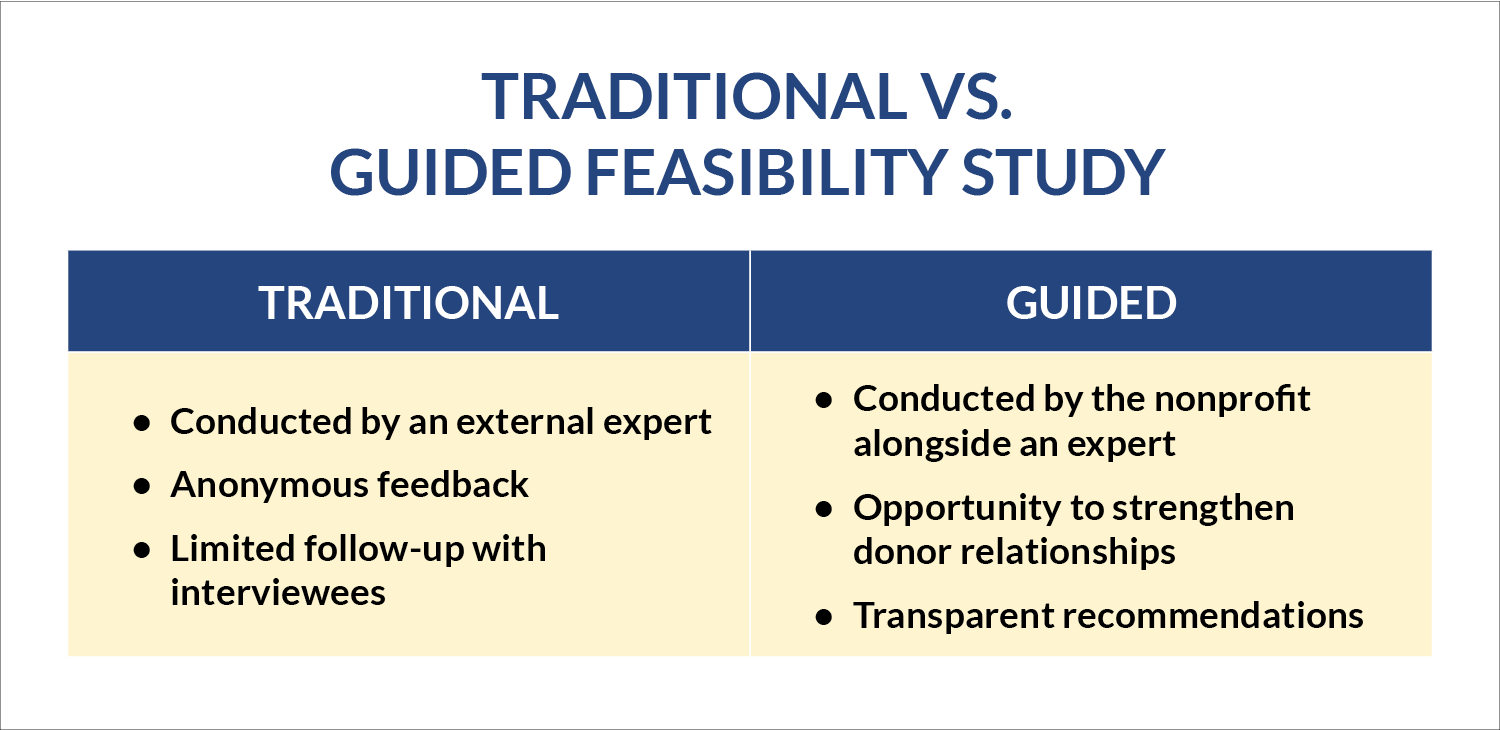
A consultant’s expertise can be especially valuable for the feasibility study. Someone who has been involved with many campaigns will know what questions to ask and how to interpret data. Typically, there are two models for how a consultant might support your organization during this phase of your campaign:
1. Traditional Feasibility Study Model
In this model, the consultant prepares all the feasibility study materials and interviews potential donors without staff involvement.
Pros
- Happen quickly
- Require less time and resources from staff
Cons
- The consultant—not the organization’s leaders—builds relationships with donors
- Limited or no transparency when it comes to interview specifics (may be completely anonymous)
- No or limited follow-up
- Nonprofits sometimes feel beholden to their consultant for ongoing guidance when it comes to donor strategy
2. A Guided Feasibility Study Model
In a guided model, the consultant provides expert training and guidance so that staff and other organizational leaders are empowered to interview donors and build relationships directly. The consultant guides the goal-setting and report-writing process based on their years of expertise, then works in partnership with the organization’s leadership to analyze interview results together.
Pros
- Strengthens relationships between donors and organizational leaders
- Full transparency exists between donors and organizational leaders
- Staff and other internal leaders develop a life-long skillset by completing the study with expert guidance
Cons
- Requires a time commitment from staff
- Feedback may not be as honest, since donors are not anonymous

Contracting for Success
While there are many consulting options, nonprofits should always take into account:
- Any consultant asking to be paid a percentage of what the campaign raises is waving a big red flag. This type of compensation compromises your consultant’s integrity and rewards unethical behavior.
- As you review contracts, it’s natural to focus on the big items—hourly or monthly fees and expectations—but don’t forget the little things. If your consultant will be traveling, for example, ask how expenses and meals are covered. It might seem like a minor cost, but it can add up over time.
- As you think about consultants, look at the other parts of your campaign budget as well. Materials, events, and travel expenses are areas where you might either save or spend. The project budget, especially if it involves a new building or major renovations, should include cushions for inflation and supply chain issues. Having a realistic overall budget will help you understand what kind of consulting investments make sense.
If you’re concerned about campaign costs, you might seek out a funder that specializes in capacity-building to fund support staff, volunteer training, technology upgrades, and marketing efforts that can advance a campaign.
Bottom Line — Take Time with Your Decision
To sum up, selecting a campaign consultant isn’t a one-time, all-or-nothing choice. It can be a series of choices depending on your priorities and the stage of your campaign. The time you devote to understanding your needs and putting together the right internal and external team will be well spent.
Each campaign is an important stage in the life of your organization, and thinking about everything you can get out of it—not only funding but also a more expert team and closer relationships with your board and donors—will help you make informed choices.
Find Out if You’re Ready for a Campaign
Download any of our four free assessment tools to help you determine whether you are truly campaign-ready.




Leave a Comment