
Podcast: Why More Nonprofits Are Ditching the Traditional Feasibility Study
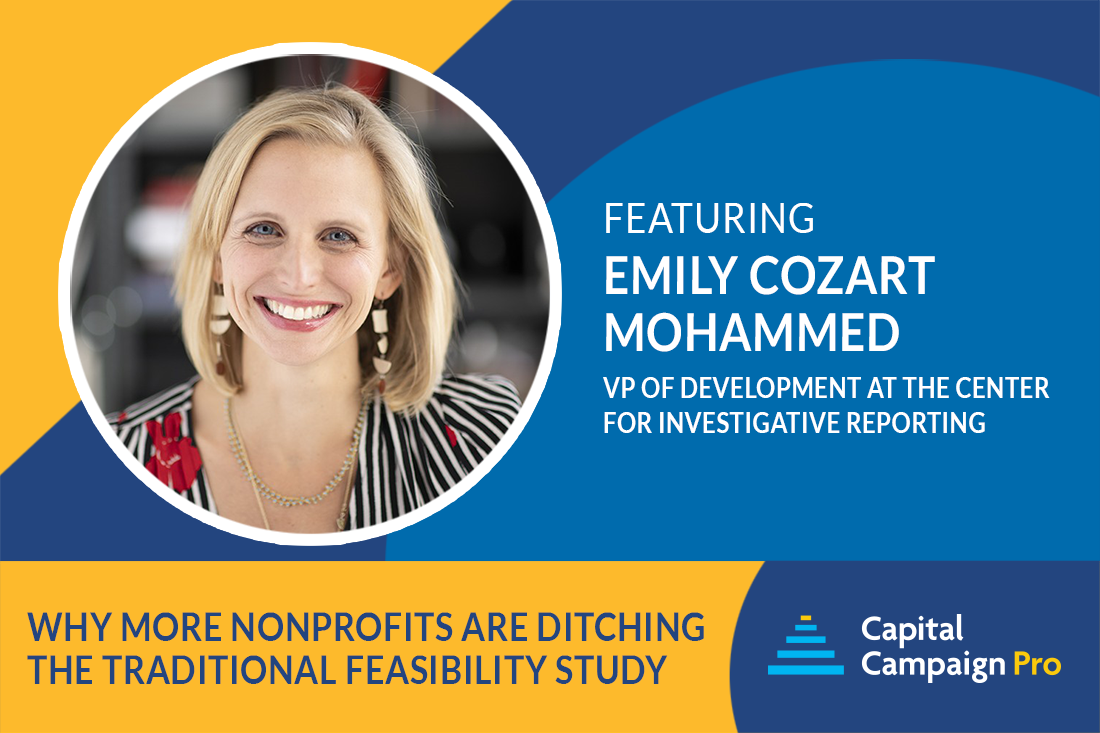
Season 5, Episode 37
Before launching a capital campaign, most nonprofits hire a consultant to conduct a feasibility study. The consultant interviews donors, disappears for a few weeks, and returns with a report and a number. It’s the way it’s been done for decades. But a growing number of organizations are choosing a different path — and getting dramatically better results.
In this episode, Andrea Kihlstedt sat down with Emily Cozart Mohammed, Vice President of Development at the Center for Investigative Reporting, to discuss her experience completing a Guided Feasibility Study for a $50 million campaign. The conversation made a compelling case for why the guided model is replacing the traditional approach.
Listen Now:
Andrea Kihlstedt:
What’s a Guided Feasibility Study? Do you want to know? Well, today you’re going to find out, because I have a special guest who’s going to tell you what it is from the field.
This is Andrea Kihlstedt, I am the Co-founder of Capital Campaign Pro. And instead of Amy, my buddy and partner and friend being with me today, I am joined by a very special person who has just finished a Guided Feasibility Study, and that is Emily Cozart Mohammed. Emily is the Vice President of Development at the Center for Investigative Reporting. And I knew I wanted to interview her when she sent an email around saying this was, “The best thing since sliced bread,” or something like that.
So, Emily, welcome.
Emily Cozart Mohammed:
Thanks so much, Andrea. I’m very excited to be here and share our really excellent experience doing a Guided Feasibility Study.
Why Do a Feasibility Study for a Capital Campaign?
Andrea Kihlstedt:
Emily, why don’t we start out by your telling our audience a little about your organization, about the Center for Investigative Reporting. What is it, and why did you want to do a feasibility study?
Emily Cozart Mohammed:
Sure. The Center for Investigative Reporting is home to Mother Jones magazine. We also produce the Reveal radio show and podcast. We also have a doc film unit that’s won two Emmys in the last couple of years, and that’s called CIR Studios. So, we are a fully multi-platform nonprofit newsroom and in fact, we are the oldest nonprofit newsroom in the country.
And part of the reason, or one reason among many that we decided it was time to launch a campaign and a feasibility study, is because Mother Jones is celebrating its 50th anniversary this year, and the Center for Investigative Reporting is celebrating next year. So, it gives us two years of celebration and an opportunity to look back on our impact and think about the years ahead.
Andrea Kihlstedt:
Right. I’m so glad you brought that up. We often have organizations come to us and say, “We want to do a capital campaign to raise $50 million because we’re 50 years old.” Right? And it always sets my hair on end, because many times they think that they’ll raise all that money for the past, when in fact you’re raising money for what’s ahead. Right?
So it’s great to use a celebration year to do that, but I just want everyone to know that by itself, a 50 years anniversary is not a great reason to have a campaign. It’s only a great reason if you’ve got exciting plans ahead, which of course, you do.
Emily Cozart Mohammed:
We do, and that is a good point. And ironically, we are doing 50 for 50. It was a number we tested out through the feasibility study, and we went into it knowing that we might come out of the feasibility study and find out that number that has a really nice ring to it actually isn’t within reach, or maybe we could do more. But in fact, once we got to the end of the process and completed all the analysis, we really came in at just a hair under 50 million. It was pretty remarkable.
But yes, we are looking at, I mean, really this campaign is focused on two things:
- One was just over two years ago, Mother Jones and the Center for Investigation embarked on a merger. We raised almost $23 million in a very short period of time to make that merger happen. And so, part of what we need to do is move from the funding that we raised during that merger campaign to a new and larger set of funders to help us both sustain newsroom operations and make some strategic investments as well.
- And then we’re also using the 50th anniversary as an opportunity to really double down on organizational sustainability through a quasi-endowment that we set up several years ago that we would like to grow, and also significantly expanding our planned giving program.
What is a Guided Feasibility Study for a Campaign?
Andrea Kihlstedt:
Right, that’s fantastic. I’m just going to take a brief moment to let people… If people are listening to this and they don’t know what a Guided Feasibility Study is and what the difference is between our model, the guided model and a regular model, let me just tell them so they’re not puzzled.
So, there are a number of differences, but the biggest difference is that in the Guided Feasibility Study model, which is the model that Capital Campaign Pro encourages people to use, and we, of course, develop this model and promote it with our clients. Rather than having a consultant come in and do the entire study and interview all of the donors, in the Guided Feasibility Study model, we work with the staff and some board members often, like we work with people like Emily and maybe the executive director or a president of the organization, to prepare them to go out and have those conversations with their donors.
And this new model grew out of a discomfort that I had for many years. When I, as a consultant would go and talk to donors and I’d think to myself, really, I shouldn’t be talking to these donors as an independent consultant. The donors really would prefer to talk to the leaders of the organization, and the leaders of the organization should use this opportunity to get to know their donors. It just seemed like such an obvious and important thing to do. So finally we said:
“Well, let’s create a model which really pushes and encourages that.”
And that’s the model that Emily used in her feasibility study. So now, did that say it clearly enough?
Guided Feasibility Studies Help You Talk to Your Best Donors
Emily Cozart Mohammed:
You did. And actually in all of our conversations or almost all of the conversations we had with our donors, and when you’re doing these feasibility studies, you’re really talking to your highest affinity donors, your highest capacity donors. So these are people, most of them was not their first rodeo with a capital campaign.
And so when I would describe the process when we were getting started, I mean, so many of them said to me, “This is so great. I can’t tell you how many times I’ve had the same guy in a suit and with all due respect, it is normally a guy in a suit come in. It’s like a revolving door pitching one organization after another.” And while they were pretty good at their jobs, they just don’t know the organization as well as the people who work there and run it.
So we found that:
- A, The donors really appreciated having the conversations directly with us.
- And B, it was just a remarkable experience in donor engagement and stewardship.
Being able to go back to square one with donors, which maybe you want to describe a little bit more, Andrea, but really starting at their origin story with the organization and going from there, I just thought it was such a brilliant way to level set and establish that baseline connection or reestablish that with a donor. And we just found that it really enriched the relationships we have with our top donors.
Andrea Kihlstedt:
Yeah. And isn’t that a great thing to be able to do, right? So often, you don’t have an opportunity to have conversations like that with your donors unless you’re asking them for money. Right? Those conversations just don’t happen.
Emily Cozart Mohammed:
And it takes all the pressure off too. I mean, obviously there’s a little bit of anxiety because you have your hopes and dreams for this campaign, but when you’re very clear upfront that this is really a data collection process, not an ask, it’s just a different conversation that like you said, oftentimes you are in pursuit of a gift and you don’t have time to really step back and do that kind of big picture thinking with a donor.
A Structured Process with Explanations and Training
Andrea Kihlstedt:
Now, I should make it clear that when we work with clients to do one of these Guided Feasibility Studies, we don’t just say to them, “All right, Emily, go and talk to all of your donors.” We actually go through a structured process. And I’m sure you did also, you were working with one of our advisors and you got support and help probably at every step along the way from that. What did that seem like to you and how did that work?
Emily Cozart Mohammed:
So, the initial part of the process is relatively short training. I think we did two or three hour sessions. I mean, short in terms of, anyone who’s familiar with a feasibility study, from the outside, it feels like an incredibly overwhelming process. So to be able to get trained up in say four to six hours feels like, wow, that’s very fast.
But I know that you, Andrea, and Amy, you’ve really honed this set of questions. Some of the questions were a little more tailored specifically to our campaign because we’re not running a capital campaign in the classic sense. We’re not building a building, we’re reinvesting in our newsroom. So, I felt like there was a lot of precision added to that conversation. But we got a set of questions, the methodology was explained. And then we did a lot of role playing both with our consultant, but also we did some role playing internally until we were ready to go. And then internally, we were also sharing out at the beginning how it went, where we were finding hiccups, where we needed to smooth things out.
But throughout the process, I was working very closely with our consultant and our director of development operations to review the data week by week. So we spent a lot of time analyzing those answers, determining whether or not that the number if they provided one sounds like a number that’s reasonable, what our ask might be. And so, I really felt like at every step of the way, we were fully supported.
Andrea Kihlstedt:
Yeah. It’s such an interesting comparison between the traditional model, where the consultant goes and talks to the donors, and then they put all of that data, I always think about it into a cauldron, and stir it around and come out with a number in a report. And you don’t know a whole lot more about it than that, you just get a number.
Emily Cozart Mohammed:
Yeah. I mean, it’s crazy to me that I don’t know who… In retrospect now, I know exactly which donors said, “I’m going to give you half a million dollars. I’m going to give you two.” Not having that intel within my own system, it feels backwards.
A Path Paved to the Quiet Phase
Andrea Kihlstedt:
Right, right. Well, and of course, now that you’ve had these conversations, you have a pathway paved for going back to your donors when you’re in the quiet phase of your campaign, which you’re just entering now, I think. Right?
Emily Cozart Mohammed:
Exactly.
Andrea Kihlstedt:
You’re just starting.
Emily Cozart Mohammed:
Yep, we’re working on the materials.
Andrea Kihlstedt:
Working on materials and starting to get ready to ask people for gifts. So when you go back to them, you can say, “Well, we’re following up on the conversation we had in the feasibility study and we’d like to come and talk to you about the campaign.” Right? Just —
Emily Cozart Mohammed:
Oh, exactly. And I have to say, and I worked on another campaign previously with Mother Jones, pre-merger, and we worked with a big marquee name. And I know that this happens in all sorts of circumstances, but our pyramid, our gift table looked nothing, it didn’t end up at all looking like where we landed.
But I’m not as concerned about that happening in this case, because I had these donors look me in the face or do the same thing to our CEO or one of our board members, and nine times out of 10, they gave us a ballpark number of where they thought their gift would land. And I mean, I know circumstances change with people, but it gives me a higher degree of certainty that someone has confided in the leaders of the organization and said, “Yes, this is what I think I can do.” Because I think you’re more likely maybe not to be quite as certain about it with a consultant, whereas I feel like if you’re saying that to a leader that you respect, there’s an intention behind that.
Early Gifts Through a Guided Feasibility Study
Andrea Kihlstedt:
Right. Did you get any early gifts? Did anybody say, “We’ll jump in”?
Emily Cozart Mohammed:
We did. We had one early gift of $420,000. We also, because planned giving is part of our campaign, we had some donors who were eligible because in terms of how you can count a planned gift toward a campaign is contingent upon a donor’s age and some other factors. But for the donors where it was possible, we were able to document $8.5 million worth of planned gifts. And our goal for the campaign is to raise 10 million in gifts, so I know that we will meet that and likely exceed it.
We are also, in addition to having a numeric value tied to that for gifts that can be counted for the campaign, we’re also trying to double the size of our current legacy program, because as you know, lots of folks aren’t necessarily comfortable telling you. They’ll tell you that you are in their estate plans, but they might not be comfortable sharing exactly what those plans are. So, we made space for both in this campaign.
About the Guided Feasibility Study Interview Process
Andrea Kihlstedt:
How many interviews did you end up doing?
Emily Cozart Mohammed:
We did 55.
Andrea Kihlstedt:
Oh my goodness, a lot. And how many of you were doing the interviews?
Emily Cozart Mohammed:
Oh, let’s see. So I did a majority of them oftentimes with our CEO. We had two, actually three board members who stepped in, who were trained and stepped in from time to time to be a second seat at some of the conversations. And then I have two gift officers and a foundation officer that also participated in the study. So, we had multiple communications going out to people.
And honestly, I mean, our consultant recommended, and it was great advice, that if we want to have at least 50 interviews, we should have a list of at least 100 prospects because a lot of people decline. And we had, I would say a 2% decline rate. We really didn’t have to go deep. We were really fortunate that we have a set of engaged donors that were really eager to help us out and give us their feedback.
Andrea Kihlstedt:
I always look at that as a real indicator of a campaign success, because there are some people who do a feasibility study, whether traditional or the guided model, who find that 30% of the people say no, 40% of the people say no, that they can’t get in touch with or interview the people who have the real capacity to give. And that’s always a harbinger of problems to come, right? So just knowing that is really, I’d place bets based on just that figure.
Emily Cozart Mohammed:
Yeah. No, I agree. I think it’s a very good sign. And I also, maybe you know this, but I would assume that maybe your hit rate is higher when you’re hearing from the CEO of an organization extending an invitation, as opposed to a consultant that you don’t have a relationship with.
Andrea Kihlstedt:
Yes, I think that’s also true. And we generally find that to be the case. But still, if you have an organization that’s not well run, if you have an organization where the CEO is not well-regarded, right?
I mean, even then you can tell where there are problems by looking at that. So, it’s exciting to watch what’s going to happen in the future for your campaign.
Emily Cozart Mohammed:
Oh, thank you.
A Collaborative Process for the Report
Andrea Kihlstedt:
Let’s talk just for a minute about the process of writing the report. In a traditional feasibility study, as I said, the consultant goes and puts all the information together and writes the report and presents it to you. In this model, you’ve done the interviews, you’ve gathered the information, you’ve put it on a spreadsheet. How did the report actually come together?
Emily Cozart Mohammed:
It was really a collaborative process. So in addition to the interviews, our consultant, Xan, has also, she’s done so many of these that she has a calculus and analysis that she does for your top 200 donors as well as your foundation prospects to bring you to a ballpark area of where you think you might land with all of your other donors, because that feasibility study cohort is only going to get you so far. In our case, I think it got us about, I don’t know, 40% of the way, which is great, from 50 donors.
And so, as we comb through the data and the segments of the data, Xan helped us put together both a written report that I included in my board book, but we also collaborated on a presentation deck that went step by step through the process, so our board was really clear on how we got to our numbers. They were clear on the high, low watermark for feasibility study, for top 200, for our public phase.
And honestly, I mean, I was shocked. I mean, I have an absolutely wonderful board, but they take their fiduciary duties very seriously. And I did the presentation with some support from Xan on Zoom, and there were almost no questions after I presented that report.
Andrea Kihlstedt:
Wow.
Emily Cozart Mohammed:
I mean, I was giving them updates throughout the prior board meeting. We launched our feasibility study in late October, wrapped it up at the end of February. So I did have one board meeting in that interim period where I gave them an update, but after that, I think given that they were hearing from me, they were hearing from board members who participated, and also from our CEO, Monika Bauerlein, who is now also just an advocate for this process, I think it gave them a level of confidence that I just don’t think they would’ve had with a more traditional campaign consultant.
Andrea Kihlstedt:
Yeah. Isn’t that exciting? I mean, how can they not feel good about it if you come in and say, “Well, listen, these are early commitments we already have from this study.”
It’s like, that’s a pretty big endorsement. Right?
Emily Cozart Mohammed:
Well, that and we talked to, we have a board of 24 people and we interviewed all of them.
Andrea Kihlstedt:
Wow.
Emily Cozart Mohammed:
So they all got —
Andrea Kihlstedt:
So, half of the interviews, roughly, were board members. Yeah, yeah.
Emily Cozart Mohammed:
They were all part of that process and that was regardless of capacity.
Andrea Kihlstedt:
Interesting.
Emily Cozart Mohammed:
Because we felt like it was vitally important, A, to have buy-in, and B, that we receive feedback, especially because a big piece of the feasibility study is getting feedback on your case statement and whether or not it’s resonating. And so, it was important for me to get that intel from everyone.
So now when I’m right now sitting through the process of working on the materials, I can improve on a case statement that was already, honestly, in very good shape. Most people gave us an eight out of 10 on a scale. That was one of the questions that’s included in the Guided Feasibility Study, if you had to grade this template that I know CCP advises we use, most people were really impressed with the materials. They actually just, what they were craving was more information. It’s a two-page document and they wanted more detail, which that’s great if you leave them wanting more.
The Most Enjoyable Part? Doing the Interviews
Andrea Kihlstedt:
Yeah, yeah, yeah, that’s fantastic. So, let me ask you a broader question. This took a ton of time for you. Did you enjoy it? Did you come to enjoy doing the interviews?
Emily Cozart Mohammed:
I loved doing the interviews. The first one I was a little bit nervous, but after that, I mean, honestly, we’re still, even though we’ve wrapped the feasibility study process for the purposes of getting approval from our board, we’re still conducting interviews, because we’ve found it to be such an incredible cultivation tool. And we haven’t launched the quiet phase yet, so getting that information and continuing to spread the word with our nearest and dearest is a really useful process.
And I started working at Mother Jones in 2012. I left for a little while to work at The Guardian and I came back, and so a lot of these donors I’ve known for a very long time. And getting to spend an hour, sometimes two hours with them, honestly, it was a gift. I really enjoyed it.
Andrea Kihlstedt:
Yeah. Did you do the interviews in person or virtually or a mix of things?
Emily Cozart Mohammed:
It was a mix, but I would say about 80% were in person. And we really felt it was important, especially because of the COVID years and there was time where we couldn’t meet face-to-face with donors, that we really prioritized trying to see folks in person.
Andrea Kihlstedt:
Yeah, yeah. Were there people in your shop, perhaps your president, executive leader?
Emily Cozart Mohammed:
CEO. Our CEO, yeah.
Andrea Kihlstedt:
Who hadn’t done so much donor work and maybe learned through this process? Were there people who developed new skills or was everybody pretty sophisticated going into it?
Emily Cozart Mohammed:
I would say everyone was pretty sophisticated going into it. I’m incredibly fortunate that our CEO is not only an excellent fundraiser, but is really dedicated to the work and she prioritizes it. But one of the reasons why I decided to go with Capital Campaign Pro is because it felt like a twofer for me as head of the development team. That one, I can accomplish my goal of launching the capital campaign, but it was also professional development for my team.
Andrea Kihlstedt:
Ah, right, interesting. Yeah, and they come out of it really with a comfort, a deeper comfort of having conversations like this and how that process works.
Emily Cozart Mohammed:
Or just with, I don’t think anyone on my team… Actually, no, one of my gift officers has worked on major campaigns before. But in some cases, while they’re sophisticated fundraisers, they’ve never worked on a very high level campaign like this. So, getting to participate in a feasibility study up close and personally I think was really, they all viewed it as an important professional development experience.
Final Thoughts
Andrea Kihlstedt:
Yeah, yeah. So stepping back a little as we wrap up, if you wanted to give some advice to the people who are listening to this, who are just thinking about a campaign, are there two or three things you would pull to say you should be sure to do this or learn this?
Emily Cozart Mohammed:
Well, I mean, number one, if you’re thinking about whether or not to go the “traditional” route or go with a Guided Feasibility Study, I truly can’t imagine doing it any other way. I can’t imagine handing off my donor intel to somebody else and not having access to it. I know I’ve already said that before, but if you’re on the fence about it or even concerned about whether or not you have the capacity to pull it off, I would say, you do.
I was still running our annual giving campaign, and in fact, it gave me an opportunity to maybe not have that conversation in the moment when I’m doing the feasibility study, but having had a touchpoint with a donor, then a couple weeks later, if I needed a follow-up on their end of year gift, it felt like an easy transition to make. So I would say also if you’re concerned about your team’s capacity or your capacity to pull this off, I’m not going to lie and say this wasn’t a lot of work. Launching a campaign is a lot of work, but I wasn’t overwhelmed by the process. So, I think my biggest piece of advice would be that if you’re hesitant or on the fence, I have no regrets. I mean, like I said, I wouldn’t do it any other way.
I did find, and this was not necessarily something that Xan recommended, but when I was introducing the concept and describing it, I think for me, it was really important for the donor to understand that we were doing this in a way that is non-traditional, that was a bit more DIY, and actually is a really smart use of organizational resources. Because in addition to just being the way I think this should be done, and in my personal experience, it’s also a far more cost-effective way to do it because you’re taking on a large piece of the work yourself.
I mean, you have support every step of the way, but you can let donors know that in choosing to go this route, you’re also really keeping in mind we’re not spending your dollars on fundraising, although fundraising is incredibly important, but we were really smart about making decisions that both helped us reach our goals and also conserved really scarce organizational resources.
Andrea Kihlstedt:
Well, it’s so much fun to hear you talk about it, it makes my heart warm. I love it, and I’m going to be so excited to watch. I watch a lot of our campaigns from the back. I don’t do campaign work anymore, but I hear from everybody what’s going on and most of the campaigns that we’re working with. So, I’m going to pay special attention to yours as you move forward. I think you’re going to be very successful and it’ll be fun to see all of that progress.
Emily Cozart Mohammed:
Well, thank you, Andrea. And thank you for, this is your brainchild. I mean, thank you for taking the work in this direction and for sharing it with all of us. It’s really, I think, a really important change in the industry that nonprofits are empowered to do this work and really enrich their relationships with their supporters.
Andrea Kihlstedt:
Yeah, it’s really high time. I don’t know why somebody didn’t make this change years ago, but I guess they just waited for me, waited for us.
Emily Cozart Mohammed:
I guess so.
Andrea Kihlstedt:
So I have to say to our, if you’re listening to this and want more information, want to figure out if you’re ready for a capital campaign or a Guided Feasibility Study, just go to CapitalCampaignPro.com and click on the Let’s Talk button, I think, on the homepage. I think that’s what it says. And schedule a time to talk to me or to Amy, you’ll probably get Amy or maybe somebody else but maybe Amy, and find out more about it and see if it fits your organization. We would look forward to talking to you.
And Emily, thank you so much for spending your time with me this afternoon, I really appreciate it. It’s just a pleasure to talk to you. And we don’t live very far apart, so perhaps as you go into your campaign, we can hop on a subway and meet for a cup of coffee.
Emily Cozart Mohammed:
I would love that.
Andrea Kihlstedt:
Okay.
Emily Cozart Mohammed:
Thanks, Andrea.

Leave a Comment