
Podcast: How to Turn Donor Conversations Into Joyful Yesses
Season 5, Episode 50
What if asking for a major gift didn’t feel uncomfortable at all? The best fundraising conversations aren’t about persuading donors—they’re about helping them discover how they want to make a difference.
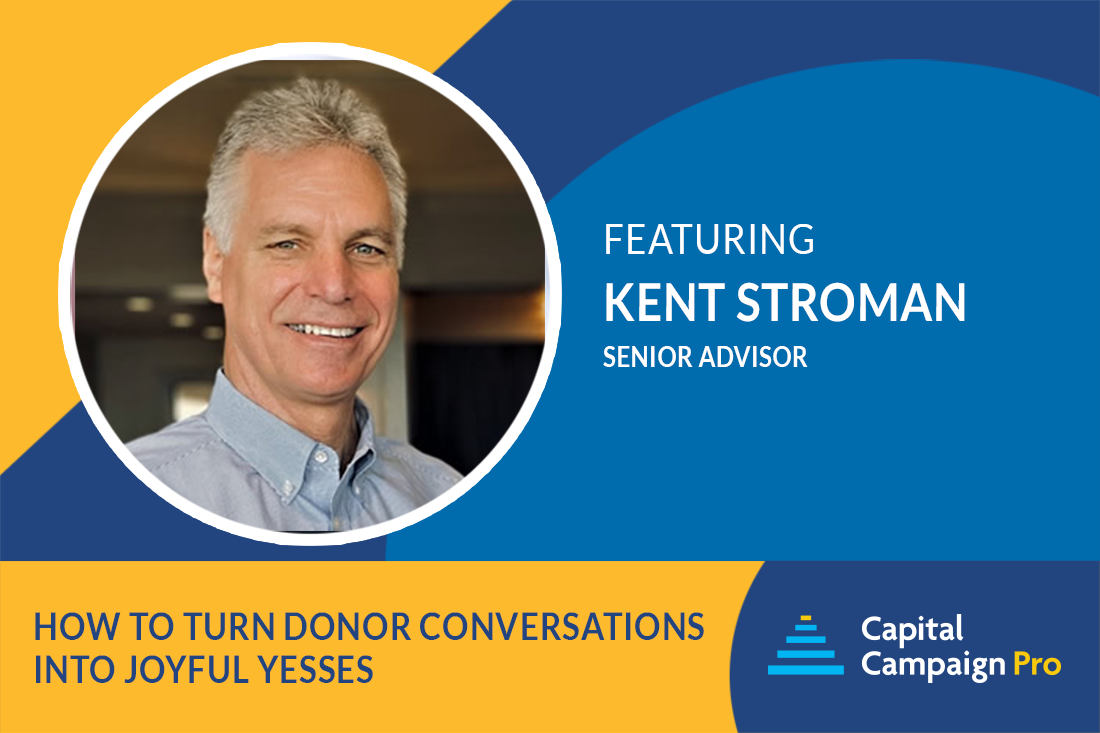
In this Best of All About Capital Campaigns summer re-run, Andrea Kihlstedt is joined by Capital Campaign Pro Senior Advisor Kent Stroman, author of Asking About Asking: Mastering the Art of Conversational Fundraising. Together, they explore a refreshingly different philosophy of major gift fundraising—one built on listening, curiosity, and authentic relationships rather than pressure or persuasion.
Whether you’re preparing for your first major gift conversation or looking to refine your solicitation skills before your next capital campaign, this episode offers practical techniques that can immediately improve the quality of your donor conversations.
Listen Now:
Andrea Kihlstedt:
Does the idea of asking someone for a really big gift make you sweat? Well, if so, today’s session is just for you. You’re actually going to learn how to have a good time with those conversations.
I’m Andrea Kihlstedt, co-founder of Capital Campaign Pro, and I’m here today, not with my partner, Amy Eisenstein, who’s away this week, but with my wonderful friend and colleague, Kent Stroman. Thank you so much for being with us, Kent.
Kent Stroman:
Oh, you’re welcome, Andrea. I always enjoy our conversations.
Andrea Kihlstedt:
Kent is one of the senior advisors for Capital Campaign Pro. He does a wonderful job with his clients. He also does some other and has done some other really interesting things. Kent is the author of two impactful books, both published by Charity Channel Press. The first one is Asking About Asking, Mastering the Art of Conversational Fundraising, and the second is called The Intentional Board, Why Your Board Doesn’t Work and How to Fix It. So one book on asking, one book on boards, both are available on Amazon. If you look him up, S-T-R-O-M-A-N. There’s no H in that, not like my name. You’ll find both of those books listed, and I encourage you to do that.
Now, in addition to writing great books, Kent in 2013, he launched something called The Asking Academy, which is an intensive five-month training program. Now that’s a long program for any who know about training programs, a long, long program that equips fundraising leaders from across the country to transform their fundraising results. Now, he’s been doing this for more than 10 years now and has some amazing lessons. It is in large part about conversational fundraising, which is why I asked him to join me today on this call.
Just one more thing. For more information about Kent, you can reach him, kent@conversationalfundraising.com or www.askingacademy.com, so jot that down. If you’re in your car, jot it down when you get home. And you’ll want to look up some more about Kent.
What is Conversational Asking?
So, all right, enough of this introductory business. Let us actually dive to the meat of the subject. And let me start by asking you, Kent, you’ve written a whole book on it. What in heaven’s name is conversational asking?
Kent Stroman:
Yeah, so great question, Andrea. And for a contrast, most fundraising is either conversational or confrontational. And nobody calls it a confrontation, but frankly, that’s the way a lot of people approach fundraising. It’s kind of a fork it over and nobody will get hurt. But I’ve never subscribed to that. Friendships and relationships are important to me.
And probably one of the biggest reservations that I encounter with people when they’re asked to engage in serious fundraising, they say, “Well, I don’t want to damage relationships.” And I say, put me at the front of that line as well. And so how can we engage in fundraising where it’s based on a relationship rather than transaction, and where we’re actually having conversation, which we’re all very good at, instead of setting up some kind of opposing forces into confrontation.
So that’s the, I guess, the frame of mind that eventually ended up in the book Asking About Asking.
Andrea Kihlstedt:
Yeah. Kent, when you talk about confrontational asking, I know that’s what makes people sweat.
Kent Stroman:
Exactly.
Andrea Kihlstedt:
That’s makes me sweat. If I think about having to confront someone and sort of saying,”well, you have money, give it to me.” It’s nothing like that to make you not want to do it.
Kent Stroman:
Exactly.
Andrea Kihlstedt:
But you’re right, many of us, most of us perhaps, are pretty good at having conversations. A lot of us do it not only for fun, because we do that in our social lives, in our family lives, but we learn how to do it in our business lives as well, how to have generative, constructive, engaging conversations. And to be able to take that and then transform it, transform the ask into that kind of a conversation, I think is just a magical idea.
Kent’s Inspiration for Conversational Asking
So how did you come up with it? Where did that idea take form for you?
Kent Stroman:
Yeah, well, probably I would say all of my good ideas are just the result of failures. I didn’t initially start out with fundraising. In fact, my background is finance. I tell people I’m a recovering accountant. And I can assure you that if a recovering accountant can become effective in fundraising, anybody can.
But the whole question of how do we start a conversation that hopefully will lead to a transformative gift, and really it’s that whole idea of it being a conversation. In fact, one of the things you mentioned, my first book, Asking About Asking, there’s a key framework in that that’s called the 10 Step Staircase. And at the top of those stairs is a door that’s marked yes. Because when we’re asking for a gift, we want somebody to say yes. And so step number 10, we’re asking for a gift, but we’ve got nine steps before we get to step number 10, where if we’re really being effective, we are not asking for a gift, but we’re “Asking About Asking” for a gift.
And so the whole idea of coming to a point where we can ask somebody for something that they want to say yes to, and we know they want to say yes to it because they’ve already told us, they’ve told us some important aspects about the gift, the size of the gift, the timing of the gift, the conditions around the gift, information about the giver, what do they want to accomplish with their gift and so forth.
And in fact, Andrea, there’s something about our industry, the fundraising industry that I think is fundamentally flawed, and that’s our definition of success. So historically, the definition of success is to get the gift. And the result of that is, if that’s our object, then it’s kind of like we have to get the gift at any cost, whether it’s the right amount, the right time, the right giver. And so we define a success as getting the gift. Well, we take a different approach to that, and we say that success in fundraising is helping donors make well-informed decisions.
And so if I were to approach you for a gift, I would want to find out is there alignment between your mind and the mission, between your heart and the passion behind that mission, and is this something that you would want to partner with as a contributor? And if so, then let’s find out how to make that happen. But if not, I don’t think it’s my job to persuade you to change your mind.
I don’t know if anybody’s ever tried to do that, Andrea, to change your mind, but I mean, that’s not what we’re created for — making decisions for other people. But if I can provide you with information about what is the cause, what’s the organization, what’s the solution, what problem are we trying to solve, if I can make you aware of that, explore ways that that may be in alignment with your priorities, then invite you to partner with us as an organization rather than trying to compel you. I’ve never found that latter version to be very successful.
Andrea Kihlstedt:
Yeah, it’s so interesting.
Changing People’s Minds and the Gestalt Principle
I think a lot about this question of changing people’s minds, of trying to convince people of something. And I often come back to the Gestalt principle. Those of you who know me know that I’ve done some work with the Gestalt Institute, am interested in their way of thinking. And one of the principles of Gestalt, this approach to psychology, in order for anyone to change, in order to change anyone’s mind, you have to fully embrace where they are currently. You have to make what they’re thinking, how they’re approaching something perfectly acceptable and okay.
And from that sort of neutral position where you’re not pushing, you’re not shoving, you’re not nudging, then change might be possible. The idea is that once you push someone, you create resistance. That’s really the Gestalt principle. The more you push, the more resistance you create. The more I’m pushing you to do something, and what your mind is doing is pushing back against me.
So to set up this idea of conversational asking, I think what you’re saying, just to translate it into this Gestalt framework, is that the task is to find out where the donor is, where this person is, what they think, what their priorities are, what they would like to do, what they’re already doing, what lights them up. And then have them find ways that they see that they are in alignment with what it is you’re doing. So everybody is working towards this similar point. You’re not pushing them to do that.
Kent Stroman:
Exactly. Yeah. And in fact, I think what you said just illustrates kind of a saying that we incorporate into our training process. And that is this. The most important part of a donor call is not what you say, it’s what you hear. And we have a tendency to prepare by trying to memorize the encyclopedia full of facts, and figures, and stories, even from what our organization is. And then we try to transfer that all in a fairly brief period of time. And it’s impossible.
Kent’s Favorite Questions to Ask Potential Donors
And so one of the things that we focus a lot on is questions. And so I’ll just give you one of my favorite. I mean, I’ve got lots of favorite questions on it. It’s a 10 Step Staircase. But one of the stair steps is asking about purpose. And again, traditionally, even though we don’t use exactly these words, here’s what we usually ask for.
So Andrea, what do you want your gift to pay for? And again, those words themselves, those are transaction words. What do you want your gift to pay for? But what I love to ask instead, as you think about this project and how you might be involved, I’m just curious, Andrea, what would you want your gift to accomplish.
And what the gift will pay for and what it accomplishes may be the same, but they just sound way different.
And I mean, I’ve never asked that question, had somebody say, “Well, I know they got a lot of salaries. I hope my gift will pay somebody’s salary, or cover the utilities, take care of the rent payment, or all that stuff.” But let’s say we’re dealing with a hunger-based or food insecurity organization, “It would be so meaningful to me if I had the confidence to know that nobody in my zip code, no child was going to go to bed hungry tonight.” Now, are we going to use the gift to pay for salaries, or build a building, or whatever? Yes, yes. But that’s not why people give, to put bricks on top of each other. It’s not that. It’s purpose.
And so anyhow, if we go into it with the idea of listening, by asking relationship questions, asking heart questions, and if our job is to listen, then probably one of the biggest obstacles to that is actually what I’m doing right now, and that’s too much talking.
Andrea Kihlstedt:
It’s easy to talk, to talk a lot. One of my favorite phrases in the asking process is not a question, actually. It’s this simple phrase, tell me more, tell me more. It’s amazing when someone starts to tell you something and then they pause and there’s this sort of vacuum.
If you just say, tell me more, they will tell you more. They’re hungry to tell you more. You have indicated that you’re interested in learning more. And when they start telling you more and you start listening, then you can keep drawing them out. You’ll learn everything you need to learn. You can then move them through the various steps so you know what it is they would like to give. And once you know what someone would like to give and why, then the ask becomes really easy.
Kent Stroman:
Well, it’s a collaboration. And in fact, one of the things I love to listen for in these conversations is when the prospective giver stops using or uses the word you less and replaces it with we, because then I know we’re collaborating rather than competing.
Andrea Kihlstedt:
Right, right. Yeah. Funny to think about asking as a competitive issue. It is who wins, who wins, and who loses. We have to get away from that. And your conversational model, I think really takes us away from that.
What’s Challenging About Learning Conversational Asking?
Kent, you’ve taught a lot of people this model. What do you find is the most challenging for them to learn?
Kent Stroman:
I’m laughing because it’s human behavior. So here are really, I think the two maybe difficult things. One is learning to listen, and the corollary to that is to listen, I have to stop talking. And we talk often because we’re nervous.
And so we think we need to fill up the space. And in fact, one of the things, sometimes we’ll encourage people, before we have a major donor call, we’ve prepared a lot for it, and so we’ve thought a lot about it. I’ve thought about what my questions are, what my comments might be, and I’m prepared.
Well, the other person hasn’t been in preparation at all. And so I may ask a big question like that, what would you like your gift to accomplish? And in my mind, I know what the answer ought to be, but one of the things we often have to coach each other on is be prepared, and help, and have tools so people can be comfortable with a quiet moment.
So there’s something I’ve been wanting to ask you, Andrea, and you may want to take a moment and even think about the question before you respond, but what would you like your gift to accomplish?
Andrea Kihlstedt:
That’s a wonderful question, Kent. Let me think about it for a minute. It’s easy to think about money and harder to think about what I want my gifts to accomplish.
Listening More Can Change Your Life
Kent Stroman:
So that’s the first thing, listen. In fact, I had a guy stop me. He had gone through the Asking Academy. This was years later. I was speaking to a group of fundraising professionals. He was a volunteer, but he made a comment to the group. He made a comment about the Asking Academy. And he said, “I went through the Asking Academy and it changed my life.” Now, those are big words to me, kind of like what we were talking about earlier, changing our mind. But he said it changed his life.
And so I asked him, I said, “I picked up on that comment. You said, ‘changed my life.'” I said, “How do you mean that” And he said, “well, it made me a better listener.” And at the time, Andrea, he was in his sixties. For people who are in their sixties, becoming a better listener is not expected. And so that’s one of the big difficult things.
And the other one is learning how to not guess or not assume. And again, that’s a very normal behavior for us. I hear a thing, and based on my experience and the words that I heard, I’ll make assumptions, I’ll make guesses. And have I told you what a bad guesser I am?
Andrea Kihlstedt:
I don’t think so.
Kent Stroman:
So my first grandchildren are twin girls. They’re not identical. And so I have a statistical 50/50 chance of putting the right name with the right girl. My odds are not even that good. I don’t know how I can consistently —
Andrea Kihlstedt:
Now, wait a minute. These children are identical twins?
Kent Stroman:
No, they’re not identical.
Andrea Kihlstedt:
Not identical twins. Okay.
Kent Stroman:
Yeah, they’re girls. They’ve got the same parents. They’re born on the same day. And the differences are, if I really study, and pause, and think about, I can figure it out. But when I look at them, even today, they’re 17 years old. And you would think I would know the difference between Michaela and Juliana. But again, 50/50 odds, I’m not that good.
And so on something as remote as these other questions, we can guess. Let’s say we’ve got a… The odds are 100. I’ve got 99 chances to get it wrong. So I have no chance of guessing right. And so I would much rather ask. And the big question is the amount. And a lot of times people say, “How much should I ask so-and-so for?” I don’t know. Who knows? They know. How about you ask them.
And so again, we have a comfortable way to ask about, when it comes time, to talk about your gift:
“I’m curious. What range should we be talking about?”
Well, who would be able to answer that question for you, Andrea? I mean, can you imagine somebody walks in, they’ve figured out how much money you should give them for this cause at this time?
Andrea Kihlstedt:
It would annoy me when told me what I should do.
Kent Stroman:
Yeah. But that is standard practice.
Andrea Kihlstedt:
Yeah. So interesting.
Kent, years ago, just like you, I was kind of unhappy with the standard practice of how people were asking for gifts, mainly because what I saw people teaching in this, when they taught about asking, was that they would teach how to overcome resistance. They would teach how to convince someone to change their minds. And it always made my stomach hurt when I… It always struck me as wrong, struck me that if you are creating objections, you’re already on the wrong track.
And the standard pattern is you ask someone for a gift, they give you objections, you argue with them and tell them why they shouldn’t have those objections, and you move forward. And that never felt right to me. So I was really wrestling with the same sort of thing that created your conversational asking pattern.
Conversational Asking vs. The Arc of the Ask
What I came up with, which is what we use in Capital Campaign Pro, is Arc of the Ask is what I came up with. And it’s, I think a simpler formulation than yours. I always refer to it as half of a pizza pie. And it’s really set up in a way that gets solicitors to encourage the prospective donor to start talking, and to talk about what their interests are before the solicitor makes the ask. And the ask is really quite simple.
And then after the ask, it again encourages the donor to talk their own selves into making the gift. Now, I think your 10 step formula and my Arc of the Ask are actually quite similar. I think you’re familiar with both of them. Is that right?
Kent Stroman:
Oh, yes. Yeah.
Andrea Kihlstedt:
What do you think are the similarities or dissimilarities?
Kent Stroman:
Well, first of all, let me just say this. I love the Arc of the Ask and what you put together with your half of a pizza. But the thing that, where I see a real common thread between the 10 Step Staircase and the Arc of the Ask is that they both, I don’t know if I would say require, but they both kind of compel planning, preparation, and listening.
And so rather than just showing up. And there’s this term shooting from the hip. I don’t know why we’re always wanting to talk about shooting, but we show up, we’re going to have a conversation. And so we’ve been thoughtful, we’ve prepared, and we know when it’s time in the conversation to make the big ask, whatever that is. And we have intentionally prepared time to listen after asking.
Because here’s what I find, and whether this particular visit, its primary purpose is to ask for the gift or to ask about some other dimension, what I find is the conversation is all theoretical for the prospect until the big question is asked. And that’s where it becomes very personal and practical.
And so I think in the arc, I think you’re about halfway through the conversation when you make the ask. We like to say, when you’re a third of the way into the conversation, that’s a good time to make that ask. Does it happen precisely like that? No. But if we plan to do it about a third of the way in, we’ll surely be there by half of the way in.
But again, once we’ve asked that really transformational question and we’ve reserved time to listen, they’ve listened to us, now we’re listening to them, and not to persuade, but rather to inform and explore. And I had one person say, “Well, in order to make a gift of this magnitude, there are these other things that would have to be in place.” Well, there were a couple of them I wasn’t real sure of, but that phrase you just used, tell me more, a little bit more about that. And so this thing that I thought might be an obstacle, and again, I was in a consulting role, so I wasn’t in any role to decide, but I said, “If they were able to address that and this other thing, I’m just curious what else?” Well, that’s another tell me more question.
And so again, it’s remarkable because I think there are two kinds of responses. One is just a shrouded no. I don’t want to be impolite and say no, so I’ll say, well, what if, what if. And when we follow up, we could find out if we’re on a dead-end street. And if so, we give everybody the freedom to turn around and walk out of that dead-end street. But on the other hand, if this is a legitimate, let’s say, speed bump, “I don’t know if we can address that. Maybe they can, maybe they can’t. If they could, what else? What else would need to be in place to make your dreams come true?” It’s just a whole different conversation.
Andrea Kihlstedt:
It is a whole different conversation. It really is.
The Biggest Mistake People Make When Asking for a Gift
So, Kent, is there one thing that you would point to as the biggest mistake you see people making in asking?
Kent Stroman:
That’s fair. Biggest mistake probably is what I would call rushing. In our minds, we have this thing made up. And the conversation has to take place on this day, it has to be this long, and it has to have this outcome. That’s not how relationships work. But in fact, one of the questions that I’ll ask a lot of times in working with organizations is, do the fundraisers have the luxury of time to take as much time as the donor needs to make their best decision? Because usually anytime I say quotas, that makes me uncomfortable because the quota brings time pressure. And what I find if I introduce my urgency on somebody else, that’s that form of resistance that you were talking about earlier, that don’t push me.
Andrea Kihlstedt:
Yeah. When you say quota, you’re talking about a development director who has to close 10 gifts a month. And actually their success in their jobs depends on it.
Kent Stroman:
Yeah.
Andrea Kihlstedt:
Well, that’s hard. That pushes them to close gifts before they’re ready. How sad is that, that that’s the way development shops are often set up? Particularly in larger institutions. I think people face this quota system, which I think is really rough.
Getting Ready for an Ask? Preparation is Key
Well, Ken, as we get ready to close, I’m imagining the person who’s driving along the road listening to this podcast, getting ready to go into the office to prepare for either, to train someone to do an ask or themselves to do an ask. And are there two or three things that you would encourage them to do to get ready?
Kent Stroman:
Yes. So what are those things? Well, I’m going to lean back on my framework. I like to just sit down with the 10 Step Staircase and ask the question of ourselves, which of these steps are valuable and which are not? And in fact, so one of the steps is asking about generosity. This is another one of my favorite questions.
So again, if we’re meeting, and let’s say that I know you as I do know you as a person who is generous, then one of the questions I’d love to ask is:
“So Andrea, I’m just curious. I’ve had the good fortune to observe you over a long period of time. I’ve seen your generosity expressed in so many different ways. How did you come to be so generous?”
Now, if I don’t know that they have come to be generous, then I’m going to ask a little bit differently. But again, that is not a head question. That’s a hard question. And so that’s preparation. If we don’t know, that’s one of those questions I want to ask.
So assess where we are relationally and then determine for our next encounter, what’s going to be the most crucial question for me to ask in this one? And then what is that question going to sound like? And I have to train my mouth, if it’s time to ask for, let’s say, a seven-figure gift, it’s amazing how paralyzed we can get by saying the word million if we’re not accustomed to asking for a gift of a million dollars, or $3 million, or whatever. And so to actually practice that thing…
Because here’s what we find, and this is another preparation thing. I think one of the most important parts of preparation is how are we expressing ourselves? Because people tend to reflect what they see. And so if I come in a panic, I’ve got a quota, I’ve got to get a gift by the end of the month, that’s October 31st. Today is October 30th. I’m not going to say it, but people are going to sense anxiety in me and they’re going to feel anxious. But if I can be relaxed, informed, confident, and comfortable, people are going to feel relaxed. They’re going to come to be informed. They’re going to be confident. They’re going to be comfortable. And I want that for others. I don’t want to go our separate ways, and Andrea says:
“Man, I’m glad that’s over. I don’t know why, but I was feeling really tense and I don’t feel tense anymore.”
So it’s that preparation. And rather than persuading somebody else, persuading to me, how do I need to show up, and what can I do to make sure that I succeeded, which is when that donor call is over, that I’ve done more listening than I have speaking?
Andrea Kihlstedt:
What wonderful things to remember when you’re going into a call. It’s easy for us to lose track of that, to lose sight of it, to think only about the gift, and to railroad or try to railroad our way through that.
Final Thoughts
So Kent, it’s been such a pleasure to talk to you and to learn a little more about your conversational asking approach. I would encourage people to actually get hold of your book Asking About Asking and take a look at the ten-step process. I think the more we learn about this business, the better. The more we try out different ways of doing it, the better.
So if you’re a member of Capital Campaign Pro, you should take a look at the Ark of the Ask. There’s a recorded training on it in the [Online] Toolkit that I hear from a lot of people that they find helpful. And then you should look at Ken’s 10 steps and say, okay, well what can I learn from both of these models, and how can I piece them together, and what’s going to work best for me?
I think what we’re all clear about is that the process of asking is not a process bludgeoning. It’s not a process of beating people up to get a gift. It is a process of finding out what people want to do and then helping them do it. And from that perspective, which I think underlies Ken’s approach to asking and my approach to asking, I think all of a sudden this asking business doesn’t get you to sweating. It gets you heart warm, it gets you excited to have these conversations.
By all means, check out Capital Campaign Pro. If you haven’t had a chance to do that, we are a host of free resources on that site. And if you are planning a campaign, ready to move into a campaign, we would be delighted to talk to you about the possibility of being your advisors and providing you what you need for your campaign, including perhaps working with Kent. Who knows? Kent is one of our terrific… We have many. We have, I don’t know. I don’t know. 15 – 18, amazing advisors, you among them.
Kent Stroman:
For sure. Yeah.
Well, Andrea, let me just say a big thank you. You always spawn creativity and ambition within me, and I am forever grateful.
Andrea Kihlstedt:
Thank you, Kent. Thank you so much. I appreciate it. And I look forward to having other people learn from you, just the way I have.


Leave a Comment