
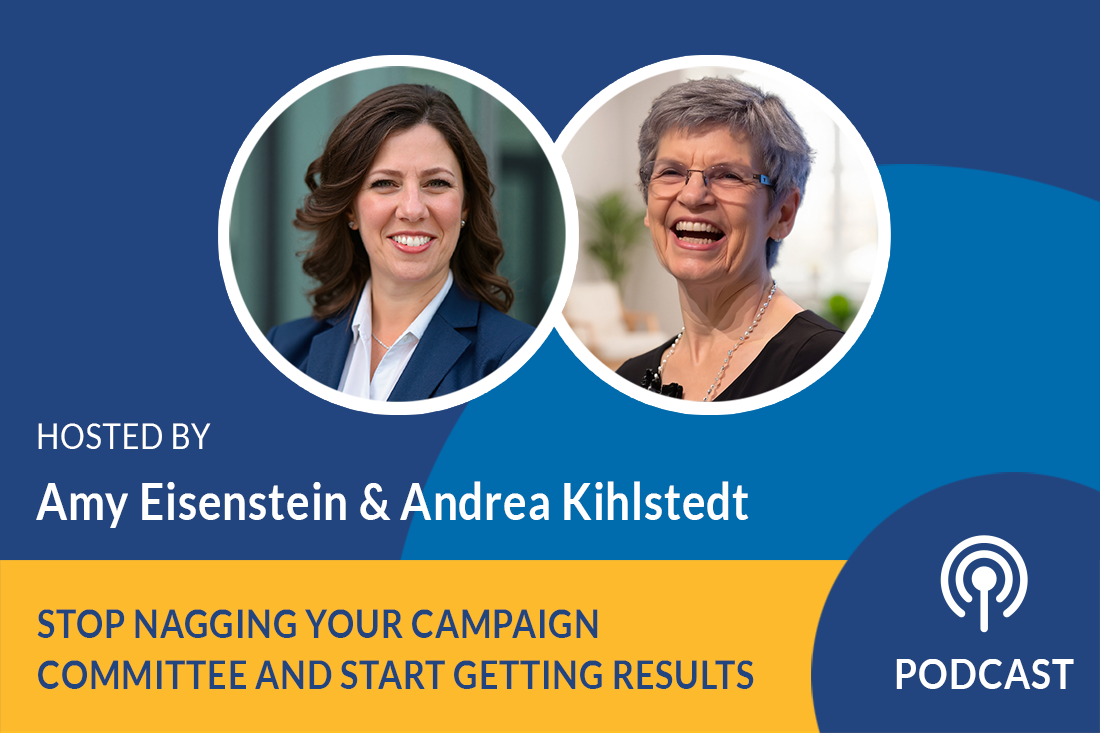
Podcast: Stop Nagging Your Campaign Committee and Start Getting Results
Season 5, Episode 31
If your campaign committee members agreed to make calls but nothing is happening, this episode will change how you respond and improve your results.
In this episode, Amy Eisenstein and Andrea Kihlstedt tackle a common frustration in capital campaigns: committee members who accept prospect portfolios and then stall. The assignments are clear. The meeting is approaching. The report forms are empty. The development director is wondering how often she can “bug” people before the relationship starts to fray.
This episode explores a powerful campaign truth: clarity is everything. A yes allows you to move forward. A no allows you to move on. The maybes are what drain energy and stall campaigns. Teaching committee members to seek clarity liberates both staff and volunteers.
Listen Now:
Andrea Kihlstedt:
Stop nagging. Start helping.
Amy Eisenstein:
Hi, I’m Amy Eisenstein. I’m here with my colleague and Co-Founder, Andrea Kihlstedt. And today we’re going to talk about how to stop nagging your committee members and how to stop stressing when they don’t do what they said they were going to do.
Why This Topic Matters
Andrea, how did this topic come up? I love this topic. It’s so important.
Andrea Kihlstedt:
Yeah. My colleague, Richard, and I were on a call, a Wednesday call with some of our clients yesterday. And we always start out by getting people to say, well, what questions do they have? What issues are they dealing with? And someone said:
“I have a lead gift committee of about eight people and everyone has their portfolio now. And we have a committee meeting coming up and no one has reported that they’ve done anything yet. How often can I bug them?”
It’s a really great question because I think it’s very common for people to be in that situation.
Now, just to set the stage, her committee members weren’t having to call people or have solicitations. All they had to do was to get in touch with the people in their portfolios and set up a call with the executive director, development director. They had to tell them about the organization, tell them they were on the board, and see would it be okay if I introduced you to the executive director?
So these weren’t difficult calls, but they were calls where the committee members would have to get in touch with people that they knew and set that up. And these committee members, I mean, many of which were major donors so that they knew the case and they were effective, but still, they were hanging back. They weren’t doing their work. And the development person who was on the call said:
“We sent them a form so that they could fill out the form when they made a call and send it to us. But we haven’t gotten one form back. And we have a committee meeting next week. What should we do? Can I nag them? Can I bug them about it?”
Amy Eisenstein:
Well, you often reference our Wednesday calls on this podcast. And I just want, for listeners who are unfamiliar with what we’re talking about, every week we bring our clients together for peer support calls. And we have you and other experts on our team facilitating these calls. And all of our clients are invited to come talk about their challenges and share successes and learn from one another, and their wonderful opportunities. So, all these juicy topics emerge from those weekly calls. So, that’s where it came up. And I think it’s such an important topic.
So what did you guys come up with on the call? What was shared? What were some of the ideas for this frustrated development director who can’t get her campaign committee members to follow through or make their calls?
Start Getting Results from Your Campaign Committee
Andrea Kihlstedt:
Right. Well, for starters, it turns out, of course, that other people who were on that call had some variation of the same problem. That this is not something that is unique, it’s not something that only happens occasionally. It’s a very common problem that people take on assignments and then the assignments sit on their desk or sit on a list of things they’re supposed to do. And because it makes them somewhat anxious, they don’t get to them until the very last minute, if at all. Or maybe if they don’t get to them, then they call and say, “Well, I can’t come to the meeting next week.” I mean, it can get dicey and you don’t want that relationship to form with your committee members.
So, we talked at some length about the things that you can do if you get off the bugging people, the nagging people sort of tenor. It’s very easy to think, “Well, I gave them these assignments. Everybody has their assignments. It’s very clear. Everybody knows what they should do. Everybody said they know what they should do. Now, can I bug them every two days or three days?” It doesn’t take very long before you feel icky about it and the people you’re bugging feel icky about it.
So after some conversation, we came up with a shift of frame. That’s maybe the best way to put it. We said:
“Okay, what happens if we stop framing it as everyone has assignments? They could be doing their assignments, they’re not. And now I am the mother sort of nagging at them. Let’s get rid of that. And instead, let’s get on the side of the people who had the assignments.”
Let’s say there’s a reason that they’re not doing these assignments. And maybe there are many reasons. Eight people, maybe there are eight different reasons for not doing the assignments.
So instead of thinking, “You’re bad, Amy, because you didn’t do your assignments.”, what if instead of that I come to you and I say, “Hey, Amy, I noticed that you haven’t gotten around to making your calls yet. Let’s talk about it. What’s holding you back? I know these are hard calls to make. It might feel difficult to you. Tell me what’s going on. What’s in the way?”
Amy Eisenstein:
What will help you do them?
Andrea Kihlstedt:
And then what would help you do them? Once I understand what’s in the way. And somebody might say, “Well, I’ve been on vacation.”, or, “My kids have been home.” There may be very simple explanations. Or it may be that you find that you’re just anxious about it, that you don’t really quite know what to say.
Amy Eisenstein:
Yes.
Andrea Kihlstedt:
And that’s, I think even for experienced people, even for experienced people who are philanthropists and who are donors, it’s like, how am I going to start this conversation? What am I going to say? So once you talk to them, not about why they’re bad in the conversation. No, you’re bad, Amy.
Amy Eisenstein:
You haven’t done what you promised to do yet.
Andrea Kihlstedt:
Right, right. Once I say, “Well, okay, here are some of the things that people find hold them back. They’re nervous about what to say. They’re anxious that the person might not respond well. They’re anxious that maybe the person won’t be willing to talk to them or because it makes them a little anxious, it just keeps falling to the bottom of their list. That’s very common.”
Try a Light Script or Office Partnership
So, what we’ve found over many years is that there are several things that really work very well. One is that you can give people not a script that they should be reading, but a script that would help them get started. What do I say in the beginning of this conversation? Once someone starts a conversation, it’s likely to flow.
So, somebody might be helpful for someone to have a script. That may not be helpful. Then it may be helpful if you offered to go to their office or to have them come to your office and essentially make the calls together where you would talk about the call. And then they would sit and make the call while you’re sitting in their office. Right? That that would…
Now we found again and again that with executive directors, for example, that really works. That when executive directors have trouble making their fundraising calls, if the development director goes every week and says, “Here are four calls we’re going to make today.,” sits in the office while the executive director makes the calls. It’s amazing what happens. So, you can do the same thing. You can offer the same thing with your volunteers.
But I think the big point really is that your volunteers need to know that you understand and you’re on their side, and that everyone wants to get these calls made. Whether or not they amount to something or they lead somewhere, the calls just need to be made.
Find Out What’s Holding Your Committee Members Back
So your job is to talk through with each of the people on the committee to say, “What would most help you? Can we try this? Can we try that?” And see what they respond to and then try it. Then when the committee comes together, you can talk about what happened. You can talk about what you did, what worked, what didn’t work. Maybe someone had a really great call at the committee meeting. They can say, “Gee, I finally got up my courage to call Joe and here’s what happened, lo and behold.”
Amy Eisenstein:
In advance, ask people to share so that they’re prepared to share. And especially if you know someone made a successful call, ask them to talk about that experience, why it was successful, what they think worked, how it felt to them, and how they think it felt to the potential donor. What the results were, how they talked about next steps.
So, really go through in detail. Don’t assume that people are comfortable or know anything or are able to make these calls. I think that’s such a good suggestion, both sort of handholding, literally, figuratively, whatever it is, but sitting with people, often that is what it takes and practicing, preparing for the call, whether it’s with a script or with bullets, just to repeat and highlight some of the things that you suggested, Andrea.
What about an email? Did that come up? And what do you think about an email? I mean, really you’re talking about inviting someone for a meeting and so many people don’t answer their phones these days. So, what came up around that, I’m wondering?
How You Communicate Can Make the Difference
Andrea Kihlstedt:
Yeah. There are many ways to communicate. One is email, one is text. So, you can have a combination of those things. You can start with a text. “Hey, Amy, I’d really like to talk to you about the XYZ organization. I’m on the board and we’re doing something exciting. Can we set up a time to do that?” So, that’s a simple text. Or it may be that if Amy then responds saying, “I’m interested in knowing more.”, then you can switch to email. Or it may be that you can say, “Well, why don’t we set up a meeting? Why don’t we meet for coffee?” If it’s someone you know quite well, you can actually offer a meeting.
So, these days we live in a world that has a variety of ways to communicate, and we often use them at the same time. If the communication gets a little more complicated, we often move from text to email, then from email to phone or in person. And you can feel what’s right. But I think when you’re working with people on a committee, the task really is to get them going. Once they get started, it’ll take over by itself. It’ll take on a life of its own.
Amy Eisenstein:
When they realize that not only is it not so bad, but that it’s actually fulfilling and rewarding, and that it feels good when they have success. They’re really contributing to the success of the campaign. And they wouldn’t be there if they didn’t want to do that.
Andrea Kihlstedt:
That’s right.
Amy Eisenstein:
And so really, it’s about tapping into that and helping them get some wins so that they’re motivated and engaged and feel how good it feels when they’re successful, and when they draw people in who are excited about your mission and your project. I mean, the idea is not to drag people in kicking and screaming. That’s not good fundraising. And so if that’s the case, they’re not good prospects, they’re not going to give a lot of money.
So, it is really about identifying people who would be interested in learning more about what’s going on, the project, the organization, what’s happening. And I think explaining that to committee members…
“Look, if somebody’s not interested in our mission or our project, you can thank them and let them go. We’re not going to chase them. We are going to be persistent and follow up with people that we think are going to be interested in our mission and our project.”
And so really reassuring them that you’re not going to hound people that are not interested, is probably an important thing to do.
Andrea Kihlstedt:
And that is super helpful to learn that, to know that, because then they come off your list, you don’t have to worry about them anymore, and then you’re onto the people who might be interested. So, it’s just as helpful to find out someone’s not interested as it is to find out that someone’s interested.
Amy Eisenstein:
Right. And maybe tell your committee that, right? We want to know. Get a yes or a no. And a no is just as important as a yes.
Andrea Kihlstedt:
Right. I mean, even more important really. Because if someone sits there as a maybe, I mean, it’s the maybes that’ll kill you. Right? The maybes go on forever.
Amy Eisenstein:
Yes.
Peer Support Can Help Too
Andrea Kihlstedt:
So we want to know, do we want to move forward or do we not want to move forward? And that’s the job of the committee members. And then when you get the committee together, you’re not wanting to… I don’t think you’re really wanting to create a competition. Gee, this person did all his calls and you did none. That’s a bad thing. You want to be able to tell stories of what worked and what didn’t work, what’s holding people back, what’s moving them on. Get suggestions. Even committee members might help one another.
But as I said in the beginning, what we did at the Wednesday call was to shift the frame so that the job of the development staffer was not to be a schoolmarm, but was to be a partner in helping to make these happen in whatever way the volunteer needed help. And that started… You could feel it on the call. It just started feeling much better to everybody.
Amy Eisenstein:
I feel better. I feel more relaxed, right? How can I help you? Not, did you get… Nobody wants to be a nag.
Final Thoughts
Andrea Kihlstedt:
Nobody wants to be nagged. I mean, we certainly have enough of it in our lives.
Amy Eisenstein:
Should we remind ourselves of that with our husbands?
Andrea Kihlstedt:
And our children, I think so.
Amy Eisenstein:
And our children. How can we help you today?
Andrea Kihlstedt:
How can I help you load the dishwasher?
Amy Eisenstein:
That’s right. All right. So listen, I want to remind listeners that this… It sounds simple when we talk about it in 20 minutes, but it’s actually not simple. These are complicated things and important campaign strategies and things that we work with our clients on a regular basis. And it really moves the needle for campaigns.
So if you’re thinking about a campaign, if you’re planning a campaign, if you’re getting ready for a campaign, I hope that you’ll consider the services that Capital Campaign Pro offers.
So go on over to the Capital Campaign Pro website, capitalcampaignpro.com and sign up to talk to us. Just let us know what’s going on and see if we might be able to help. We’d love to talk to you. So Andrea, great topic today as always.
Andrea Kihlstedt:
Thanks, Amy. Always fun to do this with you.
Amy Eisenstein:
Thanks for listening and we’ll see you next time.


Leave a Comment