
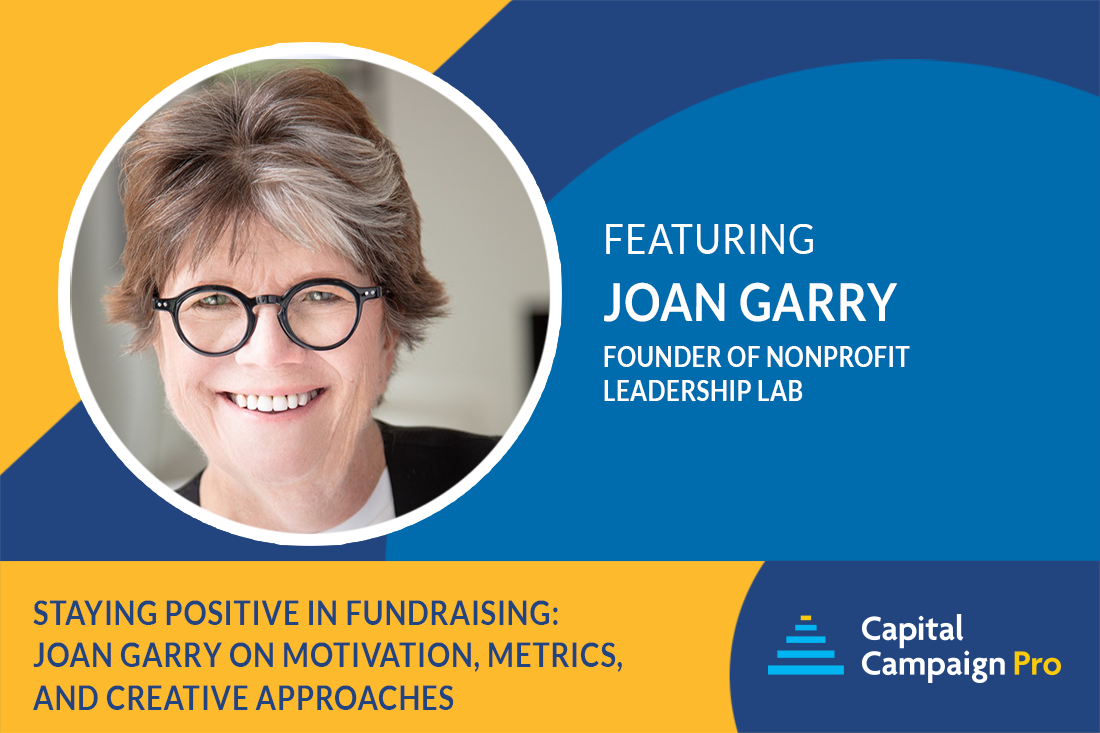
Podcast: Staying Positive in Fundraising: Joan Garry on Motivation, Metrics, and Creative Approaches
Season 5, Episode 7
In this episode, Amy Eisenstein welcomes nonprofit leader, coach, and advocate Joan Garry for an inspiring conversation about how development directors and nonprofit executives can maintain optimism, motivate their teams, and rethink what fundraising success looks like in challenging times.
Whether you are an executive director, development officer, or board member, this conversation will help you see fundraising in a new light. By focusing on relationships, creativity, and inspiration, nonprofit leaders can foster resilience and optimism in their organizations even when external challenges feel overwhelming.
Listen Now:
Amy Eisenstein:
If you are stressed and finding negativity, creeping in and getting in the way of your success as a fundraiser. Today’s episode and Joan Garry, our guests have things to offer you. We’re going to talk about encouragement and ways you can help yourselves and your teams stay positive.
Hello and welcome. Today we have Joan Garry, who I imagine if you’ve been in fundraising for five minutes or five years, you have heard of her (or now will look her up). Joan is an internationally recognized champion for the nonprofit sector and a highly sought after executive coach for CEOs and for some of the nation’s leading organizations, the largest nonprofits in our sector.
She is an author, a blogger, a podcaster and founder of the Nonprofit Leadership Lab. Joan has helped hundreds of thousands of nonprofit board and staff leaders become five-star managers, communicators and ambassadors for the organizations that they love. And I am so thrilled. Joan and I both live in New Jersey, but we don’t cross paths often. So, I am absolutely delighted to have her here as a guest on the All About Capital Campaigns podcast. But of course we don’t always just talk about capital campaigns, we talk about fundraising and really good fundraising. So, welcome, Joan.
Joan Garry:
Well, thank you, Amy. And yes, we actually live, I’m at Exit 148 on the State Parkway.
Amy Eisenstein:
I’m on 145, right?
Joan Garry:
Yep.
Amy Eisenstein:
We’re close.
Joan Garry:
We’re a stone’s throw away from each other, but mostly see each other on Zoom. And isn’t that the way the world works today?
Amy Eisenstein:
It is, it is. Well, listen, thank you so much for joining us. I mean, I’m excited to talk to you because you really look at development directors and nonprofit leaders in more of a cross section than we do here at Capital Campaign where we’re super focused on those that are doing capital campaigns and unfortunately we are living through some really challenging times for nonprofits and fundraisers and nonprofit leaders right now.
Negativity Settling Over the Nonprofit Sector
So, I want to talk about the negativity that’s sort of settling over or has blanketed our sector to some degree because there’s a lot of things to be worried about and I think development directors and nonprofit leaders are stressed and worried. So, talk to me about what you’re seeing and what you’re hearing.
Joan Garry:
So, first off, thanks Amy for the work that you do. And one of the things actually that gives me quite a lot of optimism is that there’s a lot of folks like you and me and others who are out there and we’re sort of hell-bent on making sure that nonprofit leaders have both the technical and the moral support that they need. And I consider it a real privilege to be able to do this kind of work and I know you would do as well. The second thing is that there’s probably not a position on the nonprofit field I haven’t played. And when I became a nonprofit executive director, I was hired with no fundraising experience. I had never actually asked anyone for money.
Amy Eisenstein:
Yes, you’re not alone. You’re not alone.
Joan Garry:
Probably including my mother because I knew she’d say no.
Amy Eisenstein:
So, you had heard no before, that’s the problem, right?
Joan Garry:
Yes, correct. And leave it to a nonprofit board to hire somebody who had no fundraising experience when the finances were in disarray would be a kind word to use to describe. But I became someone who became really enthusiastic. I actually really love fundraising and I don’t think I’m in the minority, but certainly that this stereotype is that this getting somebody to put a wrench to their wallet. And I was told that people really like to give money to causes they care about, makes them feel good. And in a world here that we are living in right now where people aren’t feeling very good, where people are sitting in the stands trying to figure out how they’re going to make sense of the world, how they’re going to find meaning and purpose in what seems to be, it’s just an ongoing morass of chaos.
Amy Eisenstein:
Yes.
Joan Garry:
I’m here to say that asking someone for money is an invitation for them to feel good feels, to say, “Oh, I’m actually on the field, I’m in the game.” And I think we lose sight of that. And I bet you see that all the time.
Amy Eisenstein:
I do. I couldn’t agree with you more.
We Don’t Know What’s Going to Happen Next
Joan Garry:
And so it is in that context that because I’m such an optimistic person and know what a gift fundraising, asking someone for money can be that this kind of negativity that I’m feeling and seeing … Which in many ways is justified because we don’t know what’s going to happen next. You think the other shoe has just dropped and then all of a sudden there’s another foot and another shoe. And so we’re living in this sort of chaos.
Amy Eisenstein:
I think unknown is scary and that is what we’re living in right now. It is the unknown.
Joan Garry:
Totally. It is the unknown. And so you asked a question about what am I seeing, and you mentioned it earlier, I blog and I have a podcast and I do executive coaching and then I have a membership site for leaders of small to mid-size nonprofits. So, I kind of catch nonprofits at every size and shape and at every leg of their journey. And this theme is starting to creep in, which is honestly troubling to me, which is that I’m hearing more and more development directors talking to their CEOs or their executive directors with a real negativity. We’re never going to hit our numbers.
Government grants are going away, people are concerned about the economy. And that what was once a kind of an optimistic kind of approach to fundraising has really shifted. And there’s a, despair is a big word, but it’s something akin to that. I’m never going to hit these numbers boss. And that is troubling. It’s troubling when you’re a CEO and you hear that from your development director because it doesn’t make you feel all that good either.
An Opportunity For Donors to Feel Good in Darker Times
Amy Eisenstein:
Yes, it’s true. I want to go back to this idea though, really flipping the script, and you’re not pinching donors’ wallets, but you’re giving them an opportunity to be in the game and to feel good. I mean, that’s what good fundraisers do. And I think if we can get fundraisers in that headspace as you suggest, and really believing that donors want to help and it makes them feel good, some of the negativity would dissipate.
Joan Garry:
Yes. And I believe, and you hear a lot of people out there in our field, Amy, who talk about making a shift from transactional to relational fundraising. And I believe that if you approach fundraising in a transactional manner, you don’t actually see that or feel that sense of purpose that someone gets from giving a gift. If you’re not stewarding those donors, if you’re just simply trying to hit your number and trying to get that gift before the quarter ends or before the year ends, you don’t feel that. And I think that it’s really key to being a great development director and especially key in dark times.
Amy Eisenstein:
Yeah, I think you’re so right. So, we started sort of high level theoretical. Yes, it would be great for fundraisers to be more optimistic, positive, I don’t know what the word is. So, let’s get a little more concrete and tangible. So, how can nonprofit leaders help development directors be more successful in these challenging times and try and meet their goals?
Joan Garry:
It’s an interesting question because I think goals are actually of the problem.
Amy Eisenstein:
Yes. Let’s talk about goals.
The Role of Metrics in Today’s Fundraising World
Joan Garry:
So, every development director I know and every development director I’ve ever had is driven to be successful. And how do they define success? Well, most of the time the organization defines success by one single metric, the total dollars raised. So, if that’s the metric, and we know that development directors are super driven to get A’s on their book reports and they know that, oh, I have 70% of my government funding all went away or back in the pandemic, the gala disappeared. If success means, if I am going to get an A on my book report, I’m going to hit my financial goal. If money goes away that I have no control over, I just feel like a failure. And people who are feel like failures are not optimistic.
The second thing is that there’s a certain amount of fear that development directors have. So, for example, they may have a particular strength in area A, but in order to actually fill the gap that’s been lost by whatever revenue stream has decreased or gone, they may be asked to do area B or C, they might be asked to build an individual giving program which they’ve never done, or explore an earned income stream. And I’m a type A, I want an on my book report and I’m like, “Oh my gosh, I’ve never done that. I can’t do that. They’re not going to need me. They’re going to need somebody who could do that.” And so there’s a certain element of fear that comes into play as well. And so I think these are things that are causing the comments that I hear. I literally heard from a coaching client who said, “What’s our plan for filling the gap?”
And the person literally said, “Well, I sure hope Mackenzie Scott comes through.” That’s not a plan. That is not a plan, that’s a wish and may or may not be particularly a pragmatic one. So, this is the landscape in which development directors are living. And I believe the root cause of it, Amy, is that they define success by, do I hit my numbers? I mean, there are CEOs and I coach against this, there are CEOs that might get a bonus and the bonus is tied to whether the total dollars, whether they hit their revenue numbers. I completely disagree with that as a metric for whether or not a CEO should get a bonus and we can talk more about that.
Amy Eisenstein:
Or he is doing a good job.
Joan Garry:
Right, right, right. Exactly. And the bottom line, as you know, is because fundraising a team sport.
Amy Eisenstein:
Right. Oh, so many good topics we can delve into. Let’s go back to what other metrics we can use to measure and perhaps how to set good goals that are, I don’t know, I’m losing the word high up, but also achievable, realistic and aspirational. Aspirational is the word I was looking for and some combination. But the idea, the example that you gave that an organization loses 70% of their funding, their federal funding cuts or whatever it is, 100,000, 500,000, 10 million, it doesn’t matter. And that gets wrapped into the fundraising goal is completely ridiculous.
So, helping organizations think about what are the other options? How are we going to … I mean, we may have to temporarily scale back programs and services, but the idea of putting it all on the development officer’s head is crazy. So, you’ve raised the issue of setting goals and also metrics and benchmarks, and how are we going to evaluate development directors, not just with one metric?
Joan Garry:
Yeah.
Amy Eisenstein:
What do you want to touch on next?
The Importance of Renewing Donors
Joan Garry:
I think here’s one metric that I believe that we ignore all the time, which is your percent of renewing donors.
Amy Eisenstein:
Yes.
Joan Garry:
Right? Is that we go out looking for new money all the time, and a board never asks what’s the percentage of our donors that renew?
Amy Eisenstein:
Right. Retainment rates.
Joan Garry:
Right. So, I think that’s actually a fantastic metric for a development director because it actually tells me as a development director that I’ve got to nurture and steward those donors in order to retain them. I mean, by the way, just as a quick aside, the fastest way to raise money quickly is to run a report of your lapsed donors. I can’t tell you how many development directors think:
“Oh, well they haven’t given in a couple of years. They’re probably mad at us for something.”
No, maybe they just have lives. Maybe they had to put their father into assisted living. Right? Lapsed donors are a low-hanging fruit, quick win for development directors to pick up some of the gap. But I think retention rates are really, really important. I think that tactical ways, practical ways that the development director has engaged with the development committee to begin to build a kind of culture of storytelling and philanthropy.
If at the end of the year, because of my work as a development director, the board members are much more effective storytellers and ambassadors, and I moved from nagging them to ask people for money. And I have shifted their mindset. Now I know it’s not a very practical, I mean it’s not a tactical goal, but if now because of my work, there are storytelling practices that happen at board meetings that the number of new people that board members have invited to learn more about the organization have increased because the board members are on my team.
So, I think that there are other kinds of metrics that you can look at where development director has engaged, not just board, but staff and has started a program where they’re fueling stories with the executive director that can then be shared on social media so that you’re getting the word out of your potentially building a larger awareness to those people in the stands that actually really want to be on the field.
Donor Appointments and Meetings as a Metric
Amy Eisenstein:
A metric that you just made me think of was how many appointments or donor meetings does the CEO do that the development director help schedule?
Joan Garry:
Correct. That’s absolutely correct. And I hear it often from executive directors. My development director seems always to be at their desk. Why are they not out? Why are they not out talking to current donors, meeting colleagues in the development field? And that’s another, what’s your relationship like with your colleagues? I also think I would include as a metric, did you try something new?
Amy Eisenstein:
I love that.
Joan Garry:
Did you come up with a new idea whether it succeeded or it failed? And one of the things that’s bothering me about this is I think innovation is key at this moment. And when you are depressed, panicked, and fearful, you don’t tend to be really creative. You tend to want to crawl in a hole, right?
Amy Eisenstein:
Yeah. I think we do have a problem as a sector of having this sort of same old, same old mindset. We’ve always done it that way, so therefore we’re going to continue to do it that way. So, rewarding creativity and innovation sounds like an amazing idea.
Joan Garry:
But if you think about this though, Amy, we did this and we did it really well during the pandemic and we figured out a way to do virtual events, theater, arts, all of those things. They made amazing things happen, schools. And I said then, as I would say right now, business as usual wasn’t all it was cracked up to be. And in some ways I feel like we didn’t hold on to that lesson. And I think it’s come with all due respect to leaders of the sector, I think we sort of let go of it a little.
Amy Eisenstein:
Yes.
Joan Garry:
And I think fear ends up being, leads you to being risk averse.
Amy Eisenstein:
Yeah. Well, that’s so interesting about that COVID point I hear constantly. I hear frequently our donors go away for the summer or the winter or whatever it is. I said:
“Did we learn nothing in COVID? Have a video chat. You don’t have to wait for them to come back from Florida or Colorado, or wherever they went for the season to continue the conversation and to continue the dialogue.”
Joan Garry:
Right.
Amy Eisenstein:
All right, so yeah, go ahead.
Joan Garry:
One other metric I think is actually really interesting for non-profit leaders to think about is how do we engage our board in stewarding our donors? I would say a great goal for a development director would be to work with the board to institute a stewardship program where they each have a couple of donors. And it’s also a fantastic way for board members who do not have deep Rolodexes for them to begin to own new relationships so that the end of the year, perhaps they’re the ones that ask for the renewal or they learn something that indicates that they go to the development director and say, that person got a new job and I think they could do more than they’re giving now.
So, I think it’s really coming up with strategies to engage board members and staff and the CEO to your point, and so that you’re building really a culture of philanthropy.
Amy Eisenstein:
Yeah. I’m glad you brought up that stewardship piece because we’ve had data from Penelope Burk and others for more than a decade that shows that when board members are involved in stewardship, donations increase. And yet, I have to say, I think of all these years of me giving donations to a fairly wide variety of nonprofits, I don’t think a board member has ever called to thank me. Not that I’m giving huge amounts, but maybe that’s the point is that everybody needs to be called and stewarded —
Joan Garry:
Oh, totally. I remember that. I to say this to my clients every time they have in a fundraising gala, your board members have to work. When they check in, they should be giving an index card with five names at their table numbers. And all they have to do is go over and say:
“I’m so delighted you’re here. I know you’ve been a loyal donor since blah, blah, blah. And I just want to say on behalf of all of us on the board, thank you.”
People just fall over when a board member comes to a table, it means something. You forget as a board member that you actually are thought of as a leader. And that’s part of the problem, isn’t it?
Creativity and Innovation That’s Helping
Amy Eisenstein:
Yeah. Yeah. All right. Let’s talk about some other ways that you’ve seen development directors be creative and innovative that have worked. I mean, I’m glad you mentioned it’s okay to try things and have it not work. I couldn’t agree with you more. Let’s give some people some examples, if you can, maybe share a story or two of a creative thing that somebody tried that worked.
Joan Garry:
So, there are two examples, and they’re different, and we don’t know quite if they’re successful or not. I just happen to think they are just off the charts innovative and creative. A climate change think tank that I work with is sitting down in Washington DC and realizing that there is a massive amount of expertise that’s basically walking the streets from the EPA, right? And they are putting together funding proposals to bring those EPA people in to fund them, to add to their horsepower to be able to do really great work. I don’t know why everybody’s not thinking that way.
Amy Eisenstein:
I just got chills. I just got chills.
Joan Garry:
Right, right. When you think about all of the expertise that is in Washington now that could be attached to different advocacy organizations, different climate think tanks, et cetera, I want more people to be thinking like that.
Amy Eisenstein:
Right. Yeah. And you about, or I think you mentioned writing grants to help support those positions, but your biggest donors want to see more of what you’re doing. So, go to your individual donors and say, we have an opportunity to get this totally brilliant person who was just let go from their position at NIH, at a university, at a think tank, at wherever, all of these people being late-
Joan Garry:
You’re absolutely right. It’s so smart that it would capture the imagination of an individual donor as well. And they would actually be incredibly impressed and they’d be like, “Oh, that’s just so smart.” it’s what Michael Hyatt says. What do challenging times make possible? I imagine Washington DC this is like people walking the streets just looking to be invited to be of help in some way, right? Then we have another organization-
Amy Eisenstein:
Can I just say one more thing before that story. So, speaking of those, walking the streets in DC, it doesn’t matter if you’re located in California or New York or Chicago or Nebraska, those people can work for you remotely. It doesn’t matter.
Joan Garry:
Of course.
Amy Eisenstein:
Don’t worry that you’re not in Washington. I just wanted to throw that in.
Joan Garry:
No, that’s really good. Actually, it does happen that this think tank is in Washington, so I’m glad you made that distinction. So, there’s another organization that I work with out of Boston. It’s called Keshet, and it lives at the intersection of, it basically advocates for LGBTQ young adults, mostly sort of teens into their early twenties. And we know that particularly transgender teens and young adults are living in states that are not safe for them. And so the organization went to a foundation and said:
“Some of these folks need to not live in the states they’re in to seek the kind of healthcare that they need.”
And so they went to, I think it’s called the Hebrew Loan Society, and they set up, now it’s not free dollars, but it’s like innovation and creative and said:
“We will offer up to $10,000 in interest-free loans to individuals and families who need to leave the state in order to seek the care that they need.”
And those are two very different kinds of examples. And the third one I have is also in the LGBT space, and you’ll actually appreciate this is my friend Kevin Jennings runs an organization called Lambda Legal, which is a high-impact litigation law firm, they work in the courts to advocate for LGBT people. And it’s a cause that my wife and I contribute to. We were plaintiffs years ago. He decided to do a capital campaign, but it’s not bricks and mortar. He calls it a human capital campaign, because what he needed was more lawyers. I need more lawyers.
Amy Eisenstein:
Yes, human capital.
Joan Garry:
A human capital campaign. And he’s raised north of $250 million.
Amy Eisenstein:
Yeah, because the need is acute and timely and here now and huge and enormous and all the words, and people understand it, and people who care about that cause are going to step up in big ways. And so we need nonprofit leaders to have these big, innovative, creative ideas to deal with the times we’re living in. And donors will respond.
Joan Garry:
Yes, absolutely. I think the other thing, one other thing where we were talking about how to jump start or ignite your development directors, and I was talking about how some of them may have gap skills if you’re going to have to pivot to a different revenue stream. If they need skills building, introduce them to the array of learning communities that are out there that provide not only technical support, but moral support.
And there are, I mean, I run one at the Nonprofit Leadership Lab, but there are others as well. And I think for somebody to feel like their CEO or their executive director is investing in them, rather than having them sit there and going, I’ve never started an individual giving program, or I don’t know how to get a board to fundraise. If they’re actually handed what I would call swimmies for the deep end of the pool where there are now shark infested waters, I’m going to feel more confident.
Amy Eisenstein:
Yes.
Joan Garry:
The more confident I feel, the more that I’m interacting with others in the same deep end. That is an antidote for fear, anxiety, and just anxiety. That begins to be an antidote, I think.
Amy Eisenstein:
Yeah, I love that you brought that up. I’m going to give an example of how we do that here at Capital Campaign Pro and then I’m going to invite you to talk about the Nonprofit Leadership Lab and what you’re doing. So, at Capital Campaign Pro with our clients, we actually invite all of our clients every week to what we call peer support or mastermind groups. And we invite all of our clients to come and join and ask questions, support one another, celebrate, share challenges, brainstorm. They’re facilitated by two of our experts.
But really, you’re learning from your peers and you’re supporting one another. And my favorite sort of description of this is fundraisers calling this their weekly fundraising therapy. I love it. And it’s such an amazing community where you can really come together and learn and grow and support one another and share challenges and celebrate successes together. It’s so important during challenging times and regular times. So, we do that every single week here. We have multiple groups, there are multiple time slots. People can come together. And I don’t know, to me, I think it’s such a magical part of the service that we offer to our clients providing that community.
So, tell us about Nonprofit Leadership Lab.
Joan Garry:
Yeah, and I will tell you that when we started the Nonprofit Leadership Lab, it was in response to realizing that there were so many nonprofits that had budgets under a million dollars, where the executive director or the development director wasn’t going to ask for leadership development money or because they just knew it would get cut. So, we came up with something affordable, and our belief always from day one is that they would come for the people, would come for the content, but they would stay for the community.
So, I couldn’t agree with you more about the power of community in dark times and in regular times, but especially in dark times. And so we are an online membership site. We have about 6,000 members from North America and around the world. So, we have folks from Kenya and South Africa and Australia, lots of folks from Canada.
And we provide very practical, it is essentially about how to be a more effective leader and manager and across formats. So, there are video master classes, checklists, templates, and then what we’re able to do, not unlike you, Amy, is we’re able to bring in, we’re able to be pretty nimble. So, we’re doing a workshop in August, five days, but one hour a day on how to actually diversify your revenue streams, how to think about that. During the pandemic, we brought in an expert to say, here’s how to fill out your PPP loan. And so you’re able to be both evergreen as well as opportunistic and —
Amy Eisenstein:
Responsive, I’m going to call it responsive.
Joan Garry:
Responsive. Exactly, exactly.
Amy Eisenstein:
Excellent.
Joan Garry:
At $49 a month, you can find whether you use it, and you probably find this too, whether you use it, use one piece of content in a month, or you find an expert seminar you go to three months down the line because you haven’t had time, it actually pays for itself. And that’s what that was originally our value proposition when we started it.
And so it’s been probably one of the more rewarding things that I’ve done.
Amy Eisenstein:
Yeah. Okay. So, I’m sure people can Google Nonprofit Leadership Lab, but what’s the
Joan Garry:
URL It is nonprofitleadershiplab.com. You can also just go to joangarry.com and find all things Joan there as well.
Final Thoughts
Amy Eisenstein:
Perfect. Okay. So, I’d love for you to share some final thoughts and tips, ways that fundraisers, practical ways that fundraisers or leaders can help motivate and inspire themselves, their fundraisers, so that they’re not as negative and sort of, I don’t know if dejected is the word, but-
Joan Garry:
I think that’s a pretty good word, actually. Not one I really want to attribute to development directors, but it’s kind of where we’re at. And I think the number one tip is that far too often development directors are at their computers or at their desks. They’re managing people and they forget to go and touch the work, to call a client or to go to a group, or if it’s a … To go fix meals at the food kitchen.
Amy Eisenstein:
Nice owners, be inspired by the work.
Joan Garry:
Be inspired by the work.
Amy Eisenstein:
Yes, yes.
Joan Garry:
Right. If you do equine therapy, go down to the barn and watch a lesson with an autistic kid, because so much of the work that you do takes gas out of your tank. You’ve got to figure out ways to put gas back into your tank. I often tell people that they should hold onto the cover letter that they wrote when they applied for the job, because if you reread it’s just juicy and so filled with all the reasons you wanted to come work there, and you can lose sight of that.
So, those are the kinds of things. I feel like we spent too much time in the work and not enough time touching it. I think it’s as true for executive directors as it is for development directors, and it’s as true for board members as it is for everybody’s got to be out there.
I did something for our library foundation, and I knew beforehand that most of the members of that board hadn’t been to the library in some time. Now, I did not shame them when I talked to them, but I said, what if at every board meeting one person was assigned to report out on their visit to the library, what they learned, who they talked to, they talked to somebody who was picking out books, they talked to a kid, they talked to a librarian. And you could see the look on people’s faces like, oh gosh, I haven’t really been to the library in a long time. It’s like, how could you possibly be an ambassador for library if you haven’t been there? Right? The last thing I want to say, I believe that development work is a noble profession. I know you do as well, and that there are fantastic people out there who have either the experience or they have the soft skills, the relationship skills to be fantastic development directors.
And I think that there’s a myth that we really need to bust, and that is, I have a poor performing development director, and I believe it is, I’ve really, really thought about this, and I’ve looked at my board, I’ve looked at me and my staff, and I don’t believe this is … This might’ve been the person who got us here, but it’s not going to be the person who’s going to get us there. And we hold onto them. I’ve seen it time and time and time and time again. Executive directors hold onto them because they don’t want to be without anyone. And there is a myth that there are not great development directors out there. And I find this so frustrating because it’s wrong, it’s absolutely wrong, and that you are not managing out a poor performer because you think there are not enough really good development directors out there.
Shame on you. There are excellent five-star people, whether they have closed a $250,000 gift or not, that can be mentored and shaped into kick-ass development directors who can make all the difference in your organization, especially in times when you need somebody who’s really thinking outside the box. Because what I have now is I have people who have development directors who may not be up to the task, but the fear of not having a development director or a fear that is actually rooted in not in reality, that there isn’t someone great out there. We have to get over that as a sector.
Amy Eisenstein:
That’s interesting. Well, let me add to that and say, and if you’re not doing things to help raise the skills and expertise of your current development director, that’s a massive problem too. And there’s so many great resources. If you’re not providing them with continuing education, if you’re not supporting them going to conferences and to joining things like Nonprofit Leadership Lab or Capital Campaign Pro, that’s problematic too. If you provide opportunities to help them grow and learn and grow into the job, that’s always my first choice.
Joan Garry:
It’s a gift.
Amy Eisenstein:
Yes.
Joan Garry:
It’s a gift to do that. It’s a gift. And it says, I’m investing in you because I believe in you.
Amy Eisenstein:
Yes. Yes. Excellent. Joan, what wisdom you shared. I think it was inspiring for me. I learned some new things and came up with some, well, you helped inspire creative new ideas, and I know it was for our listeners too, so thank you so much for being here and joining me.
Joan Garry:
My pleasure. And thank you for the work that you do, and I’ve learned a lot about the world of capital campaigns as a result of your expertise too. So, thank you.
Amy Eisenstein:
Excellent. All right. Thanks, listeners for joining us, and we’ll see you next time.


Leave a Comment