
Podcast: Capital Campaigns Without a Traditional Board: How Small and Grassroots Organizations Raise Big Money
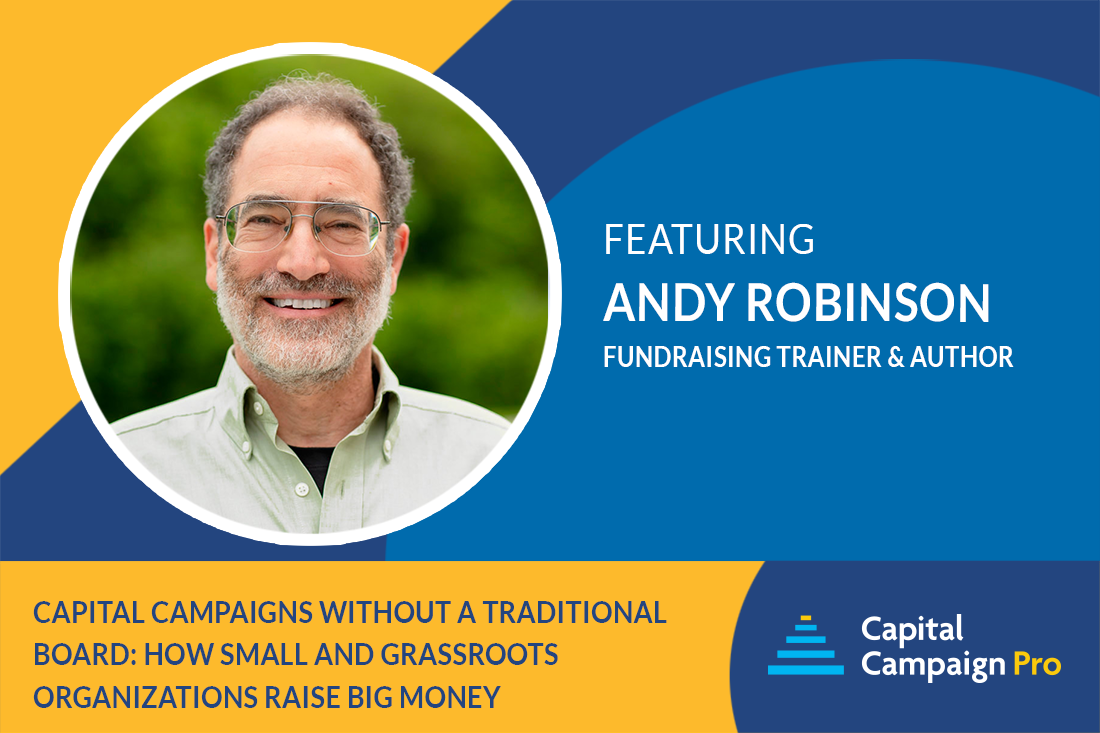
Season 5, Episode 24
When your board lacks time, wealth, or fundraising experience, does that mean a capital campaign is out of reach?
In this episode, Andrea Kihlstedt is joined by fundraising trainer, author, and longtime colleague Andy Robinson to explore how capital campaigns succeed in small, grassroots, and unconventional organizations. Drawing on decades of experience and two detailed case studies, Andy challenges common assumptions about board-driven fundraising and shows what really makes campaigns work when infrastructure is thin and capacity feels limited.
Listen Now:
Andrea Kihlstedt:
Is your organization a small organization with a board that has no chance of raising a lot of money? Well, if so, this podcast may well be for you.
Hi there, I’m Andrea Kihlstedt, and I’m here today with a very special guest and friend, Andy Robinson. Andy is going to talk to us about non-traditional campaigns for non-traditional organizations. My friend and colleague, Amy Eisenstein is not with me today. She will, as always, be back next week. But I’m super excited to have Andy here.
Meet Andy Robinson
Andy is an author. He’s a trainer. He’s a thought leader in the field. I think he’s a sage, one of the wiser people I know in this world. And I have to tell you that he’s a gardener in Vermont where the season is very short. He produces wonderful vegetables, which when I show up on his doorstep in-season, he provides me with some.
So welcome, Andy. Thank you so much for being here.
Andy Robinson:
Andrea, thank you for inviting me. For the record, yesterday was December 1st and I harvested the last of the Brussels sprouts and the kale.
Andrea Kihlstedt:
You see? I knew it.
Andy Robinson:
Out of the snow. So yeah, it was good.
And it’s fun to pinch hit for Amy, who is wonderful at what she does. I’ll tell you a quick story. I was looking at one of her videos and my wife Jan came and looked over my shoulder, and she said, “Oh, that woman’s like the female version of you, Andy!”
Andrea Kihlstedt:
You know, I think that’s right. I hadn’t thought —
Andy Robinson:
I think it’s pretty good. Yeah.
Andrea Kihlstedt:
It’s true, yes.
Andy Robinson:
Yeah. Yeah, yeah.
Andrea Kihlstedt:
Amy and I have been partners in Capital Campaign Pro now for about eight years, and really it has been just a magical partnership and it has been the most successful business I’ve ever been part of. And really it is just a treat.
So listen, before we really dive into the subject matter, I have to say that I have written several books and Andy has written six books, and one of the favorite books that I have ever worked on is the book I did with Andy called Train Your Board (and Everyone Else) to Raise Money. And it is really a cookbook of board training exercises. We had a terrific time doing it. And of the books that I’ve written, and I’ve written a couple important ones, people are more excited about that book than any other book. They love the exercises. They tell me again and again that it sits on their desk with dog-eared pages. So I’m still proud of that book, Andy.
Andy Robinson:
I am too. And it was fun working with you, and it was nice to have an excuse to assemble all the stuff that we both knew and colleagues knew about how to train other people how to raise money. It is worth noting we recruited exercise from probably 10 other people who participated. We borrowed and adapted with permission from a lot of friends.
Andrea Kihlstedt:
Right.
Andy Robinson:
So it was sort of crowdsourced from the fundraising training community. And I think you’re right, I think it still stands up. I’m proud to have my name on it. I’m glad it’s still selling and people should look for it.
Andrea Kihlstedt:
People should look for it. Train Your Board (and Everyone Else) to Raise Money by Andy Robinson and Andrea Kihlstedt.
Andy Robinson:
Well, your name is first because you’re first in the alphabet.
Andrea Kihlstedt:
Okay, Andy, here we go.
Training a Nonprofit Board to Raise Money
Andy Robinson:
So today’s topic, I want to enter this conversation sort of pulling some threads together.
The first thread is this, I have been training people to raise money for 30 years, and the number one request I continue to get, and this never goes away, is, “Will you help my board learn to raise money?” It’s endless. It’s an evergreen. It’s a part of my business. I’m grateful for the business, but we haven’t solved this. And there’s a couple of ways to think about this:
- Either we’re not doing a good job training, recruiting, setting expectations, building capacity on our boards, and that’s one legitimate way to look at it.
- But the other way to look at it is that maybe our expectations are out of whack. Maybe we are expecting too much of our volunteer board members who have jobs and families and other commitments.
And I’m conflicted on this because I think there’s some truth to both of these statements, but I wonder if this whole idea of board-centered fundraising is appropriate anymore, point one.
Point two, we’re seeing societal trends that make this more difficult. The economy is being hollowed out. We’re losing the middle class. There’s a decline in volunteerism that goes back 20, 25 years. People are not joining things the way they used to. And so this makes it harder to recruit for boards and it makes harder for us to get board members who have available time to do the work that we need them to do. Point two.
Point three, and I won’t get into this in a lot of detail, but my latest thing that I’ve been thinking about a lot is alternatives to the 501(c)(3) and how else we might organize ourselves. And there’s a lot of interesting examples out there of people that are doing really excellent social change work without going to the federal government and getting a certification. And there’s a lot of ways to raise money that don’t require a 501(c)(3) and I’ll talk about that in a minute.
Thinking about capital campaigns here, I’m wondering about if the model needs to change. And specifically, and you and I were talking about this before you turned the mic on, I think your model is awesome and it works really well with organizations that have a certain amount of resources and a certain amount of capacity and a certain amount of infrastructure.
And some of the groups that I work with are smaller, more grassrootsy, less capacitied, don’t have a lot of infrastructure, don’t have systems. And so what I want to talk about is, how do you do a capital campaign in a grassroots environment where, A, you don’t have a terribly engaged board, and B, you don’t have a lot of systems in place? So I want to share two stories. Before I do, I want to give you back the mic, because if there’s anything specifically you want me to address, or if you have even thoughts about this before I jump in, I would love to hear those.
Andrea Kihlstedt:
Yeah. Yeah, I do, Andy, thank you. I think you raise really good, really good questions for certain kinds of organizations. Capital Campaign Pro works at any given time with about 80 campaigns. That’s a ton of campaigns.
Andy Robinson:
That’s a lot.
Andrea Kihlstedt:
It’s a lot of campaigns. It’s a lot of information, right?
And we have a ton of successful campaigns using some version of the traditional campaign model where we do train boards, we do call on board members to be involved in the campaign in some way. Now, it may have shifted some over the years, but roughly the model is the model that has been in play for decades really, that board members are key when their commitment to the organization is powerful and strong, and that they’re standing up in both their effort and their philanthropic commitment sets the tone for a campaign.
Now, we have some organizations who come to us that aren’t so well-resourced, that don’t have the systems in place. And we have to decide always, is this an organization that if they put their mind to it, could become resourced and structured —
Andy Robinson:
And build systems.
Andrea Kihlstedt:
Get ready for a campaign.
Could they use the campaign as a motivator to put in place those systems? And sometimes they are, and sometimes they’re not. And those are the organizations that really we are going to focus on today, the organizations that come to us, or that don’t come to us because they don’t see that our model will work for them, that don’t have resources, that don’t have donor lists. That don’t have the structures in place, but have powerful impetus to raise money and have a huge commitment to the mission. And how can they move forward? And then I think the set of organizations we’re talking about today, it’s a set we seldom talk about, and I’m so happy to actually have this chance to do that.
Andy Robinson:
Yeah. Well, these are my people.
Example #1: A Small Grassroots Nonprofit
Sometimes we build the plane while we’re flying it, and I’m okay with that. And another point you make, which I will make slightly differently, is that a capital campaign can be an excuse to build your annual fundraising, to build your systems you need to treat donors better, to build your capacity of askers and people who are engaging with donors.
So this is a nice segue to my first story. I’m a member of a very small synagogue in Montpelier, Vermont, Beth Jacob Synagogue, which is as grassroots as it gets. There’s an annual budget of about $100,000. There is no rabbi. This is a lay-led organization, about 100 member families, give or take. Now, our physical building began in an old house in a residential neighborhood, and then another part of it was added onto, I don’t know, 50 years ago, 40 years ago.
About 15 years ago, we were told that we had to abandon half of the building because the roof would not manage the snow load. The building was literally condemned. And the choice was we have to build a new building or we have to abandon this place. And if I had been their campaign consultant, I would’ve said:
“You guys aren’t ready. You don’t have any infrastructure. You have a very small donor base. You have no history of raising a lot of money. This is going to be impossible.”
But we literally had no choice because the roof was caving in. So we did a capital campaign, and there’s a lot of story here, but the short version of this is, this is an organization with a $100,000 annual budget. We raised $775,000 for our capital campaign. It took seven years.
And what happened was we did it in two phases. We raised enough money to rebuild the front of the building that was falling down and then we took a pause, and then we looked at the back half of the building and said, “We really need a better community space.” So we rebooted the campaign and raised enough money to refinish the second part. And as I say, it took seven years. It was biblical in scope in terms of we can beg the word campaign, because campaigns have beginnings and middles and ends, and this one took a long time to end.
But it was wildly successful in the sense that we have this beautiful new building, there’s no debt. And the side effect of this is people are like, “We can’t do this,” and when we were able to do it, we all looked at each other and like:
“Well, we actually have more capacity and more power and more muscle than we thought we had.”
And it changed the vibe of the community in a really significant way. People became less cranky and less skeptical and more optimistic.
The Traditional Model
Now, let’s talk about the traditional model. We had a board of directors, and I want to say the board gave as generously as they could. I don’t know, back in the day we used to say that boards needed to contribute at least 10% of the goal, to get to goal. Is that still true, Andrea? Do you have a number on that?
Andrea Kihlstedt:
I always hesitate to give a number because, of course some boards can give 60% of the goal.
Andy Robinson:
A lot more than that, yeah.
Andrea Kihlstedt:
And some boards, 5% or 10% is great. So I always wince when someone says, “What’s the number?” It depends.
Andy Robinson:
Fair point.
Andrea Kihlstedt:
It depends on your organization, is the number.
Andy Robinson:
Thank you. Well, that’s good to articulate that. Anyway, in terms of the campaign itself, the president of the board was awesome. She had no fundraising experience and leaned in and became a really good fundraiser, and other board members helped in other ways, but there were basically two solicitors, the president and myself. I was the nominal chair of the campaign, though I never had that title.
But we didn’t have any staff to do the database or to get the materials or to interact with the architects and the planners. That was volunteer-driven. But there wasn’t a traditional committee and a lot of the solicitation was done by two or three people, and that was it. So the board was supportive and the board turned over, over the course of seven years, but it was not like they were out identifying and soliciting donors at all.
Many Donors Helped the Campaign Succeed
The other interesting thing that happened, I mentioned we had about 100 member families in the congregation, we had over 300 donors. So two-thirds of the people who gave were not actually members of the congregation, but they heard about what we were doing and they thought this was a really interesting story and they participated. In some cases, it was 50 bucks, but in some cases it was actually a substantial gift. So I think this was successful for a couple of reasons.
- Number one, we had no choice. Literally, the building was falling down.
- Number two, they had a unicorn in their back pocket, which was me. You know what I do for a living. I’m not afraid to do this. I had the time. I committed to it. So not everybody has an Andrea or an Andy on their committee to lead the work and is sophisticated about how to do that.
- The third thing, and I’ll emphasize this again, it’s sort of changed the culture of the organization because we stepped up and we did it.
What I often say to people is you need two things to be successful at fundraising. You need optimism and you need persistence. You have to believe you can do it, and you have to actually do the work to get you from here to there. But this is a deeply under-resourced organization that pulled off a major capital campaign over a long period of time.
Andrea Kihlstedt:
Yeah, Andy, here’s what interests me about your story. While you set this story up to be an example of an organization that does not follow the traditional campaign model, I would argue that in many ways you did.
That this organization had, because the need was so major, because I’ll bet the people who are in that congregation feel strongly about having a synagogue that functions for them … It’s not like, “Well, I don’t really care if this happens.” The people who go to that synagogue, who are members, care deeply about it. So they were set up to want to contribute to the extent that they could.
And you knew enough about capital campaign strategy, know full well that top-down, inside out solicitation works. For example, do you name just one traditional campaign pattern that if you get the largest gifts first, that the smallest gifts will be easier? And if you get people who are most committed, that other people will then follow suit.
A Little Serendipity Never Hurts
Andy Robinson:
Yeah. And we had a surprise bequest that came in early from someone who was not a member of the congregation, and somehow we were on this person’s estate plan list, and that was essentially the lead gift for the campaign.
You need some serendipity. That’s part of this.
And I would also say, to echo what you said, we had one donor, someone who was giving, I don’t know, 1,000 bucks a year, $2,000 a year as a member for dues, but this person gave us either $25,000 or $50,000. I forget the amount. But he said:
“I’m not going to come to services, I’m not going to be an active member, but I want there to be a synagogue in this town. I see what you’re doing and this is a situation where I have the resources, and here I’m giving you this big gift. Build the building.”
So, point taken. I think we did use a lot of traditional strategy, but per our topic today, it wasn’t board driven, with the exception of the president who was all in. The board was supportive, but it wasn’t like they were out knocking on doors or doing a lot of asks. Some of them gave very generously, which is amazing. So that’s story number one.
Andrea Kihlstedt:
Yeah. I love that story, by the way. I love that story because I love the passion of it. I love remembering how little it takes to have a successful campaign, as long as the passion is there and as long as you have someone who knows what they’re doing.
Andy Robinson:
Yeah. And luckily, I was that someone and I was willing to see it through. It was one of the more interesting of my professional experiences. I did it as a volunteer, but in terms of as my life as a professional fundraiser, this was a really interesting experiment.
Example #2: A Campaign for a For-Profit Business
All right, so here’s story number two, and this is actually a story about a capital campaign for a for-profit business.
I am a member, I think you are a member, of my local food cooperative. Food co-ops are member-owned for-profit businesses. They’re governed democratically. Members elect the people who leads the board, etc. And when you visited, I may have taken you in there. I can’t remember. Our old co-op was in a terrible location off of a parking lot where you couldn’t find it, in a little room with a low ceiling and an uneven floor.
It was founded in 1973, I think, and if you walked in there, it still felt like 1973. It had the vibe of all the old hippie co-ops from back in the day, that the incense was present in the air. And it was a marginal business forever. And also the building was decrepit and there was a deficit most years and there was random fundraising to try and solve the deficit.
Anyway, two or three years ago, I think three years ago now, there is a large hardware store that had a grocery section that was up on the highway three miles from town and a much better location, and it was put up for sale. The leadership of the co-op went out and got a planning grant from the USDA to figure out if it would be possible to relocate our little funky co-op to this bigger, better location. The planning grant did its thing and they came back, and there were multiple meetings with the membership about should we do this? And ultimately we voted. Oh, I think 83% of the members who voted, voted to approve the move. This was a big deal because getting out of the funky little place and getting into a bigger place was very ambitious and also going to be very expensive.
Borrowing Money
So we did a capital campaign. What I want to say is that the total campaign raised about $2.2 million. A lot of that was commercial loans, because this is a for-profit business and generally when you raise money for a for-profit business, you are borrowing money. And so we had a couple of commercial lenders, including those that lend to the food cooperative community. But we raised $550,000 from our community, and that was about 30% gifts, straight up gifts.
We did have a fiscal sponsor as a nonprofit to handle those gifts. And it was about 70% loans from our members, which will be paid back over seven years or 10 years or 13 years, whatever the timeframe is. We raised $450,000 in 12 weeks, and we needed to do that to buy the business. And then there was another $100,000 that was raised over the next year to close out the campaign, but the vast majority of this happened in about 11 or 12 weeks.
And speaking of boards, the co-op board at the time was five people, and they were spending most of their time dealing with lenders and dealing with the owners that we were buying stuff from, and they did not have time to be involved in the community part of the fundraising. And so there was a call-out to do a committee and I raised my hand, and I have a colleague here, Lauren, who’s another professional fundraiser, and she raised her hand. And then we started recruiting a committee, and we ended up with a committee of 15 members who were willing to help with fundraising. It was far and away the best campaign committee I have ever been attached to, but one of the reasons was we had to do it quickly.
This wasn’t a capital campaign that was going to spread over years and years and years. We had a deadline. We had to have a certain amount of money by a certain amount of time or we couldn’t close the sale and buy the business.
This was one of those instances where the board said, “We don’t have the bandwidth, but we’re empowering you as a group of volunteers to go out and do this.” The board was involved. Some of them helped a little bit. Most of them gave money. But they were juggling other balls and there were other things they had to do to make … This was a very complicated business deal and it had to be done that way.
Lessons in Nontraditional Fundraising
So lesson number one is you don’t necessarily need a 501(c)(3) to raise money if people care about what you’re doing. This is an established business in our community. We had, I think 700 active member owners of the food co-op, so that’s obviously where we started. Not every donor was a member, but most of them. 100%, most of them were. And so that’s one lesson.
The second lesson is there was two years of community building and decision-making that went into this before we started asking people for money. This ground had been plowed and seeded, and there was a lot of process around this very difficult decision. Will we take the risk or do we not take the risk? And so a lot of that homework had been successfully done, and by the time we got around to asking people for money, they had been primed and they were ready for it.
Again, this is not non-traditional, I think any organization should be doing what I just said. But in this case, it was a for-profit business and that’s not something we talk about that much is, how do community businesses raise money? Sometimes they raise money from the community.
My colleague and I, Lauren, looked at each other in the middle of this and we said, “This is capital campaign 101 that we’re doing. We’re just doing it in a different context.” So in a way, I’m undermining my own pitch here, because it was traditional-ish, but it wasn’t. And certainly, as I say, the board was busy with other things and this was not a board-driven process at all, but the board seeded power to what was essentially a campaign committee, I don’t know that it had that name, and the committee did the work.
Andrea Kihlstedt:
Right, right. No, I think that’s a really lovely story. A couple of observations. First of all, we know quite well, we in the fundraising business know, and it has been tested, that people don’t give because they get a tax deduction.
Andy Robinson:
No.
Andrea Kihlstedt:
They don’t give because of the 501(c)(3).
Andy Robinson:
Thank you.
Andrea Kihlstedt:
What the 501(c)(3) gives them is a tax deduction. Right now, that’s changed slightly coming up in 2026. That’s changing a little bit.
Andy Robinson:
Well, and it changed. It changed in 2017 when they did the last tax bill.
Andrea Kihlstedt:
And really, it’s not why people give.
Andy Robinson:
Yes. Thank you.
Andrea Kihlstedt:
People give because they are passionate and they care about the mission that they are giving to, whatever that is. So I’m not surprised that you were able to do a campaign style fundraising without a 501(c)(3). That doesn’t surprise me. Although, people don’t think about that so often.
Impact Investing: Engagement Drives Investment
The second thread I want to pick up is that you said, I think, that a lot of the money, even the philanthropic style money that people gave, many of them were loans that would get repaid over time. Now, that’s an area that we’ve actually dipped our toes into, and it’s really interested me, and it’s called impact investing.
Andy Robinson:
Yes, it is.
Andrea Kihlstedt:
That when there is a project that will yield revenue over time, and sometimes it’s housing, for example, if there’s going to be rental housing, your business, your food co-op yields revenue over time. So there will be money that can be paid back. And there are organizations that have had parallel campaigns going on in exactly the same time. One half are asking people for investments to invest… to do what’s called impact investing.
Andy Robinson:
Impact investing, yeah.
Andrea Kihlstedt:
Where they will actually get their money back over time, slowly, and perhaps at a lower interest rate that they might if they were to invest in other ways. But the very same people will often make a philanthropic contribution. Now, we’ve seen some very interesting examples of that, where doing both at the same time inspired donors, where they would come back and say:
“I want to do another impact investment, and by the way, I’ll invest $50,000 and I’ll give $25,000.”
Andy Robinson:
I can reinforce this. We had about close to 40 community lenders for this campaign, nearly all of them made a charitable gift on top of their loan. Some of them ran that money through the fiscal sponsor so they got a tax deduction, and some of them just gave the money to the co-op without getting a tax deduction back. But nearly all of them did both. It might be a case where, for example, I’m going to loan you $10,000 and I’m going to give you $1,000 on top of that.
Andrea Kihlstedt:
Yeah. It was so interesting to me as we’d… It was we, dug into that for a couple of our campaigns to see how one triggered the other. People felt more and more engaged. And if they invested and got paid back over time, they continued to feel engaged.
Right? They felt it.
Andy Robinson:
And the timing of this is really interesting because I have volunteered … It’s time for us to pay interest to our lenders. We do that at the end of each year, and this is the first year we’re paying people back for their loans. We’ve given them three offers:
- We’ve said, “We’ll write you a check for the interest you are owed,” one.
- Two, if you’d like, you can donate that money back to the co-op and we’ll use it for operations.”
- Or three, “If you want, we’ll apply it to your account in the store and you can use that money to buy groceries or buy hardware.”
I’m in the middle of all this, I don’t have the final numbers, but I’m getting a pretty even split in terms of some people want their interest payment, some people would like store credit, and some people would like to donate it back. It’s another engagement piece, and I’m sending thank you letters to all these people on a form for them to fill out.
So it’s a way that we stay in touch with them and that’s going to drive more sales, because then people will be coming in to shop.
Andrea Kihlstedt:
Yeah, yeah. You know, Andy, you and I both know that one of the key lessons of fundraising is that engagement yields investment. Engagement drives investment in our business.
Andy Robinson:
And vice versa.
Andrea Kihlstedt:
And vice versa, the more engaged people are, the more they invest, whether philanthropically or through an impact investment, an actual investment of some sort where they get a return on their investment. And vice versa, right. When you invest in something, you become more engaged with it. Kim Klein’s —
Andy Robinson:
You become invested in all senses on a word.
Andrea Kihlstedt:
Yes. Kim Klein’s writing years and years ago taught me that when something I read of hers said, “If you can get a small gift from someone, small first gift, what’s going to happen is that they’re going to start reading your material. And from reading your material, they’re going to learn more, and when they learn more, they’re likely to be interested in giving more or to become involved in some other way.” So you’re exactly right, engagement yields investment and investment ups engagement.
And going back to the capital campaign business, that’s one of the core ideas of capital campaign fundraising, that it pushes people to do more engagement and to invite people to invest. At the heart of it, this is a very simple business. Everybody thinks capital campaigns are big enterprises. If you strip away, these campaigns you’re talking about, Andy, are really campaigns that use the basics, the powerful basics of capital campaign fundraising, and shows that even in a very small, non-traditional or under-resourced organization, they work.
Andy Robinson:
I think that’s fair. The caveat I would offer there is, in both cases the board was not a driver of the campaign, and that’s okay.
Andrea Kihlstedt:
Yeah, and that’s okay.
Andy Robinson:
That’s okay.
Andrea Kihlstedt:
That’s okay. Exactly. Exactly.
Andy Robinson:
I don’t know if that’s a major exception to the rule. I think it’s probably a minor exception to the rule, but yes, the answer is you can still do this under some circumstances if you have a board that’s on the sidelines or less fully engaged than optimally.
Andrea Kihlstedt:
Yes. Your boards, however, Andy, in both of those stories, were engaged in the projects.
Andy Robinson:
Correct. 100%.
Andrea Kihlstedt:
They may not have been engaged in the fundraising, but they were committed to the projects.
Andy Robinson:
That’s fair, yeah.
Andrea Kihlstedt:
And that’s what’s necessary. Some boards can be involved in the fundraising and some boards don’t have to be. It’s so interesting to strip this out with you, Andy, and to talk it through the life, really.
Final Thoughts
Andy Robinson:
Do you know Joan Flanagan’s work?
Andrea Kihlstedt:
I don’t.
Andy Robinson:
Joan is the person who taught people like Kim Klein, who taught people like me. So she’s sort of my grandmother in fundraising and I’m going to misquote her badly. She’s also written several books. But she says:
“All the wisdom about fundraising can be summed up in 10 words, and the 10 words are ask them, thank them, ask them again, thank them again.”
There’s some wisdom there. And we add all this architecture around that, and that’s necessary and important, but there are a lot of people, you are not one of them, but there are a lot of people who overcomplicate fundraising.
And it’s not that complicated. It’s one person asking another person to participate.
And then appreciating them when they do. Capital campaigns are fundraising, and fundraising has basic rules that apply regardless.
Andrea Kihlstedt:
Right. That’s right.
Andy Robinson:
And this is one of those rules, because if you don’t ask, you don’t get.
Andrea Kihlstedt:
You don’t. Right. That’s exactly right.
Andy Robinson:
And if you don’t show appreciation to people, they don’t give again. So in that sense, this is as traditional as it gets.
Andrea Kihlstedt:
No, that’s right. Andy, thank you so much. It’s been so much fun to talk with you and to hear your stories that sound like they’re about non-traditional organizations and non-traditional approaches, but turns out that they have a powerful connection to the most important parts of capital campaign fundraising. I think this all nicely weaves together. I’m so happy to have had a chance to unthread or to rethread or to reweave this with you, whatever the right word is.
Andy Robinson:
Reweave, unpack, open up.
Andrea Kihlstedt:
Reweave, whatever.
Andy Robinson:
All the metaphors. Andrea, thank you for inviting me. Amy, I hope you’re having fun wherever you are. And if I can participate in the future, let me know and perhaps we’ll talk.
Andrea Kihlstedt:
Excellent. Thanks so much, Andy.


Leave a Comment