
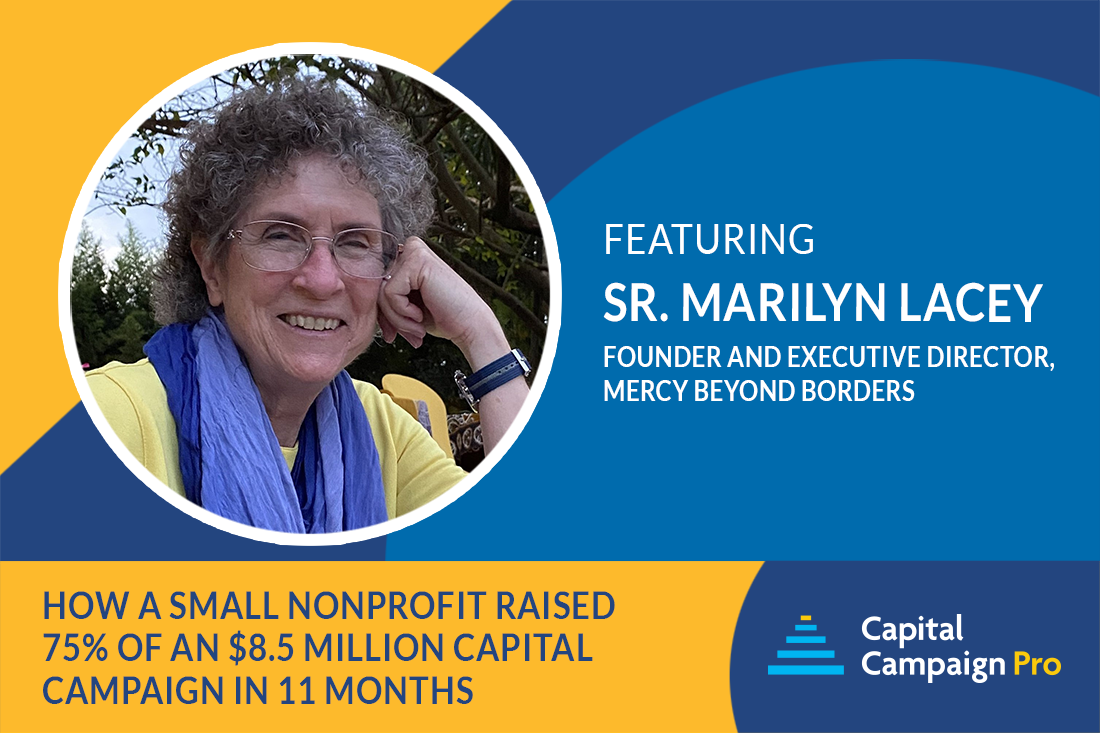
Podcast: How a Small Nonprofit Raised 75% of an $8.5 Million Capital Campaign in 11 Months
Season 6, Episode 2
What can a nonprofit with just 650 active donors—and a median gift of only $100—teach us about raising millions through a capital campaign?
In this episode, Andrea Kihlstedt speaks with Sister Marilyn Lacey, founder and executive director of Mercy Beyond Borders, about how her small international nonprofit raised more than 75% of its $8.5 million campaign goal in less than 11 months.
This episode offers valuable capital campaign guidance for small nonprofits, international organizations, founders, executive directors, development professionals, and anyone wondering whether their donor base is large or wealthy enough to support a major fundraising initiative.
Watch Now:
Listen Now:
Andrea Kihlstedt:
Some campaigns raise money and lots of money for programs that aren’t here in the United States, but that are flung all over the world. And today we have a special guest who can tell us about them.
A Closer Look at Mercy Without Borders
Welcome to the wonderful, wonderful woman that I have a privilege to be with on Wednesday afternoon calls, Sister Marilyn Lacey, who is the founder and executive director of Mercy Without Borders. Welcome.
Sister Marilyn Lacey:
Thanks, Andrea. It’s kind of fun to do this after being with Capital Campaign Pro as a client for almost a year now. Well, let me start by saying I’ve been working with migrants, refugees, and displaced people for 45 years. And it has brought me to far-flung places, as you’ve mentioned, and wonderful adventures and tremendous enrichment from working in different cultures. So I’m happy to share how some of that has now folded into a growth campaign for which we are attempting to raise 8.5 million. My organization, as you mentioned, is Mercy Beyond Borders.
Mercy because I’m a Catholic anonymous sister of Mercy, but this organization I’ve started is not a religious organization at all.
It’s a regular old Bible 1C3, and we have chosen specifically to work in chaotic, dangerous, extremely poor parts of the world. These are, some of them are fragile states or even failed states like Haiti. Others are refugee camps adjacent to war zones. Often these are places with corrupt governments, with places definitely where girls get left behind and are in danger. vulnerable situations. So we choose to go there and it’s in our mission statement. Mercy Beyond Borders mission is to forge ways for women and girls in extreme poverty to learn, connect, and lead.
So we do that by getting girls into school to start with. These are places where often only 5% of females even get to go to school. So we’re trying to up that percentage and get them learning, get them motivated. We have in one school, we don’t own any schools, but we get girls into school and then we improve the environment for them there and motivate them to do their best. Over a hundred of these are girls who’ve been trafficked, forced into early marriages and have escaped.
So we’re also working with trafficking survivors. They’re definitely not equal to the men and boys in the various cultures where we work. So we’re ultimately aiming to improve their conditions. So I started this nonprofit 18 years ago, and that’s really how long it takes to get a young girl from preschool through university.
And we now have 138 that have made that complete trip and hundreds and hundreds and hundreds following up behind them in primary school, secondary school, and in university. So because we know our model works, we have proof now by looking at our alumni. We thought this would be an excellent time to have a growth campaign and expand what we’re doing, reach more girls, benefit them more, create more of a base for ultimately for these alumni to work in advocacy that will better the conditions in their homelands.
And we have no brain drain. That’s the amazing thing. When they graduate, they go right back into these difficult places to work. So we set a goal originally of $10 million. And while we were trying to put together our case study, we got a phone call.
And out of that phone call came a $1.5 million anonymous gift. So we were able immediately to lower our goal. No strings attached, nothing. It was just incredible. But it was a sign, right? It was a sign we’re on the right track. So the struggle for me was to figure out what could we do? We have only about 650 donors. Both. But we have marvelous retention. We have 59% retention year over year. So they’re loyal. They’re engaged. But most of them are poor, like me. I mean, our median gift is $100.
If you were to put the most generous gift on top and then every other gift down to $10, the one in the middle would be $100. So… The median gift is 100 and the mode is 100. The most gifts that we get are $100.
So we’re dealing with a lot of regular folk, right? But we have a few outliers. We have a few millionaires. So it’s kind of, you know, bipolar, if you wish. Just so you know how we, that shapes our outreach and our fundraising.
Andrea Kihlstedt:
Yes. Sister Ellen, let me stop you for just a second. Well, I would love to have three hours and ask you if you just woke up one morning and decided that this was going to be what you were going to do in the forest. It’s difficult.
Sister Marilyn Lacey:
Well, the other reason I decided this was the time is because I’m going to be 78 tomorrow. Not tomorrow. Next month. So we’re looking at an ED transition in a couple of years. And so I thought, well, this is the time to make my… my swan song here. I was not born and did not enter the convent in order to be a fundraiser, but I’m finding that it is easy to do. We just inspire people to give. We don’t ask them.
Building a Donor Pipeline as a Small Nonprofit
Andrea Kihlstedt:
Yes, well, I really have so many questions for you, but let’s start with this question of 650 donors. You built this organization from square one. How have your donors come to you? Have you led that charge? How have you gone about getting donors?
Sister Marilyn Lacey:
Well, yeah, by chance, a memoir that I had written about my experience two decades of working in stateside with refugees, welcoming and resettling them. That memoir got published the year after I started. And so I started having schools and book clubs and churches say, oh, this is an interesting book. It’s full of amazing stories. Come and tell us about your life and what you’re doing. So it provided a sort of a ramp to get to know people and get in front of people. that I never otherwise would have.
So I chased around the country and gave a lot of presentations and got good at PowerPoints. And that gave us a little base. A lot of people would sign up for my e-news. I write a monthly e-news in which I always do something, kind of a clever opening paragraph.
I can share some samples later. And then one story of one of the young women or girls that we’re working with. And the stories are so compelling. Honestly, these people live such difficult lives and are so resilient and so determined to get an education that we have a lot of readers of that newsletter, probably a thousand. And many of them become donors or they become a donor for a while and then they drop off because they lost a job or they moved away or their husband died or whatever.
So it’s kind of fluid. But in terms of annual donors that we can kind of count on, It’s between 600 and 700. So it’s very small. So then I had to convince my board that, you know, I’m an absurd optimist. Yeah, sure. Why can’t we raise $10 million?
They’re like, okay, what can I say? Our board chair said to me, well, Marilyn, nobody ever says no to you, so let’s go for it. So I’ve actually used that line sometimes when I’m approaching a donor who’s hesitant, and I say, well, You know, our board chair has seen that nobody ever says no to me. So certainly you don’t want to be the first.
What might happen? I mean, I don’t know.
So we are now less than a year into the quiet phase. We began last August with a goal of $8.5 million. And our first gift was a $3 million pledge from one of these people.
Andrea Kihlstedt:
Now, that was on top of the anonymous $1.5 million gift that somebody called you about. But we don’t need to raise $10 million anymore.
Sister Marilyn Lacey:
So now I only need to raise $8.5 million. So that pledge brought it down to, okay, we’ve got to do $5.5 million. So I’m encouraged. And what can I say about that?
Andrea Kihlstedt:
You know, let me interrupt you for a second because it’s so interesting how you think, right? If I… I were doing a campaign to raise $10 million and someone called me and said, I’ll give you out of the blue and said, I’ll give you a million and a half dollar gift. I don’t think my natural response would be, well, now we’re going to have an eight and a half million dollar campaign. My natural response would be to say, now we’re going to have an 11 and a half million dollar campaign. Right? Right. Well, you’re more experienced than I.
Sister Marilyn Lacey:
My thought was if I put it too high, Most of our donors are just going to give up because they’re like, oh, gosh, I’m on a fixed income. I got you in my will because I own a home in California. But, you know, I’m thriving. So don’t count on that this year. So that was why I did it. I don’t know. Yeah.
Andrea Kihlstedt:
No, it’s just wise or not. And it’s interesting just how you can look at the exact same situation and you can say, oh, well, it’s that we have to raise less. It makes perfect. What you did makes perfectly good sense. And you could also translate it the other way.
Sister Marilyn Lacey:
You’re right. So every campaign is unique. And I’m happy to say that after only 11, not even 11 months, we’re into this:
We’ve raised 75% toward our goal. We are at 6.3 something million.
Now, of course, it’s going to get harder later because right now we’re creaming those who have actual resources. And I don’t know how to account for why it’s going so fast. Smoothly, but I expect it to get harder. Right.
Top-Notch Donor Stewardship Matters
Andrea Kihlstedt:
So I can account for why it’s going so smoothly because I have learned a bit about you on the Wednesday calls for those who are listening at Capital Campaign Pro. We have calls every Wednesday for our clients to come to if they wish to bring questions or to have conversations with one another. And Sister Marilyn and one of her staff members often comes to those calls.
And what I know, what I have learned about Sister Marilyn is that she is the quintessential best person I can think of for donor stewardship, for really making her donors feel great. for leaning into that rather than leaning into, can we get the money?
You’re always leaning into:
- Who is this donor?
- What will they want to do?
- What will inspire them?
I mean, you are always on that side. You’re always giving credit to other people. You were always, every time I say, Jesus, Marilyn, you’re wonderful at doing this, you point to your staff member that happened just recently. Absolutely. Right? Absolutely.
Sister Marilyn Lacey:
I’ll give myself credit for being a good hirer. But beyond that, I get out of their way and let them run with it. They have marvelous ideas and they’re much younger than I am, so energy and the future is with them. But I would say… that the structured feasibility study that Capital Campaign Pro provided was very helpful because I was on the fence as, did we even need a consultant? Because I’m just ridiculously optimistic, right? Oh yeah, I can do this, whatever.
But I realized I did not know anything about fundraising in terms of the structure and process of it. I think I know how to talk with donors It’s the way I’d talk with somebody over breakfast, you know, it’s like keep it informal, find out what interests them.
So that was very helpful. And we had no problem getting interviews. Everybody said yes. And then everybody said yes to becoming a donor that we had interviewed, except one person who doesn’t believe that nonprofits should ever have profit. So I was like, You couldn’t run your family finances this way. Anyway, so we had a marvelous response and that gave us a lot of confidence.
Stewarding Donors When No One Knows You Exist
And I would say that our main problem is that nobody knows we exist. We being Mercy Beyond Borders, we’re so small. And there are so many zillions of nonprofits. And we’re not working in popular places, right? We’re not working in the neighborhood where we can get the local businesses to support us. We’re working… with people who care about black people.
We’re working in Haiti. We’re working in East Africa. We’re working in the war zone of South Sudan, in the refugee camps of Uganda and Kenya, and in Malawi, the fourth poorest country in the world. Who’s even heard of it? Who could find it on a map? But we choose these places knowing that it would be difficult. And then we’re excited about what we do. We can prove that it’s working. And so we just invite people, don’t you want to be part of this? Which is not easy today because of the political divides and crushing of USAID and the anti-DEI diversity push from the current government. So we’re kind of doing an uphill thing, but I like a challenge.
Do you invite people to go and look at the programs in the countries? Yes, we have done that as much as is possible. It is usually too dangerous. Even in Uganda, in the refugee camps, which are basically supposed to be safe havens for the Sudanese refugees, we’ve had to cancel volunteer trips twice this year for various reasons, the latest being Ebola. So it’s not easy where we work, but the reward is just so great in terms of the resilience of the women and the ability for them to have their talents develop and their self-confidence.
And transformation is just a stunning thing for me to witness. And it’s like I have, you know, a thousand children and grandchildren out there that I’m proud to be part of their lives.
In terms of what works, I think, to support, besides the capital campaign helpfulness, the [Online] Toolkit. You have a lot of templates that you don’t have to reinvent the wheel.
But I just think mainly it’s the mission when people find out about it and see the story. So if you’re interested in the e-news, I have no proof for this, but I personally think it’s our most effective outreach. It comes once a month to about couple thousand people. And if you go to our website, mercybeyondborders.org, and go to the latest tab at the top that says the latest, and you can go down and you can find the past 12 months of those e-news. Just look at how the story is told and the tone of it.
It might give you some ideas here and there. I don’t know. You probably have your own way of doing e-news, but It’s mostly focused on our clients, not on Mercy Beyond Borders.
Donor Outreach as a Small Nonprofit
Andrea Kihlstedt:
In the e-news, do you invite people to contact you? Do you talk about the campaign in that e-news?
Sister Marilyn Lacey:
No, we’re still in the quiet phase.
Andrea Kihlstedt:
So you don’t invite people in from the e-news, or you invite them in to make an annual gift, I imagine.
Sister Marilyn Lacey:
No, we use a special campaign for that. Twice a year, we do a mail-out campaign to our donors. Summertime campaign always for a specific goal. And then the end of year that’s done annually. The e-news is more of an engagement thing. It’s like, here’s what your good support is accomplishing. Here’s Twisley’s story. Here’s the background. Here’s the transformation. Here’s the impact that you’re making possible. And it doesn’t usually ask for money. It just says, wow, you’re amazing. Look what you’re doing. And there’s so many ways, you know, to do it. And the other clue, I guess, is exude joy and confidence.
Never come out of a, oh, my God, we’re going under. We really need your donation. I mean, who wants to join a sinking ship, you know? And I know that a lot of nonprofits are in this boat because they – government money. It’s all being ravaged. So I think it’s just my personality, but I think optimism and invitation rather than presenting, I never present organizational need. I mean, I try not to slip into it once in a while, but the need is in the clients. It’s in these bereft places.
Gaining Experience Asking for Larger Gifts
Andrea Kihlstedt:
Before this capital campaign, did you do a lot of individual fundraising, a lot of talking to people and asking for large gifts?
Sister Marilyn Lacey:
I did a lot of talking about Mercy Beyond Borders. I would tell stories. But large gifts, no. The $3 million gift came from a donor whose first gift was $125, 20 years ago. But before Mercy Beyond Borders existed, when I was doing refugee resettlement work. But over the years, we’d get together for coffee like maybe once a year. We weren’t really friends. And one day I decided we’re going to do this campaign. I need major donors, right? So I went to visit her because I knew she was best friends with a really major donor.
I knew she was wealthy. She was best friends with and vacationed with another couple that were very wealthy. So I went over and asked her if she would introduce me to that other couple. And of course, she wanted to know why. I told her what we’re doing, blah, blah, blah.
And the next week, she had me speak at her book club. And as she was walking me out to the car afterward, she put her arm around me and said, we don’t want you to be worried about money, Marilyn. And I said, well, I do. I have payroll, you know. And she said, well, we’ve decided to give you a million dollars. Now, I didn’t ask for it and stupid me because this was the first time I had ever been in a situation like that, I said, wow, thank you.
What about the other couples?
And she said, oh, they’re going to chip in a hundred grand. So in five minutes, I got 1.1 million. And I thought, well, this is not so hard, but it’s, it’s the relationships. I think, I mean, I make her a casserole every month. I go to ball games with her. It’s, it’s turned into a real friendship, but it didn’t start that way. It started with something I could have paid $125.
So I think don’t really ask for money. Just invite people. Just say, we’re doing this great thing. I want you to be part of it. What would it take? If they’re hesitating, I say, what would it take to get you interested in this? Or are you simply someone who doesn’t want to invest in girls’ education in really poor places, who might have been trafficked into a marriage at age 10 and is now happily in primary school with a guard with an AK-47 at the gate of the school so that no one can get her back.
Andrea Kihlstedt:
Wow.
Sister Marilyn Lacey:
So I think it’s, I’m lucky to have a really powerful message.
Andrea Kihlstedt:
Yes. I think. But of course, you know, here, right here at home, many organizations also have powerful messages.
Sister Marilyn Lacey:
Oh yeah, absolutely.
Andrea Kihlstedt:
They, they aren’t, They haven’t learned, perhaps, to be as good at telling the stories as you’ve learned yet. I think that’s a key.
Sister Marilyn Lacey:
Yeah. And then I think the invitation, frame the ask as an invitation, exude a lot of confidence, you know, that people want to be connected. And then you guys told us, Capital Campaign Pro told us, new donors would come out of the woodwork. And I thought, well, that hasn’t happened. But now it’s happening.
So… by referrals and by just dropping in my lap, just last week, we got a $100,000 donation from somebody I only met a month ago from another country. So people pass into your life and out of your life.
So keep telling the stories. And even when you hit the hard times, which I suspect we will next year if we’re going toward the smaller donors.
Keeping in Touch with Donors
Andrea Kihlstedt:
Yeah. And do you keep in touch with the donors after the fact? How do you handle that?
Sister Marilyn Lacey:
Well, I always write a personal thank you. I also write a monthly donor thank you letter. So for the June donors, they all get the same letter, but then I customize it with a note at the bottom. You know, hey, Joe, this was such a great surprise. It’ll buy solar lamps for five girls who otherwise would not be able to study because they’re doing chores during the day and then they have to study at night in a mud hut that has no electricity.
So it’s time consuming, but I think donors tell me, I love your letters. I love the e-news. I read every one. Well, that’s, you know, it’s a small group doing that. It’s not 10,000 people, but however…
Your organizations can customize. And then for the big donors, yeah, I was at one of their homes once and another recipient of a grant from them knocked on the door and brought in barbecued ribs that he had just cooked. And I thought, aha, I’m not a good cook, but I know how to make a good casserole.
Andrea Kihlstedt:
So every now and then, because they’re elderly, they’re in their 90s, bring that over.
Sister Marilyn Lacey:
Anyway, It’s been surprisingly fun, actually. And I don’t spend my whole time doing it. I mean, I’m running an organization in five countries, so probably a third of my time, maybe a quarter. But so far, it’s, you know, I have no reason to believe we won’t reach our goal.
Andrea Kihlstedt:
I’d bet my wad on that. Is that what one bets? I don’t know, but I would certainly bet on your success, and I will bet on donors continuing to… to come out of the woodwork and surprise you.
Final Thoughts
Well, thank you.
Sister Marilyn Lacey:
And if any of your listeners go to our website and have ideas of how we can improve it, the development team is actually my coworker, Lizzie, and she’s full-time, and then me. I’m about a third of the time on this, so it’s not a huge operation, obviously, but we’re getting there.
Andrea Kihlstedt:
Yes. Someone can get on your mailing list. Someone can look at your monthly e-newsletter. Someone can reach out to you or to Lizzie and say, hey, here’s someone who might be interested.
Sister Marilyn Lacey:
Absolutely. And mercybeyondborders.org, if you go to the main page and scroll to the bottom, you can sign up for my monthly e-news just to find out what’s happening to girls around the world in places very unlike our own.
Andrea Kihlstedt:
Yes, yes. Mr. Maryland, I so appreciate you taking time to talk to me today. It’s always inspiring to hear what you’re doing and how, with what sort of humility and… Humor. You do it, and humor, you do it, really. You don’t seem to bring to the table what many people do, which is this anxiety about I’m sure you’re under a lot of anxiety to have money. As you say, you need to pay your salaries, but somehow you don’t bring that into your donor work.
Sister Marilyn Lacey:
I have never been an anxious person. My mother worried a lot, and so I told her once, I said, you know, you have worried enough about your five kids, all of whom turned out okay, that the next few generations, we don’t have to worry at all. Right. She could have taught advanced fretting at the university level. You know, she was just always worried. She said, parenting, it’s a sentence with no parole.
Anyway, she was very funny and I’m very blessed. And Capital Campaign Pro has really guided us in the structure and the weekly things are helpful and fun when I’m able to hop onto them.
Andrea Kihlstedt:
Well, we’ve been so happy to have you as a client. And for anyone listening, I really encourage you to go to the Mercy Beyond Borders website and sign up just to look and see how they tell their stories and how they make these really incredibly difficult situations seem so appealing to donors. So, They can improve. The girls are so motivated.
Sister Marilyn Lacey:
Like, wow. So it is exciting to be part of it. And you can just pray for us. You can donate to us. You can tell your rich uncle about us. That’s what I tell people.
Andrea Kihlstedt:
Thank you. All right. Thanks so much, Sister Marilyn.


Leave a Comment