
Meeting the Moment: How Food Banks and All Nonprofits Can Prepare for a Sudden Spotlight

As the longest federal government shutdown in modern memory stretches on, one of the most serious and immediate ripple effects is falling on America’s hunger-relief network. The Supplemental Nutrition Assistance Program (SNAP) is expected to halt payments beginning November 1, 2025. Nearly 42 million Americans rely on SNAP to purchase groceries each month.
With federal funds unavailable to cover this month’s payouts, states and local food banks are already preparing for what many fear will be a massive surge in need.
A Word to Non–Food Banks — This Will Be You Someday!
While this post focuses on food banks and hunger-relief organizations, every nonprofit should pay attention. Disruption, whether caused by a government shutdown, a natural disaster, a global conflict, or a viral social media moment, can put any mission in the public eye without warning.
The lessons below are universal. When urgency and opportunity arrive at the same time, preparation determines whether your organization responds with clarity or chaos.
The SNAP Situation: A Crisis and an Opportunity
For food banks and hunger-relief nonprofits, this moment represents both a crisis and an opportunity: an influx of need with limited additional capacity, and heightened visibility that can attract new donors and partners. Whether or not your organization is in the midst of a capital campaign, this is the time to sharpen your systems, your messaging, and your readiness.
When attention turns your way, how you respond shapes your credibility and future support.
1. Check Your Technology Now
When attention spikes, your website becomes your front door. Donors, volunteers, and journalists will visit first, and they will judge your readiness by what they find.
- Start by testing your online giving process from start to finish. Is it easy to get to the “giving” page or do you need to hunt around on multiple pages to find it? Make a small test gift. Confirm that emails, thank-you notes, and CRM automations work properly. If a donor has a question, make sure there is up-to-date contact information listed on your website for key development staff members. Review all donation buttons, volunteer forms, and links for accuracy.
- Then review the basics — is your homepage current, your data up to date, and your site easy to use on a mobile device? A high-traffic period magnifies every flaw.
If you use automated email series or reminders for recurring gifts, check them for accuracy. Technical problems during a surge in interest can lose both gifts and goodwill.
2. Start Communicating Early and Clearly
Waiting to “see what happens” is not a communications plan. Even before the SNAP disruption takes full effect, begin explaining what your organization expects and how you are preparing.
Use your email list, social media channels, and, if needed, a homepage alert bar to share updates. Get ahead of speculation. Clear communication now prevents confusion later.
You don’t need every answer. It is enough to say, “We are preparing for what may come, and here’s how we’re getting ready.” People value honesty and direction. Silence, on the other hand, can make you appear unprepared.
3. Educate the Public About What Actually Helps
 When a crisis hits, the instinct to “do something” often leads to food drives. But as many food banks know, cash donations go much further than in-kind gifts. Feeding America explains why — bulk purchasing, wholesale discounts, and efficient logistics allow every dollar to feed far more people than donated groceries.
This is your opportunity to teach your community how to make the biggest impact. Use short videos, social media posts, or live Q&A sessions to explain the value of financial support.
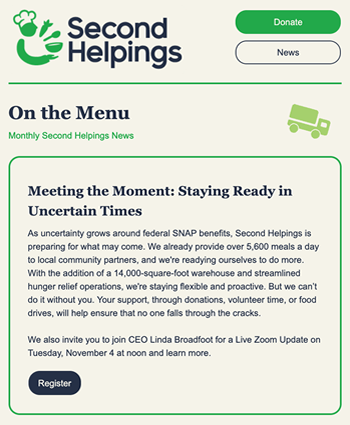
Second Helpings in Indiana provides an excellent example (see graphic above). They are hosting live Zoom town halls with their CEO to share updates and answer questions directly. This approach helps supporters understand both the urgency and the strategy behind your response.
4. Do Not Let Urgency Derail Your Campaign Strategy
When the spotlight shines brightly, it can be tempting to accelerate plans, especially if you are in a capital campaign. Resist that temptation.
Stick with your established campaign timeline. If you are in planning, feasibility, or a quiet phase, stay on course. Launching publicly before you are ready may bring short-term attention but can weaken long-term results.
You can still reference the crisis in your messaging, but let it reinforce—not replace—your broader case for support. Frame your work around resilience, sustainability, and readiness for moments like this.
Food insecurity will always be an urgent issue, but your campaign goals (facility expansion, program growth, or endowment-building) make that work possible. If you want to respond to this moment, direct that energy toward your year-end fundraising. The timing aligns, and the urgency is already top of mind for donors.
5. Segment Your Communications
When things feel chaotic, the easiest move is to send one big message to everyone. That rarely works. Segment your outreach so that each audience hears what matters most to them.
- Major donors deserve personal outreach. Call them or send a note that explains how their support has strengthened your readiness.
- Monthly donors should hear gratitude for their reliability and a reminder that steady giving keeps your work consistent.
- Volunteers or community members who have not yet given might respond best to a small, specific request tied to current needs.
- Corporate partners may want to organize matching gifts or employee drives.
Most donor databases and email tools make this kind of targeting simple. It only takes a little planning, and the results will far outperform a mass message.
Pressure Reveals Preparation
Moments like these do not create capacity; they reveal it. The systems, relationships, and habits you have already built will determine your strength in a crisis. The upside is that pressure can clarify priorities, build trust, and attract new supporters who see your impact firsthand.
Every nonprofit will face a moment like this at some point. What you do now will decide whether you merely get through it or come out stronger.
Starting a Campaign? Prepare Now:
If your organization is facing uncertainty, or if you are planning or beginning a capital campaign, now is the time to prepare:
- Download our free guide: Fundraising in Uncertain Times
- Schedule a free strategy session: Talk with a Capital Campaign Pro expert
Preparation is an act of optimism. Let’s make sure your nonprofit is ready to meet the moment.
Have An Expert Assess Your Campaign Readiness
Capital Campaign Pro can review your organization’s readiness in detail. We’ll help identify your strengths — and weaknesses — so you can move forward with confidence.
![[GUIDE] Capital Campaign Marketing and Communications Plan](https://capitalcampaignpro.com/wp-content/uploads/2026/10/capital-campaign-marketing-communications-plan.jpg)


What a great article. Thank you for sharing all of these easy to apply tips to your readers during this uncertain and unnerving time.