
[GUIDE] Capital Campaign Marketing and Communications Plan

Capital campaigns rely on large gifts from a small pool of donors. Those gifts are solicited and secured through personal conversations during the quiet phase, which accounts for most of the campaign’s fundraising. Broad marketing to your entire community comes later, after you have raised at least 75 percent of your goal and are ready to begin the public phase.
That timing is central to a capital campaign communications plan. Early campaign communications should be personalized and customized with each individual donor in mind.
Mass email appeals, broad social media promotion, campaign videos for general audiences, peer to peer fundraising, phone or text campaigns, and community wide events belong in the public phase. They help you invite more people to take part after the largest gifts have been solicited and have established a strong base for the campaign. They are not the starting point for campaign fundraising.
A Guide to Capital Campaign Marketing and Communications
This in-depth guide explains how communication supports both the quiet phase and the public phase. The quiet phase focuses on sharing the case for support with key donors and soliciting early gifts. The public phase uses traditional marketing channels to raise the remaining funds and invite a wider circle of supporters into the campaign. The goal is to use each kind of communication at the right time.
- For a broader overview of campaign phases, goals, and planning, check out Capital Campaigns 101: Ultimate Guide for Beginners.
- For more on the donor conversations that help shape campaign plans, read the Capital Campaign Feasibility Study: The Ultimate Guide.
What does a Capital Campaign Communications Plan actually do?
A communications plan is the strategy for how you will talk about the campaign, with whom, and at what point. It connects your campaign goals and case for support to the conversations, materials, events, and public outreach that will move the campaign forward.
The plan should reflect the structure of capital campaign fundraising. A capital campaign depends on major gifts, so the early work centers on identifying and engaging prospective lead donors. The public phase comes after the campaign has secured much of its funding. At that point, public communications can share the campaign’s progress and invite broader participation.
A communications plan is different from a content calendar. The plan sets direction and priorities. A content calendar turns that strategy into scheduled work by listing each piece of content, its channel, publication date, owner, and deadline.
5 questions your communications plan should answer
A useful plan should answer these questions:
- Who needs to hear about the campaign at each stage?
- What should each audience understand, feel, or be invited to do?
- Which messages and materials will support that conversation?
- Who is responsible for writing, reviewing, approving, and sharing them?
- How will the team know whether the communication is helping?
These questions are relevant throughout the campaign, though the audiences, channels, and calls to action change by phase.
Start with Your Case for Support
The case for support is the foundation of campaign communication. It explains what the campaign will fund, why the work is needed, what the organization hopes to accomplish, and how donors’ gifts can help make it possible.
The case is a set of ideas, not a single finished brochure. It should start as a draft that can change as plans develop and donors offer feedback. During the feasibility study, leaders share the preliminary case with key supporters and listen to their reactions. After the study, the organization can revise the case to reflect what it learned. As the campaign moves ahead, the same core ideas can be adapted for donor conversations, proposals, presentations, a campaign website, video, and eventually public materials.
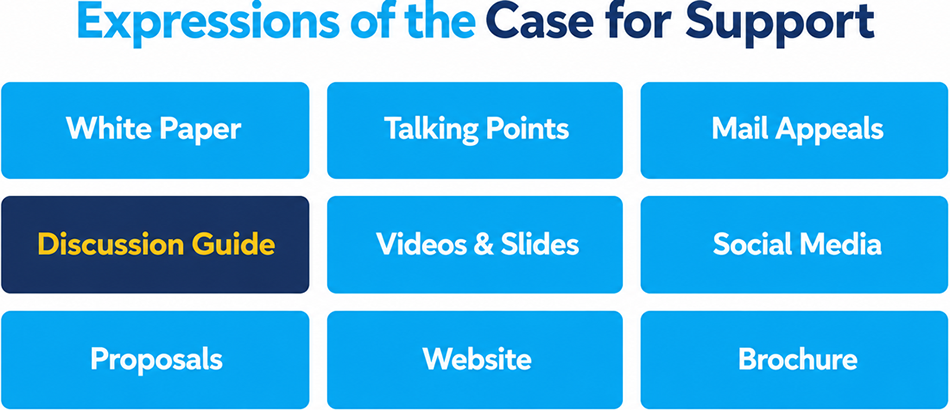
We explain this progression in our article Capital Campaign Case for Support: How to Write Your Own. The article Ditch the Fancy Case for Support and Brochure describes why flexible early materials can be more useful than a highly produced brochure before the campaign plans have been tested.
Your case should make the campaign easy to understand. Connect the project or initiative to your organization’s mission and describe the people or community who will benefit. Use clear language, specific goals, and examples that help a donor picture the outcome. Keep the core message consistent while adjusting the format and level of detail for each audience.
Communication During the Feasibility Study
The feasibility study (also called a campaign planning study) is an early opportunity to test the campaign’s plans with key donors and community leaders. It is a listening process as well as a chance to share the vision.
For those conversations, we recommend preparing a preliminary case for support and a donor discussion guide. The guide can present the main campaign ideas visually and help the interviewer explain the plans. It should leave room for questions and feedback. These materials do not need to look like final public campaign pieces. Their purpose is to help people understand the proposal and offer an honest response.
In a guided feasibility study, staff and board members conduct the interviews with training and support from campaign counsel. The organization’s leaders gather the feedback and use it to refine the case, campaign plans, and fundraising goal. Read our feasibility study guide for more on this process.
The communication around these interviews should be personal. Invite each person directly, explain why their perspective is valuable, and follow up after the conversation. Track questions and themes so the campaign team can respond consistently and consider feedback as it develops the plan.
Quiet Phase Communication: Targeted and Personal
During the quiet phase, the campaign team works to secure the largest gifts from lead donors, board members, and other key supporters. The fundraising work is active. The communications reach a selected group through personal contact.
This is a time for donor meetings, proposals, presentations, and thoughtful follow up. A leader may invite a donor to discuss the campaign over coffee, share a short written summary before a meeting, or send a proposal that reflects the donor’s interests. A campaign chair might host a small gathering for a few invited supporters. These are purposeful communications tied to relationships and individual conversations.
The quiet phase also calls for internal communication. Board members, staff, and campaign volunteers should understand the case, the current working goal, their roles, and the campaign’s progress. Consistent internal updates help leaders speak clearly and make good decisions together.
Hold off on broad promotion for the public phase. During the quiet phase, mass email appeals, general social media campaigns, public progress trackers, and community wide fundraising events are not strategic or advisable. The focus during the quiet phase is personal solicitation and donor engagement.
Our Capital Campaign Quiet Phase guide describes the phase and the work involved.
Useful quiet phase materials
A quiet phase communication toolkit can include:
- A case for support that explains the campaign vision.
- A donor discussion guide for campaign conversations.
- A short campaign summary or proposal prepared for an individual donor.
- A presentation, rendering, or program story that helps explain the plans.
- A consistent process for recording questions, feedback, next steps, and follow up.
The right material depends on the conversation. A donor proposal should speak to a donor’s interests, while a discussion guide should help an interviewer describe the campaign and invite feedback.
Donor tours and small gatherings
Some events can support quiet phase cultivation when they serve a focused group of donors and lead to personal follow up. A small tour, house party, or project briefing can help supporters understand the campaign vision, ask questions, and see how the project connects to the mission.
You might consider a house party or a hard hat tour to give a small group of donors a closer look at the campaign. A house party offers a relaxed setting for a supporter to introduce friends to your organization. A hard hat tour lets guests see the project taking shape and connect it to the campaign’s purpose. In either case, keep the gathering focused on the campaign story, leave room for questions, and follow up personally afterward.
An event should have a clear purpose, a host or leader who can make the campaign personal, and a plan for contacting guests afterward. A tour or gathering can open the door to a donor conversation. Decide who will follow up before invitations go out.
Prepare for the Public Phase *BEFORE* it Starts
The public phase should be planned well before the public launch. During campaign planning, outline the audiences, messages, channels, events, roles, and major dates your team expects to use. Then develop the detailed calendar as the public phase approaches.
Before going public, review campaign progress and confirm that you have secured at least 75% of your goal (the right percentage varies with the organization, its donor base, and the campaign). At the public launch, the team should have a clear sense of the official campaign goal and a realistic plan for raising the remaining funds. Our article Use the Public Phase of Your Campaign to Energize Your Community discusses the purpose and timing of this phase.
Use the final months of the quiet phase to prepare the materials and people who will support the launch. This may include a campaign webpage, a brochure, email templates, social graphics, a video, press materials, pledge forms, and talking points for board members and volunteers. Assign owners and approval steps so the team can publish content on schedule.
Public Phase Communication: Reach a Wider Audience
Once the campaign enters the public phase, communication can extend to a broader group of donors, volunteers, families, community members, and local organizations. The message moves from one to one donor conversations to a more visible invitation to participate.
The public phase gives the community a chance to see the campaign’s progress, celebrate the leadership gifts already secured, and help close the remaining gap. Your campaign communications should state the goal, explain what the campaign will fund, show progress, and give people a clear way to contribute.
Reach your audience via these channels
A coordinated public phase may include the following channels:
- Email: Send a launch announcement, progress updates, stories, event invitations, and appeals to appropriate segments of your list.
- Website: Create a clear campaign page with the case, goal, progress, giving options, and contact information.
- Social media: Share campaign milestones, donor and volunteer stories, photos, video, event details, and links to give.
- Press and community outreach: Share news about the launch, major milestones, project plans, or campaign events with relevant local outlets and partners.
- Video and stories: Feature a program participant, volunteer, donor, or staff member who can explain the project’s purpose and potential impact.
- Events: Use a launch event, community gathering, open house, or campaign tour to give people a personal way to learn about the effort.
- Peer to peer outreach: Equip board members, volunteers, and other ambassadors to share why they support the campaign and invite people in their networks to participate.
- Phone and text outreach: Plan an effort with clear audiences, trained volunteers, message templates, gift recording, and prompt follow up.
These channels work best when they reinforce one clear campaign story. A social post can point to the campaign webpage. An event can provide a reason for a follow up call. A volunteer’s personal message can help someone understand why the project is meaningful to a person they know.
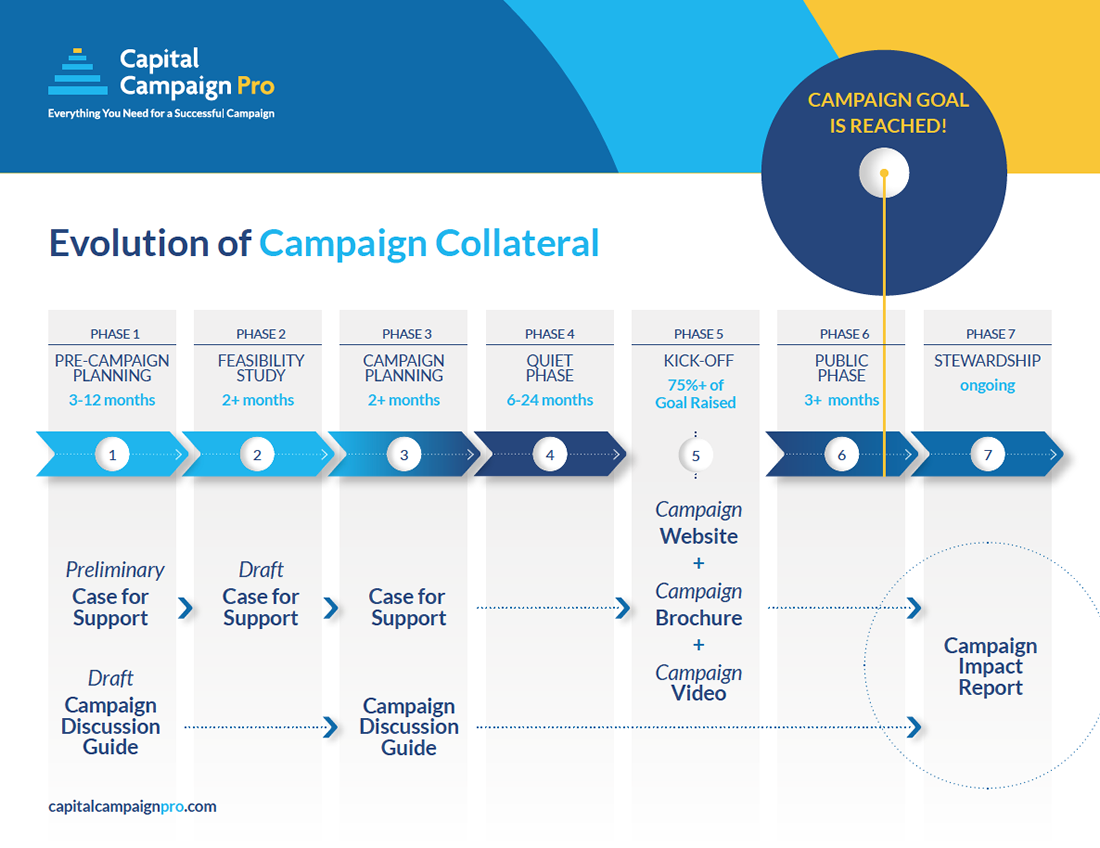
Build a Content Calendar that Works for Your Team
A simple calendar can help your team coordinate the public phase. List the date, channel, content, owner, and any details needed for approval or publication. For example, you might schedule a launch announcement, a donor story, a campaign event, a progress update, and a final appeal. Plan a mix of formats and messages so each communication gives people a useful reason to learn more or take part.
Plan communications in waves instead of sending the same message repeatedly.
A launch announcement can introduce the campaign. A later update can share a donor story or explain how a project will serve the community. A milestone can give supporters a reason to celebrate and share the campaign with others. As the campaign approaches its goal, a matching challenge or final appeal can invite additional gifts.
Vary the content. Use stories from program participants, donors, volunteers, staff, or community partners. Explain campaign details in plain language. Show renderings or project images when they help people understand the plan. Share progress updates that are accurate and easy to interpret. Each piece should have a clear next step, such as attending an event, learning more, sharing the campaign, or making a gift.
Make peer outreach easy to do well
Peer to peer outreach can help the campaign reach people through trusted relationships. Set a clear goal, invite board members and volunteers to participate, and give them a short campaign overview, talking points, stories, images, and answers to common questions. Help ambassadors share why they support the campaign and invite people in their networks to learn more or make a gift. Check in with them during the campaign and thank them for their outreach.
Track gifts and follow up in your donor management system. Thank people promptly, record campaign commitments accurately, and give new donors a personal welcome.
A planned phone or text effort can give supporters a personal invitation to participate. Choose the audience, prepare clear messages, brief the volunteers, and decide how gifts and follow up will be recorded. Thank donors promptly and contact anyone who asks for more information.
Keep campaign events connected to relationships
Public phase events can introduce new supporters to the campaign and give current donors a reason to invite someone else. A bring a friend tour, for example, gives a current supporter an easy way to introduce a guest to the organization and its work.
A host can explain their connection to the organization, a staff member can describe the project, and a program participant or volunteer can share a relevant perspective. Leave time for questions and give guests a clear way to learn more or make a gift.
Follow up after the event. Thank guests, share any promised information, and ask hosts or staff to contact people who expressed interest. The event creates an opening for continued conversation, while personal follow up helps each guest decide how they would like to participate.
Measure progress and adapt the calendar
Track both fundraising progress and communication activity. Campaign leaders need to know how much has been raised and pledged, which donors need follow up, and whether the campaign is on pace to meet its goal. The communications team can also review email responses, event attendance, video views, social engagement, website visits, and new donor activity.
These channel measures are useful when they help the team make a decision. If an email has a low response, review the audience, subject line, timing, and call to action. If a tour brings in new guests, plan the follow up while interest is fresh. If volunteers are sharing the campaign, give them new stories and updates to use.
Keep a record of what the team sends and what happens afterward. The calendar can be updated as dates change, new stories become available, or campaign milestones call for a new message. The overall strategy should continue to guide those changes.
Close Your Campaign with Gratitude and Follow Through
Campaign communications continue after your campaign goal is reached. Thank donors, volunteers, staff, and community partners. Celebrate what the campaign has made possible, share next steps for the project, and keep donors informed as plans move into implementation.
A campaign impact report can bring the story together. It can describe the need, the campaign’s progress, the people who contributed, and the work made possible by their support. Ongoing stewardship helps donors see how the organization is using their gifts and keeps them connected to the mission beyond the campaign.
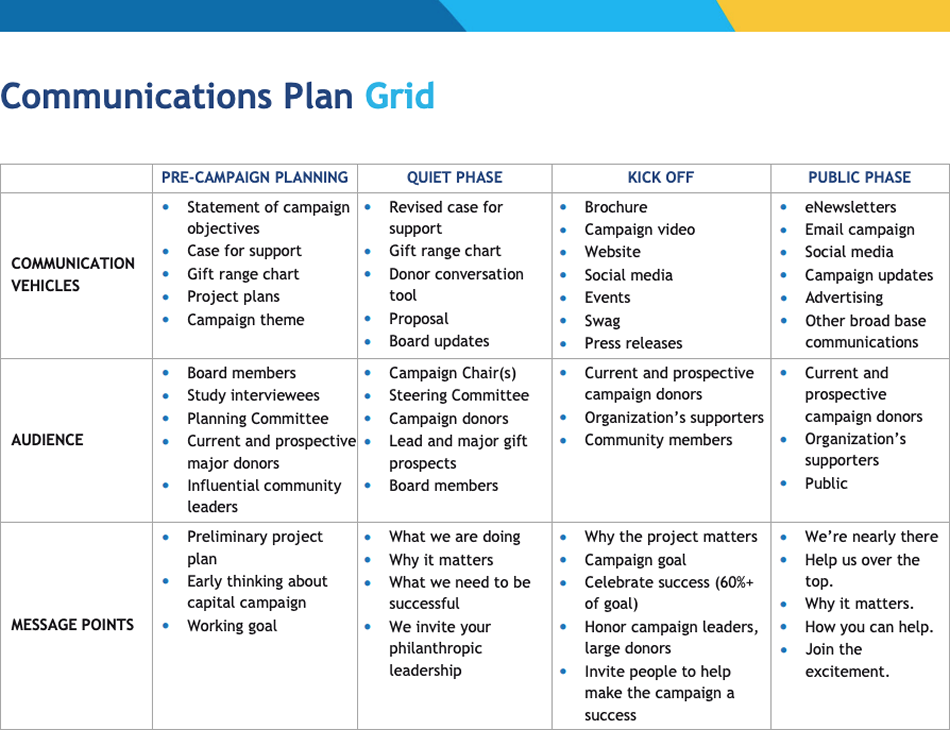
A Simple Phase-by-Phase Guide
| Campaign stage | Communication focus | Examples |
|---|---|---|
| Feasibility study | Share the preliminary case and invite feedback from key supporters | Draft case, discussion guide, personal invitations, interview follow up |
| Quiet phase | Support individual donor cultivation and solicitation | Donor proposals, presentations, small tours, house parties, internal updates |
| Public phase | Share progress and invite broader participation | Campaign webpage, email, social media, press, video, peer outreach, events, phone or text efforts |
| Stewardship | Thank supporters and report on the campaign’s results and impact | Personal thank yous, campaign report, project updates, donor recognition |
Remember, a capital campaign communications plan works when its timing follows the fundraising strategy.
In the early stages, focus on the case for support and the donors whose gifts will form the campaign’s foundation. After roughly 70 to 80 percent of the funding is secured, use public communications to share progress and invite a wider community to help complete the goal.
Get the support you need to succeed.
With our approach, you get the support, expertise, and guidance you need — plus all the tools and materials — to make your campaign a success.



Leave a Comment