
Podcast: When to Hire an Owner’s Representative for Your Capital Campaign Building Project
Season 5, Episode 15
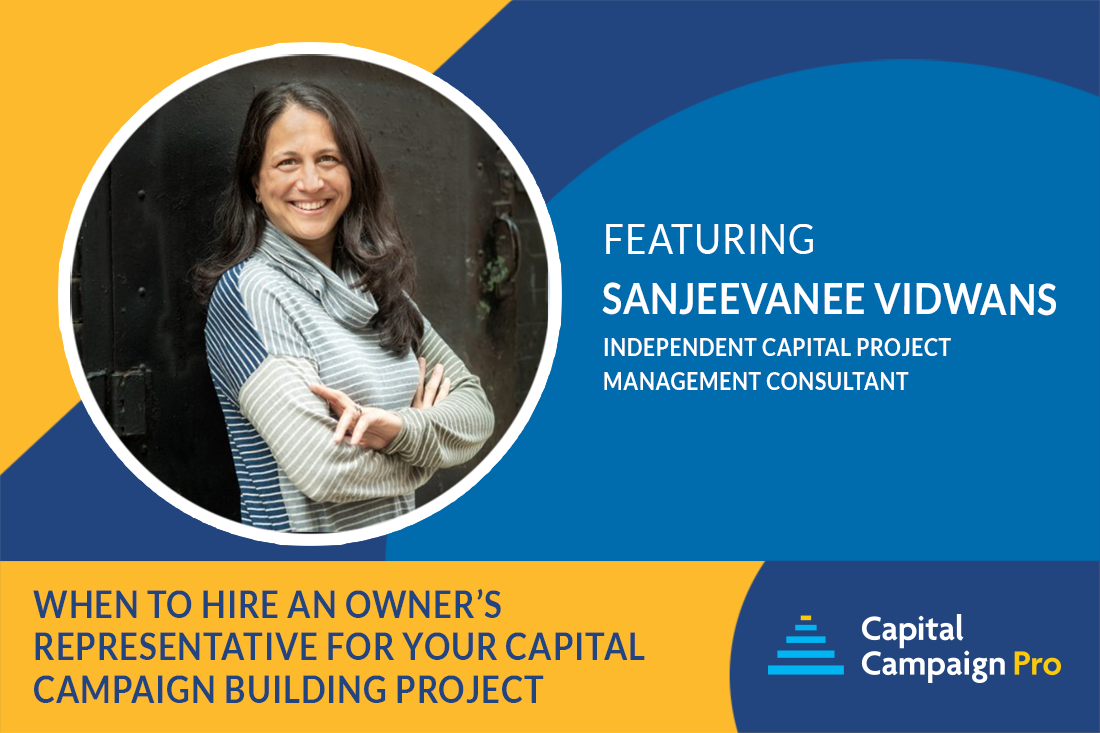
If your capital campaign includes a construction or renovation project, there’s far more to think about than fundraising goals and donor lists. In this episode, host Andrea Kihlstedt sits down with Sanjeevanee Vidwans, an independent capital project management consultant, to unpack what it really takes to plan and manage a successful building project from the owner’s side.
Tune in to learn how preparation, communication, and the right expertise can turn your campaign’s construction goals into a reality.
Listen Now:
Andrea Kihlstedt:
If your campaign is funding a building project, you’ll need more than money to succeed. In today’s podcast, we’re going to talk about the planning and construction side of building projects. We usually don’t do that, but we think it’s important. And I’ve got a very special guest to help make sense of that.
Amy’s away this week. And I’m here with Sanjeevanee Vidwans. She’s a wonderful woman who lives in New Jersey and she is an owner’s rep. But let me give you a slightly bigger picture of her. So in a bigger frame, she calls herself an independent capital project management consultant. That’s a big mouthful. And she’s been working in this field for more than 25 years. But what I love is that she’s a civil engineer by education and she started her career as a construction field superintendent.
So I’m sitting here looking at her now and I can just imagine her with a hard hat and overalls and kind of making sure all those tough folks in the field are actually doing what they’re doing. It just makes me chuckle to think about that, Sanjeevanee. But mostly she moved into the project management side of the business. She’s worked in the public sector for the city of New Jersey as Deputy Director of Department of Housing, Economic and Development and Commerce. You have so many mouthfuls of titles. But really most of her career and what she’s doing now is that she is what we call an owner’s rep. Now, I love that idea. She actually represents the owners in these complicated building projects and they’re all complicated. So let us welcome Sanjeevanee and let’s start talking to her about what this is.
Hi, Sanjeevanee.
Sanjeevanee Vidwans:
Hi, Andrea. Thank you so much for the intro.
Andrea Kihlstedt:
Well, thanks for joining us today. And sometimes it’s really good for … most of the time, most of the people who listen to this podcast are board members or development staff members or executive directors, right? And we generally, because we are in the capital campaign business, we generally kind of look narrowly at that. But I think it’s so important for us, particularly for capital campaigns that fund big building projects, it’s really important for us to help our clients understand what other people they might need to bring to the table and what other kinds of expertise they might need.
Who to Hire First to Figure Out Your Building Project
So let me start by asking you this. So if I were a nonprofit planning a campaign to raise $30 million to build a new building for my organization, who would I hire first to help me figure this out? Or when would I think to hire an owner’s rep?
Sanjeevanee Vidwans:
I mean, in my opinion, I’d say the earlier, the better. You want to be talking to an owner’s rep pretty early on in the process when you’re still in the questioning phase of the project, not in the already decided what you’re doing phase, because an owner’s rep can give you input to answer those questions. What’s going to be my scope of my project? Am I going to build on my existing building or am I going to build down the street? Or am I going to try to acquire another building? How big is this going to be? What am I going to try to house there? What will be the program inside the building?
All these questions that you may need to speak to people beyond an owner’s rep, but an owner’s rep can shepherd you towards the right people and bring them all together to help you develop your plan and what it is you want to do. So I would say the earlier, the better. It doesn’t have to be a full-on full-time person by your side from the beginning, but having an earlier conversation will at least guide you in the right direction.
Andrea Kihlstedt:
Yeah. So let’s kind of look at the pieces of, again, putting myself in that position. It’s sometimes easier to understand things when we’re talking about a specific project, right? So here I am. My board has approved the project to build a new facility. We don’t yet have a piece of property. We don’t yet have a budget. We think we’re raising $30 million, but we’re really not sure if that’s the amount of money or not the amount of money. And I think I might be inclined to call a real estate person who’s going to help me find a piece of real estate, and an architect. Is that not right?
Sanjeevanee Vidwans:
I mean, it is right, but those are a few pieces that together might make your plan, but who’s bringing together the plan? I think that’s where an owner’s rep can be very helpful. So many times a client or an owner will hire an owner’s rep to begin with a project implementation plan. And that is your concise document that they’ll put together for you that will be your roadmap for the project. It’ll summarize:
- What’s the project mission?
- What are you trying to accomplish?
- When this project is over, what do you hope that it will bring to your organization?
- What’s the scope of the project?
- What is the timeline of the project?
- Are there certain funding sources that are important to the project?
Obviously, fundraising is one piece that your audience knows a lot about, but there could be other funding sources like public funds that might come with certain reporting requirements or other restrictions, or … It puts together the roadmap. The budget, of course, is a big part of it. And an owner’s rep will pull in different experts to inform that plan.
And once you have that plan, your board knows what it is that everyone’s working towards. You and your board know that. An owner’s rep will help you put that together and they may in that process speak to a real estate representative or an architect or an engineer or a code consultant or any other people that specific project might need to bring in the expertise of.
The First Thing an Owner’s Rep Can Do to Help
Andrea Kihlstedt:
Right. Now, let’s turn the tables a little. Let’s say that I’ve hired you to be my owner’s rep for this project that I’m undertaking. And it’s still early days. Perhaps I’ve identified a site. Maybe I haven’t bought it yet, but I’ve identified it. I know where we want to be. I have a pretty good idea that this is going to be a 10,000 square foot building and what has to happen in the building because I know my program pretty well. I don’t know very much else, but I know that. So I would hire you. Now, what’s the first thing you would do to help me to work with me?
Sanjeevanee Vidwans:
Yeah. I mean, so the first thing is a feasibility study to —
Andrea Kihlstedt:
Okay, now let me stop you there. Now, when you use the word feasibility study, you mean something different than what I mean when I use the word feasibility study. So let’s be really clear. When I use the word feasibility study, I’m talking about a fundraising feasibility study, right? When you use the word feasibility study, you’re talking about a project feasibility study.
Sanjeevanee Vidwans:
Yes. A project feasibility study.
Andrea Kihlstedt:
And that’s really important for people to understand, that there is such a thing as a project feasibility study and they need to do it. So what goes into that?
Sanjeevanee Vidwans:
Yeah. So a project feasibility study is where you would start. And a project feasibility study, it doesn’t necessarily have to just consider one concept. It can consider many concepts. It can have different pieces and versions of different concepts that at the end of the day might come together to be your project. But sometimes you might have to consider 10 different pieces, of which five of them come together and add up to your project. Sometimes all 10 come together and add up to your project. Sometimes it might just be one.
But I think that exploring to some extent different possibilities and giving yourself and your board some options to piece together to figure out what’s the best way to move forward makes everyone feel comfortable about how you’re moving forward. And that to me is the biggest key everyone, especially the staff, but especially your board, needs to feel comfortable, because then in turn your donors will feel comfortable.
An Example of a Project Feasibility Study
Andrea Kihlstedt:
Right. So for example, let me back up in this fantasy project I’m concocting here and say, “Well, okay, maybe I think I know what the property is,” but you might come in and say, “Gee, why don’t we look at three different properties? And I can help map out the pros and cons of each of those properties.”
Sanjeevanee Vidwans:
Yes, exactly. It might be three different properties. It might be this property, but doing a light touch renovation, a gut renovation, knocking the building down and building a new building, adding three floors to the building, making it a combo of your existing building and a new building. It’s really whatever the organization has the appetite to explore. Sometimes some things you know already are not, you’re not going to do. So then those aren’t worth exploring. But the feasibility study can have many layers to it.
Andrea Kihlstedt:
Right. And I mean, it seems to me that in order to do that well, you need a great amount of expertise of many different things. We need an expertise when we help our clients about how to raise money, how they should raise money. That’s relatively simple compared to what you need. Now, some people are going to say raising $30 million is not simple. And I suppose that’s true. But you need to understand about zoning, about utilities, about requirements on public land, about construction types.
Sanjeevanee Vidwans:
Yes, all those things.
Andrea Kihlstedt:
That’s only just a few, right?
Sanjeevanee Vidwans:
You’re absolutely right. And I mean, an owner’s rep, a good owner’s rep will have some amount of knowledge about all those things and know when you need to bring in someone with more expertise about those things.
In feasibility studies I’ve worked on in the past, often we will engage an architect for some limited amount to do a … really, it’s a high level, it’s a bird’s eye kind of analysis of that scheme. If there is something that’s really specific in terms of zoning, often architects have that expertise as well, or they should have that expertise, but there may be a need to engage a code consultant if it’s something specific. Cost is an interesting thing because yes, you do need specifics of cost eventually, but to make decisions you really need order of magnitude of costs.
Andrea Kihlstedt:
What do you mean by that, order of magnitude?
Sanjeevanee Vidwans:
Order of magnitude of square foot cost, a square foot range of cost. Also just understanding what costs more, what causes things to cost more. So sometimes renovating a building actually costs more than knocking down a building and building a new building. An example would be if you’re a museum and you’re trying to retrofit a building that doesn’t have a good shell, it doesn’t have … the bones of it won’t support a very robust HVAC system, like a heating system, a cooling system, a sprinkler system, all things that a museum would need. It’s harder to retrofit a building to make museum quality space than to build a new building.
So those types of things would come out in a feasibility study. And an owner’s rep will know what a space requires, what an order of magnitude of cost would be for that.
Andrea Kihlstedt:
Right. So you might look at, let’s say three different sites, you know what the organization does, you understand what it needs. You might help an organization look at three different sites and then give them options and cost estimates, not based on details, but based on size and construction type, for example. Is that right?
Sanjeevanee Vidwans:
Exactly. Or I think an owner’s rep can also bring you to see certain constraints to a site. Like if a site is very small and you’re wanting to build a new building that’s very high, you need to be able to access it. If it’s wedged between two buildings, sometimes building between two buildings causes the cost to be a lot higher because the logistics will drive the cost up. So then maybe in that scenario you do need to speak to a construction manager and just understand how much higher the price tag would be because of logistics. But knowing to ask those questions is what an owner’s rep would bring to the table. And we’re talking about scenarios where the slate might be open. Sometimes organizations have a much better idea of what they want to do, and so a project feasibility study might be a little bit more narrow. I think it can be very flexible depending on what the organization needs.
Differences Between an Owner’s Rep and a Construction Manager
Andrea Kihlstedt:
Right. Now, you brought up the idea of a construction manager. Now, what’s the difference between an owner’s rep and a construction manager?
Sanjeevanee Vidwans:
Very big difference. Yes. So an owner’s rep is really an extension of the owner, managing and directing on behalf of the owner. A construction manager, an architect, and a few other key consultants will have direct contracts with the owner, and the owner’s rep is kind of on the side managing those consultants on the owner’s behalf.
So a construction manager is really responsible for the execution of a design that the architects and the design team designs. So they’re given a design, construction manager is given a design, and they’re tasked with providing a cost and a schedule to execute that design. So design team comes up with the scope, also thinking about costs and schedule, but the scope, and then the construction manager executes it. And the owner’s rep is overseeing all of it and making sure they’re working together.
Andrea Kihlstedt:
Right. So that means that once you’ve finished a project feasibility study and my organization, to keep going back to my organization, has decided with your help we’ve selected a site. We know what the ins and outs of it are. We know what the zoning issues are. We know what the construction issues are with your help. Now we hire an architect to do more fully developed plans. And then the architect helps us hire, and maybe you also would help us select a contractor?
Sanjeevanee Vidwans:
Yeah. So an owner’s rep … And just to be clear, a project feasibility study or a project implementation plan, even if it engages consultants, they can be consultants like an architect or even a construction manager. They don’t necessarily have to be the ones that end up building the project or designing the project. So at that point, there can be a selection process to find an architect that best suits the needs of your project. Owners reps will oversee an RFP, request for proposal, process, develop an RFP that outlines all the needs of the organization, the things that are important. If there’s a budget in place, it would likely tell an architect, “This is the budget that we’re designing to.” If there’s still options that are still being considered at that time, an architect can be selected with the knowledge that they would have to work on a couple of different options.
But yes, an owner’s rep would manage an RFP process, can do it for an architect. And then usually the architect has other consultants under them like a mechanical, electrical, plumbing engineer, a structural engineer. Usually they’re under the architect. And then an owner’s rep can also oversee the RFP process for a construction firm. And there’s several different types of contracts that construction contracts can be construction manager, general contractor, construction manager with a guaranteed maximum price. There’s a few different types.
Andrea Kihlstedt:
Building a new building is a very complicated process. And the more you talk about it, the more I’m reminded of how complicated it is.
Sanjeevanee Vidwans:
It can be, yeah.
Andrea Kihlstedt:
And often in the fundraising side, which is the side where I sit most of the time, where we at Capital Campaign Pro sit most of the time, we see only a limited piece of that. But occasionally it comes together, and I’ll give you an example.
An Example of the Process
So I was working on a project in Providence, and as they began to more fully develop their architectural plans and figure out what the actual costs of the project were going to be, it turned out that the costs were going to be higher than they had imagined, which is not uncommon, frankly. And as they started thinking about the costs being higher, that of course translates to the fundraising side, that the campaign they had been planning might not be raising enough money to cover the cost of this project that now seemed like the one that they wanted to do.
One of the issues that came up was whether they should dig out the basement when they did this project, or not. They could save money by not fully excavating a usable basement, a full usable basement. And I don’t remember what the cost was, but let’s say they could save a million dollars just for the sake of discussion. It seems to me that this is an issue that an owner’s rep might have helped with, might have helped to say, “Can we put this off? Could we do this later? What can we delay until later? What can we not delay until later? What do we lose if we don’t dig out the cost of a basement level?” I mean, it was very complicated. Would you be involved at that level?
Sanjeevanee Vidwans:
Yes, I would hope so. Absolutely. So the question in my mind is how was it discovered that this was going to cost so much more and at what point? So at what point in the process was it that it was discovered that the cost was higher than what was anticipated? And were they already far along in the design? Because yes, it does sound like an owner’s rep would’ve helped a lot earlier with that situation.
Andrea Kihlstedt:
Yeah. I mean, as with many things and many building projects, because the people who are doing the building project, the executive director, the program people, board members, are not super experienced, in many cases not experienced at all in design and construction in any of those skills, that they’re feeling their way as they go. On one hand, they want the nicest and best and most wonderful building they can possibly get. On the other hand, they haven’t really come to realize that as they start making specific decisions about what material the building is going to be built out of, is it going to have a basement or not have a basement? All of those have cost consequences, right?
Sanjeevanee Vidwans:
Absolutely. I think the biggest thing that an owner’s rep does is they align your scope, budget and schedule. And those have to be aligned from day one, day negative one, the very beginning. And it has to be aligned till the very end. I mean, the example you’re describing, it sounds like the scope changed and that made the budget change, but that’s because they weren’t aligned in the first place. An owner’s rep —
Andrea Kihlstedt:
They weren’t aligned in the first place because people were inexperienced and didn’t fully know, right? The questions hadn’t been fully addressed, which is common.
Sanjeevanee Vidwans:
Yes.
Andrea Kihlstedt:
Most of us don’t know what we need to know before we have to make decisions.
Sanjeevanee Vidwans:
Yeah. I mean, those three things, scope, budget and schedule, I think a lot of times owners start with an architect and they think, “I have an architect. That’s all I really need.”
Andrea Kihlstedt:
That’s right.
Sanjeevanee Vidwans:
But architects aren’t always focused on all those three things. I mean, they have a sense for them. Obviously, the scope is the number one objective for the architect to make sure they’re designing you a beautiful, functional building that’s code compliant, and that’s what they’re responsible for. They’re doing this in the context of a budget, but they need to be told what the budget is, to design to it. And if it works the other way, sometimes that’s when you get into problems, because the scope is leading what you want your budget to be. And it is a conversation.
I mean, obviously an architect is going to show you what’s possible and you need to make an informed decision on whether or not that element is worth that cost. But you need to know what the cost is to make that decision. And the schedule is a piece of it, but the architect is not as involved with that as much as the construction manager is.
Andrea Kihlstedt:
And you really, you as an owner’s rep have your arms around all of those. You see all of those and you’re able to be a go between for this complicated set of information and people and the board of the organization and the executive director of the organization.
Sanjeevanee Vidwans:
Yeah. And hopefully speaking that speak that maybe the executive director and their staff doesn’t know, adding that expertise to that they may not have.
Andrea Kihlstedt:
Right. So let me just tell you at the end of the story so people know what happened with my little story. But then I want to hear more about the projects that you’ve done and what kind of projects you really enjoy doing. But what happened with this organization is that as they learned more about the building and what the building might be and whether they needed a basement or didn’t need a basement and how much more it was going to cost, we kept making eye on the fundraising side, kept saying:
“You don’t know how much money you can raise until you try to raise it.”
That you shouldn’t cut yourself off from possibilities because you’re afraid. If it makes every sense to dig out this full basement and give you a whole ‘nother functional part of this facility, you shouldn’t be put off by fundraising. We should start testing that and working on the fundraising side to do that.
So that’s what happened. They dug out the basement, they raised more money than they ever imagined. They raised all the money they needed to pay off the building and some, because they had the courage to go ahead and do it. And they did, by the way, hire an owner’s rep that they felt was hugely valuable through this whole process, to help them wrap their arms around all the complicated things they were dealing with. So it was a very heartwarming story. But in the middle of it, it didn’t feel so heartwarming.
Sanjeevanee Vidwans:
I’m glad it was a success story. And hopefully with a great architect, an architect can really aid those conversations too, aid the fundraising team in those conversations as well, creating visuals that really sell that space and why that’s important to the overall design.
Some of Sanjeevanee’s Projects
Andrea Kihlstedt:
So let’s go back to you though. You’ve worked on some really iconic projects here in New York City, sort of buildings that people now know.
Sanjeevanee Vidwans:
It’s fun to walk around and look at them. I don’t think my kids care, but I care.
Andrea Kihlstedt:
I do care. Absolutely. Do you have a couple of projects you want to talk about a little?
Sanjeevanee Vidwans:
Oh, I’ve been really blessed to work on some really amazing projects. I mean, I think the one that’s always the favorite to me is the Cooper Union Academic Building. Cooper Union is, for those that don’t know, it’s an academic institution. It’s a college in the East Village in New York City. It happens to be my alma mater, so it’s very special to me, but that’s not what led me to work on the project, it just happened to be a coincidence. But they were building a new building. It was actually a whole campus consolidation of two buildings into one. And being an architecture school, such an amazing architecture school, their intent was they wanted to find the next Pritzker prize winning architect to be the architect that designed this building. And they tasked our OR firm with that task, find us the next Pritzker prize winning architect.
And we conducted a worldwide search, an exhaustive search, and we found the architect. The architect was Tom Mayne, a Morphosis architect, and later he won the Pritzker Prize. And actually the runner up ended up also winning the prize as well. So we had two in the running and accomplished that mission. So there’s so many cool things to love about this project. I get so excited talking about it. It was the first lead platinum certified lab building in New York City, which was an amazing feat. I mean, it was just so built so holistically, sustainably designed for a lab building with all those requirements in a lab to be lead platinum certified is pretty remarkable. And it just had so many cool design features, such a great building.
But the reason why it’s my favorite project is really because of the project team. I mean, we helped the owner hire the architect. And on the very same day the contract was signed for the construction manager for the project. So it’s very unusual for them to be brought on at the same time. But it was on this project because collaboration was just the key there. I mean, they worked so well together. All of us worked so well together because they had a common goal. They started from the beginning, they informed each other’s work. And just came up with just a really amazing building as a result of it. And to me, it’s about … I just am always searching to create that type of project team because I think like with anything, it’s all about the people.
It’s All About the People
Andrea Kihlstedt:
Yeah. Yeah. And if the project team is wrong, these projects can be brutal, right? People can be fighting each other, pushing in opposite directions with each other.
Sanjeevanee Vidwans:
And they have to be the right fit for that owner as well, be able to communicate effectively for that owner, for that client, what speaks to that client? Are they getting the essence of that organization and the design in the construction? Believe it or not, the construction also needs to reflect that organization.
Andrea Kihlstedt:
Right. So the Cooper Union building is a big, iconic, beautiful building. I too walk by it and I’m always awed by it sometimes. Do you also work for smaller, less iconic buildings or does an organization need to be big and fancy to hire you?
Sanjeevanee Vidwans:
Oh no, not at all. I love smaller projects. And then it’s all really the same challenges in a way, just on a smaller scale. But no, absolutely, I’ve done everything from office fit-outs to even just feasibility studies. I’ve worked on historic buildings, retrofits, like out of the ground buildings, really you name it. Most of my work though has been with nonprofits, educational institutions, performing arts institutions. That’s really been most of the projects that I’ve worked on and ones that I love to work on.
Andrea Kihlstedt:
Right. Well, I think anybody would be fortunate to have you as an owner’s rep, Sanjeevanee. It’s just a pleasure to talk to you and to get to know you and to help understand what an owner’s rep does. And to encourage everyone listening, that if you are doing a building project, it is more complicated. Unless you are really an expert in this field, it’s more complicated than you think. And you probably should have someone on your side, hired to be on your side, who understands all of the complexities of planning and construction and the public sector aspects of building projects. It would make a huge difference.
Sanjeevanee Vidwans:
Might be a little scary, but you can do it.
Andrea Kihlstedt:
You can do it. Sanjeevanee just wrote a blog post for us, which you can check out on the Capital Campaign Pro blog. It’s called Do I Need to Hire an Owner’s Rep for My Capital Campaigns? 3 Reasons You Should. So you can check that out at capitalcampaignpro.com, and just take a look at our blog. I’m sure we will post her contact information in what they call the show notes, I think, for this podcast.
Final Thoughts
Sanjeevanee, any final words from you? Any final bit of advice for someone going into a building project?
Sanjeevanee Vidwans:
Yeah, I mean, I think I started to say before, it may seem scary, but you can do it. Your team can do it. You just need to have the right people by your side. And your dream for your organization can come to fruition. I love seeing that. I love making that happen for organizations.
Andrea Kihlstedt:
Fantastic. Thank you so much. Thank you so much for taking the time to join me today. I think our audience will be happy to have a look at the other side of the capital project business than we usually offer to them. So maybe you’ve opened some people’s eyes in a great way.
Sanjeevanee Vidwans:
Thank you. Thanks, Andrea.
Andrea Kihlstedt:
Bye everybody. We will see you next week.



Leave a Comment