
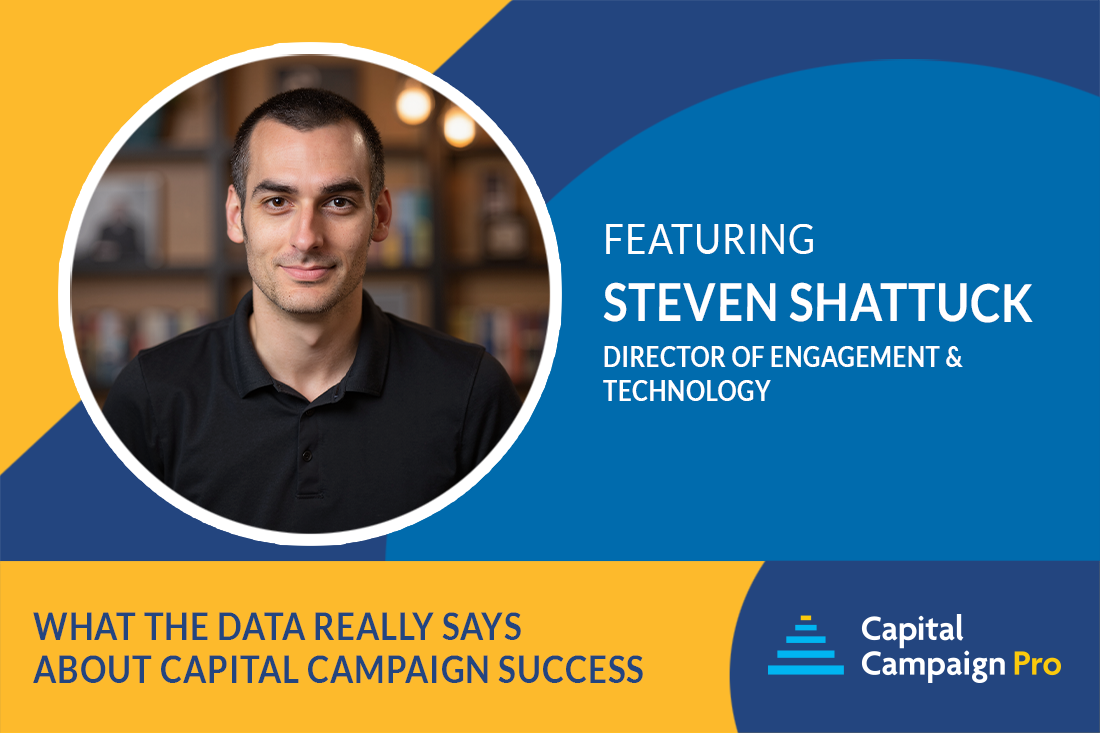
Podcast: What the Data Really Says About Capital Campaign Success
Season 5, Episode 28
Most capital campaign advice comes from stories and experience. This episode brings three years of real data that confirms what actually works and what common fears miss.
In this episode, Amy Eisenstein is joined by Steven Shattuck, Director of Engagement and Technology at Capital Campaign Pro, to share findings from the third annual Capital Campaign Benchmark Report. Drawing on responses from more than 650 organizations, they explore what successful campaigns have in common, how annual funds perform during and after campaigns, and why gift distribution follows a predictable pattern that boards need to understand.
Listen Now:
Amy Eisenstein:
The third annual benchmark report on research and capital campaigns gives us data that will wow your board.
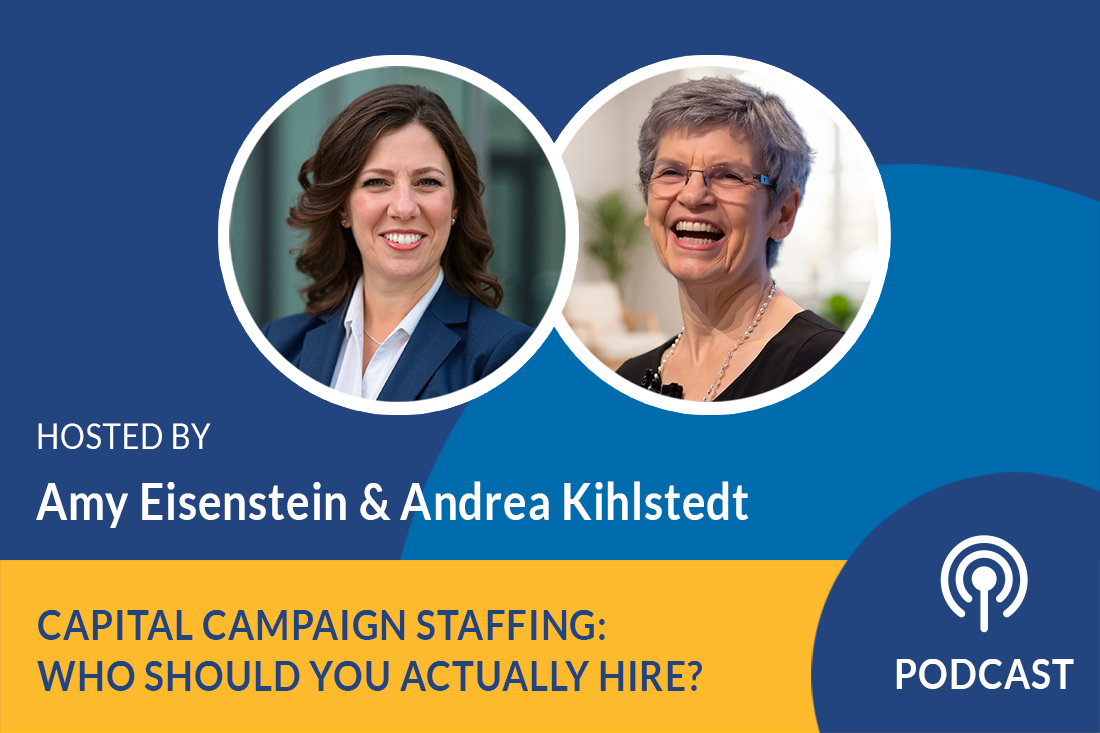
Hi, I’m Amy Eisenstein. Today I’m here with a very special guest, our director of engagement and technology, Steven Shattuck, who leads the way on our annual benchmark research report on campaigns and what makes them tick and how they work and what’s true and what’s not true. And we’re going to bust some myths today and share some data-based and backed research. So Steven, thanks for joining me.
Steven Shattuck:
Hey, thanks for having me.
Capital Campaign Research: Digging into the Data
Amy Eisenstein:
Yeah. Well, thanks for doing the research for Capital Campaign Pro. It’s been an amazing three years of building on research that you really thought let’s get some numbers to back up what we say in the Capital Campaign world. It’s not just anecdotes anymore and stories and … We have experience to inform best practices and decisions, but now we actually have three years of data too, which is super helpful.
Steven Shattuck:
Yeah. It’s hard to believe it’s been three years and we’ll get into it. But one of the things that’s most fun for me is the data didn’t take a lot of wild swings from year to year. You always worry in those first couple years, did we really get an accurate picture of the sector or did we just get some early adopters or corner cases? And now that we have over 650 organizations and campaigns analyzed, all three reports were pretty steady percentage-wise.
But yeah, happy to dig into the numbers because there’s some interesting tidbits this year.
How Our Campaign Research Is Conducted
Amy Eisenstein:
Amazing. So why don’t you first lay the groundwork, set the stage. How do you conduct the research? Who are we asking? What are the cohorts? Give listeners a little bit of a picture here.
Steven Shattuck:
Yeah. So what we do towards the end of the calendar year for the last three years, like we said, is we put out the bet signal to our community and we have some great partners that also reach out to their community on our behalf, which is very helpful. And we basically ask people:
“Hey, if you are either thinking about a campaign in the future, if you are currently in a campaign or if you have recently finished a campaign, fill out one of these three surveys.”
So there’s three surveys and each one corresponds to those three cohorts I just mentioned. Just thinking about a campaign, in a campaign and recently completed a campaign. And people have been great about responding over the last three years. We got, like I said, over 650 responses total over the last three years. This year we added a few hundred, which was great. And the really fun thing that happened this year that we’re just now starting to see in our third year is people updating the survey response from the previous year in moving cohorts. So we had a handful of people who last year were in the planning phase and then filled out the mid-campaign survey and similarly filling out the mid-campaign survey and moving to a post-campaign survey.
And we even had a couple organizations who in previous years have finished a campaign, start a new campaign, a second campaign. So it’s fun to see the dataset grow. We view it as a living database because like you said, historically we’ve been relying on anecdotes and case studies and that’s fine, but now we have that third leg of the stool. Our empirical data on how people plan, execute campaigns and what the impacts are on their organization, not just how successful the campaigns are. So yeah. That’s what we did. And we’re recording this in June of … January 2026. My J months mix up.
Amy Eisenstein:
I was going to say, what month are you in, Steven?
Steven Shattuck:
Yeah. So we’re going to keep doing it.
How to Access the 2026 Report
Amy Eisenstein:
All right so we just got the data. We just crunched the numbers. And we’re super excited to be rolling this out. But first of all, we’re going to talk about three of the findings and then encourage people to go get the whole report. So just where can they find the report?
Steven Shattuck:
Yep. So it’s pretty meaty. So yeah, we won’t dive into every single aspect in just the short conversation, but there’s a lot of good stuff in it. So people should go to capitalcampaignpro.com/research. There you will see this newest 2026 report, and it covers everything from campaign success rates, impact on the annual fund, board and executive director involvement. Pretty much every aspect of a capital campaign. We asked a question about feasibility study.
Amy Eisenstein:
Yeah. Why people should do feasibility studies. So if anybody listening, has leadership or board members that are questioning the value of a feasibility study, you can go get this research and wave it in front of everybody’s faces.
Steven Shattuck:
Yeah. And that’s a good point. That’s why we did this. Because I’m sure you experienced this. I certainly do in my work here. We have early conversations with people who are thinking about a campaign and they’re nervous.
Maybe they have some of those myths or misconceptions in their mind that we have squashed in some of the aspects of this research. But also to your point, maybe they want to do a campaign or do a campaign in a certain way, but maybe someone above them, perhaps a board member — and shout out to board members. I don’t mean to tease them, and I know you don’t either, but sometimes there are feelings that aren’t based in reality.
And we wanted to present that reality to people so that they could say, “Well, no, actually this is how things usually shake out and these are the benefits to doing things a certain way. And if we want this campaign to be successful, maybe we should follow suit.” So I’m glad you said that because that really gets to the heart of why we do it.
Amy Eisenstein:
Yeah. All right.
The Majority of Capital Campaigns Are Successful
Let’s talk about the first, to me, the lead question and one of the main exciting data points, and that is that a majority of campaigns are successful. So break that down. How do we know? What are we asking? What does that mean?
Steven Shattuck:
Yep. So we asked people who filled out that last cohort, people who have obviously recently completed a campaign, did you consider it a success? Just a blanket yes or no question. And this year, 95% of those completed campaigns said that they thought it was a success, which is where it’s been. I think it was 94% the first year, 96 last year, so it’s right there in the upper 90th percentile for sure.
We keep waiting for those horror stories to come in. And there were probably 5% of people that maybe the campaign wasn’t very successful or they weren’t happy with it, but it seems like for people that follow through and see it towards the end, that they think it’s a good thing for the organization, even if they don’t hit their goal. We had somebody who was around 70% of their goal still say they thought it was a success because 70% of a big number is perhaps a lot of money that can make a big difference in the mission.
So for the most part, if people really see it through … I think something we haven’t ever said, and I’m curious, your take on it is, people don’t do campaigns if they don’t think that they are prepared, which is good. And we preach that of really getting your house in order before embarking on this because it’s hard to recover from a failed campaign.
But for the most part, most people don’t fail, which is good because like I said before, people are nervous embarking on this and they should be. It’s a big deal. If you secure counsel and get good expert guidance, which most people do … And we can talk about that, that’s part of the survey as well, I think that really drives those success rates for sure.
Amy Eisenstein:
That’s right. Careful planning, doing a feasibility study, getting expertise, and going for it. And the average of the survey respondents raised 116% of their campaign goal over goal.
Steven Shattuck:
Yes. Yeah. And that was up. That was up 10% from last year.
Amy Eisenstein:
Yeah. We love to see that. Now, of course, you mentioned that even organizations that don’t quite hit their goals still considered their campaign a success. And I just want to drill down into that for a minute because listeners may have been like, “What? If you don’t reach your campaign goal, how could your campaign be a success?” So two things. One is, I think you were right to point out, if your goal is $10 million and you raise $9.5 million, does that mean you’re not successful? Most organizations that embark on a campaign raise more money than they’ve ever dreamed possible and get to do big, exciting projects.
Maybe they don’t either get to do the full project that they originally envisioned or they find alternative funding sources like dipping into reserves that they hoped not to do, or taking a mortgage or a loan, financing a piece of their project that philanthropy didn’t cover. So they still get to do their projects so the campaign is a success and we really believe that. Now, of course, we’re hoping to plan a successful campaign and organizations get to their goal and surpass it, but 95% of people that responded said that their campaign was a success by any definition. And that’s amazing.
What Happens to the Annual Fund During a Campaign?
All right. Let’s talk about annual funds because I think to me, one of the most exciting data points as a result of this research over the past three years is what we’ve learned about annual funds because I think it’s a huge concern of every board member, nonprofit leader that their annual fund is going to suffer when you go into a campaign. And we’ve been saying for years anecdotally that that doesn’t need to be true. It isn’t true. There are ways to make sure that the annual fund not only maintains, but thrives during and post-campaign, and now we have the data to back it up.
So what does the data say this year?
Steven Shattuck:
Well, this was our number one myth that we were curious about. We thought it was a myth, but again, until you do something like this, you really can’t definitively say, no, that doesn’t happen, or yes, that does happen. But now we can say, and especially three years running, consistent numbers that the annual fund can suffer during and after a campaign, but for a vast majority of people, it doesn’t. In fact, it grows.
So we asked a couple of questions along the lines of the annual fund. One, we asked, what happened to your annual fund during a campaign? So we asked the mid and post-campaign cohorts that question, and more than three quarters of organizations said that the annual fund either stayed the same or increased during the campaign, which was awesome. And that was our sense from our client work. Of course, we don’t see that happen through our work, but we still will encounter people that are thinking about a campaign saying:
“Well, I don’t know if we should do this because if the annual fund’s just going to go down, what’s the point?”
But now we can say that over three fourths of organizations don’t see that during the campaign. And after the campaign, the number of annual fund folks that say it grew goes up to 73% of just the increase. So that three quarters from the previous cohort is stayed the same or grew, but just growing after the campaign is 73%.
So almost three quarter of organizations see growth in the annual fund. And that has always made sense to us because if you do a campaign, it has multiplying positive effects on all aspects of the organization. And annual fund is front and center there. So capital campaigns are great for all the things you said about transforming your mission, but we also see them as growth catalysts for many aspects of the organization, including the annual fund.
So of course it can happen, it can suffer, but any consultant worth their salt is going to put guardrails in place to prevent it from happening. And of course, we’re no exception.
Amy Eisenstein:
I think that’s the key. I want to just hammer that home because certainly in my experience and all the consultants that we work with here at Capital Campaign Pro, that is one of the top priorities is ensuring that the capital campaign or that the annual fund, excuse me, stays the same and grows during and after the campaign because there are strategies, there are techniques to ensure that. And it’s interesting.
Capital campaigns really sometimes we talk about them as capacity campaigns. They grow the capacity of an organization. So the idea is that the annual fund should grow certainly after a campaign, even if it stays steady during a campaign. The whole point is to put in systems and infrastructure and build relationships and develop the teams so that the annual fund grows post-campaign. And I’m just thrilled that 75% of respondents are reporting that it does. It grows. They see growth post-campaign in their annual fund. That is the point.
Steven Shattuck:
And there’s a strong correlation between the success rates we’ve mentioned, these annual fund numbers we’ve mentioned, to the fact that most people hire outside counsel and most people do a feasibility study. So I’ll say correlation. I’m not going to go as far as saying causation because this study is, it’s mostly for fun, but it’s undeniable, I think, to not connect that through line. Certainly you can go alone in a capital campaign, but why not have someone there by your side to help you avoid any pitfalls because campaign consultants, they’ve seen it all and they can see things coming down the pike that maybe you wouldn’t.
Capital Campaigns and the Pareto Principle
Amy Eisenstein:
All right. Let’s move on to one more really exciting, important data point. And that is this idea of the Pareto principle. So talk about that new … I think that’s new this year. Did we add that this year?
Steven Shattuck:
It’s new-ish.
Amy Eisenstein:
Okay.
Steven Shattuck:
We asked an aspect of the question last year, but this time we wanted to get crystal clear on it. So the question we asked is, what percentage of your total amount raised towards the campaign goal came from the top 20 gifts?
So the reason we ask that is we’ve helped hundreds of organizations with their campaigns and the gift pyramid, the shape of a campaign is usually a pyramid. And maybe the height or width of it can change organization to organization, but for the most part in our work, we see that a vast majority of the funds raised are going to come from a small group of donors. We recommend people don’t go into the public phase until they’re 70, 80% of the dollars raised and usually that 70 to 80% comes from a small group of donors.
So we picked out top 20 gifts just a little bit arbitrarily, but the response was that the average raised from those top 20 gifts is around 72%. So the Pareto principle is 80%. It’s the 80/20 rule, but pretty darn close to that, right?
Amy Eisenstein:
Well, don’t forget, we’re not talking about percentage here. We’re talking about hard number of donors, 20 donors. So if you talk about 10% of your donors, then they get you to the 80 to even 90%. Ooh, I have a frog in my throat. So absolutely it follows the Pareto principle or even more extreme. We talk about it as the 90/10 rule, but 20 donors is probably 10% or less, of course, of the donors to your campaign. So it absolutely follows it.
Using a Gift Range Chart Calculator
So Steven, you have created the most awesome gift range chart that people can … Calculator — gift range chart calculator, I should say, that people can start playing around with this concept for their campaign. Do you remember what the URL is for that or I’ll let you look it up and —
Steven Shattuck:
Yeah. If people just Google “Capital Campaign Pro gift range chart”, they’ll get to it.
Amy Eisenstein:
Calculator. I think they have to put in calculator or maybe not. I don’t know. All right, good. Gift range chart.
Steven Shattuck:
You’ll find it.
Amy Eisenstein:
It’ll pop up. But anyways, to me, this is such an important data point to share with your board so that they really understand how campaigns work and understand campaign strategy. We work with organizations to do what we call a top down inside out campaign strategy, which means that you start with those top donors and people closest to your organization, top down, inside out. And that really helps people understand why you don’t go public early, why you do such a long, targeted, strategic quiet phase, why the feasibility study is so important to make sure that you identify and engage those lead donors early.
So this research and these data points are so exciting because they really do inform and bust myths that surround campaign strategy.
Steven Shattuck:
Yeah. And set expectations. Most campaigns aren’t going to raise $10 million from thousands of thousand dollar gifts. It’s usually you’re probably going to have a lean donor at one or two million at a $10 million goal and it branches down from there. But yeah. I think you’re right. It’s a good way to show perhaps campaign novices that, hey, this is the typical shape of a campaign of what you can expect.
Amy Eisenstein:
Yeah. So for that $10 million campaign, at least a 20% lead gift. So two million, not one or two.
Steven Shattuck:
Two million.
Amy Eisenstein:
We got to have that —
Steven Shattuck:
Not one or two. Two. Got to have two.
Amy Eisenstein:
$2 million gift. Excellent.
Final Thoughts
All right. This is so exciting! I am so grateful that you do this research every single year, Steven. So we’re in the third year and running strong. So to get the research, people should go to capitalcampaignpro.com/research to download the latest findings and share them with your board and your leadership team. And thanks for sharing them with us. Any final thoughts that you want to share?
Steven Shattuck:
Well, if you download the research, you’ll probably get that survey here in about nine months. So if you’re listening saying, “Hey, this wasn’t my experience,” let us know. I want to know that because we want the report to be as accurate as possible. And if you are listening along and thinking, “Hey, that does sound like us,” still respond to the survey. We want as much data as possible. We want to get to … I got a lofty goal of a thousand next year, but the folks that took it really make this possible, so I’m so appreciative of them.
Amy Eisenstein:
Well, and if you took the survey this year, thank you so much for participating. We appreciate you.
Steven Shattuck:
Yes, thank you. You make it possible.
Amy Eisenstein:
Thanks for listening. Steven, thank you so much for sharing this research and the data, and we’ll see you next time.


Leave a Comment