
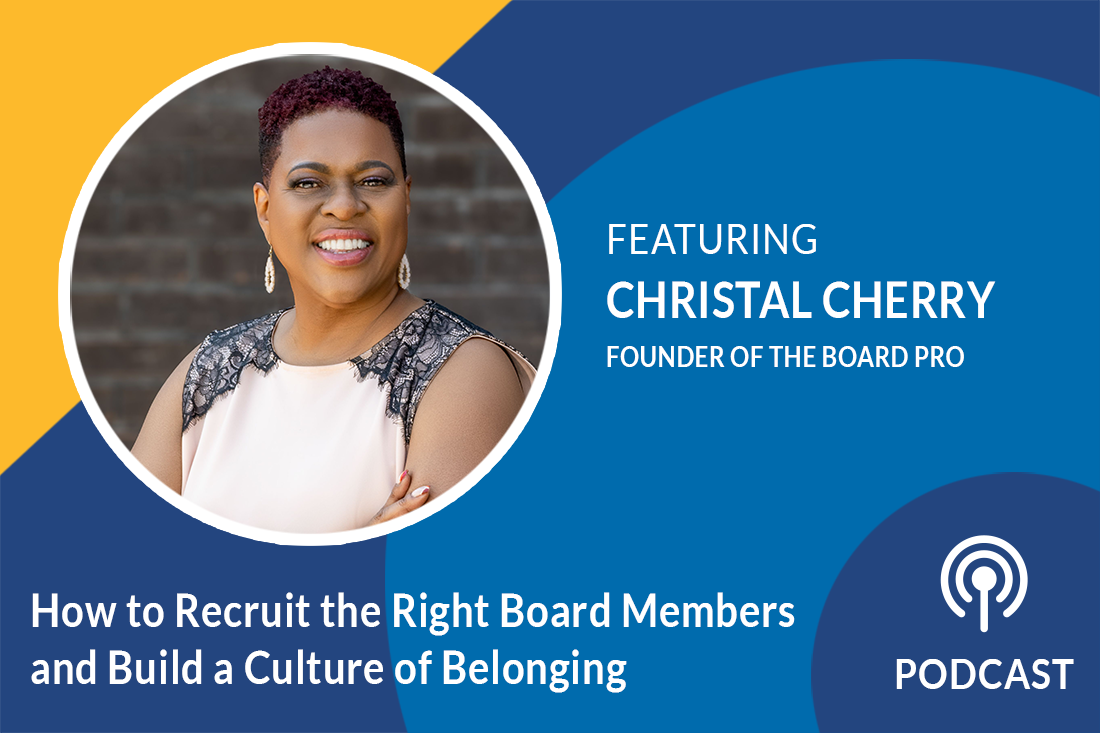
Podcast: How to Recruit the Right Board Members and Build a Culture of Belonging
Season 4, Episode 51
In this episode, Amy Eisenstein is joined by nationally recognized nonprofit consultant Christal Cherry, known to many as “The Board Pro,” to talk about one of the biggest challenges for nonprofit leaders: how to find and keep the right board members.
With more than 20 years of experience in the nonprofit sector, Christal has helped hundreds of organizations rethink board service by focusing on purpose, inclusion, and long-term commitment. In this candid conversation, Christal shares practical, experience-based strategies for board recruitment, onboarding, and engagement that go far beyond the usual advice about fundraising potential or “big pockets.”
Listen Now:
Amy Eisenstein:
If you’ve ever wished you had the right board members around your board table, this episode is for you.
Hi, I’m Amy Eisenstein. And Andrea’s on a break today, but you are in for a very special treat, because I have a very special guest with me to today. Our guest is Christal Cherry, the Board Pro.
Christal is known across the country as the Board Pro, and she is a nationally recognized nonprofit consultant, speaker and author, who has helped hundreds of organizations reimagine board service as a tool for transformation. With over 20 years of experience in the sector, Christal specializes in recruiting purpose-driven board members, building cultures of belonging, and designing onboarding experiences that spark confidence and commitment from day one.
According to board sources leading with intense study, only one in four boards rate themselves as effective in building a diverse and inclusive culture, and many report that board engagement has declined post-pandemic, which is why I am so excited to have Christal here, talking with us today. Hi, Christal.
Christal Cherry:
Hi, Amy, how are you today?
Amy Eisenstein:
I’m good. How are you?
Christal Cherry:
I’m wonderful. Thank you for having me.
Amy Eisenstein:
Absolutely. So, I think every single nonprofit struggles with their board in terms of board recruitment, or participation, or engagement in fundraising, or whatever the case may be. So this is such a timely and important topic, and thank you so much for joining us.
Recruiting the Right Board Members
So, let’s get started with this idea of recruiting the right board members. So, talk to us about what is a right board member, and how should organizations think about recruiting the right board members?
Christal Cherry:
Right. This is so subjective. So, when I’m trying to find the right board members for an organization, the first thing I do, is I sit down with the staff and the board, to find out who they are, what their mission is, who they’re serving, where they’re located, how big they are, how big their budget is, how they are perceived in the community, all of those things.
And we talk about what they’ve been doing, what board they have now, what’s going well, what’s being challenging for them, what kind of board members do they wish they could have… who’s missing. We talk about values, we talk about things that are important to them, we talk about vision, what do you want to see for your organization 1, 3, 5, 10 years out, and who do you want to serve on the board in three to five or seven years, when you may be gone.
Amy Eisenstein:
Oh my gosh, you just said so much. I just need to pause for a second and reflect back on some of those things, because you listed so many good things. I picked up who’s missing from your board. That’s such an interesting concept, and I’m going to take that maybe a step further, what skillsets, what connections, who are you missing?
But I also love the idea, I want to pick up on this idea of looking out three to five years. And I think a lot of boards make the mistake of being so in the moment, today, today, today, butts in seats. We have to be strategic, so I love this idea of who do you want to be on your board in three to five years. So, you’re going to ask them as they’re thinking about these things, a whole series of questions as they figure out who are the right board members for them. What are some of the most frequent things you find, that boards wish they had, or how do you help them recruit the right board members?
Christal Cherry:
Yeah, well, a lot of times board members think, “Well, we need people with big pockets. We need people who have lots of connections.” And that is true, you do need that in a lot of instances, but you need so much more than that.
Amy Eisenstein:
Yes.
Christal Cherry:
You need board members who have… Well, we hope they all have passion, but definitely have passion and compassion, because we know in nonprofit work, the road will bend. A lot of times we’ll have a plan A, a plan B, we’re looking at that strategic plan, and we think we have it all set, and all of a something, something will happen, a pandemic, a national crisis, and all of those things go out the window. And so, you need board members who can be compassionate and flexible, and will ride it out with the CEO, because often the CEO is stressed, and it’s a lot of tension, and he or she really needs the support of a compassionate board, who will say, “We’ll hang in there with you. We know it’s not going the way we had hoped, but we’re going to pivot, and it’s going to be okay.”
So, yes, big pockets, yes, being able to fundraise, you definitely want to have those, but you want to have people from the community that you’re actually serving. You need the voices, because nothing worse than having people who have no idea what their community is going through. They’ve never lived in that community, they’ve never had those challenges, sitting at a table, making decisions about them. And so we definitely want to make sure we have the right people at the table from the community that you’re actually serving.
Amy Eisenstein:
Yeah, so okay, so what’s a good mix? Big pockets, and maybe people from the community that you’re serving. Sometimes those are the same people. Maybe in an arts organization, perhaps, maybe at a hospital board, but at a many community-based organizations or social service organizations, those are not the same people.
Seek the Right Mix of Traits for Board Members
So, what is the right mix? And then I’m going to ask you really strategically and tactically, starting with the big pockets, how do board members find those people? But let’s start with first, what’s the right mix?
Christal Cherry:
Yeah, and so a lot of organizations believe that. I have a client right now where fundraising is not a priority for their board. They are fiscally sound, very strong reserves, and while they will accept donations and want their board members to donate, that is not a big component of their board work. And so, for their board, they’re not really interested in people who are fundraisers. If they come, that’s great, but they’re all interested… I know, that’s weird.
Amy Eisenstein:
Is that the exception.
Christal Cherry:
Yes, yes.
Amy Eisenstein:
That’s the exception, not the rule.
Christal Cherry:
That’s the exception, that’s the exception.
Amy Eisenstein:
Yeah.
Christal Cherry:
But they’re really looking for people with lived experience. They’re really people who understand governance, who understand uncertainty, and being able to pivot, who understand that sometimes we need a plan A, B, C and D.
Amy Eisenstein:
Right, yeah.
Christal Cherry:
Who can get along well with the CEO, who understands that their job is to support the CEO, to be advocates for the organization, to champion the cause, to not only just attend the meetings and approve budgets, but to be out there, rah-rah-ing for this mission, posting and reposting their stories on social media, being a great storyteller, knowing how to use the videos and compelling documents that they give them to tell the story about the organization. They need people with those kind of skill sets.
And I have had board members ask me for everything. I’ve done a matrix for a lot of organizations. The matrix is just a document that helps us fill in all the things that that organization needs, and everyone’s matrix is different. So I’ll have an organization who serves the LGBTQ community, so they want people who with lived experience, or people who have had HIV and AIDS, or family members who have. So that matrix is going to look very different than maybe a faith-based organization, where they want Christians…
Amy Eisenstein:
Right.
Christal Cherry:
… or they want Muslims, or they want people who are agnostic, whatever it is. And so, every organization’s matrix is going to look different. People say:
“I need strategic thinkers, I need visionaries, I need people who take attention to detail, I need people who are social media influences, I need people who are in government.”
And so, whatever the organization needs, we talk through all those things, and then I ask them:
- Why do you need those people?
- Why do you need someone who works in government?
- Why do you need a social media?
Tell me why, what they’re going to bring. Because once I start recruiting people, I have to let them know why I am interested in them. I think you would bring this value to the board, and by bringing you on, this is going to add.
Amy Eisenstein:
Yeah.
Christal Cherry:
So that helps me when I’m recruiting.
Amy Eisenstein:
I love that you said social media. I want to add probably somebody who’s an expert in AI or technology who can bring that to the boardroom, right?
Christal Cherry:
Yes.
Amy Eisenstein:
Because nonprofits are behind in that area, so wouldn’t it be great if every board had a couple of people who really could help them raise their sights or bring them up to date in terms of using AI and technology?
Christal Cherry:
You’re spot on, Amy, absolutely, absolutely.
How to Find Board Members with Certain Skills
Amy Eisenstein:
All right, so let’s go back to this idea for any skill set. Every board probably needs an attorney, or somebody with finance skills, and philanthropists, people who can bring networks and donors. Most organizations do. So where do you start looking for those people? How do you guide organizations to find the people that they need in their matrix?
Christal Cherry:
Absolutely. And so I cast a wide net when I am actually searching for these individuals. I had used, when I’m looking for C-suite level, high philanthropists, I have used prospect research companies to help me find those individuals, people who have high net worth values, they have real estate, they have given to other nonprofits, they’ve given to political organizations. And so, sometimes I seek the assistance of other resources to help me find, particularly for those kinds of individuals.
If you tell me that you are looking for… And I’ve had people say, “We need someone who we know that Delta Airlines, our mission is a priority for them. We need someone from Delta on our board.” And so I’m initially scoping everybody I know from Delta. I might be on LinkedIn, I’m calling friends, I might call the human resources office or the community relations office at Delta in your city, to say:
“Listen, we know this is a priority that your organization really, really embraces, and if you need someone from your company to sit on a nonprofit board, I have this wonderful organization for you.”
So I do a lot of old-fashioned phone calls, emails, LinkedIn. I’m the kind of person that I’m going to find you. And so, I do the research, and it takes time. And often, boards don’t have time. The executive director doesn’t have time to do this work, and so they hire me.
Amy Eisenstein:
Oh, I love that. And it’s really strategic, and thoughtful and intentional, and researched. I love that. I love that. Now, of course you’re leveraging current board networks too, I’m sure on LinkedIn and other things. If somebody’s linked, it’s even better, right?
Christal Cherry:
Amy, I make them take out their phones. We do something called roll and scroll. And I’m not playing with you. We go through your… I say, “Pull up that contact list, so let’s go through your phone.” And I say, “Okay, let’s look at this phone list here and see how many people are in your phone, who maybe don’t even know that you serve on this board.”
So if you were just to ask them now to make a $250 donation to the organization because they love you, or because they want to support you, who would donate? We’ll start rolling and scrolling, and they realize, “Oh my God, my uncle, he’s general counsel for Home Depot, and my cousin, she works at the Woodruff Foundation. Oh, Jesus, I didn’t even remember my best friend’s sister is at Wachovia Bay or Wells Fargo.” And so you start realizing, “Wait.” So I say:
“Okay, guys, let’s start writing those names down. We’re going to give those three or four or five names to the executive director, and we’re going to come up with a plan to steward them.”
Because a lot of times people don’t realize there are people in their sphere of influence that they’ve not thought about, who might be interested in the organization for multiple reasons, because they really could be passionate about it, because they love you and they want to support you, because they’re trying to make a tax donation, because they would love to volunteer. There are lots of reasons why people might want to get involved, and unless you ask them or tell them, they’re not going to know.
Amy Eisenstein:
Yeah, I think that’s great. So, clearly the organizations that are working with you benefit from this really strategic, thoughtful planning and research that you do to recruit board members.
Christal Cherry:
Sure.
If You’re Just Getting Started with Your Board
Amy Eisenstein:
And let’s say a board is just getting started, or not working with you yet, what are one or two things that they can do to start down this path of recruiting great board members, or even identifying them?
Christal Cherry:
Yeah, well, there’s a series of questions I give to them to think about and to consider before they even start looking, like first, why do we need both new board members? Like you said, who is missing? What will these new board members bring?
If you need more women, if you need people of color, if you need people from the LGBTQ, why? Why is having their presence on your board… So you need to know your why. What skillsets are you looking for? How will they add value to what you already have, and who might need to go? Because there’s some board members who are seat warmers, who are not pulling their weight, and quite frankly, they’re dragging the board. And I always tell my clients, “I know he’s a friend of yours.” Or, “I know he’s been on the board for six years, but he’s not pulling his weight, he’s not coming to the meeting, he’s not engaging, he’s not giving, his being on the board does absolutely nothing for you. And if his term is not up, it’s time for you to have that really tough conversation with him.”
And they’ve hired me… Some folks have hired me to actually ask board members to leave because they’re uncomfortable doing it. So I say, all of those questions you need to think about and consider, particularly if you’ve got something big coming up. If you’re about to do a capital campaign, or if you’re about to scale your program, or you’re trying to do a relocate to another area and have it in another state, you need to make sure you have the right people at the table. But why? And we sit down, and we do all of that.
Amy Eisenstein:
And I love that you brought up that it’s just as important to let board members who aren’t effective for you go, as it is to bring new board members on. I absolutely love that.
Building a Culture of Belonging and DEI
All right, so I think that leads us beautifully into a slightly different topic, and that’s about building a culture. You talk about building a culture of belonging and reward. So, how do you think that looks like, or what does that look like to you in boardrooms today? And how can leaders move in that direction?
Christal Cherry:
Yeah, and for every organization, that too will look different, because what belonging is to me, it might be different what belonging is to you. And so I think that’s the question you need to ask your board members. And when I’m actually recruiting the members, and I’m vetting them, or prospective, I asked them that question in the interview process, “What does it feel like to you to belong on a board?” And people will tell you:
“Oh, I feel like I can bring up ideas. I can ask questions that might be silly to others, but I’m not sure. I can ask hard questions, or people won’t be upset with me because I’m challenging them. I feel like I can come to my authentic self, I can wear what I want to wear, my hair is purple, I have a nose ring in my ear, in my nose, I could be who I am and I’m not targeted, and I feel like I belong in this room.”
So for each person, this is different.
And I always tell my clients that before you diversify your board and bring in different faces and different voices, make sure your culture is ready, because you want to diversify because that’s what everyone says you’re supposed to do. “Well, we’re supposed to diversify, we have to have voices from the community.” Okay, are you ready to welcome them? And that might mean changing some things. So if you’re going to bring in some single moms, is that 7:30 in the morning meeting going to work now? Because these moms are getting their kids ready for school. If you’re going to bring in individuals who are maybe a little lower income, they may or may not have a car, so that meeting in the suburbs is not going to work if there’s no public transportation.
And so there’s just some things you have to think about in terms of how you’ve been operating, if you’re going to bring in individuals who are different than what you’ve had, everyone is not Kevin from the same zip code. That’s the problem, we keep bringing in more Kevins, and thinking things are going to change. But if you’re going to start bringing an Angie and a Tony, your culture is going to need to change, and you need to do that work beforehand. And when I say do that work, I mean do your work in terms of any biases that you might have about these individuals who might be different.
If you have an Indian woman who has Indian garb, with a red dot on her forehead, you need to do that work before you bring her in. Don’t be looking at her side eye, making her feel uncomfortable about asking her a lot of questions. You have to do that work about your own biases about people before you start bringing them in. So, there’s a whole training on that as well for me, in terms of being open and understanding your own race story, and what that means for you, and how you’ve related that to other people, so…
Amy Eisenstein:
Yeah, great. Okay. Anything else in terms of specific things that organizations… I mean, scheduling a culturally sensitive training, to me, is that it’s not a one and done, of course.
Investing in Cultural Sensitivity
So talk about what… it’s one thing for a big organization to invest in that kind of work and that kind of training. What might that look like for a smaller or community-based organization, that is struggling just to pay the bills?
Christal Cherry:
Yeah, yeah, yeah. There’s some small things you can do. You can create a DEI calendar so that you’re aware of some of the holidays that maybe some other folks who celebrate, that you’re not your traditional Christmas, July 4th and Easter, but Diwali, some of the Jewish holidays, national Black Philanthropy Month, LGBTQ, whatever it is, so that you might know that some of your board members might not be able to participate or attend an event during those days. Don’t plan something big on a holiday that one of their board members may be celebrating. So small things like that.
Having a social and asking folks from different backgrounds to bring different dishes in, just so that they can get to know one another. I have a little thing that I created, called Board Bingo, where people play bingo and they learn a little bit about each other, just by putting their little thing, their little pin on the box. “Oh, we both speak Spanish? Oh my God, I didn’t know you speak Spanish.” “Oh, you went to France? I went to France.” “My son was in the military too.” You just start learning about people.
So, I think with the smaller boards, you have an opportunity to really get to know the people who are sitting next to you at the table, understand their backgrounds, understand what they might think. You might have someone who, from an Asian culture, who doesn’t speak a lot, and it doesn’t mean that… He might need a little bit more prodding to participate. It doesn’t mean he’s not interested or not engaged, he just, that’s not how his culture taught him.
And so you just have to have an understanding of how people come to your table, respect that, and understand that, and let them contribute the way that they could best contribute, with a little prodding if you need to pull them out a little bit.
Amy Eisenstein:
I love that.
Christal Cherry:
And that’s the job of the board chair to do that, to make sure if there’s a board member that’s not participating, just say, “Juan, how did that land for you? I haven’t heard from you today. Did you want to share maybe what you thought about that?”
Amy Eisenstein:
Yes, yes, letting people know that you’re going to be inviting everybody to contribute. I love the idea. First of all, I love the idea of a potluck. I’m always interested in tasting other people’s foods and tasting a little bit of different cultures. So, an annual potluck party, bring something that represents you, yes. I love the idea, at every board meeting, of a little get to know you something, because I’ve been in too many board meetings where you dive right into business, you have no idea who else is in the room, you don’t know what’s going on in their life, you don’t know anything about them, and you’re expected to work well with people that you have no context for.
Christal Cherry:
Sure.
Amy Eisenstein:
So, taking the first 15 minutes of a board meeting to check in with people, to learn about them, I think is time well spent, because it will probably make for more effective committee work and other board work down the road.
Christal Cherry:
Yeah. So I recently… I’m on a board, and we actually participated in a walk, as a board, for another organization. And so we wore our T-shirts that said board members of our organization. And during the walk, the woman who I was walking with, I learned that early on… She’s not doing this anymore, but early on, she was in the military, she was a police officer, she’s now getting her PhD, she leads a soccer league, a soccer team or something. I was just like, “Oh my God, I had no idea any of these things about this woman.” Just by talking and having a chance to get to know her.
Building Trust with One Another
So now when we get back to the boardroom, we’ve built some trust with one another, and I know a little bit about her background, which I think she’s very courageous, and I don’t think we’re tapping her skillsets nearly enough. And so those are the kinds of things that you learn when you get an opportunity to just get to know people and let them come exactly as they are.
Amy Eisenstein:
Yes, trusting your fellow board members is such an important part of the process, because when you get into sticky or difficult conversations, if you have that grounds for trust, that will be much more effective in terms of a jumping off point of having difficult conversations.
Christal Cherry:
Exactly, exactly.
The Process of Onboarding Board Members
Amy Eisenstein:
All right, let’s talk about onboarding board members. So, I’m curious how you think about onboarding, and what are some creative ways to turn it into an ongoing process? It’s not a one and done, right?
Christal Cherry:
Yeah, yeah, and how you bring them in really matters. And so I always tell my board, “Make a big deal out of it.” Let everybody know that you have these new board members coming in. Create an announcement, put it on your website, put it on social, let people know, :Hooray, we added these new board members. We’re so excited.” Let the world know, let your staff know, show pictures so people can see them.
And then, when you have your onboarding session, of course, make that warm and welcoming. If you could have some kind of treats there, that would be great, some kind of beverages or snacks. Make sure there are name cards so that everybody can see who that person is. Invite the person to speak up and introduce themselves, tell a little bit about their personal lives, what they like, “I’m married, I have two kids, I love to walk my dog.” Whatever. So people could just get an idea of who you are.
And then of course you’re going to have the CEO there to welcome them, and maybe some of the executive team. There’d be great if you had a video, a mission moment video, to share a little bit about why everyone is there to champion the work.
And then you want to let them know some things that are going on. I have a board toolkit, and so I always tell them, “Put the minutes from the last two meetings in that toolkit so they could see what you discussed before they got there. Put that board directory in there. Make sure those bylaws are in there, in case they have insomnia one night and they need to get back to sleep.” Those bylaws will do that, right?
Amy Eisenstein:
Yes.
Christal Cherry:
Any newsletters or anything that will bring them up to speed about what the organization has been doing, and then get them engaged right away. We have four committees. Right there at the onboarding session, “We have a fundraising committee, a governance committee, a finance. Is anybody interested in serving on any of these committees? Because we’d like to add you today, before you even leave. And then we had the two great events coming up at the end of the month. We want to make sure that’s on your calendar. And by the way, let me give you the dates of all the board meetings for the year on your calendar, so don’t say that you’ll have that.”
So you’re setting them up for success, and you’re [inaudible 00:23:42] know, “We want you to get engaged right away. You’re welcome here. Everyone is very warm and welcoming.” And you make them feel… If you have some swag, if you have a hat, or a T-shirt, or a sticker or something to give to them, but make them feel warm and welcome from the very beginning.
And then, if you can match them up with somebody who’s a little bit more seasoned, that’s been on the board for three or four years, give them a board buddy or a board partner that they can call and say, “Hey, listen, did you get the mini minutes from the last one? I can’t find them. Can you send it to me?” Or, “Do you need a lift to the board meeting? I’m happy to share a ride with you.” Whatever, just get someone that they could feel… Because it’s weird and awkward coming into a board meeting the very first time. You don’t know anyone, it feels weird, but to have a buddy is great.
And then, the first few… I think every meeting should have a board bite. This is something I’ve created, where you add just a bite of every board meeting about something related to boards, whether it’s fundraising, whether it’s engagement, whether it’s Robert’s Rules of… Whatever it is, just a five-minute on every agenda, to keep the board engaged about participation, building culture, whatever it is, so that you’re getting training all throughout. You don’t have to wait till to retreat, you don’t have to wait to the big board meeting. Every month, you’re getting a little training on board governance, so…
Amy Eisenstein:
I love that. I’m even going to take it a step further and say, and there should be a 15-minute fundraising discussion, not just a reading of the report of how much did we raise and what did the staff do, but sort of a mini training or discussion on what should we be doing to identify donors? How can we thank our donors more effectively? What do we know about bequests and plan gifts? So having a discussion, a little 15-minute fundraising discussion at every single board meeting.
Christal Cherry:
I love that.
Amy Eisenstein:
You’re right, you don’t need to wait for the retreat. In fact, you shouldn’t, you can’t, you have to do it all the time. It’s got to become part of the culture of your organization.
All right, so in a minute, I’m going to invite you to share a resource and maybe one or two more key takeaways that you want to leave listeners with.
I want to direct people to the Capital Campaign Pro website and our resources tab, because we have a board member’s guide for capital campaigns, and it’s an amazing free resource that you can download if you’re thinking about going into a campaign. If you’re ready to go into a campaign, or maybe you’ve gone into a campaign, but you need more support, this board member’s guide to capital campaigns is truly comprehensive. It’s at capitalcampaignpro.com/resources, and you can find it and download it for free there.
So, Christal, what’s a resource, or where can people go to find out more about you or learn about your services?
Christal Cherry:
Yes, absolutely. I’m going to refer people to my website, which is www.theboardpro.com, where you’ll find lots of resources. All my blogs are there. There’s some freebies in my store, there’s some things you can purchase in my store. And if you google me, there are a million podcasts that I’ve spoken on. So, yes, that is the best way. To find me on LinkedIn, Christal Cherry, and we can certainly connect all of those ways.
Key Takeaways
Amy Eisenstein:
Wonderful. Okay, so let’s get some key takeaways. What are the most important next steps for organizations that are looking to improve their board? You can repeat what you’ve already said, you can offer something new. What are the next things that listeners can do to help improve their board?
Christal Cherry:
Sure. First, understand who are the right people to serve on your board? Who are the right people to support your executive director? Who are the right people to champion your mission? And then once you find that out, then find them, go about finding them. And that may mean letting some folks go. You got to have to clean the room, and to get it right. So, find the right people to serve on your board, onboard them properly and appropriately and warmly, be clear about your culture, making sure that you’re ready to welcome them.
And then, once they come on, give them things to do in between board meetings, not just come and approve budgets and reports, but keep them engaged in between board meetings. Invite them to events, invite them to serve on the Giving Tuesday Committee, invite them to look at your giving policies. Or there are many things that fundraisers need. Often we’re under-resourced, that the board can support. They can come on visit with you to see our funder, they can come down to the after-school program and read to the kids.
There are lots of things that boards can do in between board meetings to keep them engaged, because if you meet quarterly, you got three or four months where there may not be anything going on, but if you let them know this is what’s happening, pull them into the life of the organization, keep them engaged, and they will be loyal, and they will participate, and they will support you.
How Often Should Your Board Meet?
Amy Eisenstein:
All right, so I have to ask, are quarterly meetings enough?
Christal Cherry:
I think it depends on the organization.
Amy Eisenstein:
Okay.
Christal Cherry:
Some of the smaller grassroots organizations, who are just getting started, they might need to meet more often, but for those who have a little bit more infrastructure in place may not need as much hand-holding. A lot of folks are moving from monthly to quarterly, or even bimonthly.
Amy Eisenstein:
Okay. Okay, but maybe committees meet in between board meetings.
Christal Cherry:
Oh, yes. Yeah, absolutely.
Amy Eisenstein:
There’s committee work.
Christal Cherry:
Yes, committee work, for sure. Yes, absolutely.
Amy Eisenstein:
Christal, thank you so much for being here and for sharing your wisdom. I think this is a topic that is on everybody’s mind, and a constant, ongoing thing at most every nonprofit. So, thank you for sharing.
Christal Cherry:
Thank you, Amy.
Amy Eisenstein:
Thanks for being here. And we’ll see you next time.


Leave a Comment