
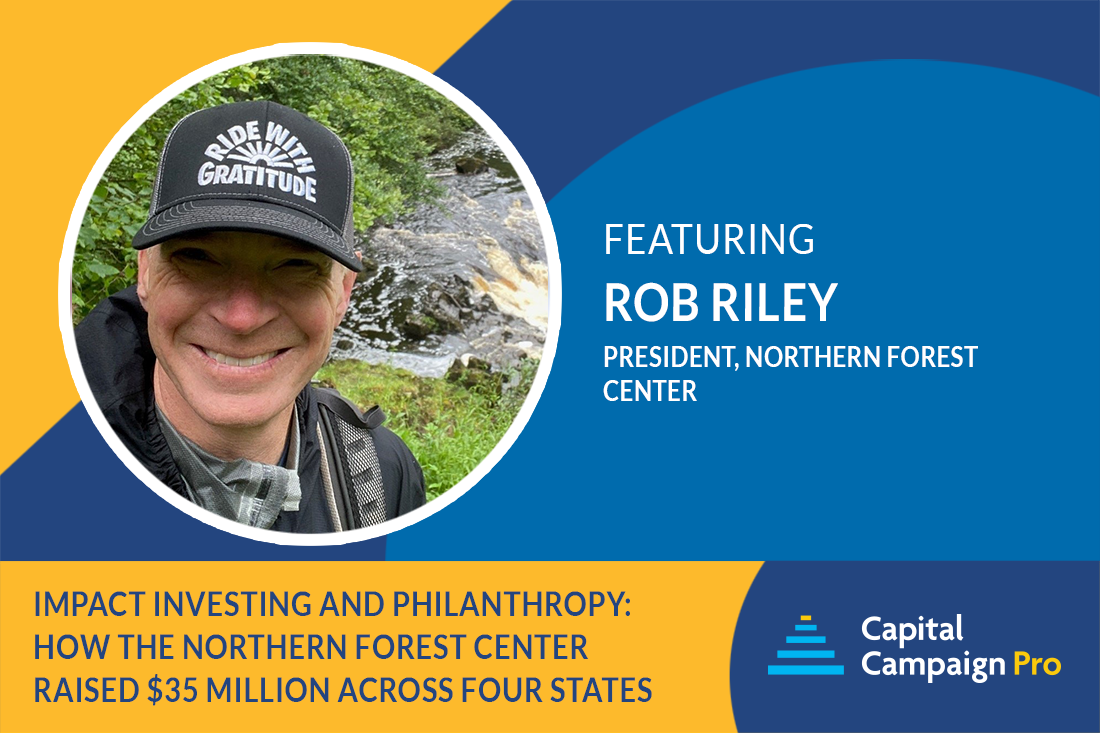
Podcast: Impact Investing and Philanthropy: How the Northern Forest Center Raised $35 Million Across Four States
Season 5, Episode 4
In this episode, Andrea Kihlstedt talks with Rob Riley, President of the Northern Forest Center, about how his organization raised $35 million through a unique blend of philanthropy and impact investing.
Rob also highlights the role of volunteer leadership, the lessons learned from structuring matches and incentives, and the importance of celebrating success to keep momentum alive. From board development to donor cultivation, this conversation offers insights into what it takes to raise transformational capital for large-scale, place-based initiatives.
Listen Now:
Andrea Kihlstedt:
30 million acres of forest across four states. Can you imagine running a nonprofit organization that raises money for that? Well, that’s what we’re talking about today.
I’m Andrea Kihlstedt, Co-Founder of Capital Campaign Pro. My wonderful partner, Amy Eisenstein, is not with me today. But Rob Riley, who is the President of the Northern Forest Center, is with me. And he’s the guy who runs this remarkable organization that touches lives across four states, and protects this remarkable or helps improve this remarkable forest that I think is the biggest continuous forest, what’s the word, in the United States; is that true? Hi, Rob.
Rob Riley:
Hey, Andrea. Thanks so much for having me today. It’s just great to be hearing the conversation with you. The largest continuous forest east of the Mississippi is how we like to talk about it. Our Western counterparts might take issue with us being the largest forest in the nation, so we’ll limit ourselves to the East Coast.
Andrea Kihlstedt:
Right. That’s great. Well, I tell you my background with Rob is that something like, I don’t know, eight or nine years ago I had a conversation with Rob. Then Capital Campaign Pro was just getting going. We were young in our lives. And Rob and one of his teammates got in touch with me and said:
“Listen, we’re thinking about doing a capital campaign, but we’re looking for a consulting firm that knows something about impact investing.”
I scratched my head. I said, “Impact investing? What do I know about impact investing?” Not much.
Well, turned out that Rob figured that there really… he found out that there really weren’t very many capital campaign firms that knew about impact investing. So, he would have to figure that part of his plan out if we could help him figure out the capital campaign. So, we did end up working together. And he has been vastly successful, which is why he’s here to tell you today about his campaign, which was both impact investing and philanthropy.
About the Northern Forest Center
Tell us a little of background about the Northern Forest Center. Just get us started.
Rob Riley:
Great. The Northern Forest Center, we’re about 25 years old. Actually, someone just told me the other day that we’re close to our 30th anniversary. So, time flies here. As an organization, really spanning, as you said, four states in Northern New England and Upstate New York, the Maine, New Hampshire, Vermont and New York. And our inception was really focused on this incredible ecological and economic region of the country, where the decline of what was open paper as a natural resource economy here, started to flag in the mid to late ’80s into the ’90s and continues today, but at a much lower predominance in the region than it was. But as natural resource economies go, they have ups and downs.
And we were on a prolonged down period. And while we have this incredible land base of this forest and the headwaters of countless rivers, and within a day’s drive of 100 million people, we still had a number of communities whose fortunes went with the downturn of the forest economy.
So, 30 years ago, my predecessor and a number of others got together and say:
“We really need to be thinking regionally and at some level of scale around how we come to rural community economic development in a forested landscape with a deep conservation effort.”
And so, that three-legged stool is really the strategy, the inception of this different way of thinking about the future of communities that were once future-dependent and now are more future of forests located. And we’re really trying to, in those cases, reconnect people and place through the programs that we do.
Andrea Kihlstedt:
Yeah. It’s such an interesting idea and such a complicated idea from a fundraising point of view. One of the things that I’ve learned about fundraising over these many years is that fundraising is often tied to narrow geographies. But money doesn’t like to flow across rivers or across state lines, or from community to community, that people tend to be fairly narrow in where they let their money go.
Rob Riley:
And this is New England, too. So, you’ve doubled down on that notion of, to use a negative term, parochialism or if you’d say the love of local places, because that’s a more positive way to look at it.
Andrea Kihlstedt:
Yeah. So, here you are dealing in four states across a great many communities. How many communities are in the region that you serve?
Rob Riley:
Beyond that I could count, so just leave it there. A lot. But very, very small.
Andrea Kihlstedt:
A lot.
Rob Riley:
Just to paint a picture, I think the largest community that we work in is maybe just over 5,000 people. So, when we’re talking rural, when people say, “My small town of 50,000 people is a rural town,” I said, “Well, I’ve got rural that’s more rural than that.” But those small towns are the… We’re at one point twice the size when they were going concerns within manufacturing for pulp paper, wood products, others. So, there’s been a decline there.
Coming At It From a Regional Playing Field
But getting back to your point of how people have given from a philanthropic sense, the notion of the Northern Forest did capture people’s attention. So, coming at a regional playing field, if you will, did appeal to certain people. But yes, that complication of people like to give to my state, my county, my community, is only exacerbated when you bring public funds into the conversation particularly. And our great friends at the community foundations, state-based community foundations like to stay within their states.
What we do know in a small, you say 30 million, but still a small acreage region, commerce, people, in particular, the trees don’t know these state boundaries. So, it’s a very fluid region of people living in one state, working in another, commerce flowing back and forth on a daily basis, and even goes to our friends to north in Canada and back. So, we really did have to set out a different value proposition of how we were working at multiple levels. And that was what set up our campaign conversation with you, is how do we work on a four state region holding this spine, if you will? We’re the constellation of communities together across four very different communities in moreover different states.
If you take New York State and New Hampshire, the only thing that’s similar is the new part of it. They have very different ways in which they operate size of government. But really, when you get down to the base level, the challenge is at the community level we’re the same. And that’s why we have this opportunity to work at scale. But we just had to present it at that regional level, the state level, the community level, but really knit it together as a constellation that made sense for people. And I think we’ve been successful at doing that.
Andrea Kihlstedt:
Yeah. It’s remarkable. Remind me, Rob, if you can remember what your campaign goal was when you first began this work.
Rob Riley:
With your help, with Xan’s help, your a great colleague, we did our self-driven feasibility study. And we thought we were going to do a 30 million campaign. Well, the feasibility came back at, I think it was 20. And that’s where we set our sights. And as you mentioned in your opener, about half of that was the debt portion of the impact investment and about half of that was philanthropic. And the different uses are these:
One was the investment was really to look at property redevelopment, because one of our suite of projects is community revitalization. And looking at middle market housing was a real gap in our communities, to spark investment in downtown, provide housing for the teachers, the healthcare workers, the hospitality workers, the entrepreneur. We needed investment capital to provide housing and redevelop properties as a developer ourselves.
On the philanthropic side, we also wanted to build our capacity as an organization, really to be local. As a regional organization, this may sound ironic or what have you. But as a regional organization, we also needed to be local. If we’re doing local investments, we had to have a staffing structure that reflected that.
So, a number of that philanthropic dollars gave us what we called basically a 10-year on-ramp that our other fundraising activities could ultimately replace once we prove to the broader philanthropic and otherwise, can create our own earned income components, that we could make the case for supporting that capacity. That was supporting a number of different community-based program initiatives and not just the real estate. But those two needed to marry and work. From just sources and uses of what type of activities we wanted to do with the money back us into where we wanted to secure it from.
On Giving Philanthropically and Making Investments
Andrea Kihlstedt:
Right. So, how often did the same person give to you or the same source give to you philanthropically and make an investment?
Rob Riley:
Oh, great question. You’re testing my memory here, which goes back. But I think that we found probably 75% of our… Do I get this right? 75% of our donors were also investors. We also found that I think we ended up having 100% of our investors become donors. But that wasn’t always the ask, the outset of the conversation. Having that, that’s diverse, probably still only two options, but that much more diverse engagement opportunity was a different way for us as an organization to engage with philanthropically minded individuals, institutions and businesses.
Andrea Kihlstedt:
Yeah. I mean that model is so interesting. And let me just explain a little more to our listeners, that if you are getting someone to invest in a project, you need to have a way to pay them back, to pay them interest on their investment. That’s what an investment is. So, you can’t just get money from them for something that you’re going to spend, which is why Rob’s organization uses the real estate market, uses real estate as the base for impact investing. Because you can invest in real estate, then the real estate is leased or rented, the apartments are rented. And out of that rental income, you pay your donors back, just like you would a bank in principle.
Rob Riley:
Exactly. I might go down a slight complicated path here of each real estate project really cannot be done on investment capital alone. That is why the process that we have taken are not being touched by other developers, because they don’t make financial sense.
So, as a nonprofit with lower cost capital coming through our debt instrument, and then with our talent of being able to layer other capital sources in, we end up with a “capital stack” each of our projects that limits the amount of debt on those projects that they then can cash for themselves. So, in other words, we bring a lot of equity into projects that just stay there.
So, we’re still doing many campaigns on these properties, but we’ve got a source of self-financing through our Northern Forest Fund, that in aggregate is much larger than each individual project would attract in debt capital unto itself. So, we are an aggregator of capital and then dispense it out through… And currently, we have, if my number’s right, eight different active real estate redevelopment projects currently right now. Whereas, when we first started, we did one at a time.
A Fascinating Campaign Model
Andrea Kihlstedt:
I mean, it’s such a fascinating model. Complicated, not for someone who is of a faint of heart in terms of complexity, right?
Rob Riley:
Yeah. And I think that at the outset of this, I remember some of the stepping stones to our first board meeting around our first million dollar find up in Millinocket, Maine. Very much in really the dead middle of Maine. And I said, how hard can this be? We’ll raise the million dollars. We’ll buy some properties, we’ll redevelop it, we’ll rent it out. And after a period of time, we’ll then sell it, we’ll get our capital back and we’ll repay our investors. And of course, on paper it’s very linear and all that sort of stuff is very helpful. And in the middle of that, COVID hit. And in the middle of that, all these other different winds moved about. The real estate world was turned upside down. And if we stayed sure to our principles of our do not exceed debt number using the different capitals we could bring in, we were successful on day one with making sure that these properties really performed financially.
They also needed to perform with the community and they needed to perform from a mission perpetuity perspective. Those three elements are ones that we are always thinking about at the beginning, middle, and particularly at the exit of our ownership of real estate. And that’s the one piece that is just so critical, is that we do have to sell the asset to get our principle back to repay the investors. The rents in which we are charging are middle market rents, but affordable within the area median income and some of the measures that we have. But those really are to carry that debt cost, as you said. You have to pay an interest rate, but we do an interest only and then we have a balloon payment at maturity. And what we found is that so far I think we’re up to 80% of those who have invested in what we call our legacy funds. Have rolled over, I should use a different term.
They said we have paid them back and they had chosen to reinvest in our new fund. We just call it a rollover, because their money doesn’t leave the building, if you will. So, that’s a pretty good way in which we’ve applied our philanthropic cultivation stewardship activities to the investor. And that’s a great way for us to keep that capital in circulation in the community.
So, your point at the very beginning of this, that bringing a capital campaign mindset to this. Structure, discipline, and the staffing, and stewardship, and communication has allowed us to make this system work, because those investors are doing this for philanthropic reasons, not for financial return reasons. So, they need to be treated in the same way that a donor would. But as I shared, they’re donors, too.
Andrea Kihlstedt:
Right. Right. And I guess it doesn’t surprise me, but it delights me, is the right word, that all of your investors have become donors. And it’s not surprising. They become involved, they become aware of how it works. They know, they understand your organization better. It makes perfectly good sense that they would want to make a philanthropic contribution.
Rob Riley:
And some of that comes in the form of them donating interest, which to us is great.
Andrea Kihlstedt:
Interesting.
Rob Riley:
If we have a zero cost of funds, that’s wonderful. That’s a form of a donation. And I would say that we have had those people who are looking for a higher rate of return. This is not the product for them. That would also probably in my mind mean that they’re less philanthropically inclined because of certain financial constraints or just their decisions that they have around funds.
So, there is a self-selection into the type of offering that we have with our fund.
Andrea Kihlstedt:
Right.
The Regionality of Investors
I would imagine that most of your investors and donors come from the regions that you serve; is that true?
Rob Riley:
I would have to go back and look at that, but I would say that probably vastly more than half come from outside the region, but they have an interest in the region. I mean, remember that we’re coming from a region that does have pockets of wealth, but that’s not where we’re operating. We’re operating in places that are either struggling to get ahead or are in that middling track of looking at what’s their next chapter. There is wealth, but there isn’t abundance of wealth. And it is necessary to bring in different forms of capital. But as you probably know for the different areas you work, people have an incredible relationship to place, whether it be a second home, going to camp as a child, a college experience, whatever it might be.
Personal experiences create a relationship with place. And whether institutions are place-based or people within them are, this does come down to people knowing what we’re doing and knowing the place. And that is a helpful thing. So, I think like east to west, we have these state borders. We also have these artificial notions of what the Northern Forest region is, which cuts straight through a lot of these states. The states are fluid. And it’s important to know people do have a relationship from south to north or from east to west through this region. And that’s a great, great group of people that we’ve been able to access and have an affinity towards. The Coast of Maine, as well as the Mountains of Adirondack.
A Closer Look at the Board
Andrea Kihlstedt:
Yeah. Rob, there are a couple of other big things I wanted to ask you about. One is, how have you put together a board for this sprawling organization? What does your board look like? Where do they live? Where are they from? Do you have different boards in different regions? Is it one board? What does that look like?
Rob Riley:
Yeah. I would say maybe everyone you interview says this, but I have the best board. And I will be willing to spare someone down on the street for that. We have assembled people who are from small towns within the Northern Forest. Some who academically look at conservation across the nation and the globe a an interest area. So, we’ve looked at this sort of matrix, as they all do. And I hate to use that word. But how do we have geographic representation from our four states?
Massachusetts, which sits just below, has a great influence in this region, from commerce to people, to second homeowners, to intellectual capital, to real capital, as well as those from Connecticut and New York State. So, I look for folks who have an abundance of curiosity. Let’s start with that. Let’s start by asking questions. The ethos of our organization is we don’t know everything. We have maybe some ideas. But if we’re driven by resolving community problems, then we better ask the right questions and listen fully to what those are.
So, inquiry and curiosity, different expertise is obviously helpful if people have that skill. But there is just that reflection of personal experience, lived experience. And I would also say that I’d go for a healthy dose of business experience, people who have run their own businesses, understand risk tolerance, understand risk mitigation, understand the need to test things as you’re going with an unproven model, and be a incredible learning organization. So, I could go on and on. But I think that the point is that the board reflects the region as best as we can and it doesn’t exclude everybody. So, from there we have other advisory groups. And I want to say just drop down to its most immediate local level.
And in those communities where we are making capital investments in real estate, we have local advisory groups that are somewhat different from, but may have some overlaps to our board. So, we are trying to recognize that, as I mentioned before, that different strata. We need to work regionally, but we also need to be relevant locally. That also is reflected in our inputs as we bring information and conversations in the board level about decision-making priorities and budgets.
Andrea Kihlstedt:
Right. Yeah, it’s fascinating.
Reaching Beyond the Campaign Goal
Rob, I believe that in your first campaign you raised more money than you had anticipated. I mean, Xan came in and said that she thought you could raise about 20 million. And what did you end up raising in that campaign?
Rob Riley:
Just about 30 million.
Andrea Kihlstedt:
Right. Where you started and then you upped it, right?
Rob Riley:
Yeah. Well, that’s right. And I say that casually now in the rear-view mirror, but every dollar we sweated for, for sure. But as I mentioned that early feasibility study, which again, I know that’s not the purpose of this podcast, but I’ll get hats off to you and your team for helping us. And I think we knew, even when you said you didn’t know anything about impact investment, we knew we wanted to go through that self-facilitated approach, be closer to our donors, learn more about that. Introduce them to this compact or this concept of impact investing. Hear real-time what their cause is, what their celebrations, what their interests, non-interest might’ve been.
But through that, we did come out with 20 million. And we’ve set ourselves a date that says if we can raise 15 by this certain milestone, we’ll go back to the board and we’ll tell them we’re so confident, why don’t we raise it back to our original conceptual level of 30 million? And we did that. And we reached that $15 million goal, and we raised the level, and then we hit the fundraising doldrums. Which were, what, January through October. And we said, oh, my God, we made a huge mistake. What are we going to do? Our reports to our campaign committee and our board are just stagnant, stagnant, stagnant. And then we hit our stride again. So, that was the cyclical nature, timing of where we were in our phasing.
Point being is we also brought on tangible projects. The outset, we were talking conceptually about help us invest in rural places. Then we were able to say, help us invest in rural places and these buildings in this community. And to your point earlier about how people like to live and the give locally, that was a real door opener for people to say:
“Aha, I understand this big vast region in these conceptual dots on the map of your 10 focal communities, but I see the project in my town that I want to support.”
And that did allow us to increase our goal, exceed our goal. And I would say that a little twist in there was that we didn’t realize that we would have to run mini campaigns on every building.
So, not only did our goal increase, but we needed to increase beyond that, too. And we’re still working on some mini campaigns on these programs. But to wrap up and claim success at $35 million after… And I think that you were generous enough to take us on as a client, because what was the disclaimers, is we’ve never done this before? So, maybe that’s how you take a leap. And neither of us had done this type of thing before. Let’s give it a shot. And we jumped.
So, it was successful. It was a three-year process. And I think that probably is pretty normal or something of this nature. So, it was a long, long, long journey, but really set us up for a different way of operating.
An Increase in Fundraising Staff
Andrea Kihlstedt:
Yeah. And I think during that time you increased your fundraising staff as well; is that true?
Rob Riley:
Yes. Yes. And that was something you warned us about too. You said if you don’t do this on an external consultant, you will need to look at your internal capacity. And I’m thinking that we were one and a half FTEs maybe on our fundraising staff. No, maybe we’re two. I think now we’re five. That’s going from an annual budget of, rough numbers, $2 million to now I think we’re at $9 million.
Our asset based from, again, roughly two to 37, 38 million. That investor capital, now going on 20 million aggregated over a number of funds, has its own care and feeding and requires that support system. So, the fundraising team has more than doubled. And that was a good problem that we needed to address is because we had more people interested in supporting.
Andrea Kihlstedt:
Yeah. I mean, I know in the beginning you had your feet pretty well dug in that you didn’t want to have a big fundraising team. That wasn’t where you wanted to be and that works for you. It did. You did it.
Rob Riley:
Through. You’re remembering correctly. And I am very cautious at adding every staff. And others have been helpful to bring me along about how things are necessary for us institutionally. But also, as I’ve been the primary fundraiser along the continuum, you can’t do all the things you want to do well across a region this scale with that many folks. So, it’s been really helpful to have great partners on our fundraising team. We’ve had a few come and go during the time of the campaign that have set us up at different foundational levels to grow from.
But yes, the need to sustain that core fundraising capacity, this is all relationship-based work. Whether we’re developing projects in communities or whether we’re really ensuring that the people have trust and faith in us to steward their capital, whether it be investor or philanthropic, it’s so critical to have a good team to do that.
Andrea Kihlstedt:
Yeah. And one person doesn’t have unlimited capacity to do that. There is a certain number of people that you can build a relationship with after which you don’t have time, energy, capacity to do that.
Rob Riley:
Right. And I recognize I’m not the right fit for everyone, too. And I think that’s one of the blind spots that maybe some of us have, is that everybody should like me because a bunch of people like me. And finding the people that amongst our team are the right fit is really critical.
And I’m so pleased that we have a diversity of people in our fundraising team that can sit down knee to knee with people that might find me just way too overwhelming in my energy level. So, it’s good to have that diversity of folks that can meet people where they are.
Andrea Kihlstedt:
Yeah. It’s surprising, isn’t it? I mean, sometimes I’m still surprised that I’m not the right person for everybody.
Rob Riley:
I’m working on some deep self-awareness here, Andrea.
Andrea Kihlstedt:
So, it’s a great learning as one gets older.
Rob Riley:
Yeah, exactly.
Key Lessons Throughout the Impact Investing Campaign
Andrea Kihlstedt:
Listen, I want to end by asking you to come up with two or three things that you learned through this campaign that you think might be helpful to others. But I don’t want to leave without asking this question. If someone who’s listening to this is really intrigued by this impact investing idea, where might they look to get additional information?
Rob Riley:
What a great question. And I have to say, I mean Googling impact investing is one place to start. But I have really found that there’s lots of cul-de-sacs in the impact investing space, whether it be how impact investment funds are packaged, how they’re delivered, who the beneficiaries are, how to set one up. So, there’s lots of tools out there.
But I think that for people who hear about impact investing in their geography, I would just encourage them to reach out to the people who are administering and developing those programs to see what’s going well, what isn’t. Because early on, we did talk to a bunch of people who talked great from a theoretical perspective, which was slightly helpful. But it wasn’t as helpful as it was to get down into the mechanics of, okay, now we have this paperwork, is this the right paperwork?
Oh, actually, I will say that the Transformative 25, I’m glad I mentioned that. Dennis Stoney is the contact person. And she has done a great work in pulling together communities of place-based impact investment funds. She has provided us space on webinars. She’s provided a platform to really promote this new way of investing in places. And I think that’s the differentiation here. Mission place-based impact investing, if we want to add more modifiers to this. But that’s a great resource.
So, Googling Transformative 25 would give people a sampling of impact investments like ours across the country that they can probably start doing some research on.
Andrea Kihlstedt:
And that’s Transformative 25?
Rob Riley:
Correct. And there might be some other way that they’re positioned, but I know that we’ve put it on some of our material that say we are a proud stamp of approval affiliated something of the Transformative 25.
Philanthropy-Related Lessons Learned
Andrea Kihlstedt:
Excellent. Thank you. Now, what are the couple or three lessons that you’ve learned from your campaign, particularly relating to philanthropy, because that’s where most of our listeners are, that you would pass on to them?
Rob Riley:
Great question. I can’t only talk about philanthropy as you know, because of the investment space. But I would just say I think that, as I said before, I do believe that the ability to sit down through the feasibility study and have that candid conversation is just transformative to the relationship. So, maybe that’s at point five, because that is already a give me.
I think the piece that we’ve learned… and I don’t know if we did it terribly well — volunteer engagement. We really struggled with how we engaged the board. Because we were such, I think a pretty core competent and growing fundraising team, we struggled with ensuring that volunteers had the right information to introduce and convey to folks. And I think we could’ve done a little bit better job there, just in terms of the deployment of people. And people who said, “I want to help them.” We said, “We don’t know how you can help us.”
So, I think that digging in there really more with your team, with others to identify how we can maximize those volunteers. And at the same time, we had some excellent ones. And their lead and my coming in at the end was just the classic way to set these things up, was just really important. I think the other from a philanthropic perspective was ensuring that we had an appropriate case statement for how a gift in our capacity was actually going to have demonstrable returns in community. And as you said, we’re complicated. So, really crystallizing that position statement, that case statement. I’d say we agonized and that was again part of our engagement in that early conversation with our feasibility study with those donors. But having that message was just so critical.
And the third one that I think I would say was a learning, is we were not able to access the match opportunity. Here’s a donor who’s put up, X, come and meet that X. I don’t know whether that was me that was an impediment to that or if it was we didn’t know really how to set the right donor to provide the match. But I would say that there’s some learnings that we’re taking away for our next one in both the leadership and the match, as to how might we think about that.
Last thing, you’ve only asked for three, but I’m going to add the fourth one because this one is so critical to my team. If I didn’t mention this, they listened to this, they would say, “What were you doing?” And Xan was like, “You’ve got to do this. I know Rob doesn’t like this.” Celebration. You have to celebrate success.
Those on the podcast, Andrea is nodding. She’s nodding along here. I was like, okay, no, we’re too busy. We’ve got to keep going. But we just finished up. Last week, we had two major ribbon cuttings on projects. What I saw there was this incredible opportunity to thank people in person, to bring a community of people together that they didn’t know were in that community, and to show them a tangible return on their either investment or their gift. And as a regional organization, we have very few opportunities to do that. But I would say that’s the biggest thing that I was so willing to downplay and I’m so glad we did it right.
And we did a series of celebrations of just the campaign. And then we’re in the midst of a series of ribbon cuttings for building projects that have been completed that are now housing people and communities. And so, people’s able to participate that in those was really gratifying. I have to say, there was a couple that I got teary, just in what to see what people’s generosity can lead to and the joy that that should bring. Philanthropy should be joyful. And if we don’t provide opportunities for donors, and investors, and staff to be part of that joy, we’ve missed something. So, there’s me. I land on that one.
Andrea Kihlstedt:
You have been transformed by that. I can see it. I love it. I love it. What, of course, is so interesting about the importance of celebration and joy is that then it leads to more people wanting to get involved, and more people wanting to invest, and people wanting to invest again because they had such a meaningful time investing the first time. So, it feels like it’s expensive, and time-consuming, and takes your eye off the ball. But in fact, it’s fuel for your campaign.
Rob Riley:
Absolutely. Yeah, it absolutely is.
Final Thoughts
Andrea Kihlstedt:
Yeah. Rob, what a pleasure to talk to you and hear about your campaign. I remember at the very beginning and now it just fills my heart to know to hear about it, and hear how well you’ve done, and to know that you’re on track to have yet another campaign in not do distant future.
Rob Riley:
Yeah. Well, thank you for having me. And again, thank you to you and your team. I mean, it’s all about partnership and meeting up at the right time at the right place. And we certainly did it. And I would also just say, I remember the day that Xan said, “I don’t think you need me to be working for you anymore.” We’re like, “Wait a minute. That doesn’t happen.” So, she said, “You’re too successful.”
So, that was another notch of we really picked the right folks to work with. So, thank you.
Andrea Kihlstedt:
And when you need us again, I’m sure you’ll be back.
Rob Riley:
We will be back. And I’ve been telling everybody they need to call you. So, hopefully, you’ll get some referrals. I know you probably don’t need more business.
Andrea Kihlstedt:
Always happy for that.
Rob Riley:
I’m out there proselytizing of like, you need to go with the Capital Campaign Pro folks.
Andrea Kihlstedt:
Thank you, Rob.


Leave a Comment