
Podcast: How to Solicit Your Board for Capital Campaign Gifts
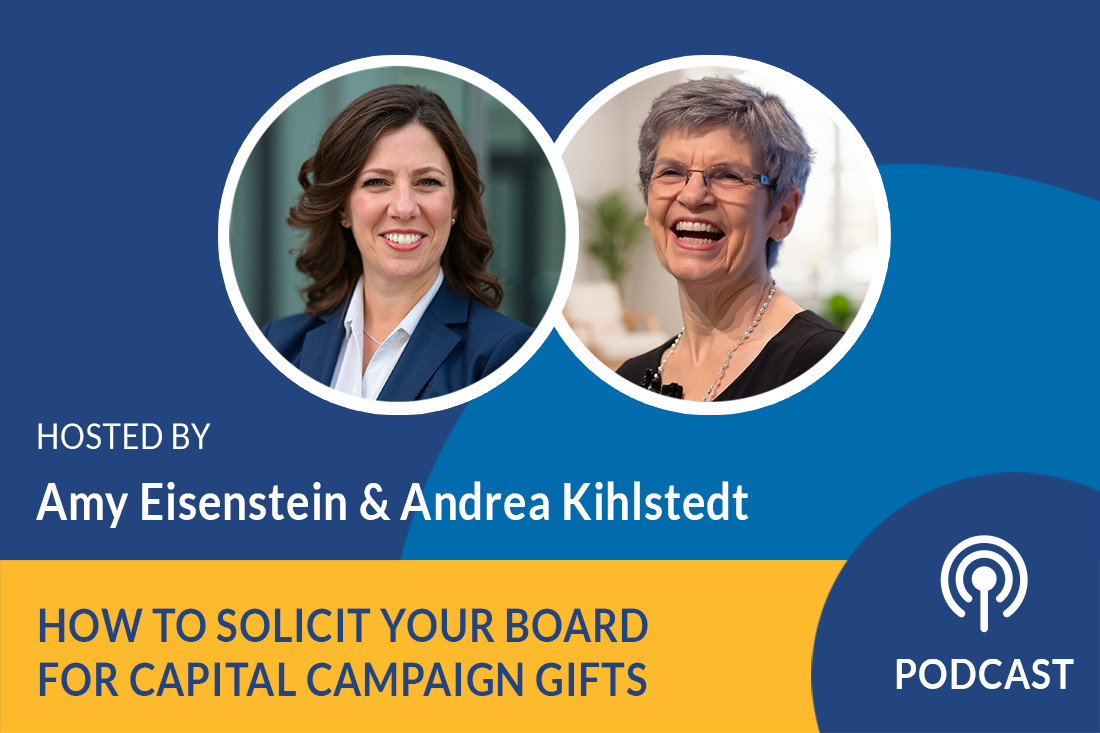
Season 6, Episode 16
A pledge form tucked into a board packet may feel like the easiest way to ask for campaign gifts. It can also leave you with unanswered forms, smaller-than-expected gifts, and no clear next step.
In this episode, Amy Eisenstein and Andrea Kihlstedt explain how to build a thoughtful, one-on-one process for soliciting board members.
The conversation covers how to set expectations before solicitations begin, establish a clear timetable, and track both board participation and progress toward the collective goal. Amy and Andrea also discuss how campaign giving can sit alongside annual giving, why board members may consider multi-year pledges or gifts from assets, and how a board can celebrate reaching its goal.
Watch Now:
Listen Now:
Andrea Kihlstedt:
Do you know how you’re going to solicit your board members for your capital campaign?
Amy Eisenstein:
Hi, I’m Amy Eisenstein. I’m here with my colleague and co-founder, Andrea Kihlstedt. And today we are talking about soliciting your board members for campaign gifts.
Soliciting Your Board for Capital Campaign Gifts
So this is a really important topic in our opinion and something that so many organizations get wrong if they’re not thoughtful and intentional and planful about it, strategic about it. So Andrea, let’s talk about the right ways and the wrong ways to solicit board members and maybe even starting with why this is such an important topic.
Andrea Kihlstedt:
So yes. Amy, you and I just did one of these podcasts on the concept of top-down, inside out, which probably aired the week before this or sometime. Anyway, the inside out part of that is that it is important early in the campaign to get the people who are closest to your organization to make meaningful gifts. And those people, the board, of course, counts for one group of those insiders that needs to be approached in a way that they will make gifts that are meaningful to them. And we see many examples where organizations don’t do a good job of that.
What Not to Do
I’ll give you a little story from my consulting career. When I came in to work with an organization and they told me proudly that the board meeting before they had slipped a pledge form into the board packets and asked board members to return them, fill them out and return them.
Amy Eisenstein:
That’s called a hope and a prayer strategy.
Andrea Kihlstedt:
A hope and a prayer strategy, exactly. And when I asked this, it made me shudder, because I know that’s not the right way to do it. And I said, “Well, what’s been the response?” And they said, “Well, unfortunately the people who filled out their forms didn’t give as high as we had hoped that they would.” And —
Amy Eisenstein:
A fraction, probably. A fraction.
Andrea Kihlstedt:
A fraction. And that there were a number of board members who hadn’t filled out their forms or sent them in, and they didn’t know what to do about that. They didn’t know how to approach them without feeling like they were nagging, or they felt like they were in a difficult place, right?
Amy Eisenstein:
Yes. And two bad results, right? Low gifts from the board members that gave, and many non-response. And honestly, you’d hope that that would be an outlier, the exception that organizations would slip a pledge form into a board packet, but we do hear about it all the time. And certainly that’s not what we teach our clients or the practice that we have our clients do with their board members, because there’s a much better way.
But when an organization doesn’t have a practice or a culture of soliciting gifts, especially from board members, or are even in the habit of talking about fundraising with their board members, that does seem like the easiest route. Just put it in the packet and hope that they respond. And it’s just the wrong way for so many reasons.
Andrea Kihlstedt:
So I just want to call out, I like the word slip, slip it into the folder. There’s something about thinking about slipping something in makes you feel like you’re sort of embarrassed about it. You’re not saying this week, this month, your folder has a really important document in it and let’s go over it before you take it home to fill it out. That would be one way of doing it, but that’s not what many organizations do. They literally almost surreptitiously slip this form in and then they mention it timidly. And of course, not much happens. So —
Amy Eisenstein:
Okay, but hold on.
Andrea Kihlstedt:
The anxiety that comes through in that process, and that’s why it’s done that way.
Amy Eisenstein:
Okay. But let’s also make it super clear that even if you have your board presidents stand up and say:
“We’ve put the pledge form in your packet, please fill it out and return it to us. We’re counting on your support.”
Even if you drum it up, it’s still the wrong way to approach board giving. So I just want to make sure that nobody leaves with the impression that just because you haven’t slipped it in, because even if you talk about it at your board meeting, that putting a pledge form in a board packet and hoping or expecting board members to respond in meaningful and significant ways is not the right strategy.
Andrea Kihlstedt:
Yes, thank you.
The Right Way to Solicit Gifts from Your Board
Amy Eisenstein:
Okay. Let’s talk about what the right strategy is for soliciting board gifts. Where would you start? How would you think about it?
Andrea Kihlstedt:
I would start before the solicitation with some kind of a process that helps the board determine what a collective board giving goal to the campaign might be. And that’s actually fairly complicated. I think we have in both written form and in other podcasts, we have discussed that at some length. So we’re not going to discuss that now. But what we’re going to say is when your board has come up with and agreed on a goal for collective board giving for your campaign, then you need to move into an effective way to solicit board members. So the first step is get that done, right? Get that done.
First, Get a Collective Goal
Amy Eisenstein:
Get a collective board goal. Agree on a goal that the board is going to try and reach. That’s right.
Andrea Kihlstedt:
And there’s no one formula for that, just to be clear. You can’t say, “Well, we have a campaign of, a $10 million campaign, so 5% of that should come from the board.” Boards are very different and the percentage of board giving that is good for your organization may be radically different from another organization with a board made up of different kinds of people. So —
Amy Eisenstein:
I’m glad you brought that up. I mean, an example I think we frequently use is sort of Lincoln Center might have 50% of the campaign coming from their board and a community soup kitchen may have 5% and that’s significant and meaningful and good. So you’re right, there’s a process to decide on a collective board giving goal or multiple processes that a good campaign consultant, certainly we take our clients through that process so that the board feels good and excited and motivated and inspired by a goal that they’ve set for their board to reach. And there’s no right or wrong answer for that.
Okay, great point. So they’ve come up, listen to an older episode or check with your campaign consultant, our clients, we’re going to take through this process and you’ve decided on a collective board goal. So now what’s next?
Andrea Kihlstedt:
So all right, then you talk with your campaign chair and board chair about developing a process for soliciting board members.
Amy Eisenstein:
Yes.
Andrea Kihlstedt:
If you’re the development director, it’s not up to you to decide that. You actually need to sit with your campaign chair, board chair probably, and say, “Let’s come up with a process.” And what should that process be?
Solicit Board Member Individually
Well, every board member should be solicited individually, one-on-one with a serious conversation about their role in the campaign and about what they might give to the campaign. And that shouldn’t be done amass, but it should be done one-on-one.
Now, you can set that up by having your board member understand what a process would be. And then at a board meeting, your board member would say, your board chair would say:
“Over the next month we are organizing a process where board members, a few board members will be talking to each of you about your giving. They will be getting in touch to schedule an appointment. You can do it on Zoom, you can do it in-person, you can do it over a cup of coffee, but we want everyone to have the chance to talk one-on-one with a member of the board and to determine the board giving.”
So you set it up by telling people what it is that you’re going to do. That’s number one. Number two, should I just keep going, Amy?
Amy Eisenstein:
Keep going. Keep going.
Andrea Kihlstedt:
Number two, if you have a small… One person can do all of that. It depends on how big your board is and whether somebody has that time, but you could also put together a small group of, let’s say three people from your board, and you should have some kind of a training so that they know how to solicit a gift, so that they know the respectful and effective way to solicit a gift. That’s important.
Number three, there should be a well-conceived ask amount for every board member. Now, let me be really clear. Every board member will be asked for an amount that is appropriate to that board member. You’re not going to take the amount of giving to the board and divide it by the number of board members. That’s not the approach. The approach is to actually sit and review the list of board members and figure out what a giving range, what a giving ask, an ask might be appropriate for each individual board member. And then the person who is soliciting that board member knows what that ask is, knows why that ask has been determined, knows how to go about making the ask, and they then go and call on every board member.
Amy Eisenstein:
Yeah, no, it’s such a good point. Let’s just spell it out quickly. So let’s say you’ve come to the decision that you’re going to try and reach a million dollars for your board collectively to give. So that means that one board member is likely to be solicited for and hopefully gives $300,000.
So let’s say you have 10 board members, so we make this super easy. In theory, you might have everybody asked for $100,000, but clearly there are board members who can’t give anywhere close to $100,000 and a handful of board members who can give significantly more. So you might have one board member who’s giving $350,000 and two more board members that give a quarter million dollars each, and then everybody else gives significantly less than $100,000. So it’s not evenly distributed. I just wanted to sort of do some quick campaign math. Basic. Basic.
Andrea Kihlstedt:
Let me add to that math. This is something that I learned partway through my consulting career that was a real aha to me. You probably know that a gift range chart usually looks like a pyramid, a few gifts at the top. And then as the gift amount goes down, the number of gifts that you raise at that level goes up. So it’s like a pyramid, starting narrow at the top and getting broader.
A Gift Diamond Rather than a Pyramid
But when you are soliciting a limited group of people like a board, let’s say you have 20 members on your board, if you were to make a little gift range chart for that board, it wouldn’t have that shape. What shape would it have? It would have one or two gifts at the top and one or two gifts at the bottom and a bunch of gifts in the middle. It would be like an egg.
Amy Eisenstein:
Diamond.
Andrea Kihlstedt:
A diamond, right? It would be like a diamond. Because some of the people on your board, for them, $100 might be a really generous and big gift. You probably have some people on your board who really don’t have the capacity to give significant gifts. They just don’t. They’re valuable board members, but you want them to feel good about their giving. And you have a couple of people on your board who can give a very large gift. The rest of them are going to be somewhere in the middle, right? So-
Amy Eisenstein:
I think that’s such a good reminder too. It’s not the traditional pyramid like the rest of your donor base.
Andrea Kihlstedt:
That’s right. Exactly.
Amy Eisenstein:
Boards operate differently.
So I think, well, a couple of things. One is I just want to remind people, listeners, that if you are not your board chair or your CEO, I hope that you’ll forward this episode to them if you think it would be important and valuable for them to hear. I also want to remind you that if you’re not a subscriber yet, please subscribe to this podcast. It helps the algorithm point it to other people and get this podcast listened to by a wider audience. So we would really appreciate the likes, the shares, the subscriptions. So please do rate and follow and share this with your board members.
Help Board Members Understand What Their Gift Means
So I want to talk about a couple of things. One is helping board members think about this as a meaningful and significant gift that’s often from assets and a multi-year pledge. So I don’t think we’ve talked about that. That’s something actually when your board chair is standing up and saying that everybody will be contacted, you could say, “And we expect everybody to think about their most meaningful gift to this campaign.” We need to lead by example.
So there are things that you could say as a group in preparation for those one-on-one conversations. You can talk about leadership level giving and giving from assets and thinking about this as a significantly more substantial gift than your annual fund. And you could talk about the difference between annual fund and capital needs and how you expect board members to do both, to continue their annual giving and give over and above a one-time gift for this capital campaign. There are things that you can talk about with your board collectively to prepare them for these one-on-one conversations.
One other thing that I want to say, and then it looks like you have more to say as well, is that one of the things that you can do when you’re preparing to go out and talk to board members, you talked about preparing people and having training, and you can tell board members that you’re practicing for other big asks with them. And while the ask is real and you expect a real response, you’re also going to be asking for feedback at the end to help solicitors get better when they go sort of beyond the inner circle. And so, that is, I think, a good way to sort of set everybody at ease to say:
“Listen, we want to make sure that the people soliciting for this campaign are the best we can be. And so, they’re going to come solicit you. But you should feel free, we’re going to welcome feedback about what felt comfortable, what felt uncomfortable, and it’s a real ask.”
You want to say anything else about that?
Setting Expectations and Reporting Progress
Andrea Kihlstedt:
No, it’s so important. Here’s where I want to go though. There needs to be a timetable for this. You don’t want to leave it, “Oh, well, sometime or other we’re going to make this happen.” You want to say:
“Our solicitation team is going to be in touch with you within the next month, and we hope to complete this process by such and such. And we will be reporting through email and at board meetings how we’re doing, how many board members have given it to the campaign, and our goal will be 100% participation.”
So then you have set the expectation, not that every board member is going to know what every board member has given, but that you will know that every board member has made a gift. And you will be tracking it, right? You’ll be tracking and reporting on it.
And you may even say, “When we get to 100%, we’re going to have a little party to celebrate, and we hope to do it by the end of the year,” or whenever it is.
Amy Eisenstein:
I love that. So you’re tracking two things, actually, participation and progress toward the collective goal. So you’re going to report on, “We have now eight out of 12 board members who have made their commitments, and we’re 60%, 80%, 90% of the way towards our board giving goal,” whatever it is. Great. I love that.
Andrea Kihlstedt:
And that sort of adds a head of steam. Nobody wants to know that they’re among the last two that haven’t done this, right? It feels a little awkward even though you’re not naming names, but people know if they haven’t done it yet and there are only two that haven’t done it yet. It’s like, “All right, guys, let’s get this show on the road.”
Celebrate the Board’s Giving Success
And celebrating at the end really is good for the board. It makes board members feel terrific. A campaign I did a while ago, the campaign goal, and it was like a $10 million campaign goal, and the board, because of its configuration, had decided on a $100,000 board giving goal, which was appropriate for that board, for that organization, and that campaign. And the board have never given, board members had never given. For many board members $100 was a significant gift. So when the board actually got to $100,000, it was a big time cause to celebrate. Everyone felt more glued to the organization, more proud of themselves in their role as board members for this organization.
Amy Eisenstein:
I love that.
Final Thoughts
So I just want to share something from the new Board Member’s Guide to Capital Campaign Fundraising, the new book that Sarah and I, Sarah Plimpton —
Andrea Kihlstedt:
The new wonderful book that you and Sarah have made.
Amy Eisenstein:
Right. So Sarah is the Chief Happiness Officer here at Capital Campaign Pro. Yes, that’s her actual title, Vice President and Chief Happiness Officer. And we just published this book this year, A Board Member’s Guide to Capital Campaign Fundraising. And one of the sections, one of the chapters is on why it’s important for board members to take this meeting and not just say, “Oh, no, you don’t have to meet with me. I’ll give.” And we go through in detail why it’s also a gift to the campaign to accept a meeting to discuss your gift.
What it does is, one, we’ve already covered this, it helps solicitors practice, because this is sort of an easier solicitation because it’s someone super close to the organization. So in theory, this should feel safer than going out to someone who’s less close to the organization. And it also helps both board members who are soliciting and the board member being solicited understand what the donors are feeling and going through and how the solicitation is made and a chance to hear the case for support again and ask questions and discuss.
And so, if you aren’t sure about this or you have hesitant board members or anybody says, “You don’t have to solicit me, just send me a pledge form. Of course I’ll give.” We make a very strong case in this book that you can just hand to your board members and discuss the chapter of why every board member should say yes. It’s part of their campaign gift to participate in a one-on-one solicitation. So anyways, I just-
Andrea Kihlstedt:
Amy, I didn’t think to say it earlier, but we were talking about preparing your board to be solicited. You could do a whole lot worse than getting that book for each board member and then reading that chapter and coming together and discussing it, right? That’s great preparation and sort of easier than someone standing up and lecturing about it, is to have a discussion about that particular chapter of the book. It’s a great way to use the book and a real help for organizations.
Amy Eisenstein:
Yeah. And if you do want to buy a copy for every member of your board, we do have discounted copies on the Capital Campaign Pro website, because the intention was that every board member would get a copy and you would discuss each chapter as training, not just for board member giving, that’s one small section of the book, but using this for the year or year and a half or two years leading up to your campaign to help prepare your board members.
So Andrea, I think this was hopefully super-helpful. And I just want to remind people, listeners, that if you have a campaign coming up and you want to explore how we at Capital Campaign Pro can help you get ready for and lead you through a successful campaign, visit capitalcampaignpro.com and sign up to talk to us. No obligation, but we’d love to hear about your campaign.
So thanks for listening and we’ll see you next time.

Leave a Comment