
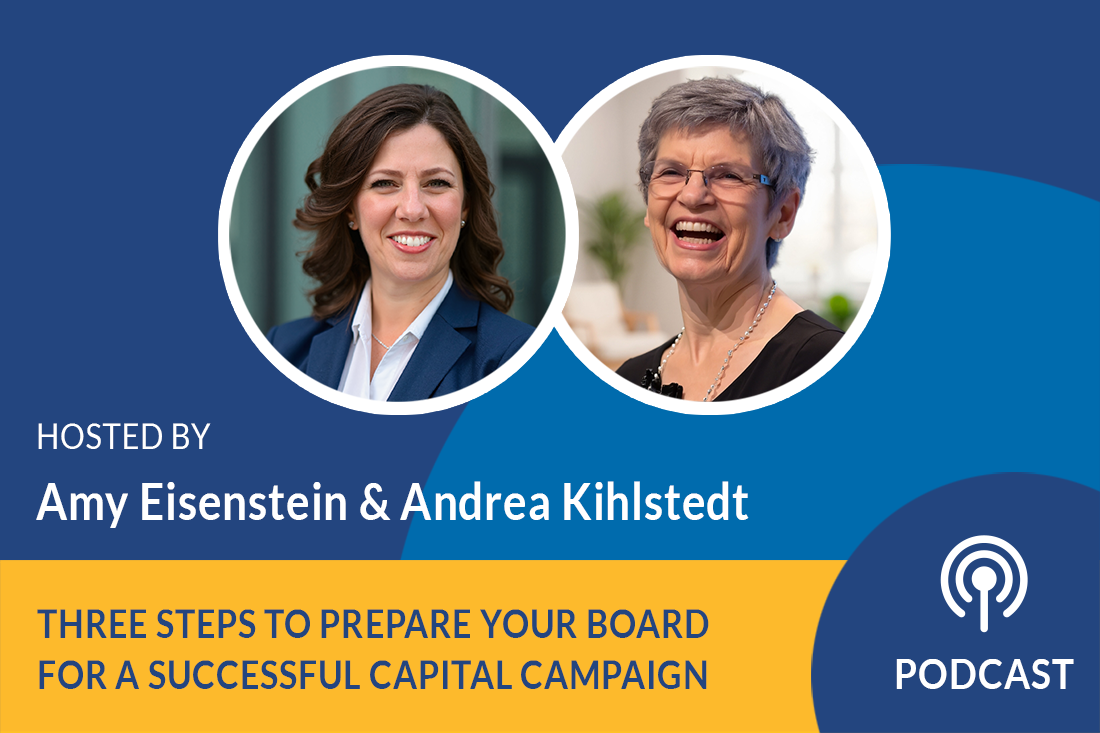
Podcast: Three Steps to Prepare Your Board for a Successful Capital Campaign
Season 5, Episode 8
In this episode, Amy Eisenstein and Andrea Kihlstedt outline three essential steps that nonprofit leaders should take to prepare their boards for a capital campaign. Many board members come to the table with limited or inaccurate ideas about what a campaign involves. Amy and Andrea explain how to bridge that knowledge gap, address common anxieties, and set clear expectations so that your board feels confident and prepared to support your campaign.
Whether you’re a nonprofit executive, development professional, or board leader, this episode will provide practical insights you can use right away to prepare your board for the challenges and opportunities of a capital campaign.
Listen Now:
Amy Eisenstein:
Are you worried about rogue board members? We’re going to talk about three things you must do to get your board on board as you head into a campaign.
Hi, I’m Amy Eisenstein. I’m here with my colleague and co-founder, Andrea Kilted, and today we are going to talk about three things that you really want to do to help get your board ready for a campaign.
Preparing Your Board for a Successful Capital Campaign
So Andrea, if you want to start with why it’s important or we can just dive right into one of the three things that organizations need to think about in order to prepare board members for a campaign.
Andrea Kihlstedt:
So let’s start a little with why it’s important. Any board that’s worth its salt as an organization goes into a capital campaign, is going to be nervous, is going to be anxious. If this campaign goes south, it’s going to end up on their shoulders. And that’s a to that’s lot of responsibility. So for a campaign to be successful, you really have to work with the board so that they know what they’re getting into, they understand what their roles are going to be, and they understand what they’re going to have to do as board members to make the campaign successful. Now, we’ve picked out three specific things. There, of course are many more we couldn’t do, but these three will take you a long way.
1. Help Your Board Members Understand the Capital Campaign Basics
So let’s jump into the first of them, and I’ll just start that off by saying that while some board members think they know what a capital campaign is and is all about, what we know is that most board members have a very vague and often misguided sense of what a capital campaign is. So that’s the place to begin.
Amy Eisenstein:
Yes, with some campaign 101s, what is it? What isn’t it? I think the what isn’t it is just as important as what it is because as you said, board members have a preconceived notion, and sometimes they’re right or mostly right or partially, but sometimes board members really don’t have an understanding of what a capital campaign is. They’ve either been sort of remotely on the side part of one, or maybe they’ve never experienced one at all. All right?
So there’s a couple of ways to get some good campaign 101s. If you’re already working with a consultant, of course you probably want to have your consultant that you’re working with come in and do a training, whether it’s an hour or a half day, whatever it is, but devote some time to it. It’s not 15 minutes at your board meeting, it’s an hour long discussion, training, whatever you want to call it. What’s another way they can get some good really expertise for Campaign 101? Andrea?
Andrea Kihlstedt:
Yeah, Amy. We have really an excellent downloadable resource on capital campaigns and boards, right? And somebody, if you didn’t want to bring in someone from the outside, you could actually download that, distribute it to your board, and then devote an hour discussing it with your board. That would be at least the way to start. Now, from that, your board may decide that they want to bring in a consultant to educate them more fully on that, but I think that’s better than nothing.
Amy Eisenstein:
Yeah, well, not only is it better than nothing, we actually put a ton of time into it. So let’s tell people where to find it. Of course, there’s going to be a link in the show notes, but it is in the resources section, the free resources section of the Capital Campaign Pro website, and it’s called A Board Members Guide to Capital Campaigns. And it really is everything that they need to know in a short, I don’t know, 10 page packet with big font, lots of white space. Don’t worry, they don’t have to read 10 pages, but it’s what they need to know about a capital campaign. I love that. Pass it out. Have a discussion. Take even five minutes at the beginning of the meeting to have them flip through it, because of course some people are going to show up not having read it, but they can look at the headlines and then have a thoughtful discussion. Great idea.
Andrea Kihlstedt:
Something else to consider is that if you’re the development director or executive director, you might want to call a meeting of with your board chair and talk about how best to do this. Your board members are going to be more receptive to learning about a capital campaign if another board member or two is pushing that agenda. So you might start with that and see if that small group is willing to bring in someone from the outside to do a training, or if not, if they would look at our guide, our board members’ guide to capital campaigns and actually have them be involved in developing that internal training based on that document.
Amy Eisenstein:
Yeah, good idea. I love it. Okay, so you’re going to have a 101 thoughtful detailed campaign, 101 conversation, how campaigns work, what they are aren’t, why you have one, how they succeed discussion with your board, either facilitated internally or externally, but I love that. Okay. What’s number two after the campaign 101, what’s next?
2. Talk Specifically with Board Members About their Role and Board Giving
Andrea Kihlstedt:
So number two is this. I found that there are really a couple of things that every board member wants to know, even though they don’t necessarily voice it, they want to know what they’re going to have to do isn’t when you’re on the board. What you want to know, what you’re going to have to do. And of course, they want to know how much they’re going to have to give. Both of those are questions that are lurking.
Now, sometimes they’re lurking out loud, sometimes they’re not lurking out loud. But that means that the second thing you need to do to get your board ready is to have some kind of a session or an opportunity to talk specifically with your board about what their roles are and what board giving should be or will be, how it will be handled. When it comes to board giving specifically for the campaign, there is a lot to know about that subject.
And while it may be covered very briefly in the campaign 101 that we discussed earlier, you should have a session that really specifically talks about that and gives board members an opportunity to identify what they think their best roles would be in a campaign. Because of course, there are many roles board members could play and not all of them have to play the same role.
Amy Eisenstein:
And there many of them are going to be worried about will they have to ask their friends and family for money. I think to your point, Andrea, that’s a really different discussion than what is a campaign. These are two separate discussions, and getting your board ready for a campaign is not a one and done activity. It is probably a many months discussion.
So you can have an initial one-on-one conversation, and then you’re going to have lots of subsequent conversations in the months leading up to a campaign. And so you will have opportunities and specific times to talk about roles and responsibilities. And of course, as you point out, board giving and answering their questions, will they have to ask friends and family for money? So some fear alleviation is going to be important part of the process in getting your board on board for your campaign.
Alright, and the third thing that we want to talk about is, oh, you know what? Actually, before we go to that third thing, I just was thinking about this call that I had with a prospective client conservation and environmental organization called the other day, and we were chatting about their campaign and the development director and the executive director were on the phone with me and were talking specifically about one board member who didn’t want to hire a consultant because he thought consultants were a waste of money. I mean, that’s how they put it, that they just thought it was a ridiculous waste of money. And so they were upset. They were upset.
3. Talking to Board Members About What to Expect During the Campaign
And I think that that brings us to the third thing that we wanted to lead into, and that’s talking to board members about what to expect. And one of the things of course is investing in a campaign and supporting the staff and hiring up. So up, let’s talk about that.
Andrea Kihlstedt:
I’m always totally bemused when we talk to organizations who don’t expect to invest in a campaign, who think that all they have to do is decide to have a campaign and their trustee development staff that is already busier than busy is going to magically raise 10 times more money in the next couple of years. It’s sort of magical thinking. It really is magical thinking. Now, I think some of it is that it’s just not on board members’ radar that, oh, we have to invest in this. They’re just not thinking about it.
Sometimes I’m on a call with a prospective client and I say, well, have you thought about what the campaign budget is going to be? And I can tell from the look on their face that they haven’t even thought about a campaign budget. They’ve just thought about bringing in money. They haven’t thought about spending money, what it would take to bring in that money about investing. It really is an investment, and it’s a tremendously good investment. When an organization invests in a campaign, you’ll invest $1 to raise 10. Now, honestly, if you were investing in the stock market and somebody said you could guaranteed invest $1 and I’ll give you back 10, you would say, here’s a hundred. Right?
Amy Eisenstein:
That’s the best ROI of any business investment, right? Yeah. So it’s interesting. So that organization that I was talking about, this development director and this executive director, the board member was sort of trying to make this compliment like, oh, you guys are smart. You can do it. We don’t need external help. And that was actually so frustrating to them. Of course, they’re smart, of course they’re working hard, but the idea that they can just, as you alluded to before, magically turn on some faucet and raise 10 times more than what they’re raising already without any additional help or resources.
So the point is starting early, talking with your board members about what it takes to do a campaign and what the investment is going to need to be, and setting up the expectation that existing staff needs both expertise and probably hands, extra hands.
So there’s some staffing component, maybe an additional administrative support person or outsourcing of some of the things they might be doing already, like grant writing or event planning or some writing. But the idea that they are going to have to hire help both expertise and kind of boots on the ground.
Andrea Kihlstedt:
Yeah. Amy, let’s talk for a minute about campaign expertise. I don’t think people understand that capital campaigns are a very particular kind of fundraising. They’re not just the same old kind of fundraising you do for your annual fund. They’re in fact quite different. You’re not asking for money through direct mail appeals. They have a strategy and an approach to fundraising that is quite complex and really in some way very sophisticated. Now, because organizations only do campaigns once every 10, 15 or 20 years, very few people have had a chance to do one campaign after another. It’s for the most part, only people who have become campaign consultants who have that level of experience so that it becomes second nature of how to make decisions about your campaign, how to make them work.
And we see people in our community, the people we work with, and we work with a lot of people, and we see what happens when they learn this kind of fundraising. Their eyes get big, they begin to understand how this system works. And to have someone who really understands the capital campaign strategy and the capital campaign approach to fundraising makes a huge difference. It’s not just sort of saying, well, we’re going to do more of same old, same old, right?
Amy Eisenstein:
Or we’re going to wing it and make it up as we go and hope that it works, kind of thing. I mean, that’s when we see organizations in trouble. It always breaks my heart when an organization calls and they’ve been working on their campaign for two years and they have raised, I don’t know, 30 or 40% of the dollars, and they don’t know what to do next. They don’t know where their other prospects are. They’re not sure what the next step is, and they haven’t planned well or really thought through campaign strategy, and now they’re sort of stuck. And what a good campaign consultant does is set up a campaign for success from the beginning.
Andrea Kihlstedt:
Yeah. It’s often very difficult for us to help organizations like that because they’ve made so many mistakes initially that it’s hard to circle back and start again. It’s very challenging. Every once in a while we’re able to help an organization that’s really sort of stuck halfway through, but it kind of breaks our hearts that we couldn’t work with them earlier when they really had the opportunity to set it up. Right.
Mistakes with Poor Campaign Planning
Amy Eisenstein:
Let’s give a concrete example or two of mistakes that organizations make when they don’t plan well, I mean, the obvious ones that jump to mind immediately are things like they haven’t taken the time to identify the best or the right prospective donors for their campaign. They have maybe a general sense of some of them, and they either don’t cultivate them well or they ask for the wrong size gifts. I mean, honestly, that’s probably the number one mistake, is that they take their best potential donors and they ask them for gifts that are sort of safe, $50,000 when that donor probably needed to be the lead gift at half a million dollars, 10 times what they asked them for. And then they get through, they’ve run out of prospects. They haven’t asked for the gifts that they need to make the campaign successful and right, they are stuck.
So it’s much better to plan well from the beginning than to try and go it alone. So that’s what your board members need to understand is that they don’t want to risk. This is too big of an exercise to make it up as you go, to rely on existing staff who haven’t been through multiple campaigns from start to finish who haven’t planned the strategy. I talked to lots of development directors who say, you know what? I was around for a campaign, but I wasn’t high enough in a leadership position to be working directly with the consultant or understand the strategy. I helped with some implementation. I was there for a piece of it. And that’s what a campaign consultant brings to the table that the decades of experience on dozens and dozens of campaigns.
Recap and Final Thoughts
Andrea Kihlstedt:
So Amy, let’s do a little review. We are suggesting three important things that you do to get your board ready for a campaign right up front before you ever really have a campaign. These are the things you need to do —
Amy Eisenstein:
Like a year in advance.
Andrea Kihlstedt:
Yes. Yes. So the first is having some way to have what we call a campaign 101, which is to teach your board members at a very basic level what a campaign, what a capital campaign is, what are the fundamentals of capital campaigning? And that’s super important. You can hire someone on the outside to come in and do that. You can use our campaign guide and have to have discussions with your board. There are other ways to do that, but don’t assume that your board members know what a capital campaign is. Generally the ones that think they know may know wrong. So that’s even more dangerous than the ones that say, gee, I don’t know. So understand that it’s your role to actually teach them and train them and to do it in a way that they’re going to be happy for that information. That’s number one.
Amy Eisenstein:
Just one thing we do campaign 101 webinars from time to time. So check the Capital Campaign Pro website and under our free resources and see what’s coming up. And you can bring all of your board members. Okay, that’s —
Andrea Kihlstedt:
Number two. We didn’t say that before, Amy. That’s so silly. That’s an obvious thing to do. So number two, be sure you plan serious opportunities to discuss with your board members what their roles in the campaign are going to be, whether they raise their concerns or not. Remember that they’re anxious about what you’re going to ask them to do and how much money you’re going to ask them for. And you need to help them understand that before they ever go into a campaign.
Amy Eisenstein:
And that discussion can take place over multiple meetings. It’s not a one and done. They need time to digest it. They need time to absorb it, to think about their questions, and to come around to understanding it. So good. It’s an ongoing thing.
Andrea Kihlstedt:
Number three, be sure that you talk to your board early on about the fact that it is going to cost money to raise money, that your campaign itself is going to take some investment, some financial investment on the part of the organization, that it is not just going to be free money coming in. And that part of that investment should be hiring a consulting firm or people that really know what they’re doing about capital campaigns, that are experts on capital campaign fundraising. This is a big important fundraising project you’re embarking on, and you don’t want to do it blind, and you don’t want to make mistakes early on. So talk to your board about why it’s important to make some early investments in expertise and perhaps additional staff for your campaign.
Amy Eisenstein:
And of course, we’re here to talk to you and your board members, your leadership team. No obligation, just an early initial conversation. So visit the Capital Campaign Pro website and sign up to talk to us. We’d love to learn about what’s going on and how we can help.
All right. Thanks for joining us, Andrea. Great conversation today, and we’ll see you next time.




Leave a Comment